22" saddle article in H&H and vet's comment about heavy horses...

kerilli

Well-Known Member
Joined
1 April 2002
Messages
27,417
Location
Lovely Northamptonshire again!
Visit site
Did this make anyone else wonder a little? I really don't want to start the whole 'big heavy riders' debate again as I suspect it's been done to death and then some, but when the H&H vet Karen Coumbe is quoted as saying:
"Its advisability depends on the horse's conformation and the rider's capabilities - a light rider can be like a sack of potatoes. Heavy horses were, after all, bred to carry a man in armour."

It did make me boggle a bit. Yes, a light rider can be like a sack of potatoes, but a heavy rider cannot physically ride at less than their weight, no matter how good, experienced, balanced they may be.
And maybe I've been misinformed, but I thought heavy horses were bred to pull ploughs, no? Hugely different to carrying any significant weight.
Do we actually have any modern-day breeds truly similar to the horses which were ridden into battle by knights (and we're going back many hundreds of years to those, no?) Because knights (and horses) in armour were rapidly phased out once gunpowder came into play on the field of battle.
I looked after a Highland x Percheron once and suspect he was the closest thing I've ever seen (or ridden) to a true destrier. He was about 15h and had a back like a table, truly built like the proverbial...
Thoughts? And this is about the vet's words and about HORSES, not about riders who need 22" saddles, okay? ;) ;) ;)
 
I think the breeding bit is true though the breeds that were 'bred' back then to be the heavy armour horses aren't really around as common riding horses these days. 'Heavy' horses such as shires, clydies etc were bred for pulling. However I think it has something to do with breeding and something to do with how well the musculature is built up around the bony structures. Some breeds are more predisposed to having better/more correct musculature IMO.

Taking it slightly away from horses (as I was a human physio not an equine one, and yes I know the loading is different, just an example :) ) Those of us with well developed core muscles (which include the back muscles) are much less likely to have back problems, that is why pilates is considered good rehab and prevention for back problems as the exercises develop the core. There is of course a limit to this, it is just an 'educated' thought.
 
And maybe I've been misinformed, but I thought heavy horses were bred to pull ploughs, no? Hugely different to carrying any significant weight.

Yes, but also developed as the war horse. Usually small at around 15hh, but highly trained, and build like a tank (usually stallions).

Knights would often have three horses, war horse, pack horse, and courser (charger or similar).
 
You are right, draught horses were not bred to carry knights in armour, the modern draught horses (Clydesdales, shires, Percherons, etc.) were developed from the 18th century when ploughing became more prevalent and soil types heavier. Draught horses, especially the taller, leggier breeds are designed to pull, not carry. The original destriers were not tall (average 14.1h), but were stocky, like a Lippizaner or the old style Spanish horse, and nippy. Contrary to popular belief, a man in full plate armour (jousting armour) does not weigh THAT much - a full 15c harness (suit) weighs less than 40kgs.
 
The other point to bear in mind is that, whilst certain breeds/types may have been used to carry knights in heavy armour, it doesn't mean that this didn't cause huge amounts of damage. Just because something is/used to be done, doesn't mean that it was right. I realise that we are now unable to make any sort of analysis, but it is something to consider!!
 
Yes, you're right, heavy horses were bred to pull a plough. They are not the best weight carriers due to their conformation. just because a horse "can" carry an excessive weight, doesn't mean we should ask it to.
 
The other point to bear in mind is that, whilst certain breeds/types may have been used to carry knights in heavy armour, it doesn't mean that this didn't cause huge amounts of damage. Just because something is/used to be done, doesn't mean that it was right. I realise that we are now unable to make any sort of analysis, but it is something to consider!!

Yes, I thought that too. I read somewhere that destriers were very expensive... I bet... all that training to get them to be able to do high school movements, and the associated risk of injury etc, before you even get into battle... I bet a sound tough one was worth its weight in gold!
 
Knights of the medieval were not as big as people are today, even 50years ago people were not as big/ tall/ fat as they are now
 
You are right, draught horses were not bred to carry knights in armour, the modern draught horses (Clydesdales, shires, Percherons, etc.) were developed from the 18th century when ploughing became more prevalent and soil types heavier. Draught horses, especially the taller, leggier breeds are designed to pull, not carry. The original destriers were not tall (average 14.1h), but were stocky, like a Lippizaner or the old style Spanish horse, and nippy. Contrary to popular belief, a man in full plate armour (jousting armour) does not weigh THAT much - a full 15c harness (suit) weighs less than 40kgs.

Hmm, that's interesting... but if you put that 40kgs onto of a man who weighs, say, 70kgs (and that's not heavy for a man) you are at 110kgs, which is getting up to a serious payload, no?
 
Yes, I thought that too. I read somewhere that destriers were very expensive... I bet... all that training to get them to be able to do high school movements, and the associated risk of injury etc, before you even get into battle... I bet a sound tough one was worth its weight in gold!

.... literally, I should think!!
 
Just found this, which seems to summarise various articles that I came across: http://www.funtrivia.com/askft/Question53664.html So height, certainly in the earlier days of armoured knights, was not so very different, but bone density was often higher. This would increase weight slightly - add on the weight of a suit of armour and that sounds like quite a hefty load to me!!
 
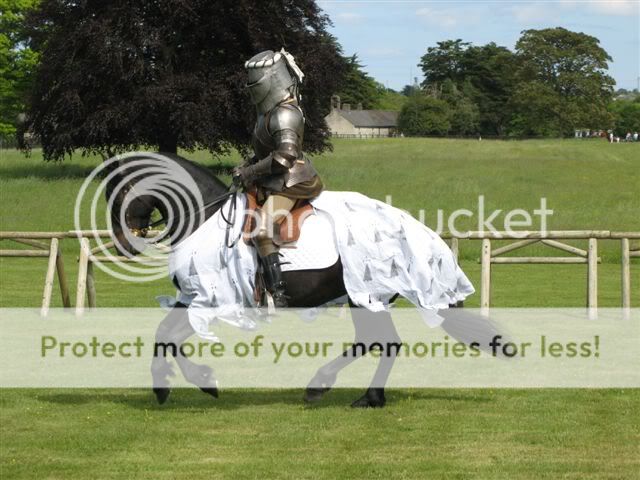
Ferninarmour.jpg

This is a 14.2h Friesian cross......
 
Nonsense! That is not "re-enactment" quality stuff, this is a museum grade reproduction; trust me - this is what we do for a living. As far as "what did people weigh", according to skeletal finds, the average man in 1450 was 5'6" and probably weighed 63kgs (that's a bout 10.5 stone).
 
I think a Friesian or the old style ID (the shorter, heavier ones which are around 15.2hh) are the nearest thing available these days.

Shires aren't actually that old of a breed. Oxen where more popular in medieval days.


Medieval armour- wouldn't they try and make it as light as possible? And anywho- they probably only wore all of it for jousting which is a short burst of speed, they would of rarely done a course of SJ in a suit or armour and gone for a long hack, far too uncomfortable!
 
Horses didn't wear armour much, for the very reason you cite: much too heavy and even more importantly, doesn't move with the horse. Getting the plates to articulate was extremely difficult.
 
A Destrier wasn't a breed, it was a type - normally stallions particuarly picked and then trained for knights to ride in the joust. War horses were normally the smaller and quicker coursers.

What really irritates me is the reference to men riding horses in to battle - any horse, even a Shetland could carry a man into battle... it only had to live long enough to be trained to charge and then charge! Most of them died! Completely different to carrying an overweight rider day in day out for 15+ years!

Plus in every historical text you read there are frequent references to horses breaking down and the need to change to fresh horses - none had a very long life expectancy, regardless of their job! Soundness and long life were not a high priority for peeps in medieval times!

P.S. the same is true of Arabians - have you seen how small and slight the bedouin men are? No comparison to western men with beer bellies :D
 
Medieval armour- wouldn't they try and make it as light as possible? And anywho- they probably only wore all of it for jousting which is a short burst of speed, they would of rarely done a course of SJ in a suit or armour and gone for a long hack, far too uncomfortable!

I agree and think many wore chainmail into battle?
 
I think a Friesian or the old style ID (the shorter, heavier ones which are around 15.2hh) are the nearest thing available these days.

Shires aren't actually that old of a breed. Oxen where more popular in medieval days.


Medieval armour- wouldn't they try and make it as light as possible? And anywho- they probably only wore all of it for jousting which is a short burst of speed, they would of rarely done a course of SJ in a suit or armour and gone for a long hack, far too uncomfortable!
The Irish Draught isn't all that terribly old either, I'm afraid. The Irish Cob, on the other hand, is probably much older and had the "Irish Hobby" as a progenitor. By studying and measuring extant sets of armour, both for men and horses, the closest fit is an old fashioned Spanish horse, Lippizaners and Connemaras. All 15h or less and not massively muscled either.
 
I agree and think many wore chainmail into battle?
Mail was used as the sole armour by the Vikings and Normans in the 9th - 12th centuries, gradually being augmented and supplanted by plate into the 15th century. Jousting was a sport, and entirely different armour was used for the lists.
 
If you look at pictures from the '50s and before proper shire horses were about 16.2hh average, short of leg and built like a brick outhouse. It's only a modern trend to breed these lanky 18hh horses which are, no offence to them as they are still gorgeous, neither useful for weight carrying or pulling heavy loads.
 
A Destrier wasn't a breed, it was a type - normally stallions particuarly picked and then trained for knights to ride in the joust. War horses were normally the smaller and quicker coursers.

What really irritates me is the reference to men riding horses in to battle - any horse, even a Shetland could carry a man into battle... it only had to live long enough to be trained to charge and then charge! Most of them died! Completely different to carrying an overweight rider day in day out for 15+ years!

Plus in every historical text you read there are frequent references to horses breaking down and the need to change to fresh horses - none had a very long life expectancy, regardless of their job! Soundness and long life were not a high priority for peeps in medieval times!

P.S. the same is true of Arabians - have you seen how small and slight the bedouin men are? No comparison to western men with beer bellies :D
I disagree! Soundness was vital; if your horse breaks down you are in a world of trouble. Don't forget, horses were transportation first, cavalry second. And yes, knights had many more than just a single horse, much like a huntsman today he would have fresh horses throughout a battle. Many died, yes, but horses were prize booty and efforts were made to capture them unharmed. There was no sentiment, 'though, and horses suffered as much as the men.
 
Is it wrong I am much more interested in the historical side of this post than fat people riding?

On the subject of horse armour: Was it really not worn in battle? I understood that whilst it was not of practical purpose it was for a great part used for decorative purposes and as a sign of social standing and material wealth? Was its use therefore mainly confined to jousting and ceremonial occasions?

Cortez: Can I do some work experience with you!?
 
Top