Clever people help me! Supplements question (sorry)

Fluffypiglet

Well-Known Member
Joined
14 October 2016
Messages
912
Location
West Sussex
Visit site
Two different joint supplements: anonymised 😊

Active Ingredients: Per 55.6g (500kg Horse Feeding Rate) delivers: Glucosamine HCl 10g, MSM 6.5g, Vitamin C (stabilised and bioavailable to horses) 5g, Chondroitin Sulphate (Low Molecular Weight) 4.1g, Omega 3 20g, DHA & EPA 2.9g, Hyaluronic Acid (HA) 150mg.

Active IngredientHigh Feeding Rate
45 grams per day
Medium Feeding Rate
30 grams per day
Low Feeding rate
15 grams per day
Glucosamine10,000mg7500mg3750 mg
Chondroitin7000mg5250mg2625 mg
MSM20,000mg15000mg7500mg
Hyaluronic Acid300mg225mg112mg
Vitamin C700mg538mg269mg

Can anyone tell me how these two different supplements compare wrt the active ingredients? Which has more in it? Ie is ā€œbetterā€? They are similar prices. I’ve tried the 4cyte and not entirely convinced it’s doing much for mine and as it’s entirely different to these it’s not comparable. so I’ve started to investigate other options and am slowly going mad.

If it makes any difference horse has a tendency to ulcers so I try to avoid anything that has ever been linked to a potential to aggravate which I believe both boswelia and devils claw can?

Sorry I know very repetitive subject and I’ve signed up to Dr Marlin and read his test results but then I don’t entirely trust myself when understanding things! I think the above have the same level of glucosamine at the high feeding rate but I don’t know if the HCI bit makes a difference to what it delivers? How important is omega 3, DHA and EPA?

Can any kind person translate for me please?
 
Experience tells me to avoid glucosamine with horses. I had one who reacted very badly to it, she became very noise reactive and spooky. I think she must have had a headache. It is derived from mussel shells, which are not part of a horses natural diet.
Interesting! I don’t fancy that reaction… šŸ˜‚
 
My vet has suggested that now he’s 14 a joint supplement is sensible / won’t do any harm but it’s so confusing. One of the above has studies to support their claims, the other I don’t think does. And then everything else is anecdotal and everyone seems to have different experiences.
 
To convert mg to g divide by 1000 ( 10,000 mg is 10 g)
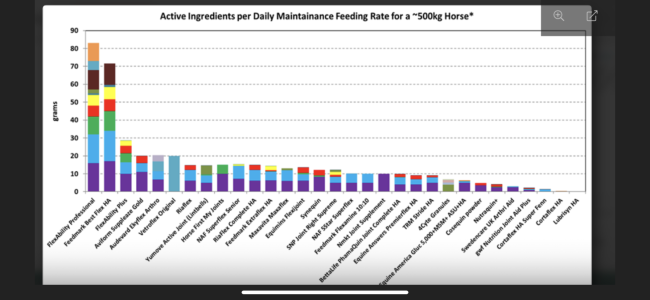
This chart (by David marlin) compares ingredients in various well known brands (no surprise his comes out top)

IMG_8295.png

There is an article here that gives the recomended levels of ingredients
 
Last edited:
To convert mg to g divide by 1000 ( 10,000 mg is 10 g)
This chart (by David marlin) compares ingredients in various well known brands (no surprise his cones out top)

View attachment 145252

There is an article here that gives the recomended levels of ingredients
Thank you for the link to the additional article. I’ve seen the other chart by DM but it doesn’t cover some that I’m looking at. I shall do some more reading! šŸ‘
 
I’d personally try the top supplement -the one with omega 3 and vit c in good amounts. Theyre helpful anti-inflammatories from an immune system perspective, and nutritionally needed for other jobs too.
(The only thing id want to check is if the vit C is sodium ascorbate or ascorbic acid - SA is gentler on ulcer-prone stomachs than AA.)

The other supplement in the table lacks these nutritional components that the body easily utilises. Its vit c is only 700mg at the highest dose. No omega 3. Its useful to have all the ā€˜guns loaded’ in a supplement and omega 3 is very useful for inflammation-type conditions.

As each horse is different and can respond differently, we dont know if anything is good or working well until theyre on the supplement for a couple of weeks. So we can only go by balancing nutritional ingredient assessment, and hope it suits as intended.
 
I’d personally try the top supplement -the one with omega 3 and vit c in good amounts. Theyre helpful anti-inflammatories from an immune system perspective, and nutritionally needed for other jobs too.
(The only thing id want to check is if the vit C is sodium ascorbate or ascorbic acid - SA is gentler on ulcer-prone stomachs than AA.)

The other supplement in the table lacks these nutritional components that the body easily utilises. Its vit c is only 700mg at the highest dose. No omega 3. Its useful to have all the ā€˜guns loaded’ in a supplement and omega 3 is very useful for inflammation-type conditions.

As each horse is different and can respond differently, we dont know if anything is good or working well until theyre on the supplement for a couple of weeks. So we can only go by balancing nutritional ingredient assessment, and hope it suits as intended.
Thank you @PurBee

According to the blurb regarding vit c : As the horse can produce its own vitamin C, its gut did not adapt for efficient absorption of the vitamin as it occurs naturally in fruit and vegetables in the form of L-Ascorbic acid, unlike the human. When supplementing vitamin C to horses it is important to use a form which can be absorbed efficiently, for example Ascorbyl monophosphate.

Any idea what that means? šŸ™ˆ. It suggests to me that it’s not the bad version but not sure if that means it’s the gentle version or something else entirely!
 
Thank you @PurBee

According to the blurb regarding vit c : As the horse can produce its own vitamin C, its gut did not adapt for efficient absorption of the vitamin as it occurs naturally in fruit and vegetables in the form of L-Ascorbic acid, unlike the human. When supplementing vitamin C to horses it is important to use a form which can be absorbed efficiently, for example Ascorbyl monophosphate.

Any idea what that means? šŸ™ˆ. It suggests to me that it’s not the bad version but not sure if that means it’s the gentle version or something else entirely!
Im not entirely on board with their reasoning, but nevertheless, if their vit c is ascorbyl monophosphate , that is far gentler than ascorbic acid and i would be happy to supplement a sensitive gut with that form.
 
5 grams of their vit c also is not a huge dose at all for a horse, its akin to 1 teaspoon of the powder which i take when hounded with flu/bug, and i weigh a tenth of a horse!
So theyre using a safe dose. The other product using 700mg vit c is a weeny dose for a horse.
 
Experience tells me to avoid glucosamine with horses. I had one who reacted very badly to it, she became very noise reactive and spooky. I think she must have had a headache. It is derived from mussel shells, which are not part of a horses natural diet.
Quick update to say that mine is the same! It would appear that mine is reactive to something joint supplement related. I started him on something with various ā€˜standard’ ingredients as referenced in various charts and posts above and within days he was loosing his tiny mind. He’s been taken off it smartish and is calming down again. So now my quest continues for something that doesn’t blow his mind or cause gut issues.šŸ™„
 
Thats a shame fp that he’s reacted to it. With a supplement with multi-ingredients, which one is the culprit can be difficult to single out.
Both supps you were interested in had same amount of glucosamine -so maybe your boy is like PAS’s experience and reactive to that?
The only way to know is to find something without it.

I once took MSM powder diluted in water as part of a health kick years ago - it tasted bitter and foul and upset my gut. I didnt last long on it!
 
That’s the problem I think. There are so many things in it and I don’t want to go and try each thing individually and find out if he goes loopy on it. Partly because that’s not fair on him and partly because it will cost me a fortune! I could put him back on the 4cyte which didn’t make him loopy but also I’m not convinced it did anything. I previously had him on buteless by equine america but again, not convinced it wasn’t just expensive flavouring with some possible gut disturbance thrown in for good measure! Perhaps I’ll see how he gets on and speak with the vet again as needed. Thanks peoples 😊
 
Top