Collapsed heels - what is there to know?

Christmas Crumpet

Well-Known Member
Joined
30 August 2007
Messages
4,036
Visit site
Horse has just been diagnosed with collapsed heels after a lameness work up and x rays.

Vet says...

Her x-ray results were very good for a horse her age and merely confirmed what we had surmised - her heels - the area where we have proven the seat of pain to be - are collapsed and are therefore placing undue strain on the quarters of the hoof and soft-tissue structures. Therefore, I have recommended that she be placed on elevated frog support shoes, not only to displace the weight off of the weak wall and through the centre of the foot, but to correct the alignment of the pedal bone as well. Once this has been done, I would like to assess her movement to see how this has improved. If it has - and I am rather hopeful that it will -with a tweak here and there I shall ask you to kick on. If not, then I will inject her coffin joints, etc.

I'd like to know good and bad stories about them. It seems to me that no matter how good your farrier, this can still happen.

Any info would be v.gratefully received. (Also in NL)
 
Shoes raise the hooves off the floor.

This means the frog cannot access ground pressure as it's lifted off the floor too.

caudalfrog.jpg


Eventually the frog loses strength. The heels contract.

Contractedhoof_zps399dd7bf.jpg


Internally, the collateral ligaments (green) and digital cushions (red) become weak and flabby.

lateralcartilage.jpg


The heels start to run forward, under the horse, in an attempt to let the frog find the ground.

underrunshod.jpg


Then the new structure means the horse is carrying too much weight on the toe area (because the back of the hoof is just too weak) and that has a knock on effect with the laminae and the coffin bone......
 
Therefore, I have recommended that she be placed on elevated frog support shoes, not only to displace the weight off of the weak wall and through the centre of the foot, but to correct the alignment of the pedal bone as well.

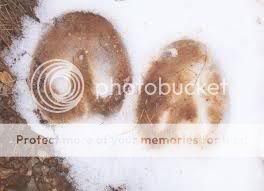
Or you could just take the shoes off to take the weight off the weak walls and through the centre of the foot.....by letting the ground do the same job as the 'magic support shoes'.

baresnow.jpg


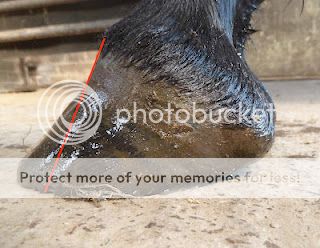
The correct alignment of the coffin bone will come when the back of the hoof gains strength and structure and the horse starts walking heel first.....

trueangleline.jpg
 
My horse's heels collapsed earlier this year after a starch overload.

They went from this, in Jan:
feet07-01-12006.jpg


to this, in June:
LH1_zpsc4808230.jpg


Hooves can change. The treatment that your vet has proposed, however, will not improve your horse's feet - it is no long term solution. (Plus how will injecting joints improve heels??)

The solution is to improve your horse's feet from the inside, not to slap on scaffolding to try and prop them up from the outside. The most effective way I know to do this is through barefoot rehab.

I'm now 4 months down the road from the second photo, and that foot now looks something like this (taken a month ago):
06-09-12%20011_zps39232153.jpg


There's a long way to go to get these feet healthy, but I'm convinced this is the way to go about it. When I'm done, the foot will look like photo 1 again (or better ;)). Imagine what photo 2 would look like with corrective shoes on - nothing like photo 1, that's for sure. The foot would still be unhealthy, and that is the real problem.
 
After almost a year of trying every heel raising method known to farrier, including a very expensive treatment using resin and heart bars which lasted all of 6 days, I'm now onto farrier number three who has, removed her shoes and trimmed her toe back to let nature take it's course. This is a last ditch attempt to improve her hoof angle, and if it works, I will be looking to re-shoe.
 
Shoes raise the hooves off the floor.

This means the frog cannot access ground pressure as it's lifted off the floor too.

caudalfrog.jpg


Eventually the frog loses strength. The heels contract.

Contractedhoof_zps399dd7bf.jpg


Internally, the collateral ligaments (green) and digital cushions (red) become weak and flabby.

lateralcartilage.jpg


The heels start to run forward, under the horse, in an attempt to let the frog find the ground.

underrunshod.jpg


Then the new structure means the horse is carrying too much weight on the toe area (because the back of the hoof is just too weak) and that has a knock on effect with the laminae and the coffin bone......

very interesting and well explained- thank you
 
It is my understanding that collasped heels are either genetically induced or farrier induced. I personally think that even if the horse's foot confirmation is poor a good farrier will stave off collasped heels with correct trimming, foot balance and correct shoeing even if there is a foot capsule deviation.

Therefore, I would question whether your farrier really has trimmed and shod your horse to produce the correct hoof pastern axis.

Incorrect balance [either produced by the farrier or confirmation] where the toes are long and the heels are low is problematic. A long toe/low heel horse will have a tendency to land toe first. That toe that lands first will shorten your horse's stride and will probably cause lameness. The deep flexor tendon on the navicular bone is then 'stretched'. The increased weight on the heel weight will then make the horn tubules of the heels bend and collapse forward, toward the toe.

As hoof growth is slowed by compression and because the heels receive a greater amount of weight, the hoof grows slower in that area whereas the toes grow quicker!

All of this of course, can be created by incorrect farriery and poor trimming to produce poor side to side balance and poor front to back balance. (Broken forward or broken back.) Fitting a shoe that is too small for the foot can also cause similar problems.

Your horse may even have a hoof capsule deviation and if the farrier has not addressed this, he may have induced the heels to collaspe.

In my opinion the picture of the foot in Oberon's post is not a 'normal' shod foot - it is a 'club' foot which is considered a deformity of the coffin joint which raises the heel. Shoeing itself does not produce this type of deformity as it is a specific condition.

I personally wouldn't choose to go barefoot in this situation and I would follow the advice of your vet but I would ask her opinion as to the quality of the farrier. I would also ask her about what type of shoe she means - egg bar? straight bar? heart bar? or combination? There isn't really 'a one shoe fits a specific condition'. - It may be that your horse requires a specific remedial shoe because every horse is an individual.

Best of luck and I hope your horse improves soon.
 
Last edited:
I personally wouldn't choose to go barefoot in this situation and I would follow the advice of your vet but I would ask her opinion as to the quality of the farrier. I would also ask her about what type of shoe she means - egg bar? straight bar? heart bar? or combination? There isn't really 'a one shoe fits a specific condition'. - It may be that your horse requires a specific remedial shoe because every horse is an individual.

Best of luck and I hope your horse improves soon.[/QUOTE]

Thanks Tonks for your input.

Shoe is a heart bar with pads I believe. I am not convinced the by wedge arguement so am going to ask that horse just has the shoes/pads in the first instance and see what happens with that combination. From what I've read/been told, wedges actually squash the heel further causing more pain.
 
Two stroke - Hummm....interesting and certainly got the brain cells working.

It appears that your horse has suffered some biomechanical changes to the heel but as you stated that it was caused by starch, it was as a result of metabolic changes rather than perhaps structural abnormalities which is different from the original poster and I don't think I would treat the same. From my knowledge this is most certainly not common as laminitis/metabolic conditions more commonly produce structural movements of the pedal bone.

In addition, I don't think that I would treat the same as original poster, as it appears to be only 1 (one) of your horses HIND feet that is affected. Collapsed heels are less common in the hind feet due to their nature and use and as such, internal structures. And I'm pretty sure that you'd normally find it bilaterally rather than in just one being due to perhaps OCD of the hock, etc. Your pictures don't show the heel from behind so there is no way of seeing or knowing if there is a prolapse of the heel itself.

I'm not stating that going shoeless is not beneficial - it can be, especially for hindfeet as they are easier to treat than front feet. However, you stated that the horses feet should be treated from the inside and that shoeing can't do this. As with barefoot the most important element with any farriery is the trimming to produce correct hoof pastern axis. I don't know how barefoot would 'treat' from the inside as it's the same procedure as traditional shoeing (the trimming) that is of utmost importance - unless you're referring to ingesting chemicals to produced cellular change 'from the inside'.

It is great to see the change in your horses foot and an improvement and I hope that continues.
 
Last edited:
From my experience wedges are not beneficial or recommended by experienced farriers who treat remedially, so I wouldn't go down that route either.

Best of luck.
 
Two stroke - Hummm....interesting and certainly got the brain cells working.

It appears that your horse has suffered some biomechanical changes to the heel but as you stated that it was caused by starch, it was as a result of metabolic changes rather than perhaps structural abnormalities which is different from the original poster and I don't think I would treat the same. From my knowledge this is most certainly not common as laminitis/metabolic conditions more commonly produce structural movements of the pedal bone.

In addition, I don't think that I would treat the same as original poster, as it appears to be only 1 (one) of your horses HIND feet that is affected. Collapsed heels are less common in the hind feet due to their nature and use and as such, internal structures. And I'm pretty sure that you'd normally find it bilaterally rather than in just one being due to perhaps OCD of the hock, etc. Your pictures don't show the heel from behind so there is no way of seeing or knowing if there is a prolapse of the heel itself.

I'm not stating that going shoeless is not beneficial - it can be, especially for hindfeet as they are easier to treat than front feet. However, you stated that the horses feet should be treated from the inside and that shoeing can't do this. As with barefoot the most important element with any farriery is the trimming to produce correct hoof pastern axis. I don't know how barefoot would 'treat' from the inside as it's the same procedure as traditional shoeing (the trimming) that is of utmost importance - unless you're referring to ingesting chemicals to produced cellular change 'from the inside'.

It is great to see the change in your horses foot and an improvement and I hope that continues.

You are correct that laminitic type events usually result in movements of the pedal bone (or maybe it would be more accurate to say that it results in a movement and distortion of the hoof capsule around the pedal bone?), and it did in this case also - x rays showed negative palmar angle and distal descent of p3. Though I should make it clear that there was no 'clinical' laminitis in this case.

Also, all 4 feet were affected; I just used photos of one foot to document the progression.

The thing is, barefoot isn't about trimming in the way that farriery is about shoeing. Barefoot is primarily about diet and environment. It's what you feed the horse, and the stimulation that the foot gets which make the big differences, not how it is trimmed. I trim this horse myself - it requires no special expertise, it's only to relieve the mechanical forces from the flare.

The improvements to the internal structures of the hoof are achieved through diet and stimulation. The diet you can do with shoes on, but the stimulation you cannot.
 
In my opinion the picture of the foot in Oberon's post is not a 'normal' shod foot - it is a 'club' foot which is considered a deformity of the coffin joint which raises the heel. Shoeing itself does not produce this type of deformity as it is a specific condition.

Actually the picture isn't a club foot to my knowledge.

But to be fair, it isn't a healthy or well shod foot either. It was merely to demonstrate the action of shoes lifting the hoof and frog off the ground :)

Lack of frog pressure being a cause of contracted and under run heels - my reference for this is Hickman's Farriery 1994 edition :). It also appears to be the opinion of the attending vet - as they have recommended frog support pads.

The issue of contracted heels is one that has followed shoeing ever since their invention. You can see a collection of remedial shoes that have been invented over the decades to try and combat this here:
http://www.horseandhound.co.uk/forums/showthread.php?t=559648&highlight=expansion+shoes

I cannot agree that such issues are all down to poor farriery or genetics, but rather the long term use of shoes without a break.

It is well acknowledged that shoes change the structure of hooves and it was always recommended in the past that a horse receive a break from shoes annually. The loss of this practice has seen an upsurge in lameness and navicular diagnosis' in recent years - despite the UK having some of the most highly trained farriers in the world.

If long term shoeing has caused the issue - I wonder at the idea of spending a fortune on more special shoes to try and fix it?

Especially when all they are trying to do is mimic the action a healthy hoof and it's relationship to the floor.......

caudalshotground.jpg


It's a matter of faith. Too many vets and farriers often place more faith in metal than they do in nature :(.
 
Top