dressage question, why WB?

Bossdog

Well-Known Member
Joined
13 August 2006
Messages
739
Location
Central Scotland
Visit site
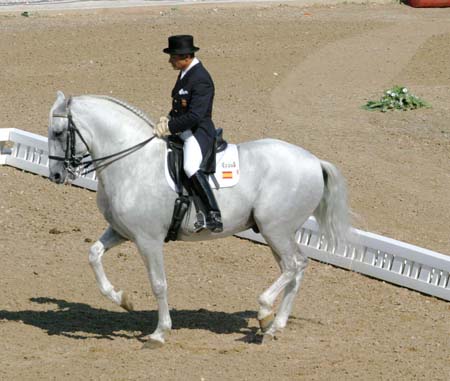
I caught the end of a Flloyd (something? chef?) programme last night where he was making paella in spain. Anyway, he visited the Lippizanners (sp?) and the trainer reckoned them to be the best dressage horses in the world. Now obvisouly they are hugely talented horses, they're built for the job and the perform spectacuarly (not just in the spanish school, I mean PRE breeds in general). So why is it that there are so few in International dressage? Why do you only ever see WB competing? It can't be to do with travel because these horses go all over the place, they even seem more chilled than some WB.

Anyone know why?
 
Fashion

or, to be more exact....

the judges have been trained to look at warmbloods and don't percieve the PRE mode of movement as 'correctly through'

E
 
We've dicussed this on here before, it makes for an interesting argument!!
Rightly or wrongly, dressage judges now judge on the biggest moving, flashiest paces. There's not so much trend towards classically correct work on slightly more 'ordinary' horses or those with knee action
 
I think that a lot of lipizzaners have a great ability to collect and sit on their back ends, but they are well known for not matching the flashy front ends with the hind legs. They also sometimes struggle with straightness... So they are great at classical dressage, but are often not technically very correct...

only an opinion before i get mobbed! lol
grin.gif
 
Would agree with Boss and Eceni too. I've been doing affiliated dressage on a little TB. He has 3 nice paces and has a fab temperament and we always to a correct and accurate test as not often is he argumentative. We are consistently placed (I think only 1 unplaced since I re-joined last August) but we never, ever win. It was a huge surprise when I won a novice qualifier back in January. I'm always beaten by the flashier warmbloods.

However, my new horse is a warmblood. Bred to jump but he has much bigger paces than my little TB so it will be interesting, when we're at the level I'm at now with said TB, how the judges will mark us.
 
OK, maybe I am being really stupid (apologies if I am!) but what other types of dressage are there apart from classical? I know thare's freestyle/music but they all involve the same movements? Is there is a 'modern' dressage or do the movements just have to be more precise?
 
I think classical is seen as the purer form of training, and it has loads more expression etc, whereas what we see at competitions is more of a textbook," the horse must go in this exact way and fill these criteria" kind of training...?
 
Hmmmmm. I have been quite disturbed by this for some years since discovering dressage.

I started my 'judging career' this year and recently went to an Andrew Gardner training seminar. The judge must mark as he/she see's whether it be a New Forest, Shire, Section A, TB or WB. It was drummed into us, and this is how I have begun and intend to continue my 'career'.

I have never been into showing as I experienced on numerous occasions the 'i'll scratch your back if you'll scratch mine' syndrome, and I felt this was criminal., after someone has produced their horse all winter/summer and put so much work into getting to the show, and getting put down the line for political reasons (not to me, but lots of others - not sour grapes). One extremely good trainer took someones horse into a RH class and knew he wouldnt get anywhere as he had placed that particular judge down the line in a previous show.

Is this happening in dressage. Do some judges give better marks because it is a WB?

I have seen a WB win a prelim, first time out at unafilliated level after making 2 errors of course.

Hope someone with more miles on the clock can offer suggestions
crazy.gif
 
I have a judge (not naming names) who will consistantly give me half a % under a qualifying score even if in my other test i get in the 70's but dont feel I did as good a test.. This is because I have beaten her several times when she was riding. It is VERY frustrating
 
I believe judges are looking for a much more forward,looser and athletic way of going with more lift and cadence.I love to watch the Spanish riding school and admire them but I don't see it as dressage ,more training.They do movements that are not required in dressage but they don't use their body in the same way as dressage horses and some warmbloods do have this grace,cadence and athleticism.
I am sure any breed can do very well in dressage but some are better than others.It isn't just obedience as I say they are athletes and dancers
927.gif
 
I admit I am biased, and apologise if I upset a few but I've seen very few WBs perform (IMO) a decent piaffe compared to the Iberian horses. The Iberian horses admittedly generally struggle to extend, their forte is the collected movements. It does seem though that judges do prefer the WBs to the Iberians. I've put it down to perhaps they are seen as too 'prancy'.
 
[ QUOTE ]
I believe judges are looking for a much more forward,looser and athletic way of going with more lift and cadence.

[/ QUOTE ]

I have very rarely seen true cadence in a warmblood. As far as I can see, the suspension is part of how their paces have been bred into them, an iberian may be built naturally more collected but the cadence is trained into them and requires a far greater skill than simply trotting a flashy warmblood around an arena.
I'm not saying either horse is better, it's just that warmbloods have been selectively bred to make them automatically look better in a dressage arena to modern judge's eyes. Imho, the classical way of working an iberian makes the horse truly athletic, collected and powerful
 
i often think that size is a factor, as the iberian, is usually small & the wb has a big presence in the arena...!
 
Bbmat, I don't know if you have ever judged but I can assure you that it would almost be impossible to calculate a score as you are going along to make it come out at 1/2% below the qualifying mark!!
I have judged for many years (am currently list 3) and although at the end of each test I could have a guess at the approximate percentage the horse will get, unless I gave it say a 6 for every single mark (when obviously it would get 60%) then I couldn't work it out to that precise!! You'd have to watch the horse, give the writer the comment and score, try and keep a running total in your head AND be good enough at maths to be able to work that out as aprecentage of the max score as you go with approx 10 secs per mark to do so!!!
If there are 2 or 3 horses very close at the top of the class then I couldn't say for certain which order they will finish in until I've seen the marks.
I think you've just been unlucky if you've just missed the qualifying %.
 
It makes for a very interesting discussion. Two of the instructos at my RS compete in BD on andalusians.

I know when the elder horse first started out on the BD scene, that a lot of the comments from judges weren't the most accepting of seeing a Spanish horse in a dressage arena.

Just would be interesting to know what the comments would have been had instructor been on a WB . But hey the older horse is now at elementary level and will be at the Winter Champs do must be doing something right
 
I'm getting out of this debate.
I had an ID/TB that I took up to P St G and he was lovely.My daughter has a dutch warmblood who is at the champs next week in the spillers and does very well.I think all breeds can do well and don't think judges care what breed they are and they all judge to the best of their ability.
Its not an easy task
 
It would however be easy enough to just give sixes instead of 7's etc. I have had not trouble qualifying, it is just a bit of a coincidence that this judge always gives me the lower scores than about 12 other judges who always give the higher marks.

I know that most judges are much fairer than this, and don't get me wrong, I am not the sort of person who always thinks the judges are wrong!

Thats the thing with dressage, and showing etc... its so subjective
 
Ah yes it would be easy to deliberately give lower marks. I'm just saying you couldn't, as a judge work it out to give someone 65.5% if the qualifying mark is 66%.
Also some judges are re-knowned for being tighter overall with their marks and others are definately more generous. I can pretty much guess what mark I'll get on different horses from most of the judges in my area.
We used to have a judge round here known as the 'ice skating' judge as she never went above a 6!! It didn't matter in the old days before qualifying percentages came in because if you won a qualifier it counted no matter how good or bad the score but it was very frustrating when the rules changed as invariably you would win the class on 60%!!
 
As A judge I have no preference whatsoever for breeds. I have a way of going that I believe to be correct and I judge according to that whether the horse appears to be WB, PRE, cob or whatever.
I have ridden many Andi's and Luso's and can appreciate their (IMO) strengths and weaknesses.
As both a judge and trainer I find they can be tight through the back and not always easy to get truly through with a proper connection. Although they find it easy to carry and balance on the hindlegs they do not always do this with a softly swinging back which is usually why they then cannot lengthen the frame to extend.
I've seen (as a spectator) horses like Pharoan (Andalucian) ridden by Ami Stovold do a stunning PSG test and score over 70% with a 9 for one of his extended trots but also have (sadly) not yet been able to give a PRE horse good marks when I've been judging them as I haven't had one come down the centre line and do a good test!! (I live in hope)
Often they are tense and this affects the rhythm which is the number one priority when assessing a movement as a judge. The sequence of footfalls must stay correct and the tempo remain consistant for a decent mark. I have found this can be a particular problem with the walk which can lose it's clarity and therefore a lot of marks both for the walk movements and the mark for the paces.
WB's have been specifically bred now for many years to be supple and athletic and to have the type of conformation that makes dressage easy for them. It makes sense if you want to do well in dressage to get a horse that will find it as easy as possible, if your lucky enough to be in the position that gives you that luxury of choice, and I think that most of the time it is the warmbloods that do the better tests and go more correctly ( and I'm being very general in this view as their are ALWAYS exceptions )
For the record I have sucessfully competed Iberians, cobs, drafts, TB's, WB's and just about anything else that has 4 legs so I have no breed bias. I took a Suffolk Punch X to the nationals and competed him sucessfully at PSG but if I had the money I would opt for a well bred WB as my dressage horse of choice. (Always had a bit of a hankering to compete a Fresian tho!!)
These are just my observations through many years experience and as I said before there are always exceptions to the majority.
 
I think its terrible that PRE horses arent seen more in dressage (and BSJA and eventing actually as they are also extremely good at this,especially when crossed with a TB). I love their higher knee action, much more so than the WB. I guess WB's look more impressive as they have such huge straight strides, whereas PRE's are better at collected than extended work and look more workman like.

Id rather have a PRE than a WB anyday.
 
Dont forget that the spanish team have done very well in the European Champs before and have beaten many teams fielding only warmbloods!
 
I'd personally like to see more saddlebreds competing at dressage. My old boy had stunning paces and was as flashy as many a warmblood I've seen (well he was warmblood but just not a danish/euro warmblood!)
 
Top