
Exercise plan for fat and unfit sports horse?

ImmyS

Well-Known Member
Joined
3 April 2012
Messages
2,326
Visit site
Hello just wanted some advice from you knowledgable people out there. In the past I've had the opposite problem having had an ex racer who was a poor doer and therefore easy to keep at a good weight and get fit however now I am having trouble with my tubby sports horse.

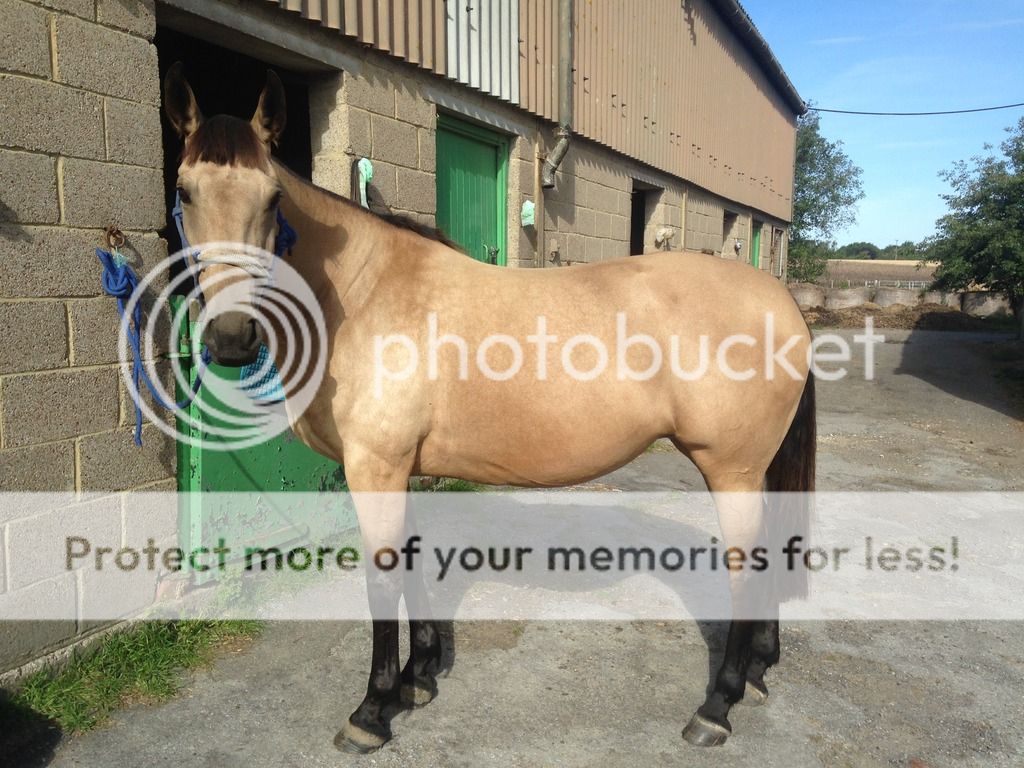
When I took her on just over a year ago she was very weak, no muscle and quite poor, could see every rib, very narrow at the shoulders and had a protruding spine. She has now after some tlc gone the complete other way and I'm struggling to get her weight down and fitness up.

She has limited grazing, hay and a handful of hi if as a token feed once a day.

She has been ridden 5/6 times a week for the last 5 weeks or so just walking hacks for about half an hour. Have recently introduce some trot and canter work and it's made me realise just how unfit she is.. two steady canters today on a slight incline and she was knackered!

Can anyone's recommend a good exercise plain? Got access to plenty of stubble and some track, can't do much in the way of roadwork at the moment due to her feet which are a work in progress!

Token picture of the podgy girl herself -
u
 
lovely horse. ride 5 or 6 times a week. week I start walking on roads 20 mins build up to 40 mins. week 2 and 3 build up to 1 hour introduce a little trotting in week 3. weeks 4 to 6 increase work to one and a half hours 5 or 6 days a week increase trot time and introduce canter. do not increase speed and length of exercise together. Work in the school can begging week 6. 30 mins mostly trot in the school. circles serpentines trotting poles small jumps. 3 times a week. hack for 2 or 3 days wekl 7. continue for another 5 weeks slowly increasing amount of trot and canter. hacks up to 2 hours with a good amount of walking on roads. by week 13 horse should be fit enough for half a days hunting a low milage endurance ride or cross country type competition. ETA he'll need shoes for boots by week 3 to cope with the work required.
 
Hi,

When you say limited grazing, is she muzzled?

I think your hacks need to be considerably longer than half an hour, now. In the good old days we used to bring horses back into work after their winter break with 4 weeks walking, and by the end of that 4 weeks, our walks were a good two hours. Then we introduced trot and canter work. By weeks 8 - 10 we would be doing interval work - 3 minute canters followed by 5 minutes walking, building up to being able to do this 5 times. Then we would shorten the intervals. In my view, two things got our horses fit, that was trotting long and low up hills, and canter work. You can build up in the school if you need to. Good old Lady Mary Rose Williams said that if you could canter around the school with 20m circles at A, E, C and B twice on one rein, the horse was fit enough to do a showjumping competition.

However, I was speaking to my vet very recently after having had my mare tested for Cushings, which was -ve. He thought that she had some insulin resistance of some sort and said that he had been reading up on research, finding that horses got fitter quicker, and lost weight where necessary, with fast work once or twice per week. They also were better able to do the necessary with the sugar, too. Obviously, be led by the horse - if she tells you she is pooped after 100m of gallop, don't push it further, but try and increase the distance each time. And be careful of hard/soft ground.

And, sorry to contradict the poster above, but if you increase gradually, you shouldn't need boots or shoes. You've already done a fair amount of walking. :)

Andrew Nicholson's book has some good fitness advice in it. There's a pretty traditional fitness plan here:
http://www.horseandhound.co.uk/features/formulating-a-fitness-plan-47803
 
Hi,

When you say limited grazing, is she muzzled?

I think your hacks need to be considerably longer than half an hour, now. In the good old days we used to bring horses back into work after their winter break with 4 weeks walking, and by the end of that 4 weeks, our walks were a good two hours. Then we introduced trot and canter work. By weeks 8 - 10 we would be doing interval work - 3 minute canters followed by 5 minutes walking, building up to being able to do this 5 times. Then we would shorten the intervals. In my view, two things got our horses fit, that was trotting long and low up hills, and canter work. You can build up in the school if you need to. Good old Lady Mary Rose Williams said that if you could canter around the school with 20m circles at A, E, C and B twice on one rein, the horse was fit enough to do a showjumping competition.

However, I was speaking to my vet very recently after having had my mare tested for Cushings, which was -ve. He thought that she had some insulin resistance of some sort and said that he had been reading up on research, finding that horses got fitter quicker, and lost weight where necessary, with fast work once or twice per week. They also were better able to do the necessary with the sugar, too. Obviously, be led by the horse - if she tells you she is pooped after 100m of gallop, don't push it further, but try and increase the distance each time. And be careful of hard/soft ground.

And, sorry to contradict the poster above, but if you increase gradually, you shouldn't need boots or shoes. You've already done a fair amount of walking. :)

Andrew Nicholson's book has some good fitness advice in it. There's a pretty traditional fitness plan here:
http://www.horseandhound.co.uk/features/formulating-a-fitness-plan-47803


Hi thanks for the reply, the half hour hacks have purely been down to the fact I've been working and that's all I have had time for however I now have a few weeks on to really crack on with her fitness.
 
lovely horse. ride 5 or 6 times a week. week I start walking on roads 20 mins build up to 40 mins. week 2 and 3 build up to 1 hour introduce a little trotting in week 3. weeks 4 to 6 increase work to one and a half hours 5 or 6 days a week increase trot time and introduce canter. do not increase speed and length of exercise together. Work in the school can begging week 6. 30 mins mostly trot in the school. circles serpentines trotting poles small jumps. 3 times a week. hack for 2 or 3 days wekl 7. continue for another 5 weeks slowly increasing amount of trot and canter. hacks up to 2 hours with a good amount of walking on roads. by week 13 horse should be fit enough for half a days hunting a low milage endurance ride or cross country type competition. ETA he'll need shoes for boots by week 3 to cope with the work required.

This - if you struggle for time at all you can also lunge (I like to lunge every now and again anyway to see from the ground how my horse is moving). You will need shoes on though (or boots). Best of luck - that's a lovely looking horse.
 
lovely horse. ride 5 or 6 times a week. week I start walking on roads 20 mins build up to 40 mins. week 2 and 3 build up to 1 hour introduce a little trotting in week 3. weeks 4 to 6 increase work to one and a half hours 5 or 6 days a week increase trot time and introduce canter. do not increase speed and length of exercise together. Work in the school can begging week 6. 30 mins mostly trot in the school. circles serpentines trotting poles small jumps. 3 times a week. hack for 2 or 3 days wekl 7. continue for another 5 weeks slowly increasing amount of trot and canter. hacks up to 2 hours with a good amount of walking on roads. by week 13 horse should be fit enough for half a days hunting a low milage endurance ride or cross country type competition. ETA he'll need shoes for boots by week 3 to cope with the work required.

Hi thanks for the reply, currently looking into boots but she has awkward feet however have enough tracks to keep us busy until I get the hoof situation sorted hopefully
 
Just to say that I have a barefoot, 16 yo connie who has some metabolic condition. We're working on building up fitness with her (and reducing fatness) - her feet get better the more work we do. If you are worried, then boot, but I think if you have the low starch diet right, she should be fine. And no, I am not against shoes - I just don't think they are entirely necessary for getting a horse fit. And the roadwork brought them on leaps and bounds. In fact, if we don't get any roadwork in a couple of times per week, her feet suffer.
 
Just to say that I have a barefoot, 16 yo connie who has some metabolic condition. We're working on building up fitness with her (and reducing fatness) - her feet get better the more work we do. If you are worried, then boot, but I think if you have the low starch diet right, she should be fine. And no, I am not against shoes - I just don't think they are entirely necessary for getting a horse fit. And the roadwork brought them on leaps and bounds. In fact, if we don't get any roadwork in a couple of times per week, her feet suffer.

would agree with the above re the feet - they need 'fittening up' in the same way as the other structures like muscles etc, getting some boots is a great idea, you don't need to use them all the time but the trick with conditioning feet is that the horse is comfortable striding out.

Fittening work does involve building up to longer rides. Hill work if you can, and consistency - better to do something 6 days a week rather than 1 long ride a week. When your horse is walking make sure that she is walking out not pootling along, that's what will get her fit not just the hours.

ETA look up the booklet 'Fat Horse Slim' by World Horse Welfare - some useful ideas about getting fatties back to work.
 
Last edited:
would agree with the above re the feet - they need 'fittening up' in the same way as the other structures like muscles etc, getting some boots is a great idea, you don't need to use them all the time but the trick with conditioning feet is that the horse is comfortable striding out.

Fittening work does involve building up to longer rides. Hill work if you can, and consistency - better to do something 6 days a week rather than 1 long ride a week. When your horse is walking make sure that she is walking out not pootling along, that's what will get her fit not just the hours.

ETA look up the booklet 'Fat Horse Slim' by World Horse Welfare - some useful ideas about getting fatties back to work.

Thank you for the comments regarding feet, not planning to shoe at the moment as she's newly barefoot and doing well x
 
Just to say that I have a barefoot, 16 yo connie who has some metabolic condition. We're working on building up fitness with her (and reducing fatness) - her feet get better the more work we do. If you are worried, then boot, but I think if you have the low starch diet right, she should be fine. And no, I am not against shoes - I just don't think they are entirely necessary for getting a horse fit. And the roadwork brought them on leaps and bounds. In fact, if we don't get any roadwork in a couple of times per week, her feet suffer.

That's encouraging thank you. Her feet are doing well, only been out of shoes a few months and with being pigeon toed and having one slightly clubbed foot I'm reluctant to shoe her. I'm hoping her feet will improve as the weight comes off and her feet get more stimulation.
 
When I was getting advice on bringing my mare with a metabolic issue back into work Liverpool advised that it is trot work that really gets the blubber off them. I was instructed (in big writing across the diet plan!) to build up trot work so we would be doing 30 mins continuous every day after 6 weeks.

Annoyingly the metabolic issues are constantly raising their ugly head, but I do notice the difference if we back off on the trot work. I'm constantly struggling for time, so find 2-3 good lunging sessions a week really helpful.

ETA - its shifted the blubber off me as well. I use the whole school when lunging and think I probably walk a few miles each time doing it!
 
I found my fatsos are much easier to manage on the track field so they are moving more generally. the grass is very short so I feed them a slice of hay twice a day.
Plus 20-30min trotting daily. they should be out of breath and sweating.
obviously build up to it over 4-6 weeks depending on the baseline fitness.
I also do 4x 3 min canters up an incline 2-3x week with mine.
if I don't have time to ride I lunge for 20min in trot on a huge circle.
 
The ability of the average sports horse/Bog trotter to hoover up food is legendary.The problem is that even with limited grazing ,they can get a lot more energy than they need .Even for quite hard work. Limit forage consumption too much and you risk having digestive problems and a very unhappy horse. I approach the problem from a slightly different perspective. I feed ad lib hay but if Bob the notacob starts to get a bit too tubby ,he gets late cut ,woody hay .Still clean and dust free ,just cut too late .Another alternative would be threshed ryegrass hay. In at night he gets as much low energy fibre as he wants .When he does go out in the morning he does not binge on the grass as he is already full.
 
I use the track system for weight it works wonders especially if it doesnt go all the way round. I have three ponies on 3/4 of an acre the center is used as strip grazing but the track goes all the way round and is stopped by the gate. The food ie grass strip is at one end, water and feed are at the other they have to go all the way round to get anywhere which the laminitic doea at a gallop he hasnt even had a raised pulse this year he is galloping everywhere chews the track up a bit in bad weather but it has kept him sound and very fit. He is a companion but I would guess he would be fit enough to go round a cross country at a low level. Ridden fittening is in my mind best done by building up the interval training until you are able to do several hours a week of canter and walk, with canter being greater time than walk by the end of about 5 weeks. Does this horse live out 24/7 as that makes a huge difference to both weight and fitness too. My pet hate is round bales of hay as the horses just stand and stuff their faces rarely moving at all.
 
I use the track system for weight it works wonders especially if it doesnt go all the way round. I have three ponies on 3/4 of an acre the center is used as strip grazing but the track goes all the way round and is stopped by the gate. The food ie grass strip is at one end, water and feed are at the other they have to go all the way round to get anywhere which the laminitic doea at a gallop he hasnt even had a raised pulse this year he is galloping everywhere chews the track up a bit in bad weather but it has kept him sound and very fit. He is a companion but I would guess he would be fit enough to go round a cross country at a low level. Ridden fittening is in my mind best done by building up the interval training until you are able to do several hours a week of canter and walk, with canter being greater time than walk by the end of about 5 weeks. Does this horse live out 24/7 as that makes a huge difference to both weight and fitness too. My pet hate is round bales of hay as the horses just stand and stuff their faces rarely moving at all.

Unfortunately where I am, I am unable to set up a track system. She is out 24/7 and does have a round bale in the field, however I have never seen her stand and gorge, she takes a mouthful then wonders off again so I'm not too worried about that. The complete change in her has just taken me by surprise. The winter before I took her on she was out in lots of grass, fed hay as well and having two feeds a day and looked so poor. Not just under muscled as expected being out of work. I thought she was just a bit of a poor doer but it seems that's not the case!
 
Following!!
Sorry to hijack thread but can someone give me the low down on track systems? How wide/ how to stop it getting muddy? currently strip grazing these 3 but there's still too much grass available; whenever it grows it's gone straightaway even with the roan being in overnight and then all of them muzzled during the day...:(

Q3FynUs.jpg
 
Introduce things like shoulder in and leg yield even when out hacking in walk. That helps with suppleness so when you come to do trot/canter, the horse will find it easier as well. I'm doing that with my horse that is in rehab from kissing spine. The other day I worked on a hill, trotting up it, turn on the forehand at the top, walk on the way down doing either shoulder in or leg yield on both sides, and then turn on the forehand the other way at the bottom to trot back up. Try that kind of thing, keeps it varied for them as well so its not just walking/trotting, they have to think as well.
 
Just needs more exercise I would say. I have one who is always fatter than the rest and she has to be in very hard work or she's podgy. Keep upping it gradually on hard surfaces but you could do a bit of faster stuff on grass I would think.
 
Just needs more exercise I would say. I have one who is always fatter than the rest and she has to be in very hard work or she's podgy. Keep upping it gradually on hard surfaces but you could do a bit of faster stuff on grass I would think.

She is already looking a bit better after a few weeks of harder work, so as you say I think she's going to be one of those that needs hard work to keep the weight off
 
This - if you struggle for time at all you can also lunge (I like to lunge every now and again anyway to see from the ground how my horse is moving). You will need shoes on though (or boots). Best of luck - that's a lovely looking horse.
Why do you need shoes or boots to lunge?
 
Top