
Fertilised Grass information. Please?

Archie73

Well-Known Member
Joined
27 March 2009
Messages
384
Location
Kent
Visit site
My question is as many of us have now been educated to understand short stressed grass is a higher lami etc risk then the longer grass BUT does the same apply with nitrogen fertilised grass. I.e is the longer grass that is nitrogen fertilised less risk then the shorter fertilised grass....I can't find anything on it but am trying to find out.

Any information or input would be gratefully received.
 
I'm no expert, I'm purely going off what I've read and my own thoughts so you will want to research further, but my understanding is that fertilised grass isn't a problem so much as the age of the grass and season. Young grass has less fiber and more sugar, then as the grass ages it becomes much more fibrous and tough and the sugars are harder to digest. There's a suspected link between lami and magnesium, where high levels of potassium and calcium in the grass make it difficult for horses to take up magnesium they need and the imbalance may be a trigger for lami. Spring grass is one time in particular where grass is especially high in potassium.

I also found this link: http://www.wayneswcd.org/Equine Ed/FAQ fertilizing p.pdf

"Laminitis
As far as laminitis being caused by fertilizers, there is no evidence that pasture grasses that are fertilized correctly cause
laminitis. It is important to introduce horses to new pasture slowly since any abrupt change in diet can trigger digestive
problems that can result in laminitis. If your horse has foundered in the past, you may want to restrict access to pastures.
Two periods of time to be especially careful in grazing laminitis-prone horses are in spring and fall. If you think back to
your biology classes, you will recall that grasses produce sugar through photosynthesis during the day. At night plants use
up some of the sugar through respiration. It has long been known that the sugar content of pasture grasses is higher in
the afternoon than in the morning. If nighttime temperatures in spring and fall drop below 45 degrees, respiration slows or
stops and the sugar remains in the grasses. Fairly high sugar contents can occur in cool season grasses if several cold
nights occur in succession and are followed by bright sunny days. This is a normal process that does not affect most
horses. However, there is some discussion and research occurring at present to determine whether the high sugar
concentration in pasture grasses caused under specific environmental conditions can contribute to laminitis in horses that
are predisposed to metabolic problems."
 
In an ideal world you shouldn't apply nitrates to grass paddocks - herbivores are equipped to deal with a normal level of potentially toxic non- protein nitrogen compound in their forage. If for any reason there is a rapid upward fluctuation in these levels the natural metabolic process can become overloaded, resulting in liver disturbance and toxic imbalance.

Nitrogen does very little to aid land used for grazing horses - the nitrogen is taken up very quickly by the grass, and puts no real benefit in the soil, which is why natural manures are encouraged and is why some people opt to disperse droppings instead of poo picking.
Excess nitrogen in food can cause laminitis, which results in toxins being released into the bloodstream - pasture which has been fertilised with nitrogen-based fertilisers, or pasture which has a large quantity of nitrogen-concentrating plants like clover.
 
In an ideal world you shouldn't apply nitrates to grass paddocks - herbivores are equipped to deal with a normal level of potentially toxic non- protein nitrogen compound in their forage. If for any reason there is a rapid upward fluctuation in these levels the natural metabolic process can become overloaded, resulting in liver disturbance and toxic imbalance.

Nitrogen does very little to aid land used for grazing horses - the nitrogen is taken up very quickly by the grass, and puts no real benefit in the soil, which is why natural manures are encouraged and is why some people opt to disperse droppings instead of poo picking.
Excess nitrogen in food can cause laminitis, which results in toxins being released into the bloodstream - pasture which has been fertilised with nitrogen-based fertilisers, or pasture which has a large quantity of nitrogen-concentrating plants like clover.

Thanks you for the reply.

100 per cent agree with above from own research but do you thing that as the grass gets longer the toxic risk becomes less or more or stays the same.

I have a horse that is not grass sensitive but nitrogen fertiliser sensitive (proven by moving to similar grazing without nitrogen fertilizer) I have unfortunately had to temporarily move back to fertilised farm whilst I look again but we are currently on short field due to switch to long field and I am just trying to work out if my risk is going up or down re how long to turn out.

He is doing 7 hours muzzled :-(((
On short grass so just trying to learn ahead.

Fully balanced as far as possible minerals etc in place and gut balancers.

Thanks again
 
Not a scientific study, but my ponies graze unimproved, never fertilized water meadows. There have been native ponies on them for nearly 50 years, and despite acres and acres of long grass in the summer, never one case of lami. My conclusions are that there are several factors which help them stay healthy:

Diversity of forage - weeds enable horses to self-medicate
Low nitrogen, as unfertilized
Roaming around a large area means constant movement, fitness and improved circulation
Winter fasting removes excess weight built up during summer.

Even my Shetland stays on the long grass, and although he gets a bit tubby (nothing on others I've seen), he's always sound, and we ride the legs off him to keep him fit!
 
In an ideal world you shouldn't apply nitrates to grass paddocks - herbivores are equipped to deal with a normal level of potentially toxic non- protein nitrogen compound in their forage. If for any reason there is a rapid upward fluctuation in these levels the natural metabolic process can become overloaded, resulting in liver disturbance and toxic imbalance.

Nitrogen does very little to aid land used for grazing horses - the nitrogen is taken up very quickly by the grass, and puts no real benefit in the soil, which is why natural manures are encouraged and is why some people opt to disperse droppings instead of poo picking.
Excess nitrogen in food can cause laminitis, which results in toxins being released into the bloodstream - pasture which has been fertilised with nitrogen-based fertilisers, or pasture which has a large quantity of nitrogen-concentrating plants like clover.

Slow release fertilisers are available that do not release nitrogen quickly and instead do it slowly over an entire season. Sure Grow is an example. Natural manure has an excess of potassium and potassium stops grass from absorbing magnesium from the soil, which is an important element for a horse. Fresh manure also takes other nutrients out of the soil and should not be left or spread on a field. This happens because the bacteria that break down fresh manure take nutrients out of the soil.

Excess nitrogen in food can cause laminitis, which results in toxins being released into the bloodstream - pasture which has been fertilised with nitrogen-based fertilisers, or pasture which has a large quantity of nitrogen-concentrating plants like clover.

Do you have a link to substantiate this? As far as I understand grass, no matter how rich, does not "cause" laminitis. It is simply a trigger.
 
Hi. I appreciate all the information but is there anyone that can answer my question.

Does longer nitrogen fertilised grass contain less nitrogen at the ends (like long grass has less frucans then short grass at the ends) then short nitrogen fertilised grass please?

I really would like to know if anyone knows this at all?

Pleeeeaaaassse???
 
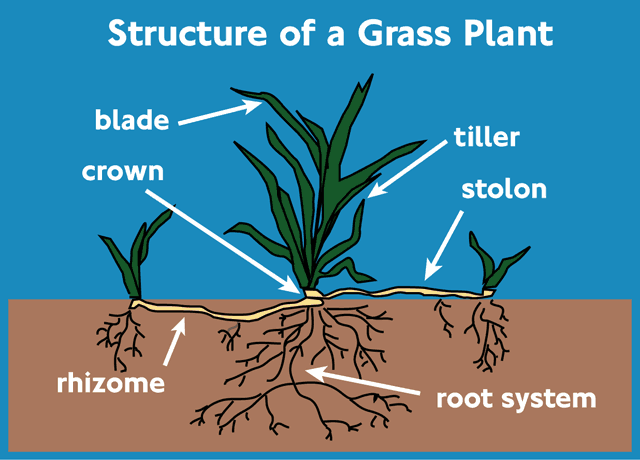
A blade of grass lives for around 40 days. Nutrients like nitrogen are mainly stored in the roots and in the crown so I don't think there is any noticeable difference in the amounts of nitrogen in the blades whether the grass is long, or short.

Grass-plant-structure.png
 
A blade of grass lives for around 40 days. Nutrients like nitrogen are mainly stored in the roots and in the crown so I don't think there is any noticeable difference in the amounts of nitrogen in the blades whether the grass is long, or short.

Grass-plant-structure.png

Sebastian. That was really helpful. Thank you. Although my logic from your really helpful diagram (I had no idea there was more to grass then root and blade!!!) and your 40 day life information makes me wonder if a field had not been grazed for 10 weeks or 70 days then would the grass blade not be dead/ dying and therefore have less nitrogen nutrient?

I am just trying to work it out as best as I can as I know from testing by trying different grazing that nitrogen fertilizer is the laminitis trigger for boy.

Thanks so much.
 
Sebastian. That was really helpful. Thank you. Although my logic from your really helpful diagram (I had no idea there was more to grass then root and blade!!!) and your 40 day life information makes me wonder if a field had not been grazed for 10 weeks or 70 days then would the grass blade not be dead/ dying and therefore have less nitrogen nutrient?

I am just trying to work it out as best as I can as I know from testing by trying different grazing that nitrogen fertilizer is the laminitis trigger for boy.

Thanks so much.
I don't think so, because grass continues to grow, unless it's gone dormant due to cold/lack of rain etc, so the newest blades will be at the top and the oldest, dead/dying ones will be at the bottom, so old and long grass is going to have significant smaller amounts of nitrogen than short grass. Fertiliser helps the grass grow and could easily make your problems worse, but I don't think that is related to nitrogen levels in the blades themselves. I would personally be looking at what grasses you have, since sugar content is the key in managing horses with laminitis. Have you read this?

An excerpt from http://www.farmersguardian.com/home...our-grass-for-a-horse-to-graze?/63000.article

The first set of results received were quite remarkable, indicating the fructose content of both the old and new varieties of perennial rye were high compared to the inferior grass species. The new variety is the highest with a 332mg/g fructose content in comparison to 0.52mg/g in Meadow Fescue. Therefore modern perennial rye-grass, which is the most popular type of grass grown in the UK, has the potential to give the laminitic-prone pony a double whammy of sugar in the form of fructose and also a high ingested fructan level.

Meadow Fescue contains 0.52mg/g fructose, 0.26mg/g glucose and 0.19mg/g sucrose, while the Crested Dogstail results are 0.48, 0.23 and 0.13.

If given the choice of perennial rye over Meadow Fescue the horse will inevitably choose the sweeter variety and over indulge on its sweet sugary content. But though the horse might choose to eat this type of grass because it tastes so sweet, the Meadow Fescue will be a far healthier choice, especially for the native pony.

The grass seed mixes I use are rye grass free and based on mainly meadow fescue and smooth stalk meadow grass and we have no problems at all *touch wood*

Here is another bit of interesting information

Cool spring and fall weather can cause sugar accumulation, thereby increasing the risk of pasture-induced laminitis for susceptible horses. Anytime forage species are using sugars for rapid growth during warm weather, or during respiration (using energy during dark periods) is a better time to graze. However, laminitis in susceptible horses can still occur if overeating is allowed.

http://www.thehorse.com/articles/23674/laminitis-risk-increased-by-pasture-grass-sugars

So actually topping the grass and making it use its energy to regrow will, in fact, be better for your horse.

Interestingly enough, the first article I linked debunks the "using energy during dark periods is a better time to graze" theory.

The second set of results showed the percentage of fructose at various times through the day. There is no significant variation in the fructose content of perennial rye, which agrees with previous research. The ‘inferior’ grass, Yorkshire fog showed the greatest fluctuation in fructose levels and the fructose fell in the Bull Grass throughout the day and into the afternoon in an opposite manner to the other grasses. This is thought to be a genetic trait.

All of the grass analysed were at their lowest daytime level between 1-2pm, which is contrary to previous studies. Therefore, cutting hay for low sugar content and grazing laminitis-prone horses is safest at this time.
 
Last edited:
Top