French or German methods?

Walrus

Well-Known Member
Joined
16 January 2007
Messages
2,433
Visit site
I've started reading a few articles on the difference between the French and German training methods. I've never really paid much attention before, but a few things have got me interested, and I'm starting to think the French methods sound interesting (i also love working in walk! 🤣).

From what I can work out both methods work towards a similar end but the German method uses more riding leg to hand and use the forward impulsion and then compress it. Whereas French way slows it down, uses flexions and focuses on lift of the shoulder / thoracic sling? (This is so basic I apologise to those who have a clue!).

I just wondered if people paid attention to the history and the method of schooling they use. And if anyone who does have an interest in these things could recommend any resources or books. I'm not sure im quite ready for Bauchers 14th edition - more like schooling for dummies!
 
I think using a mixture of both can prove really useful - for example I have a very hot mare and am utilising more of the French techniques as she has a lot of power but doesn’t quite know what to do with it all as she is young, so working away at the flexion, leg yielding etc. in the walk is the bulk of her schooling. Once she is comfortable in that nearer the end of a session then I ride her in what I would consider more of the German way of training - as you say, using the impulsion, leg to hand which is usually my preferred method of schooling.
 
Not something I know a lot about but it reminded me of something I read from a show jumper.

He said that years ago most European warmbloods were of the heavier substantial type but the US SJs had a lot of TB blood and the two types needed very different riding and training. He added that the differences are less nowadays as breeding has moved from the extremes to something in-between.

French breeding used more Arab and TBs in Selle Francais so It may be that the french approach worked better with hotter horses as Barklands mentioned.

Then things carry on that way through tradition even though modern warmbloods are mixed.
 
Leg to hand was always the way for me - engage the horse's 'engine' in its quarters and then maintain a light contact (so not the fierce contact we're seeing in so much of modern dressage).

However as a cross with what is referred to above as the more french way of training I also did a lot of work/warmup in walk using 80% leg aid (both for forwardness and for bend) and 20% hand. My favourite warmup exercise for dressage was 4 x 1m loops in walk to engage the hindquarters before ever thinking of picking up trot.

You can maintain a very light contact, to provide a 'connection' to the horse, even in a bitless bridle. I rode a lot decades ago in what was then called a 'german bitless' (courtesy of a certain Eddie Macken and Boomerang!). I still had a connection to the front of the horse, although the contact was super light (think fingertip rather than hand) and also used a light rein touch to the neck, accompanying the leg aid, for some amount of steering.

My then horse swapped easily from hacking bitless to dressage in a mild snaffle and also happily swapped again into a double bridle for showing. My last riding horse was a 3/4TB/Irish type and did all his dressage and flat work in a Happy Mouth mullen mouth bit. He was a bit 'hot' but I'd taught him to stop from seat and leg and not from the hand.

As with all riding it's the hands that hold the reins that are what provides 'abuse' - not the bit alone.
 
I think you are right, French is based a lot on shoulder in (La Gueriniere) and German on impulsion and contain the impulsion to collect. When I was little, Germans used to win all the Olympics in dressage. French are generally more show jumping orientated.

Found that article while googling La Gueriniere :
 
You see that's an interesting statement, that's it just simply balanced
first (sorry, dont seem to be able to quote!). because what does it mean? My understanding is that both schools end up with a balanced horse but it's about the how you get there and actually what you physically do on the route to achieving that.

No offence but there's a lot of terms banded round about balance, feel and "leg to hand" etc and I really struggle with what is physically and practically going on. Because no professional is riding around with no contact and not doing anything and magically the horse is improving, they're doing something and it's exactly what that something is that I am thinking maybe a bit more reading about these different methods might give me some enlightenment (or at least something to think about!).
 
I’m in the process of reading through works by La Gueriniere, Baucher and Steinbrecht. I see similarities there.. for eg La Gueriniere talks about sending the horse forwards at the trot first.

I wonder if modern German, and even classical French to some extent, are more distilled versions of the same ideas espoused by those three. It seems to me that the thing which has been lost most of all is the emphasis La Gueriniere repeatedly put on adapting your methods to the horse you’re sitting on. He was very firm in the belief that you need to know the character (as well as physical type, conformation etc) of the horse you’re training well before you can know which methods are suitable for that horse. These days it seems much more of a one size fits all approach.
 
I’m in the process of reading through works by La Gueriniere, Baucher and Steinbrecht. I see similarities there.. for eg La Gueriniere talks about sending the horse forwards at the trot first.

I wonder if modern German, and even classical French to some extent, are more distilled versions of the same ideas espoused by those three. It seems to me that the thing which has been lost most of all is the emphasis La Gueriniere repeatedly put on adapting your methods to the horse you’re sitting on. He was very firm in the belief that you need to know the character (as well as physical type, conformation etc) of the horse you’re training well before you can know which methods are suitable for that horse. These days it seems much more of a one size fits all approach.

I like that thought, what books are you reading? I've seen one that's racinet explains baucher which I think is supposed to be a bit more digestible, but it's nearly £30 on amazon!
 
You see that's an interesting statement, that's it just simply balanced
first (sorry, dont seem to be able to quote!). because what does it mean? My understanding is that both schools end up with a balanced horse but it's about the how you get there and actually what you physically do on the route to achieving that.

No offence but there's a lot of terms banded round about balance, feel and "leg to hand" etc and I really struggle with what is physically and practically going on. Because no professional is riding around with no contact and not doing anything and magically the horse is improving, they're doing something and it's exactly what that something is that I am thinking maybe a bit more reading about these different methods might give me some enlightenment (or at least something to think about!).

Balance before movement, if you lose balance, stop or reduce movement until you have re-established balance. I don't think anyone trained using broadly French techniques when I had horses, not anyone I knew anyway. Not an expert, but the work I see, help with and like, is French. I think it's probably very hard to ride in the German way without compressing the head and neck - as, I think, Manolo Mendez says, short the body, long the neck though also agree there is crossover between the two, for sure. And absolutely, different horses will need a different blend of techniques.

The Slow Walk Work group that's been mentioned a few times on HHO is based in the French approach and is free, a good intro to both ridden and in hand French techniques. Annie Dillon and Mills Consilient Horsemanship on FB are really interesting in terms of practical but also academic discussions on the French school and different writers and approaches. Science Of Motion has taken the French school and reinterpreted it with modern understandings of how the fascia and skeleton work, and truly addresses the physical forces acting on horse and rider, but is, err, challenging to say the least.

The German school, ironically, was more about military training, covering ground, so it makes sense it has a focus on forward, and is more common in the UK as it's more closely aligned to our hunting and military background. And yet...now it's the basis of competition dressage. My first serious in depth understanding of the German school was watching Erik Herbermann several times at Arrow Training in Herefordshire. He was one of the last fully trained people to come from Von Neindorffs, and I think that truly classical German influence on dressage has probably faded because of it, but then Saumur, Jerez, SRS don't exactly seem to be wholly good influences.

I'm not sure that taking a more French approach would lead to reward in the ring, sadly.
 
I like that thought, what books are you reading? I've seen one that's racinet explains baucher which I think is supposed to be a bit more digestible, but it's nearly £30 on amazon!
Yes, I got the racinet one, but I got it on kindle which was a bit cheaper. The La Gueriniere one is the school of horsemanship book 2. Steinbrecht was Gymnasium of the horse - also kindle due to cost 😬
I still have a ways to go before finishing any of them but it’s super interesting.
 
Interesting you mention military influence, because the French of course had a tremendous cavalry tradition. But nevertheless led to a different emphasis it seems
Balance before movement, if you lose balance, stop or reduce movement until you have re-established balance. I don't think anyone trained using broadly French techniques when I had horses, not anyone I knew anyway. Not an expert, but the work I see, help with and like, is French. I think it's probably very hard to ride in the German way without compressing the head and neck - as, I think, Manolo Mendez says, short the body, long the neck though also agree there is crossover between the two, for sure. And absolutely, different horses will need a different blend of techniques.

The Slow Walk Work group that's been mentioned a few times on HHO is based in the French approach and is free, a good intro to both ridden and in hand French techniques. Annie Dillon and Mills Consilient Horsemanship on FB are really interesting in terms of practical but also academic discussions on the French school and different writers and approaches. Science Of Motion has taken the French school and reinterpreted it with modern understandings of how the fascia and skeleton work, and truly addresses the physical forces acting on horse and rider, but is, err, challenging to say the least.

The German school, ironically, was more about military training, covering ground, so it makes sense it has a focus on forward, and is more common in the UK as it's more closely aligned to our hunting and military background. And yet...now it's the basis of competition dressage. My first serious in depth understanding of the German school was watching Erik Herbermann several times at Arrow Training in Herefordshire. He was one of the last fully trained people to come from Von Neindorffs, and I think that truly classical German influence on dressage has probably faded because of it, but then Saumur, Jerez, SRS don't exactly seem to be wholly good influences.

I'm not sure that taking a more French approach would lead to reward in the ring, sadly.
 
Interesting you mention military influence, because the French of course had a tremendous cavalry tradition. But nevertheless led to a different emphasis it seems
I think the poster further up was onto something when they mentioned different types of horses. As I agree both appear to have military background (I believe baucher trained the French cavalry before going back to the circus!). But I think the French horses were lighter, more tb / Arab influences perhaps and the German warmbloods more substantial?


Balance before movement, if you lose balance, stop or reduce movement until you have re-established balance. I don't think anyone trained using broadly French techniques when I had horses, not anyone I knew anyway. Not an expert, but the work I see, help with and like, is French. I think it's probably very hard to ride in the German way without compressing the head and neck - as, I think, Manolo Mendez says, short the body, long the neck though also agree there is crossover between the two, for sure. And absolutely, different horses will need a different blend of techniques.

The Slow Walk Work group that's been mentioned a few times on HHO is based in the French approach and is free, a good intro to both ridden and in hand French techniques. Annie Dillon and Mills Consilient Horsemanship on FB are really interesting in terms of practical but also academic discussions on the French school and different writers and approaches. Science Of Motion has taken the French school and reinterpreted it with modern understandings of how the fascia and skeleton work, and truly addresses the physical forces acting on horse and rider, but is, err, challenging to say the least.

The German school, ironically, was more about military training, covering ground, so it makes sense it has a focus on forward, and is more common in the UK as it's more closely aligned to our hunting and military background. And yet...now it's the basis of competition dressage. My first serious in depth understanding of the German school was watching Erik Herbermann several times at Arrow Training in Herefordshire. He was one of the last fully trained people to come from Von Neindorffs, and I think that truly classical German influence on dressage has probably faded because of it, but then Saumur, Jerez, SRS don't exactly seem to be wholly good influences.

I'm not sure that taking a more French approach would lead to reward in the ring, sadly.
I've tried the slow walk group but it just filled my feed with people posting so I came off it. I follow the no back no horse group and use some of their in hand stuff and also Kelly de geuass (sp?).

manolo is the French school isn't he? I'm only just starting to appreciate the difference!
 
I have two books by Henry Wynmalen, which I have found excellent. He was Dutch. He came to live in the UK and did a great deal for the development of horsemanship here. He wrote his books in the 60’s or early 70’s I think I remember. It was all about lightness and working with the horse.
 
In my experience, every horse is different, and different methods suit different types.

Your average leisure horse probably suits the French method better - they can balance themselves to a point both with and without a rider, they benefit hugely from suppling work and that is very much the route to connection and expression within correct paces. Mostly, it’s my preferred method, in part because this is the type of pony I prefer.

Competition bred equines, sparky and loose in their joints, with the aids almost pre programmed, don’t benefit in quite the same way. My first competition bred pony was quite a revelation - how I had done things before didn’t suit her so we had to adjust. And since then I have learned more about which ponies suit which methods.

An example or two…

French method (Philippe Karl etc): New Forest ponies, every one I have had has absolutely loved this method, responding well and quickly to the methods and programme suggested. New Forest mares are strong willed and strong in body. They can balance themselves and then benefit hugely from suppling work to help step under more and work ā€˜better’ when carrying a rider.

German method: send on into the hand, create the balance and contain the energy usefully. This by necessity has been the sports pony model. They don’t need suppling in quite the same way, they’re so bendy they are wobbling all over the place and need to gain strength and straightness above all else. So I create balance for them, directing them from leg into hand and keeping them straight with my body until they get strong enough to do it themselves. So much comes easily but balance under a rider is not it when you’re wildly bendy and not that strong.

I guess my riding in general is a bit of a mix - the kind that relies a lot on feel with a toolbox of options to help with whatever issue is present at any one time. Every horse is different. I hacked one out on the buckle today and another in an outline - in the arena the first pony is able to balance herself, the second is younger and bendier and still needs a lot of help with straightness. I don’t ride with much weight in my hand ever, and always ride from back to front, but the finer details are whatever suits the horse/pony and helps them learn happily.
 
I like that thought, what books are you reading? I've seen one that's racinet explains baucher which I think is supposed to be a bit more digestible, but it's nearly £30 on amazon!
It's not an easy going book!

I've dived down various rabbit holes over the years. I spent some years in Germany as a child and certainly the teaching in those days definitely wasn't chasing the horse forward into a contact. We were taught most lateral movements from a young age and that ToH and SI were critical for balance. Having come from a UK riding school it was a steep learning curve (plus all the ponies were very spicy). I'm not sure whether the references to compression have arisen due to the horrible sights in modern dressage, but my old instructor could pirouette & piaffe her horse off a headcollar. All us kids reckoned we'd be able to do that on the ponies with a bit of practice. Still practising!

I've had some dalliances with the PK teaching in recent years. There's bits I like but I also spent a lot of time looking at horses whose faces didn't look relaxed - horses like to move forward. The lady who runs the FB page Safe & Sound (I think that's it) seems to have the right mix of using the PK method alongside getting her horses out doing "stuff". Perhaps I've been to the wrong clinics.
 
In my experience, every horse is different, and different methods suit different types.

Your average leisure horse probably suits the French method better - they can balance themselves to a point both with and without a rider, they benefit hugely from suppling work and that is very much the route to connection and expression within correct paces. Mostly, it’s my preferred method, in part because this is the type of pony I prefer.

Competition bred equines, sparky and loose in their joints, with the aids almost pre programmed, don’t benefit in quite the same way. My first competition bred pony was quite a revelation - how I had done things before didn’t suit her so we had to adjust. And since then I have learned more about which ponies suit which methods.

An example or two…

French method (Philippe Karl etc): New Forest ponies, every one I have had has absolutely loved this method, responding well and quickly to the methods and programme suggested. New Forest mares are strong willed and strong in body. They can balance themselves and then benefit hugely from suppling work to help step under more and work ā€˜better’ when carrying a rider.

German method: send on into the hand, create the balance and contain the energy usefully. This by necessity has been the sports pony model. They don’t need suppling in quite the same way, they’re so bendy they are wobbling all over the place and need to gain strength and straightness above all else. So I create balance for them, directing them from leg into hand and keeping them straight with my body until they get strong enough to do it themselves. So much comes easily but balance under a rider is not it when you’re wildly bendy and not that strong.

I guess my riding in general is a bit of a mix - the kind that relies a lot on feel with a toolbox of options to help with whatever issue is present at any one time. Every horse is different. I hacked one out on the buckle today and another in an outline - in the arena the first pony is able to balance herself, the second is younger and bendier and still needs a lot of help with straightness. I don’t ride with much weight in my hand ever, and always ride from back to front, but the finer details are whatever suits the horse/pony and helps them learn happily.


Have seen new forest pony competing at a very high level in france, he was trained at cadre noir, he was actually quite narrow between the front legs, lovely mover

Some we had years ago were very good movers
 
I was taught by a student of Charles Harris who learned from Podhajski, the German Nazi put in charge in Vienna.But that was later, after the war.
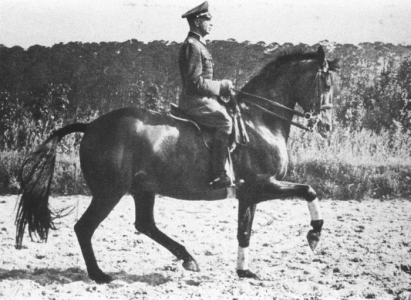
I think in the 1935 Berlin Olympics, all the equestrian medals went to Germans, to military riders. Their medal winners were killed in the war. The rider who survived was General Felix Burkner whose autobiography. Ein Reiterleben, I treasure (A Rider's life.) He survived World War 2 because one of his grandparents had some partly Jewish ancestry which removed him from active service as a General and also prevented his appointment as Director of the Spanish School in Vienna.
It looks like a ferocious bit? But they used to ride in an indoor school at the weekend with their wives and children
1742157154104.png
 
  • Like
Reactions: SEL
You see that's an interesting statement, that's it just simply balanced
first (sorry, dont seem to be able to quote!). because what does it mean? My understanding is that both schools end up with a balanced horse but it's about the how you get there and actually what you physically do on the route to achieving that.

No offence but there's a lot of terms banded round about balance, feel and "leg to hand" etc and I really struggle with what is physically and practically going on. Because no professional is riding around with no contact and not doing anything and magically the horse is improving, they're doing something and it's exactly what that something is that I am thinking maybe a bit more reading about these different methods might give me some enlightenment (or at least something to think about!).


Could you research the school of lightness , l ecole de legerete., for further reading on the French school
 
Have seen new forest pony competing at a very high level in france, he was trained at cadre noir, he was actually quite narrow between the front legs, lovely mover

Some we had years ago were very good movers
I have found them to move beautifully when suppled up, my current one went out to dressage for her first time and got 1st and 2nd with absolutely fantastic comments. But I find they suit the French school with more suppling work to create engagement rather than the ā€˜just ride it forwards into the bridle’ approach.
 
I have found them to move beautifully when suppled up, my current one went out to dressage for her first time and got 1st and 2nd with absolutely fantastic comments. But I find they suit the French school with more suppling work to create engagement rather than the ā€˜just ride it forwards into the bridle’ approach.


Oh well done maya !
 
Interesting thread. I have found out very recently in my whole life of riding how there’s been such differences.

I was born and grew up in Germany for example we were taught a leg yield by ā€œpushingā€ the horse placing more weight on the opposite seat bone of direction of yield (so if you want your horse to yield to the left you are pushing with the right seatbone) and I believe this is taught differently in other traditions :)

I don’t think I now follow a certain way. I am not one for following certain methods all along but adopt things as I go along if they work for my horse she is my teacher now
 
Have always been interested in the French system and exploring it more but have lacked an in person instructor.

The person I normally have lessons with is more classical leaning than competition dressage leaning (ie no hauling in of the head and riding mostly from the seat… well that’s the idea!) but I’d still say what we’ve done is closer to the German style than French.

I can read around a subject, watch videos etc but I can’t ā€œgetā€ something and do it truly correctly without watching it in action in person & then having someone there in person to help me correctly apply it to my horse and correct all the subtle little things that I’ve missed (I’m also crap at spotting such things ā€œin the momentā€ without them being pointed out that I probably would spot myself on video or photos)
 
I had a weekend clinic as an introduction to the Philippe Karl "School of Lightness."

What a revelation, for the first time I and my horse seemed to be working from the same page, willingly and with understanding, rather than the previous "Oh, I suppose if you insist I'll do it."

And we had reasonable competition success and several nice instructors, it just all seemed a lot of hard work, for both of us.

Trouble was, there were no local instructors and by that time my horse was in his teens, and I decided that to change the system - but not the desired outcome - I would need guidance and shortly after I stopped doing much dressage due to physical reasons. However, I decided that if I ever had another horse this is the method I would go.

I have read Philippe Karl's books, and they are entertaining and also describe why this method is better suited to the non warmblood. (He acknowledges that the warmblood is suited to the German method). I liked the story of the little horse being schooled from scratch and ending up doing Spanish walk and piaffe and show jumping, with its ride being instructed from the ground, not schooled by an "expert."
 
Top