Good jumping hands

little_critter

Well-Known Member
Joined
20 June 2009
Messages
7,271
Location
Somerset
Visit site
What are your hints / tips / visualisations for giving a correct release of the rein when jumping?
(I will of course be having lessons, but sometimes a phrase or visualisation is the lightbulb moment)
I have a tendency of not releasing the contact over jumps, then when I think hard about releasing the contact I tend to drop the horse in front of the jump. I just can’t get the timing / flow right.
Bear in mind I’m only jumping dinky stuff at the moment, but I don’t want to upset my horse.
 
I find this happens most when the rider stands up in the stirrups/thinks about gong forward as opposed to shoving the bum back. When jumping by shoving the bum back the lower body automatically stays stable and the upper body comes lower and forwards. It is in balance. The hands automatically release.

The other way is duff and not independent, and the rider can't release.
 
It's not easy to help without a broader picture of what you're doing. if your basic position over a fence is correct, you are not using the reins to balance yourself, and you are secure, then the release should come pretty naturally, and you won't need to actively do it If, as I suspect is the case, you are relying a little on the reins to keep your balance, you're not going to find it easy to release.
If you're happy that you are balanced and secure, you are allowing your hips to slide back, and your uper body to fold, then try carrying your hands wide, with your arms very soft (particularly the elbow), and the horse should take your hand forward, rather than you having to make a conscious effort to push your hands at his/her mouth.
just having light hands, and soft arms is usually sufficient if you're just jumping dinky stuff.
 
I ask riders to soften their hands, I remind them on the approach and it works to help them release their elbows and open the fingers a little rather than dropping or throwing the reins up the neck, if the jumps are smallish and the rider secure that should be more than enough freedom for most horses, I think the exaggerated release can put horses off if the timing is not perfect and anything ungenerous may take the opportunity to duck out.
 
I usually grab a bit of mane mid neck for the first few jumps with a new horse or if I haven't jumped for a while. It helps me get a feel for how much the horse is going to extend his neck and avoid jabbing him in the mouth if I get caught out with timing/striding.

You can also do some schooling in 2 points without jumping to make sure you are balanced in all gaits and less likely to rely on your hands.
 
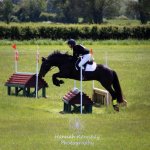
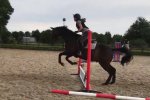
A couple of examples. The one on grass was 3 years ago on my super safe girl. The one in the school is the new boy who tends to need more checking / steadying and it’s clear I struggled to switch from steadying to releasing.
I’ve done very little jumping in the last 2+ years. I spent this evening walking / trotting / cantering over poles and reminded myself how uncoordinated I am when poles are involved!
I have a lesson tomorrow so hopefully my trainer will give me a good boot up the arse!
 

Attachments

  • 1E6D1348-3E98-4A4E-B24B-7AC82963E5FB.jpeg
    1E6D1348-3E98-4A4E-B24B-7AC82963E5FB.jpeg
    177.6 KB · Views: 32
  • D895B473-1741-4CD8-B6C0-F8D7D64B27F5.jpeg
    D895B473-1741-4CD8-B6C0-F8D7D64B27F5.jpeg
    116.2 KB · Views: 31
I try not to think about folding in front of the jump and instead about allowing the horse to jump up towards me. I found when I started jumping that if I thought about folding I would just close my shoulders over my hands, not releasing at all.

So think about the horse coming up to meet your body and keep your elbows soft on the approach. If you are struggling with the timing, try coming towards the jump in your 2 point (provided your horse is calm and genuine). From your 2 point position you won't need to do anything as your horse picks up - he will jump up to meet you! It can help to rest your hands on his neck when you first start to avoid catching him in the mouth.

The other thing is that it just takes lots of practise and experience jumping...so I wouldn't worry too much as I generally found the more I practised the better my seat got and the better everything got - that includes hands, heels, lower leg and shoulders.
 
A couple of examples. The one on grass was 3 years ago on my super safe girl. The one in the school is the new boy who tends to need more checking / steadying and it’s clear I struggled to switch from steadying to releasing.
I’ve done very little jumping in the last 2+ years. I spent this evening walking / trotting / cantering over poles and reminded myself how uncoordinated I am when poles are involved!
I have a lesson tomorrow so hopefully my trainer will give me a good boot up the arse!

I think your position in the first one is good! Overall I think you look really stable and your horse is stretching his neck out nicely (I am not an instructor but just done a lot of critiquing of my hands over the years!).

The second one you are just standing in your stirrups and your bum is too far out the saddle - but it's not easy as the horse is jumping quite awkwardly and also it's a lot harder over such a small jump as they don't make a good shape that's easy to follow. So for this I would think about doing a lot less - shift your hands forward slightly and allow the horse to come up to meet your body, but you don't need to drastically change your position at all. You will be much more stable on a speedier horse if you think about keeping your bum closer to the saddle and allowing the horse to jump up to meet you.

Also do lots of grid work!! Including bounces. I find best for position (and great on speedier horses too) is trot into a line of crosspoles set as bounces - here you don't need to do anything! Just have your hands slightly forward and a light seat (provided your horse has some experience with bounces he should sort you out). At the end have one stride then a vertical, and once you're used to the grid and horse is confident this can be made into an oxer to encourage a bigger jump. This lets you sit up and get ready for one stride after the bounces and your timing will improve as there's no almost no change you'll have the wrong stride. Have someone video you!
 
Thanks everyone for your comments. Our lesson today switched from "calm introduction to jumping (for the horse) to sorting out my position. I was expecting Theo to get in a tizz as he's done previously, but I think I've overdone the calmer and he was a bit too chilled out! So lots of focus on poles / tiny jumps and getting my bum back and my hands and feet forward. I still catch myself doing crap hands but it was improving.
 
I find this happens most when the rider stands up in the stirrups/thinks about gong forward as opposed to shoving the bum back. When jumping by shoving the bum back the lower body automatically stays stable and the upper body comes lower and forwards. It is in balance. The hands automatically release.

The other way is duff and not independent, and the rider can't release.
You hit the nail on the head. My instructor said imagine every jump you go over is a drop. You need feet forward and bum BACK!
I need to channel my inner Peter Scudamore!
 
Ruby Walsh / AP McCoy then? I’m not very good on NH jockeys.

Back in the day I would give you Scu but these days he is more suited to a western approch lol! McCoy was most definitely one of the best jockeys to have ever lived. Quietly and confidently putting horses into fences making it all look effortless most of the time.
 
Top