How exactly can a horse be a bully?

Enfys

Well-Known Member
Joined
11 December 2004
Messages
18,085
Visit site
Further to the 'Facts - deal with it' thread earlier, and a subject touched on there, can horses indeed be bullies (for want of a better word to describe it) or are we just mistaking normal behaviour for such?

One quote was:

" I cringe whenever I read posts about horses being "bullies". Its just wrong. How exactly can a horse be a bully."
 
Further to the 'Facts - deal with it' thread earlier, and a subject touched on there, can horses indeed be bullies (for want of a better word to describe it) or are we just mistaking normal behaviour for such?

One quote was:

" I cringe whenever I read posts about horses being "bullies". Its just wrong. How exactly can a horse be a bully."

Some horses are dominant in some situations, some less so.
'Bullies' is just a word.
There's a whole heap of anthropomorphism on here though, and idiots who think horses are like giant cuddly toys to be cuddled and loved, and if you just love them enough everything will be alright.
Such idiots often have horses called 'Teddy', 'Thumper' or 'Pooh'. :D
S :D

PS Now I'm going into hiding :D
 
Well, I define bully as anti-social . . . so, yes, by that measure I think some horses can be bullies. Unable (for whatever reason) to form amicable relationships with other horses . . . overtly aggressive, domineering . . . hell bent on hurting other horses, for whatever reason (see my post in the "Facts" thread).

It isn't a judgment statement . . . it is just a way of characterizing what is.

P
 
Well, I define bully as anti-social . . . so, yes, by that measure I think some horses can be bullies. Unable (for whatever reason) to form amicable relationships with other horses . . . overtly aggressive, domineering . . . hell bent on hurting other horses, for whatever reason (see my post in the "Facts" thread).

It isn't a judgment statement . . . it is just a way of characterizing what is.

P

That describes my 'bully ' exactly , bully is just a word you could say inappropriate dominant behaviour but bully is easier to type.
 
Depends what definition of 'bully' you are using, as the UK has no legal definition.

First definition online:

One who uses strength or power to harm or intimidate those who are weaker.

Using this definition, and this alone, yes horses can be bullies. Find me a different definition and my opinion may vary :)
 
The term 'bully' is a human concept whereby people think vindictively about another person. In relation to animals (horses), they display natural herd hierachry (SP?) and instincts. Their ways of discipling others of their herd can be deemed as bulllying if we humanise the animals
 
The horses Ned's kept with at the moment bully him. They don't hurt him or starve him, so it's fine for the moment. They just intimidate him, group together and herd him around, tell him where he can go and if he can leave the pen, I have to chase them away if I want to get him out. They're all from the same herd, Ned was not, so I guess it makes sense that they'd exclude him.
He's fine in there with them, but you can see his expression and body language change instantly when they look at him.

Also, I know 'bully' is just a word. It's much easier than saying 'natural herd dominance' or whatever :P
 
Some horses are dominant in some situations, some less so.
'Bullies' is just a word. Absolutely

Such idiots often have horses called 'Teddy', 'Thumper' or 'Pooh'. :D
S :D

Haha! I have just waved Farewell (and Good Riddance if the truth be known) to a horse called Teddy. I think someone was having a joke when they christened him that, Gnasher would have been more apt :D
 
My horse has been branded a "bully" but it's what I would call dominant behaviour (towards other horses, never to people). I agree with what others have said, in that it's easier to put "human" labels on animals behaviour than explain it in animal terms or try to understand it fully (which some owners are guilty of!)
 
Haha! I have just waved Farewell (and Good Riddance if the truth be known) to a horse called Teddy. I think someone was having a joke when they christened him that, Gnasher would have been more apt :D

Love this , complete Pratt would be the better name for my teddy .
 
My mare definatley senses weakness in people and other horses. She is a pain in the backside for less experienced handlers (I have seen her drag more than one person and she also chased my livery mate out of the field and attempt to double barrell her) yet she knows I will not tolerate this behaviour and has never actually tried it.
I have to keep her seperate from her ex fieldmate for the same reason, she was constantly chasing, pulling faces, kicking out, generally terrorising the poor soul (who, may I add never once fought back) we even struggle to ride them together because she spends the whole time trying to bite or kick him, yet I ride her with another mare and shes fine (they both have a little squeal and buck if we have a canter but I think thats more excitement than her wanting to kill our companions :o)
If horses can be classed as bullies I'm pretty sure my girl is one as its always 'weaker' horses/people.
 
The horses Ned's kept with at the moment bully him. They don't hurt him or starve him, so it's fine for the moment. They just intimidate him, group together and herd him around, tell him where he can go and if he can leave the pen, I have to chase them away if I want to get him out. They're all from the same herd, Ned was not, so I guess it makes sense that they'd exclude him.
He's fine in there with them, but you can see his expression and body language change instantly when they look at him.

Also, I know 'bully' is just a word. It's much easier than saying 'natural herd dominance' or whatever :P

That is just natural herd behaviour. Ned hasn't been accepted yet..

We had one mare on DIY that is what I would truly class as an equine bully (in 40yrs of being around/working with horses). She would attack other horses for no reason, and rip strips off their rugs. I once watched her get hold of one of the ponies manes/crests and hold onto it for the full length of the field, despite the other horse trying to get away and being submissive. She was a funny piece of work.

Bully is an adequate term if it covers the characteristics shown and people aren't confused with the herd behaviour that is normal.
 
IMO (and look where this has got us) if an animal can be a bully then they have a sense of self worth. If a dog showed the same behaviour as some of the horses mentioned they would be deemed "poorly socialised" or that they were just sorting out a hierarchy. I think it's a way of people describing something they don't have a word for.
 
Mine is dominant when she can get away with it. Bully? Yeah, I think she can be.
She was in a very large field a few years back and another horse was grazing, not looking at her or anything - mine had taken a dislike to this one - and she just charged across the field and chased her away. She also used to pick the Shetlands up.
IF a horse gets dominant with her, she's very quick to back off, but if she can be dominant, she'll go for it.

She's quick to either like or dislike another horse.
 
My little colt is out with 2x 16hh+ WB geldings they push him about and his sometimes allowed in but most of the time his on his own.
People say its sad he doesn't have a friend and his bullied but I think he has to learn respect and that's best learnt in the field by other horses.
He is a massive pest as well - he knows his bottom of that pecking order but thats where he should be.
It's natural IMO.
 
My friends cob is a bully. She was 3rd out of 4 in the herd hierachy but would dominate the one below her far more than necessary to assert her dominance. The 2 above her did not act towards her as she did the one below her, chasing, kicking out biting, constantly harrassing her.

When the cob tried to take over the number 2 spot she was removed from the group as she was constantly running my old gelding around the field lashing out at him with both barrells everytime he stopped to eat, drink or poo.

Funnily enough the cobs owner thinks she is some kind of giant teddy bear. When she corned the old mare at her new field and was double barrelling her my friend ran and got a bucket of feed to get the cob away and in doing so gave her a reward for her behaviour without thinking. Friend says she thought the cob would have killed the old mare she was going so crazy at her. Bully cob now has an individual paddock and only bullies her owner.
 
I think that often yearling, 2 or 3 yrs old colts or geldings when out together can be known as 'thugs'.
They push, shove, bite and kick and generally try to stamp their authority over each other, occasionally it occurs with older animals in herds too.

I've had a lot of thugs over the years :o (and plenty of pleasant fuzzies too)

Big Fuzzy can be a thug at times (over food) but so can I too :D
 
I think that when people see a horse using dominant behaviour, it's often refered to as bullying. An anthropormorphic reaction perhaps, but, within the dynamic of a herd situation, perfectly natural behaviour.

The stresses imposed on many domestic horses in the management style we sometimes have no option but to employ, ie, an ad hoc number of horses of differing ages, sexes, types even, unrelated, expected to live together in a fairly confined space, may sometimes give rise to a horse which is exhibiting behaviour of extreme dominance, over and above what may be normal in a natural herd.

Horses do tend to fall into three types, a lead, always a mare, a dominant horse, can be a mare or gelding, (always a stallion, in a natural setting), and passive horses, the majority.

A lead mare is a fantastic horse to own, dominants can and will use this behaviour in their interaction with humans, this is where a lot of problems arise, particularly if you try to out dominate them, or react passively toward them. Fortunately most horses are the passive majority.
 
I think that when people see a horse using dominant behaviour, it's often refered to as bullying. An anthropormorphic reaction perhaps, but, within the dynamic of a herd situation, perfectly natural behaviour.

The stresses imposed on many domestic horses in the management style we sometimes have no option but to employ, ie, an ad hoc number of horses of differing ages, sexes, types even, unrelated, expected to live together in a fairly confined space, may sometimes give rise to a horse which is exhibiting behaviour of extreme dominance, over and above what may be normal in a natural herd.
Agree entirely with this.
 
Agree entirely with this.
Seconded. PR's point about domestic management is a very good one.

(However, as you'd expect, I disagree with PR's calling the dominant mare the 'lead', as this may be a different horse. Leadership and dominance are not the same thing.)

It is of course possible to single out certain horses whose dominant behaviour seems inappropriate or OTT, and who, at the risk of being anthropomorphic, could be called 'bullies'. I think that's an attribute displayed by individual horses. As an illustration of this, I have known groups of horses living outside together where there was seldom any dominance behaviour to be seen - and yet dominance was still a present force (particularly evident when hay was put out in the winter or feed in the summer). However, when another dominant mare was added to the herd, the level of kerfuffle increased markedly due to this mare going after others at the slightest (or no!) provocation. I would have no hesitation in calling her a bully for her plainly unnecessary -- except in her eyes, I suppose -- shows of dominance.

Given the existence of a linear hierarchy, there presumably was a most-dominant mare before the new one was introduced. Yet the herd dynamic was completely different before versus after. Why? I personally would put it down to the more aggressive temperament or 'personality' of the new mare. It's not just the fact that one horse is always dominant; it's how the dominance is manifested.

So while it would true to say that the behaviour of the 'bully' is perfectly natural behaviour (even if the underlying cause may be due to management as well as genetics), it is also true to say that non-bullying behaviour is also perfectly natural!
 
I disagree with PR's calling the dominant mare the 'lead', as this may be a different horse. Leadership and dominance are not the same thingQUOTE]

Agree with this.

My 22 year old stick insect of an arab mare is the Leader in that where she goes, the others follow in an orderly fashion. She is, incidentally, middle ranking in a herd of about 12 mares.

248397_133985843346529_100002053418084_229694_4414299_n.jpg


(Stick insect at the front, Paint is at the back with her colt and best friend behind her)

The Dominant mare is a 10 year old Paint. She is invariably way back behind when they move along, yet when she comes along she merely has to put her ears back and her head out and the path clears - immediately, if Robin says she's coming through they get out of way - fast! She rarely resorts to more than pinned ears or a nip unless some upstart attempts to usurp her position and then not many argue with her.
 
Last edited:
Nice example, Enfys!

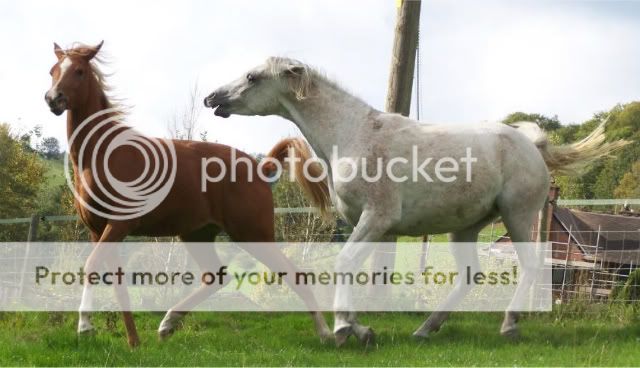
Faracat - What provoked the aggression in the photo? And was it a one-off? Without further info, I would guess your grey is a bit of a 'bully'.
 
Faracat - What provoked the aggression in the photo? And was it a one-off? Without further info, I would guess your grey is a bit of a 'bully'.

She's just putting him in his place and didn't actually make contact with him at all. They are best buddies really and 99% of the time all is sweetness and light between them. :)

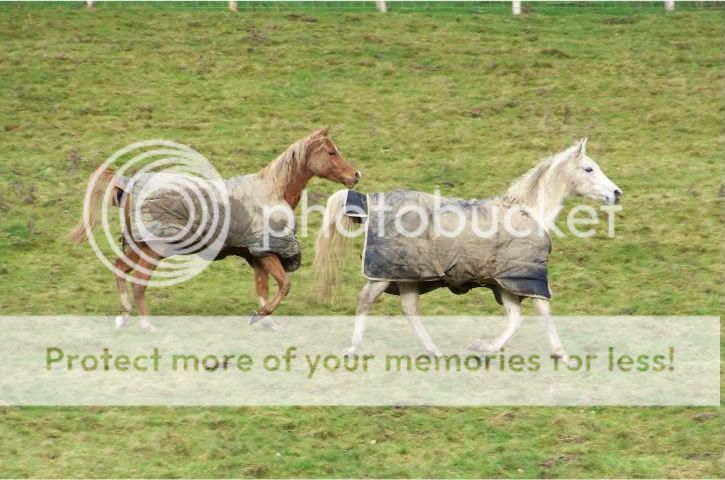
100_2074.jpg


If he moves away when she pulls a face at him, then that's the end of it. I would call it normal horse behaviour.

It's quite a good photo though as she's got the most awful aggressive expression and he was doing the 'I'm only a baby' mouth snapping thing - so it looks far worse than it really was. I'm still amazed that I managed to catch the moment as my camera has an awful delay between pressing the button and it actually taking the photo.
 
Top