How to you decide what footing is ok when out hacking?

feesh

Well-Known Member
Joined
24 September 2021
Messages
98
Visit site
Help! How do you, in actual real life, decide what footing you are willing to ride on?

Around here, the people I know who trail ride pretty much only do so on what amounts to groomed trails: soft dirt, mowed grass, maybe the occasional puddle or a root across the path, but nothing rocky or very muddy or uneven. And on the other hand, I see videos of people hacking or hunting in the UK, going full tilt through mud and rocks and holes. I assume the sensible approach is somewhere between the two, but I really don't know how to judge what that is. I remember Pony Club books saying things like "do not work your pony too fast in very deep going"... but never any guidance on how deep is too deep.

So: What are you willing to ride through? Where do you draw the line? How muddy is too muddy? How rough is too rough? If it varies (eg horse at a certain level of fitness), how do you judge when it's ok? What are the variables?

The land I'm riding on has a huge variety: an assortment of grass fields (lots of small lumps but mostly flat, smooth but all a hill, flat but boggy), a bunch of fields that were planted and are now fallow - some were rolled and packed, some were disced, and some were just plowed and still have huge furrows. The one that was rolled & packed has the best footing, and is the largest and the only space that's really suitable to open up for faster work - but it's still pretty soft, and it doesn't take much rain to be sinking the full dept of a hoof (or past the fetlock in the boggier parts). There's also a dirt road through the forest with a lovely grassy middle, but very deep tire ruts. Some of the fields likewise have a nice grassy strip around the edge, but you're riding only a foot or two away from a very deep furrow. I've made some nice routes through the property, but I'm always second-guessing myself about whether I should change my route in wet weather, or whether a new route over there is worth it. Any and all advice is welcome!
 
Okay for what?

At walk, so long as they're not baws deep in a bog or falling over, I'll ride over whatever. That depends on the horse. My Highland can stay upright on stuff 99.999999% of domestic horses would be upside down on. If I'm really not sure, I'll get off and lead them.

My PRE should be doing as much fast hacking as possible, and I spent my life staring at rocky trails, wondering, 'how many rocks are too many rocks to run over?" Because every trail where we live is rocky, so you just have to decide the level of shight you think is safe for faster work with your particular horse. I know that is very unhelpful.
 
I don’t do fast hacks but I do do ‘alternative’ routes through the woods where we will walk over / through uneven ground, roots, small steps and banks, even picking through scattered small branches on the ground.
I think walking on a variety of ground is good for the horse, teaching them to think for themselves and be aware of where their feet are.
I am however picky about trotting or cantering on iffy ground. We have lots of tracks that are 75% inviting canter track 25% random patches of brick or rubble. I won’t do more than walk on them because I don’t want to be cantering on nice footing then wham you’re on a patch of very hard rubble.
 
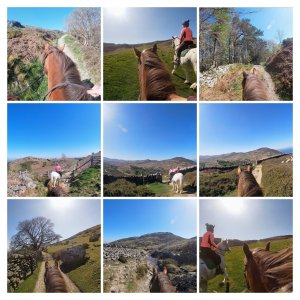
I'm in North Wales, UK and there is nothing in the way of flat countryside, bridleways, indoor schools, or man-made type trails here; our local mountains are very steep, rocky, sometimes like a stream bed with water rushing down it, boggy, ditches, gates, wild ponies, sheep, ford crossings, and generally very uneven ground. In some places, when the ground is dry enough we canter... my pony is a native to this country (Dales/Welsh) and will tackle anything. If I think its too extreme or he says no... I just get off and lead. It isn't fast riding but it is good for fitness and creating a trust bond. Horses are four-wheel drive so should be able to cope with a challenge! That said, its the ponies and cobs that do better on this terrain. Also, some barefoot horses struggle round here; Goose is better shod on the front (rear ok barefoot) and I think he's more confident with the ground in general with his shoes on.
 

Attachments

  • Screenshot 2025-04-09 at 15.36.52-COLLAGE.jpg
    Screenshot 2025-04-09 at 15.36.52-COLLAGE.jpg
    568.6 KB · Views: 56
Depends on your horse and how clever they are - my current connie is brilliant compared to previous warmbloods. But unless the going is not too lumpy, boggy, stony, steep I would walk. I only do fat work on good going and I wouldn't risk him hunting. ! I also think they learn so a clever horse that is fit and has always been riden on a type of surface will do better. I went to the beach with my friend on her warmblood and he struggled in soft sand - mine felt like he was pinging off the top - were were only walking but by choise I would have walked a bit slower but he said nooo, its fine! If we are going downhill and it gets slippery, he takes more careful steps of his own accord.
This horse is a unicorn and I'm not so young and need his legs to last me forever
 
It depends what the horse is used to. When I got my ex-racer, (flat) he was APPALLED at the idea that he might have to get his hooves muddy, and was frankly dangerous going faster than a walk on less than perfect ground. Now, after years of turn out on a rough hill side and quarry, and many many miles of hacking over all possible terrains, he feels quite safe to have a hooley ride over the moors, which include lumpy, stoney, rooty, boggy etc . This obvoiusly has helped his XC jumpng immensely too.

Wierdly I have a fear of galloping flat out on the beach though, because it can go from miles of firm to a very soft patch for 2 strides and back to firm again. I worry that at a very fast pace, his tendons wouldn't cope with the sudden change. Our beach has lots of rivulets so even at low tide the surface can change.
 
Personally I am totally precious about ground and footing, my horses soundness is a total priority, I want to develop the horses movement over years so bruising, injury I dont want

I would never take them hunting and very often inspect any ground I canter over, but we have land here to ride on and I mark out places I have walked over and checked for rabbit holes and stones

Where I am is pretty flat anyway
 
I'm willing to go through most terrains with certain horses, as long as it's not open mountains/stones where it's both high up and very slippery, or muddy enough that the horse might actually get stuck. Our adventures usually involve me getting off and walking in front of the horse if it's too difficult for the horse to navigate safely with me on. I'm not keeping a horse that isn't safe to take everywhere like that, even though it does take some training to get there.

The exception would be my Standardbred mare, whom I've had for close to nine years. She's terrified of water and reacts by dramatic attempts at flying if she gets scared of the ground. It's not safe nor worth it to take her out in the wilderness. I've tried, she doesn't get used to it. She stays on roads and safe paths, where it's not dangerous if she is dramatic.
 
My darling Connie hated getting her feet wet. Since there was a possibility that parts of the track were completely under water in winter, I obliged her to walk through one puddle on each hack.
One lesson learned was that where there is a puddle on the track, there is often hard footing under the water. On really soft ground, the water drains down through the mud.
This was all long ago as our entire riding track was eventually relaid with gravel and sand, getting rid of the puddles and allowing long canters. But also removing the need for step by step steering of ones horse.
 
It's very much a "how long is a piece of string" question.

My highlands (and, before them, my cob) were sure-footed over any terrain. I'd canter them on ground I'd hesitate to walk some horses on. They would cruise through water up to their necks, splash through snow, mud and puddles, up and down steep ground without a thought. My mare less so, and I was much more careful about where I took her.

It also depends on the nature of the ground - not all mud is equal. Some mud is slippery, some is deep and holding, some is deep but wet and splashy - I'd treat them all differently. Some hard ground is stoney, some cracks, some has a spring even when it's solid - again, you wouldn't tackle them in the same way. Those sorts of differences aren't always obvious on videos / photos, but if you know the area, you generally have an idea what you're riding on.
 
but if you know the area, you generally have an idea what you're riding on.
This is very true. But the maths are complicated. I have ridden the same tracks for ca 25 years so know it well. And all year round. But the horse's knowledge may be more recent than mine. She is an RS share who may go round that track three times a day so she knows today's surface better than I do because she has already been round it.
 
This is very true. But the maths are complicated. I have ridden the same tracks for ca 25 years so know it well. And all year round. But the horse's knowledge may be more recent than mine. She is an RS share who may go round that track three times a day so she knows today's surface better than I do because she has already been round it.

Naturally, I was talking about my own horses who are never ridden on the same tracks multiple times per day, and not by other riders. If anything, my own experience might have been more recent as I may have ridden that particular track on another horse earlier that day (though as a general rule I tried to avoid that, just for variety).

If you're riding a horse that isn't your own, there's a whole other range of questions about what it's appropriate to do with a horse that is less familiar to you, that doesn't belong to you, and that others also ride. I'm not sure that was the OP's question though.
 
My coblet is now 21 and we have crossed all terrains at all speeds. I have always evented so quite used to making dynamic decisions about the going and my pace, then got a bit bolder hunting when I realised this pony has the most incredible mountain goat-like balance. He is trustworthy and won't allow himself to be pushed beyond what he can handle (which is mroe than my nerves, often). The only ground he is not fond of is claggy mud so we walk/gentle canter (gentle canter much easier for him no claggy than a trot). I avoid deep terrain as in "ploughed" but don't mind deep mud with care. Uneven is fine; rabbit holes he is excellent at spotting but I will only walk if I think there might be holes about as it's not worth the risk. My horses live out on a hillside in summer, so they are three dimensionally fit and active and know to how to handle the ground as the seasons change, holes appear, etc ... Buy by 16.2hh ISH is only just becoming reliable despite having the same start as the cob. The cob is a natural. The ISH needed more time ... and I still wouldn't trust him not to step in a hole (and spook at it and fall in a ditch or something),.
 
I would trust my forest bred Chief over any terrain - his instincts are so good that he can tell a bog/clayhole/deep rut at a good distance (and how to avoid such like). Shame that due to English Nature's new rules his carriage can only use enclosure tracks/roads, rather than my previous ponies being able to go anywhere on the open Forest we could physically reach. When I see the damage that mountain bikes cause out there it makes me feel very unfairly treated 🤣 🙈
 
If I think its too extreme or he says no... I just get off and lead. It isn't fast riding but it is good for fitness and creating a trust bond. Horses are four-wheel drive so should be able to cope with a challenge! That said, its the ponies and cobs that do better on this terrain. Also, some barefoot horses struggle round here; Goose is better shod on the front (rear ok barefoot) and I think he's more confident with the ground in general with his shoes on.
Exactly the same here on the North York Moors - my cob is barefoot so I do put Scoot boots on all round so it's easier for him to cope with rubbly, rocky bits. I'll ride him (slowly) over more or less anything except bog, and as above I will just get off and lead if he's really not confident about something. I usually carry a lunge line for situations where I need to get off an encourage him over something I can't wade through / jump alongside him - I clip the line on, I go first and then I encourage him to follow me once I'm in a safe spot out of his way.

It's a totally different kind of riding really - less "riding" and more "adventuring with your horse".
 
I used to do a lot of riding on a beach and we were very careful about where we did any fast work. The sand had to be hard packed, if we strayed into a soft patch we'd slow down right away to avoid any wrenched legs.
Now I am hacking out on the moor we have been a bit constrained by how relentlessly wet it has been this winter - there is still good going to be found but many places are still too soggy.
 
Similar to @congrat my ex flat horse was horrified the first time we hacked round the edge of a field and the weeds had the temerity to touch him. He was used to pristine gallops and tracks. Can remember trotting round the edge of a field and a pheasant spooked him, he went onto the deeper ploughed field and really could't cope at all with not being on firm ground. Now he happily makes his way through overgrown tracks but he really doesn't get on with muddy tracks with tractor or quad bike tracks, so we avoid those when they are slippery. I don't trot on hard tracks and uneven stony ground.
 
I think it depends a lot on what the horse is used to. My Connie's are generally born and bred on the hills of Connemara and have always been fantastic on all types of terrain. My old boy, now 22 sees a bit of rough going as a challenge, he loves it. However I still try to be reasonably sensible and wouldn't go fast on hard or very boggy ground or very stony ground. When negotiating rocks and boulders I let them pick their way through rather than telling them where to go.
My friend has two ex racehorses one is brilliant on this feet the other needs the ground perfectly level otherwise he falls on his face!
They are all individuals but it helps if they weren't born and bought up on a bowling green!
 
Thank you! This is all very helpful, although as noted, it's sort of a "how long is a piece of string" question!

It seems like for slow work, at least, I'm on the right track. I'm riding two share horses that had slowly become mostly pasture pets over the last several years, so I spent most of last year just walking over a route that was as varied as I could make it (so going over hummocks and through trees and over grass and logs and gravel and dirt, and through water - but not anywhere they seemed to really struggled, like through deep mud, or across the furrowed fields). They were both a bit hesitant over some of it to start, but they adapted really quickly. It helps that they're both quarter horses. Neither of them has experience with needing to be surefooted, so unfortunately I can't really trust their judgment, but they've got the breeding to at least have a sensible brain about it.

But... I really started second guessing myself once I started trying to add in faster work at the end of the season, and realizing that I had no clear guide for what is ok. The owner is not particularly helpful, as she tends to contradict herself (she'll be worried about a particular footing... and then when I say I avoided riding there, she'll say "pffff they have four feet. They'd've been fine!"), and she's very lassez-faire about what I do.

I think the two main things I'm trying to figure out are when/whether it's safe to do faster work along rutted tracks, and when the big field is muddy.

The tracks I'm riding on are (kind of) like this or this - basically there's usually a line you can ride, but there's also awful bits. I would run on it without question, and I've definitely seen people ride full tilt on ground like that, but I don't know if that is wise!

The big field looks like this or this, but these photos give a better sense of how muddy it can get at the wetter end. Right now, I'm only doing faster work if footprints are less than a couple of inches deep, stick to walk until we're sinking past hoof depth, and after that stay out. (I think? I'm mostly eyeballing from horseback, so I don't know if I'm being particularly accurate.) I have no idea if this is too conservative, too risky, or what!
 
At walk as long as it’s not a knee deep bog or a sheer cliff face then I’ll go over most things in walk on a horse with good control over their feet. (I don’t deliberately seek out horrid ground and will avoid places I know turn into unending bogs in winter but sometimes if you’re on unfamiliar routes you just have to deal with what’s there)

If it’s particularly rocky / steep then I’ll get off and lead.

As to what ground is ok to trot / canter on that can be horse dependent. Some can cope ok with a bit of mud and some absolutely can’t and it wouldn’t be fair or safe to ask them to. This can improve with correct training and muscling. (Also depends on any physical issues they have)

Generally I like a level, non rutted surface that’s not deep or boggy. (Ruts are one of my big no nos for faster work, although I’m ok with a flat bit in between tractor tracks) That can be grass, sand, limestone or gravel / grit. I prefer a slightly firmer mire level surface over a softer more uneven one. If it’s a random newly discovered bridleway then I prefer to have done it at a steadier pace first before going flat out just to make sure it’s safe (or to be in the company of someone who knows the ground), if out hunting or competing in TREC then the ground will (should) already have been checked for hazards.

Sometimes the best way of knowing is to ask the horse the question in a sensible way (ie steady trot or canter first before moving up the gears) and see how they feel. If they don’t feel happy / are slipping and sliding around then pull up.
 
To an extent it depends on the horse. Some of mine are much more sure footed than others. Breed determines foot shape and that affects their grip and ability to cope on different terrain.

I listen to my horse (pony) and assess how they feel under me. In general I teach the kids to watch for stones, darker patches of ground, reedy looking grass, and to trot a trail we haven’t been on recently rather than canter. We don’t go faster than walk in mud - none of mine are shod, might make a difference? Young ponies we teach about uneven ground with older friends to demonstrate and are more careful due to their less developed muscles. I do canter on less than flat grass and they know the trails so we can jump over dips and move to flatter parts between tractor ruts etc.
 
At walk as long as it’s not a knee deep bog or a sheer cliff face then I’ll go over most things in walk on a horse with good control over their feet.

This can improve with correct training and muscling. (Also depends on any physical issues they have)

(Ruts are one of my big no nos for faster work, although I’m ok with a flat bit in between tractor tracks)

the ground will (should) already have been checked for hazards.

Sometimes the best way of knowing is to ask the horse the question in a sensible way (ie steady trot or canter first before moving up the gears) and see how they feel. If they don’t feel happy / are slipping and sliding around then pull up.

Thank you! These bits in particular are very useful. I do always walk a route before riding it, sometimes with flagging tape, because it's all old farmland, and you never know when you'll stumble on sheet metal or barbed wire or broke-glass-and-rusty-can piles.

I've listened to the horses as much as possible so far, and it's definitely been very helpful, they've both been trained to listen to their rider over their own judgment in ALL circumstances, and they both have shown that when it comes to speed, they will frequently choose wheeeee! even with deeply inadvisable footing, if it's up to them.

I've definitely found that more fitness has been making them more surefooted, but I think part of why I'm asking is that I'm finding a bit of a chicken-and-egg situation where I'd be a lot happier doing fast work on the ground we have if they were fitter... but the ground we have is the only place I can do the work! We've been muddling along, but it's definitely a muddle!
 
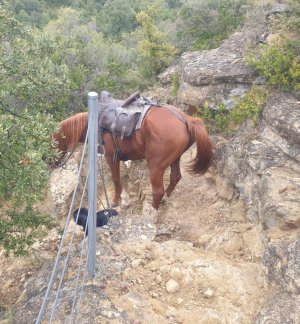
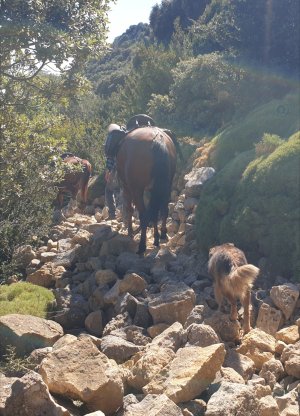
Not the best photos but the horses on my riding holiday a few years ago took surefooted to another level, though granted only without the riders to interfere!
They grew up on the terrain though. You need to know your own horse and what they are comfortable with (and how sensible they are!) my old gelding was fairly sensible and would decide what ground conditions he was ok with and what pace he was happy with, and I knew I could usually trust his instincts. Logical human brain had to engage occasionally though if something was exciting.

1000029887.jpg
1000029889.jpg
 
Not the best photos but the horses on my riding holiday a few years ago took surefooted to another level,
We had the same thing on precipice trails in the USA. The horses and mules walk down right on the edge. We were told that it is because horses can see that there is no predator lurking between them and the cliff wall, but a mountain lion or coyote could be hiding just over the edge so the horses always walk to the outside to see over the drop.
My first experience of this was in the Rocky Mountains. I am not good at heights and I was scared. I thought it was my novice, crooked riding that was pushng the horse to the edge.
 
I have noticed that I am much braver with what ground I ride on compared to others on my yard. I have an Icelandic and have ridden Icelandics up mounts in Norway, on terrain that’s tricky on foot. So I know she’s very capable and will and can go almost anywhere. I don’t go fast on tricky terrain, though.
 
Ive ridden over all sorts of terrain on a variety of horses, and as others have said if they aren't used to uneven terrain you have to build their experience with handling it.

Also if you want to trot and canter, sometimes you need to take advantage if the small stretches that are suitable and trot/canter 10 strides before coming back to walk, if thats all the space you have.

You get to do more than walk and has the added advantage of working on transitions.
Having a horse that is responsive to the leg so you can move over on a trail to avoid stones etc also helps.

As to what is too hard/soft I think that is relative. In Aus where the ground is as hard as tarmac for months, what I considered soft/suitable for fast work is very different from here where even in a dry summer is ground is generally still softer than Aus. But its linked to what the horses are used to working on. Fitness, tendons etc

The gold standard for going is old turf/grass, that has a good spongey layer of organic matter in the soil and a mat of grass to give the surface stability.
 
Last edited:
I'll walk on anything that I would walk on myself. That includes ankle deep mud if I know that underneath is solid. I have been know to get off and test ground on foot leading my horse, but that's when I've gone *ahem* off piste and therefore am unsure. I certainly don't stick to smooth ground. Round here we have a lot of illegal mountain bike trails and sorry to say my horse loves them, so I do let him go up the occasional one as a treat if it's not a busy time for bikers.
 
usually it depends on whether I think my hoof boots will slip on the ground or get sucked off by the mud! I tend to be quite hesitant on wet grass as years ago my horse slipped on of the wet with his cavallos! and I've never quite recovered from it! even 2 years ago when I was riding down a steep grassy hill with my mare in flex boots and it was actually my friends shod horse who was the only one who slipped!
 
Top