IBS/worms in horses - treatment

Joined
30 June 2022
Messages
19
Visit site
Short introduction to the case in question:
8yr tb gelding, not raced due to leg issue as a foal, a paddock ornament till 4. This guy came to me as a companion to my old ex-racer, and has turned out to be a whole 'nother rehab case.

The very first FEC came back zero, but the horse turned out to be carrying a heavy load of small redworms that don't really respond to the usual Pramox-treatment the way they should. Cue frequent colic episodes. The bloods revealed anomalies that pointed to IBS, and hence the diagnosis. We presume the prolonged wormload has done damage. The horse has also been treated for ulcers.

Over the past four years we have progressed to a point where we are mostly ok, though the worms (and ulcers) keep reappearing. He's recently had another course of steroids and a Pramox in the middle of it, and the droppings are ok('ish) most of the time. The only trigger I can isolate for a bout of IBS colic seems to be sunshine - we get the first sunny days and he colics. Nothing in his diet does this. His is forage based, spiked with small amounts of protein-rich balanced hard feed. And fennel.

What I'm looking for is something to repel the intestinal parasites. Strongyles are mostly now wormer-resistant, and they definitely don't knock these back to the degree they should, and there don't seem to be new anthelmintics on the horizon, so supplements it is. I can see the "natural options for harsh chemicals" on the market but do they work? Does anybody have any experiences they would like to share?

At present I've started adding a clove of garlic to his feed twice daily. He also gets joint supplement that has boswellia in it. The salt I've replaced with Black salt, and he gets fennel every day. I'm looking into Slippery Elm, but boy is that stuff expensive :oops: He almost definitely has hindgut ulcers again, but possibly the squamous type as well.

Thank you in advance 😊
 
I am afraid nothing will help repel them. The infestation occurs just by the horse picking up eggs from the pasture, rather than something attracting the worms to the pasture or horse to the eggs. There is also nothing that will prevent the eggs from hatching and the parasite continuing the life cycle in the horse. I recommend contacting westgate and your vet to look at an environmental burden reduction (poo picking mostly, but also careful pasture management).
Garlic is also toxic to horses (in larger doses and over time as an accumulated dose) and it has zero benefit to them so I wouldn’t bother with that
 
I did the Equibiome test with one of mine that kept getting high tapeworm scores. I know it isn't rated by some professionals but following the suggestions has really helped him. My saddler saw him just before Xmas and couldn't believe the shine on his coat. Added bonus is the Equisal test is now down to a v low score.

Many people start by adding oily herbs which aren't expensive. You might also look at marshmallow instead of slippery elm.
 
Does he have access to grass currently? If so my thoughts would be that the way the grass he’s on responds to increased periods on sun and how his gut then responds to that might be a possible trigger? If practical it may be worth trying him in a reduced grass / grass free turnout environment to see if this affects how he responds to changes in the weather?

Would second trying the equibiome test to see what they suggest and if those suggestions make a difference or if that’s not feasible then trying something like oily herbs & / or a gut balancer (see what your vet feels might be most appropriate) or even things like faecal transplants? (Where you basically give them poo from a healthy horse which in theory contains beneficial bacteria etc)

Speaking directly to somewhere like Westgate if you haven’t already also a good shout as they might have ideas about less commonly used wormers / how to resistance test and what to do next if resistance is suspected.
 
I am afraid nothing will help repel them. The infestation occurs just by the horse picking up eggs from the pasture, rather than something attracting the worms to the pasture or horse to the eggs. There is also nothing that will prevent the eggs from hatching and the parasite continuing the life cycle in the horse. I recommend contacting westgate and your vet to look at an environmental burden reduction (poo picking mostly, but also careful pasture management).
Garlic is also toxic to horses (in larger doses and over time as an accumulated dose) and it has zero benefit to them so I wouldn’t bother with that
I already poo pick daily. There is absolutely nothing I can physically do more.

I asked the vet shouldn't he be developing some sort of resistance by now? To be able to cope with them? I didn't really get an answer. I know this is something he has had since he was a foal (I know where he comes from), so this is not a new infestation. How much this is an auto-immune issue is still debatable, but since he is a lot better now than what he was 2-3 years ago I am optimistic.

I am aware of the garlic toxicity in the long term, I don't intend to keep him on them all the time. As I understand for them to have any toxic effect he'd have to get a lot more than two cloves a day.
 
Does he have access to grass currently? If so my thoughts would be that the way the grass he’s on responds to increased periods on sun and how his gut then responds to that might be a possible trigger? If practical it may be worth trying him in a reduced grass / grass free turnout environment to see if this affects how he responds to changes in the weather?

Would second trying the equibiome test to see what they suggest and if those suggestions make a difference or if that’s not feasible then trying something like oily herbs & / or a gut balancer (see what your vet feels might be most appropriate) or even things like faecal transplants? (Where you basically give them poo from a healthy horse which in theory contains beneficial bacteria etc)

Speaking directly to somewhere like Westgate if you haven’t already also a good shout as they might have ideas about less commonly used wormers / how to resistance test and what to do next if resistance is suspected.
Atm they are on a sand turnout - paddocks are too muddy/slippery for safe turnout, so no access to grass. The grass does seem to make things worse at times.
 
I did the Equibiome test with one of mine that kept getting high tapeworm scores. I know it isn't rated by some professionals but following the suggestions has really helped him. My saddler saw him just before Xmas and couldn't believe the shine on his coat. Added bonus is the Equisal test is now down to a v low score.

Many people start by adding oily herbs which aren't expensive. You might also look at marshmallow instead of slippery elm.
Thank you for the suggestion. Also, marshmallow??
 
Does he have access to grass currently? If so my thoughts would be that the way the grass he’s on responds to increased periods on sun and how his gut then responds to that might be a possible trigger? If practical it may be worth trying him in a reduced grass / grass free turnout environment to see if this affects how he responds to changes in the weather?

Would second trying the equibiome test to see what they suggest and if those suggestions make a difference or if that’s not feasible then trying something like oily herbs & / or a gut balancer (see what your vet feels might be most appropriate) or even things like faecal transplants? (Where you basically give them poo from a healthy horse which in theory contains beneficial bacteria etc)

Speaking directly to somewhere like Westgate if you haven’t already also a good shout as they might have ideas about less commonly used wormers / how to resistance test and what to do next if resistance is suspected.
Faecal transplant has been discussed, and might be an option. I use Quick Fix probiotic paste on flair out days, normally he gets Brewer's Yeast. I have had him on probiotics (the right kind, checked by vets), but they had little or no effect.

Westgate and Equibiome next then 👍

Thank you all.
 
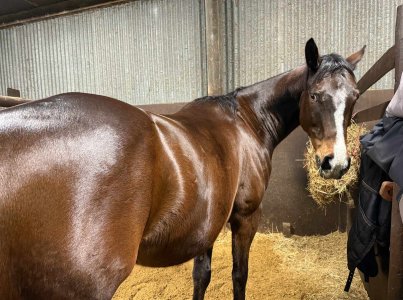
This is what he looks like atm.. Not exactly sickly or poorly, just having random colic episodes and red worms in his droppings and depositing cow pads every now and then...

But as I said, he is better now than what he has been, so presumably we are going the right way. It is just incredibly frustrating when you tie yourself in knots trying to do the right thing by them, and you keep getting setbacks and new flair ups. He is still young, he is bright and intelligent and full of life, and I hate seeing him miserable.

Mobile phone photo so not a great angle and ridiculously distorted, but you get the idea..

bojo feb26 pieni.jpg
 
This is what he looks like atm.. Not exactly sickly or poorly, just having random colic episodes and red worms in his droppings and depositing cow pads every now and then...

But as I said, he is better now than what he has been, so presumably we are going the right way. It is just incredibly frustrating when you tie yourself in knots trying to do the right thing by them, and you keep getting setbacks and new flair ups. He is still young, he is bright and intelligent and full of life, and I hate seeing him miserable.

Mobile phone photo so not a great angle and ridiculously distorted, but you get the idea..

View attachment 173049
Beautiful kind face he has. I hope you can get to the bottom of it all. So hard when they are just 'not quite right' and nothing seems to be helping, I have heard good things about equibiome so fingers crossed it can shed some light
 
Top