Is this the right place to introduce my boy?

Pr1nce

Well-Known Member
Joined
29 March 2013
Messages
104
Location
Northamptonshire
Visit site
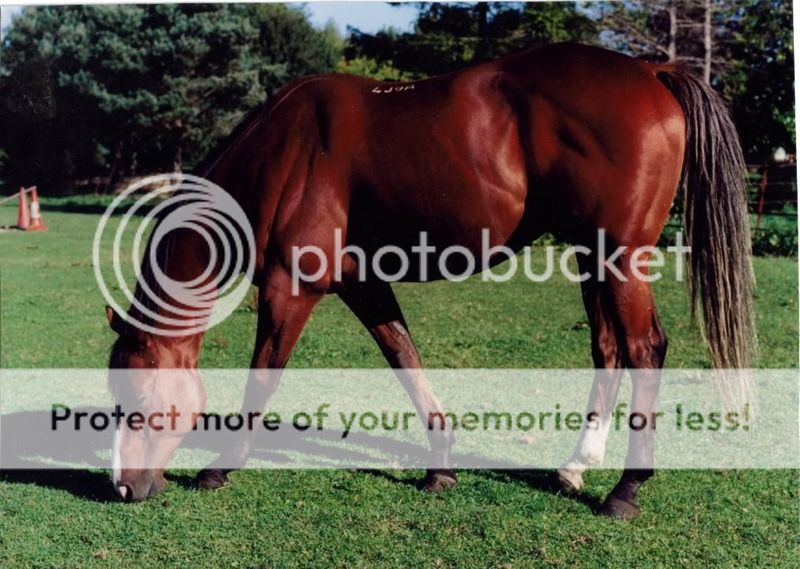
This is my handsome man Prince :) he is 17hh and 9 years old. His passport says he is believed IDx (crappy generic passport)
Can any colour gurus tell me if he is dun or buckskin? he has a dorsal stripe but no leg barring

20072009001.jpg


28082009.jpg


These photos are from a couple of years ago not long after i got him, stupid photobucket is refusing to play ball and let me upload any newer ones! lol
 
whats the difference between dun and buckskin?

I was always taught duns have primitive markings which can be striping on the legs, body or face but is usually a dorsal stripe. My old instructor told me if it has a dorsal stripe it's a dun if it doesn't it's probably as buckskin.
 
I was always taught duns have primitive markings which can be striping on the legs, body or face but is usually a dorsal stripe. My old instructor told me if it has a dorsal stripe it's a dun if it doesn't it's probably as buckskin.

buckskin is caused by the cream gene acting on bay (i believe?) whereas dun is caused by the dun gene!
so it all depends on whether his parents were buckskin/palomino/cremello or whether one was dun :P

you could get a colour test to find out for sure? :D:cool:
 
What a stunning boy!

he is buckskin, the dorsal stripe wont be a true dorsal stripe, more what they call countershading.

Buckskin the the basic "dun" colour DUN is a factor carried and presenting on the coat as webbing, leg barring dorsal stripe ie primitive markings. I stand to be corrected of course but my time as a "dun" quarter horse owner made me do some reading as her sister was the same colour but registered buckskin due to lack of dun factor or primitive markings.
 
He's lovely!

Reminds me of Tracey Garside's eventer (his name escapes me at the moment), he was a big buckskin gelding.

I Have no idea what is dun and what is buckskin, mine I believe is technically buckskin and I think is more of a yellow/golden colour whereas yours looks quite pale (unless that's just the pics?). Mine has one white sock and a white blaze and I understand that a true dun would not have any white markings? Could be completely wrongabout that though! Who cares anyway, either way he's a lovely colour! :D
 
i have absolutely no info on his sire or dam, it is all just down as unknown on his passport. Im not sure which breeds actually carry the Dun gene?

Dun is found in Przewalskis, Shetlands, Highlands, Fjords, Quarter horses, PRE's for example.

Dun is not found in Welsh a/b/c/d's or Connemaras despite buckskin examples of the breed often being misidentified as duns.

This is a red (chestnut) dun. Wagtail on here has a beautiful red dun.
Diego_s+Back.JPG


Dun on a black base is often called grulla/grullo (depending on the gender of the horse) or blue dun.

deluxe_dun_blue_morgan_709.jpg


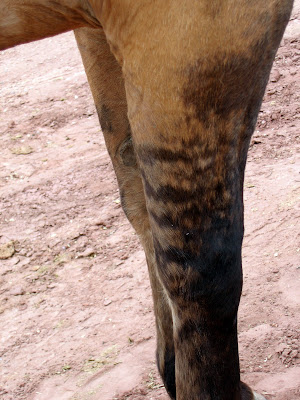
Leg bars on a bay dun.
bosszebra2.JPG


You can have dun on a seal brown base too but it's hard to tell apart from a bay dun.

You can also have the dun gene and other modifying genes eg dunalino (chestnut base + cream + dun).
 
Your horse looks wonderful, but perhaps the only way to tell for certain whether he is dun or buckskin, is by doing a colour gene test. I suspect that it is just something with the photo, but on the second photo it looks like he has some white around the base of his tail, if that is true, then I would say he's probably dun, but as mentioned, I suspect that is just something with the photo, and then I'm uncertain about which colour he has.

As I understand the difference between Dun and Buckskin:

A dun carries the dun dilution gene.
A buckskin carries the cream dilution gene.
Both these genes are dominant, one parent must carry the gene for a horse to become dun or buckskin. To really confuse things, I've read that it is possible for a horse to carry both those genes = buckskin dun/dunskin? ...

The dun dilution gene is very dominant, it usually dilutes bay, chestnut and black base coat, even if the horse only inherits one copy of the gene.
The cream dilution gene is dominant, but if there is only one copy of this gene, it will only dilute bay and chestnut base coat, to dilute black base coat the gene must be doubled.

A dun always have a dorsal stripe, no stripe, not dun. The stripe is usually (on adult horses) well defined, have a clear colour, and is visible all the year around.
A buckskin can have something that looks like a dorsal stripe, but they doesn't have to have it.

A dun can have zebra striping on the legs and/or other primitive markings, but (besides the dorsal stripe) they doesn't have to have them.
A buckskin never (or rarely?) have "true" primitive markings, but they can have "false" primitive markings that resembles, mimic the "true" ones.

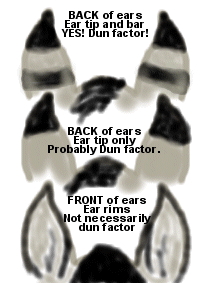
A dun can have (white, light or black coloured) primitive markings on their ears, ear tips and ear rims, depending on where they have them, it can make it more likely that they're dun, but they doesn't have to have them.
A buckskin can have "false" primitive markings on their ear rims, but they doesn't have to have them.
ear_drawing.gif


A dun often have a more dull body colour, but I've seen Fjord horses with very clear "yellow"/golden body colour, so they doesn't have to have a dull body colour.
A buckskin often have a more clear cream or golden body colour, but they doesn't have to have it, some have a smutty/sooty body colour.

A dun can have lighter coloured guard hairs at the base or outer edges of the tail, sometimes also on the edges of the mane, but they doesn't have to have them.
A buckskin never (or rarely?) has lighter coloured guard hairs at the base/outer edges of either the tail or mane.

A dun rarely have seasonal dappling, but they can have it (if they do, the seasonal dappling is caused by other colour genes that the horse also carries).
A buckskin is more likely to have seasonal dappling, especially if they're smutty/sooty, but they doesn't have to have it.

I think that this site has some good photos grullablue.com/colors/dun_factor_markings.
 
Dun is found in Przewalskis, Shetlands, Highlands, Fjords, Quarter horses, PRE's for example.

Dun is not found in Welsh a/b/c/d's or Connemaras despite buckskin examples of the breed often being misidentified as duns.

This is a red (chestnut) dun. Wagtail on here has a beautiful red dun.
Diego_s+Back.JPG


Dun on a black base is often called grulla/grullo (depending on the gender of the horse) or blue dun.

deluxe_dun_blue_morgan_709.jpg


Leg bars on a bay dun.
bosszebra2.JPG


You can have dun on a seal brown base too but it's hard to tell apart from a bay dun.

You can also have the dun gene and other modifying genes eg dunalino (chestnut base + cream + dun).

I am so confused now lol

He does have quite a bit of white at the top of his tail and the top layer of mane. I will try and get some photos of it tomorrow to demonstrate.

Presumably he is far too big to have any of the true dun breeds mentioned? Of course it makes absolutely no difference to me what colour he is, i'm just curious.

The red dun is beautiful! I have never seen one of those before!
 
But the dun dilute gene is very dominant, he might have inherited his size from one parent and the colour from a parent that was i.e. a Fjord horse.

On your first photo, it looks like he has a dark stripe on his forehead, which could be a primitive marking. On the other hand, your second Facebook photo shows him as dappled, which makes him more likely to be buckskin, or he is dun and carries another colour gene that causes the dappling...

Fjord horses are always dun, but not all of them have (visible) zebra stripes on their legs.
honiindex.jpg


horse.jpg


2007LaCrosse3.jpg


I've read that buckskins sometimes have something that can mimic zebra striping on their legs, but, as I recall, they're described as countershading leg stripes?

:confused:
 
Well you learn something new every day! :-) My pony is registered as dun on her passport but clearly from the definitions described she is buckskin! She sort of has a dorsal strip but its more shading I reckon as it's not black like her legs it's dark golden and in the summer light (haahaa whenever that might appear!) she does seem to have a bit of zebra striping on the legs but as you guys pointed out if I really scruntinize it it's actually shading!
 
Some good info there FL.

In the UK, unless you have a foreign breed, highland or shetland, it is most likely that a 'dun' horse/pony is actually a buckskin. This is mainly because the cream gene is more common here.


I personally, looking at the photos, get a buckskin feeling for the OP's horse.
 
Dun is found in Przewalskis, Shetlands, Highlands, Fjords, Quarter horses, PRE's for example.

Dun is not found in Welsh a/b/c/d's or Connemaras despite buckskin examples of the breed often being misidentified as duns.

This is a red (chestnut) dun. Wagtail on here has a beautiful red dun.
Diego_s+Back.JPG


Dun on a black base is often called grulla/grullo (depending on the gender of the horse) or blue dun.

deluxe_dun_blue_morgan_709.jpg


Leg bars on a bay dun.
bosszebra2.JPG


You can have dun on a seal brown base too but it's hard to tell apart from a bay dun.

You can also have the dun gene and other modifying genes eg dunalino (chestnut base + cream + dun).

Faracat, how are you so knowledgeable? Do you read a lot? (don't have to answer, just admire your vast information base!)
 
I used to own this horse

Seamus.jpg


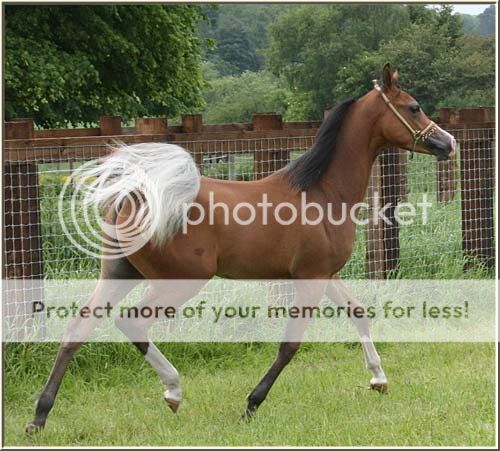
and wondered why he had a grey tail even though the rest of him never greyed out (he wasn't a grey). So I started to learn about the colour genetics and found that he had a 'Gulastra Plume' which is caused by sabino.

This horse - which I sadly do not own - has an incredibally striking Gulastra Plume.

greytailedcolt.jpg
 
Top