
Caroline2123
New User
Hello everyone, I'm here to get some advices on how to proceed and what to do so I can help better my horse.
My native language isn't English so I'm sorry in advance for the mistakes.
For the background : My horse is a small horse, criollo style, with a past of malnutrition and abuses until his 5 years old, when I got him. My horse was extremely skinny, and I did the mistake to feed him a lot for him to get back in shape, which alternatively made him obese, but after his first laminitis crises he kept his weight under control, he isn't fit neither as he is not being worked/muscle trained, but he isn't fat neither. he lives in a big pasture, with other horses, he has grazer on most of the time during spring days and mostly pasture rotation, and when the grass is too sweet, he returns to the stable.
First laminitis crisis at the age of 10, the vet told me it was because he was overweight. I made him loose weight, he was alright after that, complemented him with some natural products and was being careful each years. changed stables and went to a more caring one with possibility to put him in a stable when needed.
Second laminitis crisis at the age of 14, the worst one, happened during the lockdown, 2 weeks after a pasture rotation where the meadow was really rich and sweet, my horse had been taking off his grazer during the night, there was a rotation of the phalanx of all of his hoofs, he didn't walk for a month. he then after a month had piroplasmosis, and then after few weeks He did another mini crisis, when he was starting to recover, and then had 2 abcess. During all that time he was in a stable, getting out everyday depending on how much he could, either walk a bit or just going out of the stables for few meters. This was in between April 2020 and August 2020. So difficult year for him. He went through, the vet told me again he was fat and that was the only reason. If it's any help, he is 157cm tall, and he had a weight of 450kg.
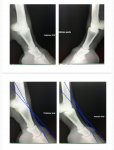
Third begin of "laminitis crisis" 3 weeks ago, age 15, my horse is not fat, the vet admitted it this time, but told me he is a "fake fat", meaning that he has low muscle because he is on retirement and not being worked, and that it's the reason now, he doesn't do exercices so he got laminitis. The crisis had been caught super early so my horse is now walking really good, feeling way better, but I still don't put him with the others, he is in the stable, and walk once a day + go with some horse on a "dusty" paddock where he can enjoy a bit for few hours his friends.
Now I'm being a bit clueless about how to understand this. I can understand that my horse doesn't do much, but as a lot of other horses, so there might be something happening inside of him that makes him get laminitis "easily". I thought of SEM and Cushing, my vet was kind of saying No. So I asked a blood test and here are the results :
Now Cushing is out of the picture from the results. From what I understood, the T4 blood test had been taking wrong because no prep had been done, we didn't do sugar intake then the shot etc.... he just took the blood like that. However, the blood result are so bad... And now my vet tells me to try some medicine for the liver. I live in the countryside, with mostly cow vets around me. He is my only ressource and until then he has been a huge help and I always believed in him. But I feel now that he might be clueless or doesn't want to get too much into and I want to understand what's wrong and how I can help my horse. I know him and I feel something is wrong and I can't seem to understand what it is... My vet is kind of in the blur I believe and makes me "try" things without really looking out for the results or how to get him better...
So here I am, what you guys would advise me to do ? If any of you have some understanding of blood test, how do you understand those ? And mostly, do you know any vet that I could contact virtually to have a good understanding and feedback about how to interpret those results, what to do next etc..
I can put the amount of money that is needed for him to get better, I'm ok to try things out, but I really need help to understand what's going on..
Thank you so much in advance, I'm a bit lost
PS: the results aren't in English, but I believe a lot are similar, let me know if something is not clear
My native language isn't English so I'm sorry in advance for the mistakes.
For the background : My horse is a small horse, criollo style, with a past of malnutrition and abuses until his 5 years old, when I got him. My horse was extremely skinny, and I did the mistake to feed him a lot for him to get back in shape, which alternatively made him obese, but after his first laminitis crises he kept his weight under control, he isn't fit neither as he is not being worked/muscle trained, but he isn't fat neither. he lives in a big pasture, with other horses, he has grazer on most of the time during spring days and mostly pasture rotation, and when the grass is too sweet, he returns to the stable.
First laminitis crisis at the age of 10, the vet told me it was because he was overweight. I made him loose weight, he was alright after that, complemented him with some natural products and was being careful each years. changed stables and went to a more caring one with possibility to put him in a stable when needed.
Second laminitis crisis at the age of 14, the worst one, happened during the lockdown, 2 weeks after a pasture rotation where the meadow was really rich and sweet, my horse had been taking off his grazer during the night, there was a rotation of the phalanx of all of his hoofs, he didn't walk for a month. he then after a month had piroplasmosis, and then after few weeks He did another mini crisis, when he was starting to recover, and then had 2 abcess. During all that time he was in a stable, getting out everyday depending on how much he could, either walk a bit or just going out of the stables for few meters. This was in between April 2020 and August 2020. So difficult year for him. He went through, the vet told me again he was fat and that was the only reason. If it's any help, he is 157cm tall, and he had a weight of 450kg.
Third begin of "laminitis crisis" 3 weeks ago, age 15, my horse is not fat, the vet admitted it this time, but told me he is a "fake fat", meaning that he has low muscle because he is on retirement and not being worked, and that it's the reason now, he doesn't do exercices so he got laminitis. The crisis had been caught super early so my horse is now walking really good, feeling way better, but I still don't put him with the others, he is in the stable, and walk once a day + go with some horse on a "dusty" paddock where he can enjoy a bit for few hours his friends.
Now I'm being a bit clueless about how to understand this. I can understand that my horse doesn't do much, but as a lot of other horses, so there might be something happening inside of him that makes him get laminitis "easily". I thought of SEM and Cushing, my vet was kind of saying No. So I asked a blood test and here are the results :
Now Cushing is out of the picture from the results. From what I understood, the T4 blood test had been taking wrong because no prep had been done, we didn't do sugar intake then the shot etc.... he just took the blood like that. However, the blood result are so bad... And now my vet tells me to try some medicine for the liver. I live in the countryside, with mostly cow vets around me. He is my only ressource and until then he has been a huge help and I always believed in him. But I feel now that he might be clueless or doesn't want to get too much into and I want to understand what's wrong and how I can help my horse. I know him and I feel something is wrong and I can't seem to understand what it is... My vet is kind of in the blur I believe and makes me "try" things without really looking out for the results or how to get him better...
So here I am, what you guys would advise me to do ? If any of you have some understanding of blood test, how do you understand those ? And mostly, do you know any vet that I could contact virtually to have a good understanding and feedback about how to interpret those results, what to do next etc..
I can put the amount of money that is needed for him to get better, I'm ok to try things out, but I really need help to understand what's going on..
Thank you so much in advance, I'm a bit lost
PS: the results aren't in English, but I believe a lot are similar, let me know if something is not clear





 do you have a laminitis horse
