Lamintis success... we’ve almost done it!

holeymoley

Well-Known Member
Joined
18 November 2012
Messages
4,821
Visit site
The last 5 months for me have been hell. My beloved best friend came down with a very bad case of laminitis. He rotated in both fronts at degrees of 11 and 13. I queried with myself and my vet on several occasions if it was kinder to pts, but vet seemed confident that we could pull him through. He’s a stoic wee guy with lots of character and kept going. We’ve had more ups and downs that thought possible, with 3 seroma’s being cut out, on and off lameness and a nasty farrier that crippled him, told me to get him pts as he would never have a quality of life. Somehow though we’ve managed to get through it! Xrays last week showed that we are at 1 degree rotation in both front with the new hoof likely to be 0 degrees once grown down. He’s now allowed to do 20minutes walking on concrete a day. I’m so happy we’ve finally made a break through. Hes marching out on his walks and loving life. I never cared if I never got to ride him again, I was happy if he was comfortable. To be able to even take him walks in hand is amazing.

Not really any point to the post other than to give people hope. I spent every hour I could reading about it and studying different case studies to give him the best chance I could. I hope we never have to go through it ever again.
 
The last 5 months for me have been hell. My beloved best friend came down with a very bad case of laminitis. He rotated in both fronts at degrees of 11 and 13. I queried with myself and my vet on several occasions if it was kinder to pts, but vet seemed confident that we could pull him through. He’s a stoic wee guy with lots of character and kept going. We’ve had more ups and downs that thought possible, with 3 seroma’s being cut out, on and off lameness and a nasty farrier that crippled him, told me to get him pts as he would never have a quality of life. Somehow though we’ve managed to get through it! Xrays last week showed that we are at 1 degree rotation in both front with the new hoof likely to be 0 degrees once grown down. He’s now allowed to do 20minutes walking on concrete a day. I’m so happy we’ve finally made a break through. Hes marching out on his walks and loving life. I never cared if I never got to ride him again, I was happy if he was comfortable. To be able to even take him walks in hand is amazing.

Not really any point to the post other than to give people hope. I spent every hour I could reading about it and studying different case studies to give him the best chance I could. I hope we never have to go through it ever again.
Brilliant, great news 😊
 
Not really any point to the post other than to give people hope. I spent every hour I could reading about it and studying different case studies to give him the best chance I could. I hope we never have to go through it ever again.

Yes there is a point and a big one, along with giving others hope --- it's allowing you to finally be able to stop holding your breath and wondering every morning you will find at the barn - or not find.

I know because I walked in your shoes with my IR horse in 2012 -- asking the same questions of my lameness vet -- getting the same replies as you received -- "he's a tough horse, he isn't ready to go. Give him six months"

I know the hours upon hours of research you did, asking questions on forums, the sleep you lost, the gray hair that came early, the huge holes in the checkbook, the micromanaging you still do.

Those are the things people have to realize they need to do with a horse with laminitis -- lose sleep, spend money, micro-manage the horse's lifestyle.

That horse is my avatar and the foto was taken on his 22 d b-day August, 2018:):). I recently posted a "YAY!" Thread where I say the blood work on both my horses came back well within normal range. One horse was my IR horse:)

Still DO NOT let your guard down. With rotation that serious, it can still leave the horse compromised.

FWIW, my equine chiro is a DVM who took the hollistic route and is well into years of studying Chinese medicine when she has the extra money (and time) for classes. There have been a few time when my horse's hooves started to pulse and she "tinged" him at the coronary band, thus avoiding another laminitis incident.

I was pleasantly surprised to find an article in hoof ting points on the Davallo Boot Company's website.

https://www.cavallo-inc.com/equine-ting-points/

Many kudos to you for your never-ending hard work and seeing a very frustrating and difficult journey through to an ecstatically happy conclusion:)
 
With such a positive OP post it is hard not to be the voice of doom It is clear once they have had a bout of Laminitis it is a full time job keeping them from getting it again. I have faced this problem and if he gets it again it will be the last time but He is happy on his track with a youngster to bully (she is fat too so not harm being done to her either ) it keeps them moving they are both neither cushingoid or metabolic but he gets laminitis from eating too much grass and gaining too much weight so I do know how to maintain his lifestyle but if he escapes it is a small margin and as well meaning people keep letting into the rested grass it is sometimes beyond my control. He has had laminitis three times twice he was let out of his track the other time was my fault as I went to a show and left him keeping a thinner horse company we were delayed and unfortunaely the hours we were delayed caused his problem I di take great care not to let that happen again and the skinny one had to join him on the track rather than him joining her in the field
 
With such a positive OP post it is hard not to be the voice of doom It is clear once they have had a bout of Laminitis it is a full time job keeping them from getting it again. I have faced this problem and if he gets it again it will be the last time but He is happy on his track with a youngster to bully (she is fat too so not harm being done to her either ) it keeps them moving they are both neither cushingoid or metabolic but he gets laminitis from eating too much grass and gaining too much weight so I do know how to maintain his lifestyle but if he escapes it is a small margin and as well meaning people keep letting into the rested grass it is sometimes beyond my control. He has had laminitis three times twice he was let out of his track the other time was my fault as I went to a show and left him keeping a thinner horse company we were delayed and unfortunaely the hours we were delayed caused his problem I di take great care not to let that happen again and the skinny one had to join him on the track rather than him joining her in the field

Yes, ^^^^. all too true I'm afraid. Once the hooves are compromised it's like forever walking on eggshells for the human:(

My horse did re-founder a few years later, thankfully not as severe but bad enough. Shortly after that my previous equine chiro moved back in the area and she has been working with my horses ever since. Her knowledge of Chines medicine and being certified in acupuncture has been a valuable asset in the well-being of both my horses:)

ATM, he is doing very well with a model of Natural Balance steel shoes -- he is great about telling me what he likes and doesn't like. He loved his pour-in pads during the time he needed them. He did not like the leather pads so I had to have the farrier come back out and remove them.

Right now he has the best sole depth I have seen in a few years, so he is in the Natural Balance shoes with no pads. He is a Tennessee Walker, seeing that natural head bob along with the sashaying backend they are noted for is the best way to start my morning when I turn him out:)
 
Yay! I had similar with my old pony, he had another 7 years of soundness and did more after his bout than before! It was tough but I found a routine that worked for him and kept him sound. I also didn't PTS initially because of his stoic character and I'm so glad I didn't at the time. I lost him in 2017 as his EMS meant he started getting recurring low grade laminitis and as he was 25 and arthritic at this point I decided it wouldn't be fair to keep putting him through the rehab so you do have to watch out but ultimately you can come out the other side of laminitis!
My lovely old man doing what he did best (after lami!)
FB_IMG_1554276857136.jpg

And at a show, he was very overweight when I got him so I had to work hard to slim him down, he had EMS because of his previous fat life. He looked good here.
FB_IMG_1554276874980.jpg
 
It isn't always a given that they will succumb again - most cases are due to an underlying metabolic cause and if you can keep on top of that there is no reason why it should strike again. Mine was PPID related, 2 years on Prascend and a carefully controlled diet and he is sounder than he has been for a long time. A good trimmer helps too - his feet are like iron now whereas before they were sensitive and poor quality. The Laminitis Site and their advice re treating and trimming are pretty much the reason I have a sound and healthy horse these days - well worth checking out if you have a horse at risk http://www.thelaminitissite.org/
 
Agree with JillA. I've had several laminitis ponies and they've only ever had it the once. If you find the cause, which is key to treating it, and remove or treat that cause, then it can be relaively plain sailing.
Rotation, again, once the cause of the laminitis is found and treated, can be sorted.
My ponies all live normal lives...out 24/7/365 albeit restricted during danger times.
 
Yes there is a point and a big one, along with giving others hope --- it's allowing you to finally be able to stop holding your breath and wondering every morning you will find at the barn - or not find.

I know because I walked in your shoes with my IR horse in 2012 -- asking the same questions of my lameness vet -- getting the same replies as you received -- "he's a tough horse, he isn't ready to go. Give him six months"

I know the hours upon hours of research you did, asking questions on forums, the sleep you lost, the gray hair that came early, the huge holes in the checkbook, the micromanaging you still do.

Those are the things people have to realize they need to do with a horse with laminitis -- lose sleep, spend money, micro-manage the horse's lifestyle.

That horse is my avatar and the foto was taken on his 22 d b-day August, 2018:):). I recently posted a "YAY!" Thread where I say the blood work on both my horses came back well within normal range. One horse was my IR horse:)

Still DO NOT let your guard down. With rotation that serious, it can still leave the horse compromised.

FWIW, my equine chiro is a DVM who took the hollistic route and is well into years of studying Chinese medicine when she has the extra money (and time) for classes. There have been a few time when my horse's hooves started to pulse and she "tinged" him at the coronary band, thus avoiding another laminitis incident.

I was pleasantly surprised to find an article in hoof ting points on the Davallo Boot Company's website.

https://www.cavallo-inc.com/equine-ting-points/

Many kudos to you for your never-ending hard work and seeing a very frustrating and difficult journey through to an ecstatically happy conclusion:)

Everything you’ve said is true. There were days where I felt horrible because I did dread going up as I wouldn’t know what he’d be like that day. Days of hope tinged by further days of looking as if we were back to square 1. He is also IR so his diet is basically his lifeline. I’m not sure what we’ll do once he’s allowed turnout again, I have asked for a small area of field which I will fence off and pop him in with a muzzle too.
 
Thanks guys, nice to hear that others have came through it too. I know the rest of his life will require strict management but I’m willing to do that. I’ve had him 14 years(he’s 16) I’m afraid he’s stuck with me for the rest lol. He is insulin resistant so will have exercise probably 5 days over 7 if not every day now as opposed to just once or twice a week. My concern is the grass quality at my yard, it’s very lush and they tend to get rotated field every few weeks. I’ve asked (pleaded!) for a small patch of field to fence off and use as my own where he can be out muzzled even for just a few hours a day. He’s a great chap, copes nicely in his stable as long as he gets even a walk out during the day. I would rather he had some sort of time out in a bare paddock though just to be a horse. Hopefully he’ll be able to cope. He seems to be doing nicely on his diet just now.
 
As said mine lives out 24/7 in a grass track at the minute they are being fed onto it by strips but once going it will be about 100 yards long by 15 ft wide I have found that Jingo is fine until his neck gets thicker which would indicate some sort of IR but his bloods were normal for everything at the height of the attack. He is needle phobic so would kill us if we tried to do it when he wasnt feeling sorry for himself so cannot get bloods now. He isnt a nice pony so there are other reasons for not trying too hard if he succumbs again
 
Interesting isn't it how traditional wisdom has been superseded by knowledge. Those who felt that once a horse had had lammi he would be prone to it in future didn't realise it wasn't the laminitis that went on but the underlying metabolic reason. They felt that compromised laminae stayed compromised, whereas now we know that a horse can grow an entirely new hoof capsule in a matter of months. And heart bar shoes whilst providing the support for rotation or sinkage of the pedal bone didn't provide as much overall support as boots and pads. Thank goodness we have moved on from nailing shoes on to painful feet!
Not all traditional wisdom is wrong of course!
 
He is also IR so his diet is basically his lifeline. I’m not sure what we’ll do once he’s allowed turnout again, I have asked for a small area of field which I will fence off and pop him in with a muzzle too.

when my horse was diagnosed IR in 2012 his insulin numbers were three times higher than high/normal. Cornell U asked the vet for another vile of blood as they thought they had messed up the testing. When the numbers were the same, they called my vet and marveled the horse was still alive.

His numbers have been in the Norma, range since 2015. 2015 is the year I stopped putting a muzzle on him after I saw him expertly sucking up weeds thru the muzzle:)

i have about 22 acres of cross-fenced pasture and yard. The IR horse has had his own six acre are since 2015. Partly because the other horse bullies him constantly, partly because he does better on his six acre section than if I put him in the big pasture.

What has worked best for me:

1. Removing anything from his diet containing any sort of grain, SOY, and added iron. Iron naturally occurs in hay and grass, so he gets enough that way (which has been supported by his blood work since 2015).

2. Hay that tests low in NSC value. I am so fortunate to be able to buy locally grown orchard grass/grass mix hay that always tests between 8%. - 8.9% NSC value. Hay was cut late in 2018 due to all the rain so I worried but it came back at 8.2% NSC value.

3. I refuse to feed RB's as I have found most of the feed manufacturers don't tell the straight truth about the percent of NSC in each pound of feed.

I feed a soy-free and no iron added vit/min supplement from HorseTech and mix it with one measuring cup of Timothy pellets 2X/daily. I know you can't cheaply get HorseTech products but hopefully you have something comparable.

4. Last and the best of all: we have very hot & very humid summers in my area of the U.S. My lameness vet suggested I add some chopped watermelon rind to the IR horse's diet and feed the watermelon to the other horse to cool them down internally.

I did some research and discovered there have been human scholarly studies on the benefits of watermelon for diabetics! The citrulline (sp?) in watermelon helps to lower insulin! I had found one scholarly equine study supporting that for horse but I can't find it again.

I start out adding 1/2 measure cup 2X/day of chopped watermelon rinds and the watermelon (now that his insulin is stabilized) to both horses feed pans. They will each get a full cup 2X/day by the time the heat of the summer arrives.

I feed watermelons until the markets stop carrying them which is ~mid-November where I live.

My horse will be 24 in August. He has other things wrong with him because the dollface has always been an accident waiting for a place to happen:). My mission is to let him be a horse as close to the way he should live as I can get away with for whatever time he has left.

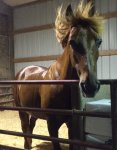
I took this foto of my IR horse on his 23rd birthday August, 2018. He had just been showered off but he was dry. The shine on his coat took my breath away:). He loves the big barrel fan that sits in front of his stall, on those miserable humid summer nights we get.
image.jpgimage.jpg
 
Last edited:
when my horse was diagnosed IR in 2012 his insulin numbers were three times higher than high/normal. Cornell U asked the vet for another vile of blood as they thought they had messed up the testing. When the numbers were the same, they called my vet and marveled the horse was still alive.

His numbers have been in the Norma, range since 2015. 2015 is the year I stopped putting a muzzle on him after I saw him expertly sucking up weeds thru the muzzle:)

i have about 22 acres of cross-fenced pasture and yard. The IR horse has had his own six acre are since 2015. Partly because the other horse bullies him constantly, partly because he does better on his six acre section than if I put him in the big pasture.

What has worked best for me:

1. Removing anything from his diet containing any sort of grain, SOY, and added iron. Iron naturally occurs in hay and grass, so he gets enough that way (which has been supported by his blood work since 2015).

2. Hay that tests low in NSC value. I am so fortunate to be able to buy locally grown orchard grass/grass mix hay that always tests between 8%. - 8.9% NSC value. Hay was cut late in 2018 due to all the rain so I worried but it came back at 8.2% NSC value.

3. I refuse to feed RB's as I have found most of the feed manufacturers don't tell the straight truth about the percent of NSC in each pound of feed.

I feed a soy-free and no iron added vit/min supplement from HorseTech and mix it with one measuring cup of Timothy pellets 2X/daily. I know you can't cheaply get HorseTech products but hopefully you have something comparable.

4. Last and the best of all: we have very hot & very humid summers in my area of the U.S. My lameness vet suggested I add some chopped watermelon rind to the IR horse's diet and feed the watermelon to the other horse to cool them down internally.

I did some research and discovered there have been human scholarly studies on the benefits of watermelon for diabetics! The citrulline (sp?) in watermelon helps to lower insulin! I had found one scholarly equine study supporting that for horse but I can't find it again.

I start out adding 1/2 measure cup 2X/day of chopped watermelon rinds and the watermelon (now that his insulin is stabilized) to both horses feed pans. They will each get a full cup 2X/day by the time the heat of the summer arrives.

I feed watermelons until the markets stop carrying them which is ~mid-November where I live.

My horse will be 24 in August. He has other things wrong with him because the dollface has always been an accident waiting for a place to happen:). My mission is to let him be a horse as close to the way he should live as I can get away with for whatever time he has left.

I took this foto of my IR horse on his 23rd birthday August, 2018. He had just been showered off but he was dry. The shine on his coat took my breath away:). He loves the big barrel fan that sits in front of his stall, on those miserable humid summer nights we get.
View attachment 31114View attachment 31114

Awh what a handsome chap. Love the hair in the fan lol I’ll try and post a photo of my guy.

That’s amazing re the watermelon, I will have a look and see if I can find anything about that, that would be great if it was shown to reduce levels. I done a lot of research about feeds and it amazes me the amount of junk that horses are being fed by naive owners. Clever marketing and uneducated owners in feed really is a problem just now. I’m on a large livery yard and am amazed at what people feed!
 
Awh what a handsome chap. Love the hair in the fan lol I’ll try and post a photo of my guy.

That’s amazing re the watermelon, I will have a look and see if I can find anything about that, that would be great if it was shown to reduce levels. I done a lot of research about feeds and it amazes me the amount of junk that horses are being fed by naive owners. Clever marketing and uneducated owners when it comes to feed really is a problem just now. I’m on a large livery yard and am amazed at what people feed!
 
Thank you for the compliment on my handsome fella:)

Here's a 2017 article written by Elleanor Kellon (ecirhorse.org) for the American Farrier's Journal, discussing citrulline, & other amino acids that benefit the hooves -- they act as vasodilators.

https://www.americanfarriers.com/ar...ter-months-what-should-i-be-looking-for-afjho

Interestingly I have just googled horses eating hawthorn because one of mine is determined to - that is also a vasodilator. I suspect we have more hawthorn than watermelons in the UK atm
 
Top