Leaking Hay Cube

AdorableAlice

Well-Known Member
Joined
24 October 2011
Messages
13,455
Visit site
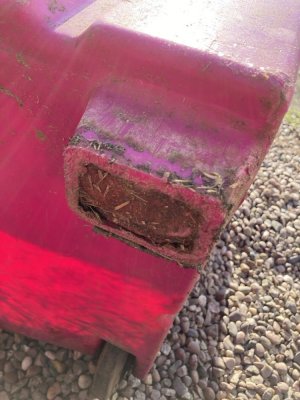
Any thoughts on type of sealant that might seal leaking hay cubes please. The feet have given up on mine. So far I have tried duct tape, gorilla tape and gorilla glue and bath sealant, none of which have worked. Has anyone successfully mended a cube ?

Thanks
 
I googled 'Plastic tank repair kit 'and there are a lot of differing suggestions. Here is one.


edit. goodness knows why it says the above, but it seems to link to the right place.
 
There’s an excellent sealant by evo-stik called ‘Sticks like Sh*t’ - there’s the turbo fast drying - for external use.

Amazon link:

If its for the inside of a hay cube for soaking, and using cold water only, it’ll likely be inert once dry. Plastic polymers can be inert, like resins. Very hot water can cause some sealants to soften and potentially leach fumes.

For hot water use, i’d likely use a 2 part mix epoxy glue - its thick to be able to spatula apply it as a layer - it dries fast, and can withstand hotter temps without softening/degrading.

If its a smooth plastic you want to mend, sand the area first with rough sand paper or a file…to rough-up the surface enabling the sealant glue to stick much better.
 
My boyfriend is a plastics fabricator and says it is likely made from MDPE and the sealants won't stick. It could be plastic welded, which would work.

He does that kind of job regularly. Took a phone call about welding a caravan toilet cartridge the other day 💩💩💩 - glamourous! Probably worse when he has to do industrial acid tanks, but somehow the thought of welding a used toilet got to me 🤣

It is quite a quick job.
 
Thank you for the guidance. I will see what I can do. They are so expensive to replace I need to try to mend it. I use cold water to soak.
 

Attachments

  • 486178012_1344781269901662_8074529542667246480_n.jpg
    486178012_1344781269901662_8074529542667246480_n.jpg
    97.3 KB · Views: 42
Miliput will stick and will work. I've fixed plenty of holes in sinking boats with it. With it being a bigger hole I'd be inclined to buy a fibreglass repair kit. They cost about a tenner and will patch up a bigger hole like that easily.
 
Following with interest.

I had to replace my original Haygain One plastic hay chest after about 6 years of sterling service as the four feet had gradually worn down and it started to leak badly. I realise that I drag it in and out of position daily over rough concrete 😬, so not surprising that the feet were worn.

Duct tape worked for a bit, then the job got too big.
 
Miliput will stick and will work. I've fixed plenty of holes in sinking boats with it. With it being a bigger hole I'd be inclined to buy a fibreglass repair kit. They cost about a tenner and will patch up a bigger hole like that easily.
Thank you, I will order some. To be fair to the cube it is old but I still don't want to buy another !
 
This is exactly what I’ve worried about ever since we got a haycube, a few months ago.

It came with two bits of rubber stuck to the two hollow feet. These fell off within one hour.

Moving the cube inevitably means wear on the feet, and someone at hay cube didn’t want to spend the pennies it would cost to make them solid.

My OH also works with industrial tanks, albeit mostly stainless steel, and confirms what Red-1’s OH said: not much will stick to it. Not many people (or companies) have access to a plastic welder. I’ve asked him to check Milliput out..

Ours isn’t leaking…but in time it will! I’d like to work out how something can be stuck to the feet to stop future leakage.

I have been very unimpressed at the quality v price of the hay cube. We have had to make so many adaptations to make it work that we may as well have started with a wheeliebin, and adapted that.

The bung is poor quality and a non-standard thread, and the wall holder has not once held the cube in place -not that it looked as though it would.

The (small-hole) grid means a lot of strong upwards tugging and I worry that the benefit to the horse’s back of eating in the correct position is lost with all this upwards pulling and lifting of what is a very heavy item. It must be quite a strain on the neck. However, it was the physio who recommended I get the cube for him.

In the morning I tend to find the cube in a different position in the stable, or on its side. The grid is not usually taken out but it is also in very strange positions, upwards, diagonal, etc, within the cube (I have the hay cube version with the slot at the back).

The main positive is for my back: I no longer have to heave ultra heavy soaked nets over a fence and hang them. I am not prone to back issues but it was beginning to get quite sore. Now that we have adapted the bung (thanks to OH’s experience with tanks) drainage is easy too.
 
This is exactly what I’ve worried about ever since we got a haycube, a few months ago.
It came with two bits of rubber stuck to the two hollow feet. These fell off within one hour.
Moving the cube inevitably means wear on the feet, and someone at hay cube didn’t want to spend the pennies it would cost to make them solid.
I wonder if it's worth pre-emptively putting something onto the feet to protect the plastic? I'm thinking perhaps some thick rubber matting offcuts, bolted on with the nuts sunk into the rubber to keep the bolts from scraping the floor?
 
This is exactly what I’ve worried about ever since we got a haycube, a few months ago.

It came with two bits of rubber stuck to the two hollow feet. These fell off within one hour.

Moving the cube inevitably means wear on the feet, and someone at hay cube didn’t want to spend the pennies it would cost to make them solid.

My OH also works with industrial tanks, albeit mostly stainless steel, and confirms what Red-1’s OH said: not much will stick to it. Not many people (or companies) have access to a plastic welder. I’ve asked him to check Milliput out..

Ours isn’t leaking…but in time it will! I’d like to work out how something can be stuck to the feet to stop future leakage.

I have been very unimpressed at the quality v price of the hay cube. We have had to make so many adaptations to make it work that we may as well have started with a wheeliebin, and adapted that.

The bung is poor quality and a non-standard thread, and the wall holder has not once held the cube in place -not that it looked as though it would.

The (small-hole) grid means a lot of strong upwards tugging and I worry that the benefit to the horse’s back of eating in the correct position is lost with all this upwards pulling and lifting of what is a very heavy item. It must be quite a strain on the neck. However, it was the physio who recommended I get the cube for him.

In the morning I tend to find the cube in a different position in the stable, or on its side. The grid is not usually taken out but it is also in very strange positions, upwards, diagonal, etc, within the cube (I have the hay cube version with the slot at the back).

The main positive is for my back: I no longer have to heave ultra heavy soaked nets over a fence and hang them. I am not prone to back issues but it was beginning to get quite sore. Now that we have adapted the bung (thanks to OH’s experience with tanks) drainage is easy too.
Completely agree, I have 4 cubes, 3 of which are old, 2 leak from the feet, one leaks via the bung. The fourth one is slightly newer although bought second hand and has the screw cap rather than a bung. I have had a horse trapped in one via foreleg but he did wait patiently for rescue, thank god for the camera. Getting him out was a 4 man task.

I too find lugging haynets too much in older age, the concept of the cube is labour saving and waste water is saved for garden watering. It is very annoying the quality is rubbish and repair tricky.
 
This is exactly what I’ve worried about ever since we got a haycube, a few months ago.

It came with two bits of rubber stuck to the two hollow feet. These fell off within one hour.

Moving the cube inevitably means wear on the feet, and someone at hay cube didn’t want to spend the pennies it would cost to make them solid.

My OH also works with industrial tanks, albeit mostly stainless steel, and confirms what Red-1’s OH said: not much will stick to it. Not many people (or companies) have access to a plastic welder. I’ve asked him to check Milliput out..

Ours isn’t leaking…but in time it will! I’d like to work out how something can be stuck to the feet to stop future leakage.

I have been very unimpressed at the quality v price of the hay cube. We have had to make so many adaptations to make it work that we may as well have started with a wheeliebin, and adapted that.

The bung is poor quality and a non-standard thread, and the wall holder has not once held the cube in place -not that it looked as though it would.

The (small-hole) grid means a lot of strong upwards tugging and I worry that the benefit to the horse’s back of eating in the correct position is lost with all this upwards pulling and lifting of what is a very heavy item. It must be quite a strain on the neck. However, it was the physio who recommended I get the cube for him.

In the morning I tend to find the cube in a different position in the stable, or on its side. The grid is not usually taken out but it is also in very strange positions, upwards, diagonal, etc, within the cube (I have the hay cube version with the slot at the back).

The main positive is for my back: I no longer have to heave ultra heavy soaked nets over a fence and hang them. I am not prone to back issues but it was beginning to get quite sore. Now that we have adapted the bung (thanks to OH’s experience with tanks) drainage is easy too.

Completely agree, I have 4 cubes, 3 of which are old, 2 leak from the feet, one leaks via the bung. The fourth one is slightly newer although bought second hand and has the screw cap rather than a bung. I have had a horse trapped in one via foreleg but he did wait patiently for rescue, thank god for the camera. Getting him out was a 4 man task.

I too find lugging haynets too much in older age, the concept of the cube is labour saving and waste water is saved for garden watering. It is very annoying the quality is rubbish and repair tricky.
My boyfriend says he could plastic weld extra blocks to the feet to increase life expectancy, and they would stick.

The grid moving could also be cured with a set of rods on each sides so it goes down level.

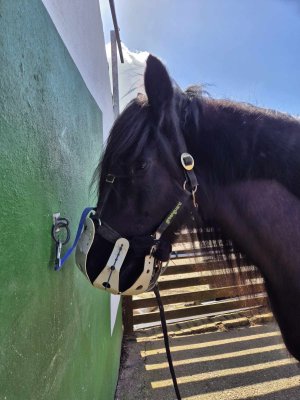
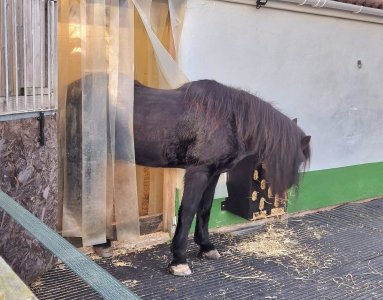
I have a horse who needs restricted, soaked hay and we discussed ways of doing this that would not break my back. He is an innovator and made a hay soaker that is really easy to use, and a hay feeder that is also dead easy, and restricts grazing. Rigsby has been the tester for those. He was also the primary tester for the grazing muzzle that has been tough as old boots and allows easy breathing as well as restricting grazing.

I looked at what was on the market and just knew that Rigs would get his foot inside a hay cube's grid and either smash it or get stuck! I knew also that he'd likely get it off the wall - he is a tank. That is why we have 2 items, they have the ease of use combined with being hangry cob resistant.

488267409_1554606775200137_2653650826164554304_n (1).jpg466492566_10227963598219304_8144914034040578768_n.jpg462198041_875843674682931_5524200667633590698_n.jpg
488065314_1028845805765217_3489528420417238697_n.jpg
487205704_1746145249268364_1962594589000826313_n.jpg


Although he is my boyfriend, we have no connection financially. As far as I'm concerned it is a personal recommendation of products that were designed for me! He does plastic fabrication, as opposed to moulded plastic (welding sheet plastic), so every design can be different as every piece is individually cut and welded. The feet on his are plastic welded, not hollow.

The charity Hope Pastures has been trialling the field grazer, they loved it.
 
My partner "plastic welded" a split in one of our 2m3 water barrels which are difficult to dispose of as junk and expensive to replace. He just heated up an old knife with a blow torch, it was about 2 years ago now and there's 2 tonnes of water in it over the winter. It wasn't as big of a gap as that one though.
 
My partner "plastic welded" a split in one of our 2m3 water barrels which are difficult to dispose of as junk and expensive to replace. He just heated up an old knife with a blow torch, it was about 2 years ago now and there's 2 tonnes of water in it over the winter. It wasn't as big of a gap as that one though.

You can plastic weld with a soldering iron and plastic cable ties, but if you plastic weld something that is going to be dragged across the floor then it will go really quickly.

You can buy rubber furniture feet, or even rubber door stops. I'd miliput or fibreglass the hole and bolt something like that on. I'd be tempted to try heavy duty castors that lock to keep it in place actually, and then just clip the box in place in case the horse somehow manages to unlock the castors. It would make it much easier to move as well.
 
Red:
Which one is the field grazer?

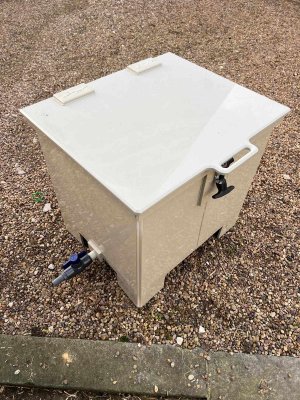
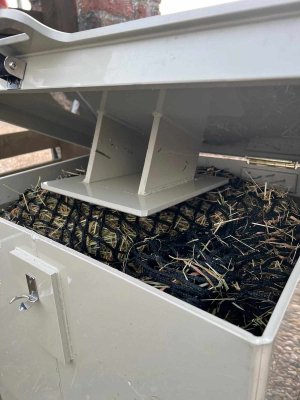
I like the fact the white one has a method of pressing the nets down into the water! I put a couple of stones on top of the grid ; ). I’ve also just sighed as it looks as though the construction looks solid and of high quality.

For soaking nets we have installed an old header tank and added a valve to open and close that.

The one fixed on the wall is not for soaked hay (unless you empty a net of soaked hay into it) I presume?
 
I wonder if it's worth pre-emptively putting something onto the feet to protect the plastic? I'm thinking perhaps some thick rubber matting offcuts, bolted on with the nuts sunk into the rubber to keep the bolts from scraping the floor?

If you put a bolt through the plastic feet (only fairly thin plastic) to attach something it will start to leak.
The most simple solution would have been for Hay Cube to manufacture it with solid feet - then you’d have 5 cm of plastic to wear down, which would take quite a long time. According to my OH that would cost very, very little. The cost of the cube inc grid was £220, iirc.
 
If you put a bolt through the plastic feet (only fairly thin plastic) to attach something it will start to leak.
The most simple solution would have been for Hay Cube to manufacture it with solid feet - then you’d have 5 cm of plastic to wear down, which would take quite a long time. According to my OH that would cost very, very little. The cost of the cube inc grid was £220, iirc.

You can get washers that wont let it leak, or just seal round it with whatever you used to fix it. They absolutely should have been solid, but they arent.
 
If you put a bolt through the plastic feet (only fairly thin plastic) to attach something it will start to leak.
The most simple solution would have been for Hay Cube to manufacture it with solid feet - then you’d have 5 cm of plastic to wear down, which would take quite a long time. According to my OH that would cost very, very little. The cost of the cube inc grid was £220, iirc.
Oh yeah 100% agree they should have just made the feet thicker/filled them in. And I'll admit, I was focussing on the 'wearing through' aspect, and forgot about the leaking aspect haha!
 
You can plastic weld with a soldering iron and plastic cable ties, but if you plastic weld something that is going to be dragged across the floor then it will go really quickly.

You can buy rubber furniture feet, or even rubber door stops. I'd miliput or fibreglass the hole and bolt something like that on. I'd be tempted to try heavy duty castors that lock to keep it in place actually, and then just clip the box in place in case the horse somehow manages to unlock the castors. It would make it much easier to move as well.
OH likes the idea of fibreglass better. Says milliput not much good if there is no hole yet, plus it’s like epoxy & will be quite glass-like and a bit brittle to stand up to the dragging around. Thinks it won’t stick if there is no hole as yet. It will be interesting to see how you get on, AA.

Re the cube: there are wheels at one end, and feet at the other. In my particular case lockable castors would not stop the cube from getting moved around or lifted up by the horse trying to pull hay through the grid. If you don’t need a grid, it shouldn’t get moved around so much when the horse is eating.
 
OP, how have you been getting on with the repair? I've been thinking of you every time I drag the cube across the yard ;)
 
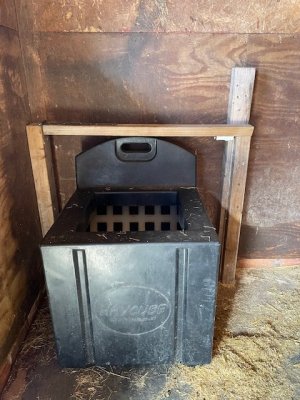
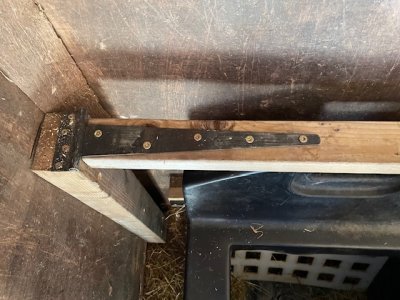
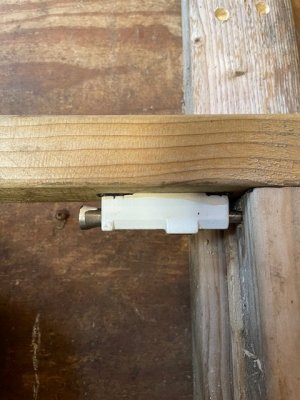
Update: OH has devised a way to keep the cube in place rather than have it lifted off its bracket in use.
See photos (if it works).
Two upright posts attached to the wall on either side of the bracket. Another length of wood which acts as a ‘lid’ and can be hinged up to allow the cube to be lifted onto its wall bracket, then put down and locked into place with a shoot bolt. The shoot bolt has fewer edges than a normal bolt so less chance of injury. Also, my horse has a habit of opening normal bolts.

IMG_9673.jpeg
 
Update: OH has devised a way to keep the cube in place rather than have it lifted off its bracket in use.
See photos (if it works).
Two upright posts attached to the wall on either side of the bracket. Another length of wood which acts as a ‘lid’ and can be hinged up to allow the cube to be lifted onto its wall bracket, then put down and locked into place with a shoot bolt. The shoot bolt has fewer edges than a normal bolt so less chance of injury. Also, my horse has a habit of opening normal bolts.

View attachment 160796
Sounds like a great idea, Lari has managed to take his 'for a walk' twice now and I've found it dragged into the centre of his bed which is a huge acheivement in itself as the bed has to be at least 6" deep!

I'm not sure how he's managing it given there are three house bricks in the bottom. I just pity his poor neck, I assume he's using his teeth to pull it in.
 
Top