Nervous/sensitive horse

amberb.xxx

New User
Joined
8 May 2022
Messages
6
Visit site
Around 6 months ago we took on a Welsh d - he has very obviously been abused before however he has a heart of gold and is extremely sweet. Because of history, he is quite often nervous and when he becomes scared, he panics and blind bolts- in hand or when ridden. I love him to pieces but am struggling to think of ways to overcome his fears without breaking his trust and confidence. His biggest fears in general are baths and he also isn’t very relaxed when I stroke his backs legs or belly, however this isn’t due to ulcers or any other medical condition, he is not in pain just mentally uncomfortable as such. He is also very sensitive when ridden so can run of the leg and bolt in the canter, and he doesn’t like things like stirrup leathers resting on his sides, however we are working on this at the moment (any tips would still be appreciated). Does anyone have any ideas of things I can do to help his feel comfortable and work towards making him completely happy and relaxed in himself and around me?
 
If he's blind bolting (in the sense that I would understand that, running into/through any obstacles, rather than going around or over them) then I'd say this is one for professional help, as he's so panicked he's abandoned all self preservation, which can get dangerous for everyone involved very quickly.
 
I would recommend a professional equine behaviourist. They will be able to advise on how to spot the subtle signs that he is becoming uncomfortable before he feels the need to panic and run. If he already has an ingrained habit of flight when he is stressed you need to be able to work inside his comfortable threshold. Every time he gets overwhelmed and tanks off he is practising that behaviour and it will be harder to overcome.

Be careful of trainers that will attempt to fix the behaviour without considering the underlying stress he is feeling. You don't want "desensitised" but still stressed underneath, as that may make the panic-and-bolt reaction still present but more unpredictable.
 
I would recommend a professional equine behaviourist. They will be able to advise on how to spot the subtle signs that he is becoming uncomfortable before he feels the need to panic and run. If he already has an ingrained habit of flight when he is stressed you need to be able to work inside his comfortable threshold. Every time he gets overwhelmed and tanks off he is practising that behaviour and it will be harder to overcome.

Be careful of trainers that will attempt to fix the behaviour without considering the underlying stress he is feeling. You don't want "desensitised" but still stressed underneath, as that may make the panic-and-bolt reaction still present but more unpredictable.

100%, plus the behaviourist needs to have a 360 view to assess whether posture, feet, management etc are playing a part.

@amberb.xxx horses don't differentiate between physical and mental pain, it manifests in broadly the same ways, and physical pain is almost impossible to completely rule out so don't stop looking in a general more passive sense, even if vets can find nothing. I've had customers whose horses have been seen often multiple times by the vet and nothing can be found, but looking at posture and movement tells us a lot about where the horse is comfortable and where they're not, where they're functional etc. Vets don't use this lens, so can miss very early stage problems. In several cases the vets have found issues when the owner kept insisting, and talked to the vets in the terms I'd explained to them.
 
Around 6 months ago we took on a Welsh d - he has very obviously been abused before however he has a heart of gold and is extremely sweet. Because of history, he is quite often nervous and when he becomes scared, he panics and blind bolts- in hand or when ridden. I love him to pieces but am struggling to think of ways to overcome his fears without breaking his trust and confidence. His biggest fears in general are baths and he also isn’t very relaxed when I stroke his backs legs or belly, however this isn’t due to ulcers or any other medical condition, he is not in pain just mentally uncomfortable as such. He is also very sensitive when ridden so can run of the leg and bolt in the canter, and he doesn’t like things like stirrup leathers resting on his sides, however we are working on this at the moment (any tips would still be appreciated). Does anyone have any ideas of things I can do to help his feel comfortable and work towards making him completely happy and relaxed in himself and around me?
my favourite sort of horse problem they are so rewarding :)

firstly stop riding for a while and secondly you need some sort of fenced area to work in.
I find working along the lines of the link below at the end produces the best results. There are lots of U tube videos if you google, TTouch, TTeam or Linda Tellington Jones or look at her FB page. She has written may books if you have a look on kindle.

First part is the touching. Do this in a stable or small yard, it will sort the back legs and belly problems. I would be spending a couple of weeks or even more doing this daily or several times a day, especially the head lowering on command,
Next are the in hand exercises which involve poles and you can do alongside the touches. Not learning to jump them but learning to meet the pole, put the head down, assess the problem and respond calmly.
After that comes the exercises but ridden.

I would also do a lot of inhand work with young/ untrained/nervous horses (which is what your horse is). This builds up to a lunge whip flying full pelt around their head and body and cracking it. A 5 gallon oil can on a rope being thrown over the horse (from side to side) over all of it from head working towards the tail and letting it land with a bang on the opposite side of the horse.
We do lots of talking our wheely bins for walks, drag logs, drag oil cans on a lead down the road as we go for a walk, lunge with a roller and wellies tied to it at the canter, lunge/loose school with a full size dummy which falls off regularly.
I play football using the horses sides to throw the ball at and OH and I play football so it rolls under the horse and often hits him. I make a walkway of 10 45 gallon oil cans, back him down them and make sure he hits one so he assumes the correct response ie stop, look around and assess the problem. Lots more you can do. Ropes everywhere. Ropes always seem to have been involved with abused horses. Long reining on ropes, almost tying him up in ropes so you drag them everywhere over him.

When you can do all this on the ground move onto long reins in your fenced area making up lots of puzzles for him to deal with. Long rein off a neck ring ie nothing on his head. Flags, flapping tarps, walking over carpet/plastic. Walking under plastic, walking with a giant sheet of plastic covering all of him including his head, walking under a washing line when it is full.

So many endless things you can teach him so that he learns to totally trust you. There is no quick fix but you will both have a wonderful time.

With sort of horse this involves several weeks and more. I have found the heavier horses eg sec D/haflingers etc are worst as people just think they are fat unfeeling horses so they get belted. Unfortunately they feel very deeply and it takes a long time to make them trust again.

I wouldn't ride because I am not brave enough to be bolted with. Also you need to very carefully keep the lid on it in hand to avoid bolting. He has to learn that the correct response to a problem is stop, put your head down and engage brain not run. Be very careful to keep a lid on it, this is a very powerful horse and you are unlikely to stop him so practice turning him quickly and learning to watch every tiny move he makes. Work in a very small space to start with.


That's really interesting Paddy, I follow a Swedish heavy breed who often gets taught to pull before riding, and foalies are tied to their mum's when they are out and about so they get used to all of this rattling and noise. As far as I can understand backing are often a non issue as they have had a lot of stuff happening already.

With your experience, do you think (true) bolters can be truly convinced that bolting should not be a flight response?
 
I follow a Swedish heavy breed who often gets taught to pull before riding, and foalies are tied to their mum's when they are out and about so they get used to all of this rattling and noise.
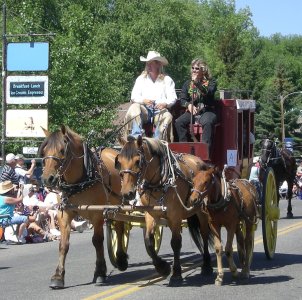
Not for this thread but we saw that in the American West. Foals accompanied their mothers pulling floats in the Carnival Street parade. OH thinks it was in Ennis, Montana
DSCN0694crop.JPG
 
Last edited:
We have one who was once similar. Came to us as unhandleable and recommended to be pts as vet felt she was dangerous. She ran, threw herself on the floor and just flat out panicked - eyes glazed, reason gone. Ours is now a soft and soppy dope on a rope, but we are nearly 2 years in (took a whole year to catch and back her!).

I find that to reduce fear and build trust, a combination of clicker training (to build a positive association) and kind but insistent handling works well. Ours still hacks in company so she has a buddy to help give her confidence.
 
my favourite sort of horse problem they are so rewarding :)

firstly stop riding for a while and secondly you need some sort of fenced area to work in.
I find working along the lines of the link below at the end produces the best results. There are lots of U tube videos if you google, TTouch, TTeam or Linda Tellington Jones or look at her FB page. She has written may books if you have a look on kindle.

First part is the touching. Do this in a stable or small yard, it will sort the back legs and belly problems. I would be spending a couple of weeks or even more doing this daily or several times a day, especially the head lowering on command,
Next are the in hand exercises which involve poles and you can do alongside the touches. Not learning to jump them but learning to meet the pole, put the head down, assess the problem and respond calmly.
After that comes the exercises but ridden.

I would also do a lot of inhand work with young/ untrained/nervous horses (which is what your horse is). This builds up to a lunge whip flying full pelt around their head and body and cracking it. A 5 gallon oil can on a rope being thrown over the horse (from side to side) over all of it from head working towards the tail and letting it land with a bang on the opposite side of the horse.
We do lots of talking our wheely bins for walks, drag logs, drag oil cans on a lead down the road as we go for a walk, lunge with a roller and wellies tied to it at the canter, lunge/loose school with a full size dummy which falls off regularly.
I play football using the horses sides to throw the ball at and OH and I play football so it rolls under the horse and often hits him. I make a walkway of 10 45 gallon oil cans, back him down them and make sure he hits one so he assumes the correct response ie stop, look around and assess the problem. Lots more you can do. Ropes everywhere. Ropes always seem to have been involved with abused horses. Long reining on ropes, almost tying him up in ropes so you drag them everywhere over him.

When you can do all this on the ground move onto long reins in your fenced area making up lots of puzzles for him to deal with. Long rein off a neck ring ie nothing on his head. Flags, flapping tarps, walking over carpet/plastic. Walking under plastic, walking with a giant sheet of plastic covering all of him including his head, walking under a washing line when it is full.

So many endless things you can teach him so that he learns to totally trust you. There is no quick fix but you will both have a wonderful time.

With sort of horse this involves several weeks and more. I have found the heavier horses eg sec D/haflingers etc are worst as people just think they are fat unfeeling horses so they get belted. Unfortunately they feel very deeply and it takes a long time to make them trust again.

I wouldn't ride because I am not brave enough to be bolted with. Also you need to very carefully keep the lid on it in hand to avoid bolting. He has to learn that the correct response to a problem is stop, put your head down and engage brain not run. Be very careful to keep a lid on it, this is a very powerful horse and you are unlikely to stop him so practice turning him quickly and learning to watch every tiny move he makes. Work in a very small space to start with.


Thank you for your reply , I will definitely give this a go before seeking some professional help 😁
 
That's really interesting Paddy, I follow a Swedish heavy breed who often gets taught to pull before riding, and foalies are tied to their mum's when they are out and about so they get used to all of this rattling and noise. As far as I can understand backing are often a non issue as they have had a lot of stuff happening already.

With your experience, do you think (true) bolters can be truly convinced that bolting should not be a flight response?
it totally depends on why a horse bolts and what is even meant by bolting. If it is running from pain then sadly so much is remembered pain. The same for fear. Horses memories are unfortunately not a good thing :D:D The problem is that the rider most likely doesn't know the trigger as they don't know the horses past in great enough detail.


I have had horses far worse than the one described that didn't make it. ie as in riding. They all lived with me for the rest of their lives. I deliberately took them on as I liked this sort of problem and also probably trying to improve on what the human race had already thrown at them. :rolleyes:
One for example, a big lad but the kindest horse who was so grateful had been winched in by a tractor on a rope. As you can imagine he never did get ropes or much else but we still gave him a good life.

what I described is the only way I have found that may work. There are no short cuts. It takes a long long time to get the trust back of an abused horse. One advantage of what I described is that the rider is generally safe as they are doing such small steps in an enclosed area. They learn to read the horse so well and are not likely to put the horse into a dangerous situation where it could run. Safety is everything. It does take time as Maya says above but it is so rewarding.

I follow a FB page in the UK where they put a pair in harness and then attach the youngster on the outside so they are learning and have to copy the others. We had one farmer close by who used to ride his hunter and took a foal (around 8 months or so) out loose with him. It just followed alongside. We used to do the same with a feral foal we took on. He came out loose riding and when we met ferals on the ride we used to stick him between our horses to protect him.
It's a shame this is such an overcrowded country that few can take out horses/youngsters running loose.
 
I have a welsh cob with similar background. I took him on as I saw similarities in his behaviour from a previous horse I owned. Unfortunately he's a little to 'broken' mentally to be a ridden horse, but he is a fab nanny to the babies and loves an in hand show so that's what we do. We work with the horse in front of us rather than the horse we want him to be. He's happy and that all that matters.

Welsh are generally very reactive and this can manifest as spooking, running etc. especially if there is a pain (whether mental, physical or remembered) it wont take much to boil over.

Take him off ALL hard feed, get him out 24/7 and on good forage. You do not want any unneeded energy in there at present. Natives in general don't do well with heating type feeds. - The only exception to this comment is a small handful of chaff as a carrier for a supplement if needed. Our lad relaxed a lot with golden herbs supercalm once the loading dose was in his system.

Stopping riding is probably a good start. Lots of ground work - like @paddy555 suggested, but start slowly and with confidence. If your worried he will feed off it.

I'd really recommend getting a professional in to do some ground work with him and give you a few 'tools' to help build confidence.

Currently your horse needs a leader - you need to be his leader and be very confident around him.
 
Top