Pedal Osteitis

CanteringCarrot

Well-Known Member
Joined
1 April 2018
Messages
6,356
Visit site
I had x-rays done on my 4 year old today, just as a baseline for my trimmer and to get a see how we're doing angle wise. His left front is good, and the right front could come up a degree. He recommended shoes and a 1° wedge. Personally, I rather just keep bringing up his heel via correct trimming. I don't think it will take is long at all to get there, but maybe I'm wrong?

The other thing he noticed was pedal osteitis. Seeing this in a 4-year-old, basically means he's done for me. I doubt he'll have any sort of truly functional ridden career.

The vet mentioned shoes and pads, but I'm not sure how a metal shoe is conducive here. I would think that a good trim, hoof boots as needed, and being careful on hard surfaces would be the way to go for now.

Anyway, I feel weird going against my vets advice then. I know some of you are rather hoof and barefoot Savvy on here, so what would you do if this were your horse.

Honestly, I told myself if this horse can't hold up to riding at a young age, that I would euthanize him. However, finding a vet to do that will be tricky. Mine certainly won't, we've already had this discussion.
 
With pedal osteitis i personally would not do anything that reduces blood flow to the foot and speed of growth with shoes suggests that's exactly what happens.

I would probably boot and pad for a while to reduce concussion to a fragile pedal bone, look for any drug that remineralises bone (osphos??) and hope for the best.

I'm sorry to hear this CC.
.
 
Thanks.

It's horses so I always expect it to come crashing down at some point.

He's such a lively and intelligent creature. It's such a shame.

I'm trying to fit some boots to him. I have another pair of Renegades on the way. The first set was just a smidge too short. I don't know much about using pads with them though. I'm assuming that boot manufacturers also make pads for some of their boots. I'm open to other boot options, I just really like the design of the Renegades.

Fortunately, my farrier is on board with keeping him barefoot and doing small trims every 3 to 4 weeks (especially to improve that 1° angle). If we see worsening on the next set of x-rays I hope that my vet will be on board with me when it comes to making a tough decision.
 
Renegades are difficult to pad because of the tight fit. I'm not experience d with pads, would one of the boot sellers give you some advice?
.
 
Renegades are difficult to pad because of the tight fit. I'm not experience d with pads, would one of the boot sellers give you some advice?
.

I know of someone that fits Scoot Boots, so I can reach out to her. Otherwise I'll have to dig a bit.

It still makes me wonder when we'll get away from putting shoes on as a remedy to (seemingly) any and all hoof conditions. They have their place, don't get me wrong.
 
This might be a stupid suggestion, if it is I'm sorry. But is it possible to fit hoof boots a little too big so you can fit a pad between the boot and the hoof? Sorry, I've never used hoof boots, so I'm probably talking rubbish, just a thought of getting the benefit of the pad without having to shoe.
 
This might be a stupid suggestion, if it is I'm sorry. But is it possible to fit hoof boots a little too big so you can fit a pad between the boot and the hoof? Sorry, I've never used hoof boots, so I'm probably talking rubbish, just a thought of getting the benefit of the pad without having to shoe.

Renegades no, unfortunately, they rely on being tight on the foot. Others, yes for slow work.
.
 
I did read something about renegades not needing to be such a tight fit, apparently. They do make a gel pad too. I'll continue to dive down that rabbit hole and find something.

I'm also going to start him on a bone supplement of sorts and we'll talk about osphos on Monday.

I'm willing to throw the kitchen sink at it and see what the x-rays say. I know that it could be all for nothing.

He did show up as very slightly deficient in calcium on his bloods, but I guess that one can be difficult in terms of accuracy and a one time blood test.

He was started at 3 years old, and I am not going to kick myself for that, and I don't know that it was a contributing factor. I've been very careful with footing and workload. This horse loves engagement and doesn't thrive off of being left idle. So I really don't regret it. "Work" has done him well mentally. What he's been doing should be fine for any healthy youngster and not failed me in the past.

Makes me wonder how many other horses have this to some extent. Especially Spanish horses. Some of them really move rather concussive, IMO. He doesn't test positive to hoof testers either. This just happened to be picked up on what I thought would be routine uneventful x-rays.
 
I use easy care gloves and manage to get pads in them.

They are mostly held on with a tight fitting boot and the glove bit is just extra support. I do like them.

They also do a longer size so more choice. I have the wides for fronts (round shape) and the normal ones on back (more oval)

Sorry you’re having issues with your young lad.
 
I did read something about renegades not needing to be such a tight fit, apparently. They do make a gel pad too.
The gel pad is installed by the manufacturer and can't be removed. I've had a set with it in, it's quite firm not very thick and does make them a bit smaller in fit if the hooves are on the larger size for the boots.

 
Then again, I don't even know that I should do any of this because I don't know that there's a point. Even if it doesn't worsen, he still can't be a proper ridden horse?
 
The gel pad is installed by the manufacturer and can't be removed. I've had a set with it in, it's quite firm not very thick and does make them a bit smaller in fit if the hooves are on the larger size for the boots.

thats exactly what I meant, I didnt know if they exsisted.
 
Thanks, I'll reach out to him.


I've been reading up on the condition because I'm only vaguely familiar. Can a horse maintain a decent existence with pedal osteitis? It seems all over the place when I read about it.
 
Is he lame? If not I would just use the x rays to get optimum hoof balance like you are and then just ride the horse and not the x rays. I had a horse diagnosed with pedal osteitis as an incidental finding when x raying after an accident involving a flint. It never gave him a days bother and he died of something completely different.

Apologies if I have missed something and he has been lame.
 
My boy is barefoot and was diagnosed with pedal osteitis 6 years ago. I was told heart bars and pads, I kept him barefoot. Apart from a couple of incidental lamenesses he’s remained sound, although unfortunately he has plenty of other issues for me to worry about! There is some discussion I believe around niw clinically significant pedal osteitis can sometimes be. I would continue with your barefoot plan, it will encourage a heel first landing and strengthen the foot which has got to be a good thing.
 
Is he lame? If not I would just use the x rays to get optimum hoof balance like you are and then just ride the horse and not the x rays. I had a horse diagnosed with pedal osteitis as an incidental finding when x raying after an accident involving a flint. It never gave him a days bother and he died of something completely different.

Apologies if I have missed something and he has been lame.

He was a bit tender recently when we had a lot of rain and the YO also dumped some large gravel on the path to the fields. If they turn him out or in he is now walked on the grass only. He's been fine since. That gravel made even the shod horses struggle.

After a few days of not walking on that, the vet happened to be at the yard and my horse wasn't responsive to hoof testers and trotted sound on grass and hard packed dirt/driveway. So he was unconcerned.

I remember my WB having it as an incidental finding years ago when his buyer was doing a PPE. I remember the vet saying it wasn't abmormal. It was years ago so my memory is fuzzy.

Also, I think I will send the x-rays for a second opinion. Just because I feel like I need to do all of the things in order to put my anxiety to rest...jk, that will never happen 🤣

I need my vet to send me the x-rays. It was so hectic at his clinic today. He said that he would tomorrow, but I also know that he's not always prompt!

I felt like what he was showing me looked like a crena marginalis due to location, size, and shape, and the fact that he said "this might just he him." However, he might've seen other spots on the bone too which is why he said PO. Again, it was hectic there and I did tell him that I'd like to speak again on Monday, and hopefully I can get the rads.

I can't find his rads from when he was a yearling and I did a PPE. I've no idea if the overseas vet would still have those (from 2022). I could've sworn that I saved them, but I guess not.
 
My boy is barefoot and was diagnosed with pedal osteitis 6 years ago. I was told heart bars and pads, I kept him barefoot. Apart from a couple of incidental lamenesses he’s remained sound, although unfortunately he has plenty of other issues for me to worry about! There is some discussion I believe around niw clinically significant pedal osteitis can sometimes be. I would continue with your barefoot plan, it will encourage a heel first landing and strengthen the foot which has got to be a good thing.

I am so thankful to have a farrier that's been great with barefoot stuff and is on board with it. He did land heel first when I took a video, but that was 3/4 months ago now.
 
.

I'm trying to fit some boots to him. I have another pair of Renegades on the way. The first set was just a smidge too short. I don't know much about using pads with them though. I'm assuming that boot manufacturers also make pads for some of their boots. I'm open to other boot options, I just really like the design of the Renegades.
you can get a thicker pad in epics. They are probably the riding boot with the thickest sole that you can fit the thickest pad in. The scoots sole is thinner and flexible and you won't get a thick pad in. Nor in renegades as you have found out nor gloves.
 
you can get a thicker pad in epics. They are probably the riding boot with the thickest sole that you can fit the thickest pad in. The scoots sole is thinner and flexible and you won't get a thick pad in. Nor in renegades as you have found out nor gloves.

Good to know, thanks!
 
I did read something about renegades not needing to be such a tight fit, apparently.

My experience is that even if they are just a tiny bit too big, they come off at canter. I got quite fit walking back a mile each way to my canter spot to find Charlie's until I realised his foot had shrunk a couple of millimetres.
.
 
I do feel somewhat like an abusive barefooter not putting shoes on him. Almost everything out there says to shoe (and pad). While putting metal on doesn't make a whole lot of sense to me, he's clearly not coping as is if he has this condition?
 
Then again, I don't even know that I should do any of this because I don't know that there's a point. Even if it doesn't worsen, he still can't be a proper ridden horse?
From what I remember Red Rum was found to have pedal osteitis. He went on to win 3 Grand Nationals and come 2nd in two others so don't write yours of yet. He may never go lame with good care which you are giving him. If you hadn't x-rayed you wouldn't have known.
 
Yeah, that's true. We'll see.

I am considering composite shoes to see if that helps anything or is a good middle ground between bare and metal shod. I'd like to alleviate any inflammation and prevent further damage.

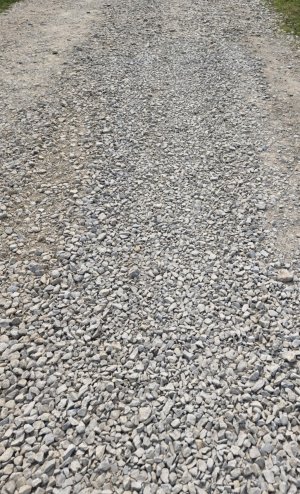
He does struggle a bit walking on this:

Screenshot_20250601_174459_Gallery.jpg

He just walks shorter and takes the occasional "ouch" step. I don't know how well an unshod horse should walk on this? There's also random larger stones in some spots.

I do have video of him free in the indoor school if anyone cares to take a look. It's just odd because the vet declared him sound and saw him trot on hard ground and grass, so I'm baffled. I don't think he has the toughest feet, but I don't know that they're complete shite either.

I've also put him in fly boots to minimize stomping on hard ground.
 
Yeah, that's true. We'll see.

I am considering composite shoes to see if that helps anything or is a good middle ground between bare and metal shod. I'd like to alleviate any inflammation and prevent further damage.

He does struggle a bit walking on this:

View attachment 161003

He just walks shorter and takes the occasional "ouch" step. I don't know how well an unshod horse should walk on this? There's also random larger stones in some spots.

I do have video of him free in the indoor school if anyone cares to take a look. It's just odd because the vet declared him sound and saw him trot on hard ground and grass, so I'm baffled. I don't think he has the toughest feet, but I don't know that they're complete shite either.

I've also put him in fly boots to minimize stomping on hard ground.
I walk shorter over stuff like that and that is with walking boots on so not surprised he does.
 
This is such a roller coaster. As it turns out, he does not have pedal osteitis. His bone actually looks quite good, there is a crena, just as I thought, on both front hooves. Nothing abnornal, no actual degeneration. It looks as solid as it can look.

My vet had me panicking. He wanted to put him on previcox, metal shod with pads, and a wedge on one hoof for that 1°.

My farrier and I reviewed the x-rays and I was able to send them over to a very reputable vet clinics podiatry specialist.

Horse looked excellent on grass today (had video taken) and walked on the smaller gravel quite well.

I really was on the fence about this horse, but after this "scare" or whatever it was, I've realized just how much I value him. So atleast I've got that and some x-rays out of it. Two of which that weren't shot dead on from the side.
 
Top