
To make hay or haylage?

lizziebell

Well-Known Member
Joined
2 January 2009
Messages
1,636
Location
...in my wellies
Visit site
Those who make their own - which is more cost effective, hay or haylage? And what are your reasons for choosing to make one over the other.

I know where I am with hay - it's what I've used for the past 25 years, however due to a reduction in storage space I'm thinking of asking the farmer to make me small bale haylage this year. How much wastage would you expect from split / spoilt bales?
 
I generally make my own hay, either small square bales or, if the weather threatens, I'll get my neighbour to put it into 4x4 rounds. One year I put a lot of muck on and the swaths were huge so I got the local contractor to wrap it. Due to a misunderstanding, the contractor put 8 layers of wrap on the bales which turned out to be a good thing. I had far too much fodder and was feeding it for three years! It kept well until year three when some bales had white mould. The mould is not harmful and is in fact a fungus or yeast and is quite OK to feed to horses.

The haylage was made a day before it would have been fit to bale for hay and I was feeding it to Highland ponies in big bale feeders. Some it is was certainly OK for over a week. I think it goes off quicker if it is damp or not dry enough when made. But I had a tractor loader to put it into the feeders. I fed some by hand by splitting the bales with a hay knife and forking it out, but it is hard work.

I did look at small bale haylage but it seems very expensive both to make and to feed. Making it is very labour intensive unless you can justify machines costing tens of thousands.

Frankly, my choice is small bale hay, but you need the weather to make it. I am in the Scottish Highlands, so…. :( At the moment, I am feeding 4x4 rounds out of the quad trailer (loaded with the tractor) which cuts down wastage and allows some rationing. But it is so much easier with small bales of hay in every respect! I haven't used small bales of haylage and the cost has put me off.
 
It is easy enough to make small bale haylage (if the baler is up to it) because the kit is basically the same. It is the wrapping that is the problem. Special wrapper, more labour to handle heavier bales, etc. I did look into it but discovered that I really needed a bale wrapper costing around £30,000! Bit it can be done cheaper with more labour. Let us know what he says.

I've now got a tractor loader to handle big bales but previously I used to do it all with a car trailer, loading ramps, and a long rope!

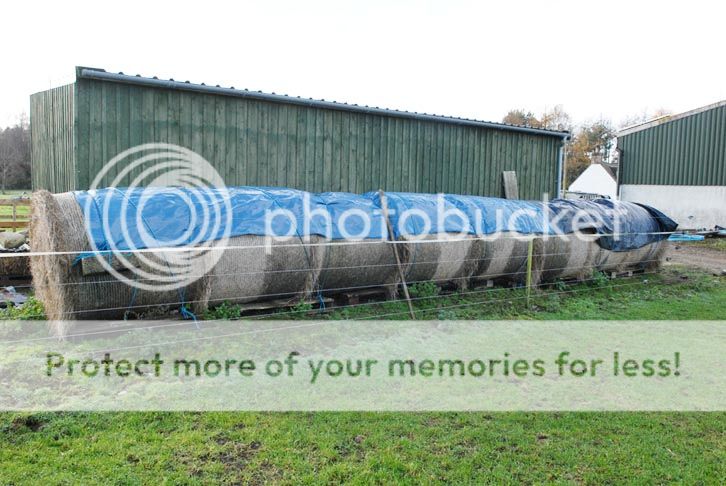
I, too, have a storage problem. I get as much as I can inside, then….

DSC_0155a_zps42d764fd.jpg
 
Hay is the most cost effective, but you need the weather for it, you have to pay the farmer for wrapping the bales of haylage, i dont know how much it cost for small bales but we paid £7 { large square bales} each to have ours done. { that might be all in bale wrap/farmers fees}
 
Hay is obviously cheap as compared to Haylage but Haylage is more nutritious than hay. Haylage has lower fructan levels and better microbiological quality as compared to Hay so I normally prefer it for my Horse. Secondly one more advantage of Haylage is that its dust free but you must take care that your horse consumes it in a limited manner. I totally agree with Dry Rot regarding the cost issue but you can try for a small bale of Haylage if cost factor is not that important for you.
 
I make hay because I'd rather feed hay, haylage can be very variable in quality (I know hay can too but I don't know enough about it to know which is good or bad) haylage has to be used quickly and is far far too rich for my oldies
wrap can be damaged during making, stacking or by birds/ sheep/ etc tearing at it. So you do need to keep a close eye on it. It'll be quite a lot more expensive to may haylage because of the wrap -
Personally I'd invest in tarp tyres and even some straw bales to go around the outside of an outside stack of hay.
 
I used to feed haylage as it was easy to store, but found we ended up throwing so much away, it was so hit and miss, that we went back to hay. In both cases we use big bales. It's much easier to handle and use big bale hay than haylage.
 
Top