Unusual colour question...

Serenity087

Well-Known Member
Joined
1 February 2008
Messages
7,581
Location
Now would I be a Kentish lass, or a lass of Kent?
Visit site
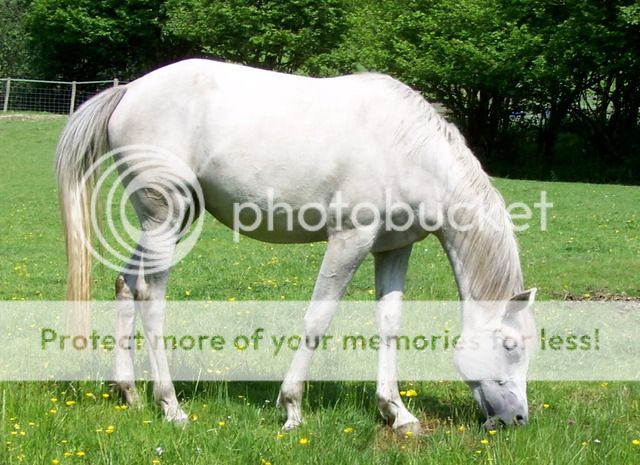
As you can see, I have a rather oddly marked horse... So I've been having a look online.

Can only find three other horses on the entire internet who have blood marks and "reverse blazes" - or solid blood marks on their heads.

As well as Dorey, they are Warface, a fleabitten grey arabian, Laska de Thaix, a fleabitten grey TB and an unknown grey.

I have never seen blood marks on another part of the anatomy that merge to form a solid block, but there's obviously these four with marks on their faces!!!

Some of the forums that discuss them think they're chimeras? Is that just overcomplicating the fact that blood marks do, for some odd reason, solidify on the face?

Opinions?

Photos...

Warface:
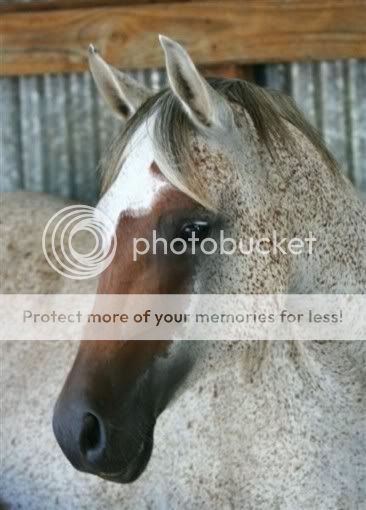
Warface1.jpg


Laska de Thaix:
laska_de_thaix_greysteeplechaser.jpg


Unknown:
pi.jpg


Dorey:
190012_10150148747342630_507522629_6506956_8258341_n.jpg


ETA: I've just noticed that, Laska de Thaix excluding, the others appear to show signs of having a white blaze/star as well. Which shows that the brown is definitely a "hole" in the grey gene... but why so solid?
 
Last edited:
It does appear that this is happening more with greys now, it looks like patches like this are able to reverse the greying effects somehow and allow the pigment to re-establish itself. This might be a new mutation that can combat the effects in localised areas and I have heard of, but not seen, a grey horse almost turning back to it's original colour. There is also an instance of a horse showing no signs of grey until it was 13!

I can't find any research on it, I did contact the project that found grey on another matter but got no reply, would suggest them, but maybe not!!
 
There is a gelding on livery at the riding school where my nephew rides with a blood mark like these. Not sure if I could get a picture of him though.....
 
DSCF1821.jpg


Appaloosa markings don't count then?

I can remember an arab race horse in training back in 1990/91 that had a blood mark on the face. No idea of the name though.
 
Last edited:
I have seen lots of blood marks on the neck and body of horses, but very few on the face. Could it have something to do with how the foal was positioned in the womb, as I know the positioning does affect the distribution of the white leg markings.
 
The markings in Appaloosas are interesting in that in the process of going whiter they do not affect the spots (if any) and leave the bony areas with colour, hocks, knees and often the nose bone. In appaloosas I think it has something to do with the shifting in pigment, it does not appear to be fixed at birth and spots on an appaloosa can move throughout it's life and new ones appear. So it might well be something similar in greys that either saves off the grey in the first place or allows colour back after the greying process?
 
Interesting....

Over my head though so nothing to add. but you learn something new everyday on her.

It's not all trolls!!!!!:D
 
A quick question KarynK, my grey filly had a small area where she'd pulled the fur out. there was no cut but the fur grew back 90% chestnut, instead of 90% grey (as it had been before). I was just wondering why this happened?
 
my little fleabitten arab is the same, everytime he has a cut the hair grows back chestnut and doesnt grey out.
 
Dorey, having greyed out to almost white, is now going in reverse and is getting more and more chestnut.

Suspect she will be a dreadfully spotty fleabitten grey! But it's interesting because in her youth, she was almost black!

Enfys - No offence, but no, appy's don't count - they're SUPPOSED to have brown spots!!! Grey isn't!

What I'm trying to see is if the reverse blaze is related to the blood mark, but why it's solid on the face and not on the body (I have seen roan blood marks on faces!).

Pretty sure that Dorey is only hetero for grey, if that helps matters. Foaly is 1 next week and is still bay, albeit with roaning in her mane and tail.

I mean, the grey mask in horses is effectively the same as a coloured mask - which plonks white spots on the base colour, so there's no reason why a grey gene, which turns the base colour, can't have holes in it too!!

There also seems to be no rhyme nor reason to breed, although more common in Arabs. Are they breeding for a marking, or a defective grey gene?

Fascinating...
 
A quick question KarynK, my grey filly had a small area where she'd pulled the fur out. there was no cut but the fur grew back 90% chestnut, instead of 90% grey (as it had been before). I was just wondering why this happened?

It's interesting that this sort of thing happens in Roans when they scar the hair for some reason reverts to the base colour, yet a base colour horse will scar white. It could be that the pigment cells in the skin are damaged and allow the opposite colour to appear where it would not because of the overall gene effect on the coat?????

800px-Blue-Moon-Roan-Nokota-Stallion.jpg


I did see some pictures on the internet years ago and am kicking myself now as I cant find them but it was reverse markings, so where you would have white socks or blaze, that area had black hairs, I am sure I remember one was a chestnut and that should not have been possible, they could of course have been fakes!!

Grey itself has been around a long time and it may be we are seeing the first genetic mutations in the horse against it?
 
Enfys - No offence, but no, appy's don't count - they're SUPPOSED to have brown spots!!! Grey isn't!

.

None taken:)

I was just asking as the dark nose/blaze is very common and I assumed it was more of a usual patterning in spotted horses rather than a 'blood' marking.

My white arab (born chestnut) started getting fleabitten at about 12 years old, I swear there were more freckles appearing every day on him.
 
None taken:)

I was just asking as the dark nose/blaze is very common and I assumed it was more of a usual patterning in spotted horses rather than a 'blood' marking.

My white arab (born chestnut) started getting fleabitten at about 12 years old, I swear there were more freckles appearing every day on him.

Reverse blazes appear in appies, coloureds and these blood marked greys. Appies and coloureds are simply just lucky spots (they're called badger faces in coloureds!) - but these solid blood marks in greys intriegue me because they're not solid anywhere else on the body!

And they're not always solid, I've seen roan blood marks on faces!

The thing with these blood marks is, it's as well as a white blaze, you can tell that all the greys have got stars or stripes in white on their base coats. So the reverse blaze is on top of their white blaze!

all very interesting!
 
It's interesting that this sort of thing happens in Roans when they scar the hair for some reason reverts to the base colour, yet a base colour horse will scar white. It could be that the pigment cells in the skin are damaged and allow the opposite colour to appear where it would not because of the overall gene effect on the coat?????

When she has had cuts, the fur grew back in a way that matched the rest of her coat. It was only the area where the hair had been pulled out but the skin wasn't damaged, that grew back 'wrong' (IYKWIM ;) ).


Flossgrazingthree.jpg

^ see the small stripe on her side. That's made up of mostly chestnut hairs. she probably scraped herself on something.

Flosscantertwo.jpg

Where as this ^
(all the yellow is fly cream over the healing cuts)

Flossgrazing.jpg

grew back grey with only a few chestnut hairs, matching the rest of her fur. ^
 
Last edited:
That's unusual Faracat, wonder if you shaved her if that would grow back chestnut, not suggesting you do of course!!!

This one was a bit off target!!

images
 
Last edited:
Top