Went to a vet talk last night

About injuries and rehab.
A physio had the last slot and was talking about kissing spines and other back trouble. She was saying you need to do groundwork exercises to supple your horse, you can’t expect them to lift through their back with you and a saddle on if they can’t while standing in the stable.
She treats a big showjumping yard and said since she had taught pre riding exercises to the owner she visited there loads less as the horses just weren’t getting the problems.
I don’t ride any more, and tbh rarely venture in tack room. So is that something everyone is already doing? It made such sense to me.
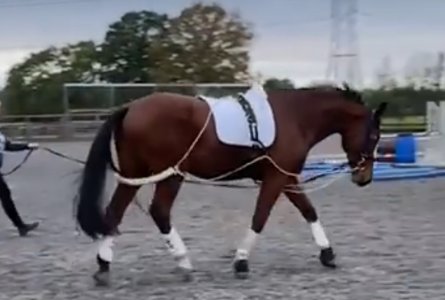
Yes I did four months, day after day after day. Groundwork, lunging with pessoa over raised trot poles. Walking backwards with head down to stretch SI and strengthen and walking through Labyrinth. Also long reining. Lots of long reining. Along with a pro rider riding 2 to 3 times a week and myoplast in his feed.

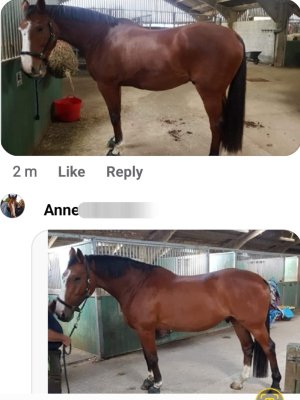
It made no difference though. KS, SI and arthritic changes everywhere all of which I had medicated.

Before and after photos.
 

Attachments

  • Screenshot_20250617_111633_Facebook.jpg
    Screenshot_20250617_111633_Facebook.jpg
    313.4 KB · Views: 29
  • Screenshot_20250617_111551_Facebook.jpg
    Screenshot_20250617_111551_Facebook.jpg
    386.8 KB · Views: 18
  • Screenshot_20250617_111537_Facebook.jpg
    Screenshot_20250617_111537_Facebook.jpg
    596.8 KB · Views: 17
  • Screenshot_20250617_111416_Facebook.jpg
    Screenshot_20250617_111416_Facebook.jpg
    783.6 KB · Views: 17
  • Screenshot_20250617_111350_Facebook.jpg
    Screenshot_20250617_111350_Facebook.jpg
    991.5 KB · Views: 24
  • Screenshot_20241024_110039_Gallery.jpg
    Screenshot_20241024_110039_Gallery.jpg
    213.6 KB · Views: 29
Yes, I use groundwork quite a lot, primarily postural, but also a bit of despooking stuff with the younger horses for fun. I also teach all the lateral work inhand first, and I dont do any of it under saddle until they are comfortable and confident doing it inhand.
 
My loan horse is a very heavy boy, [Clydie x] coming up in years [18], with a sticky stifle, so we really need to get that old synovial fluid in the joints, and his muscles, warmed up before i get on.

His warm up/ground work is mostly dynamic rather than static, though I might do some neck stretches, tail pulls and belly lifts.

Then, we do some Tristan Tucker style patterns - moving the shoulders around, moving the hindquarters around, some in-hand laterals at walk, (shoulder in and leg yield), some 'clocks' moving hindquarters around and asking the horse to stop at 3 6 9 and 12 - both directions. Then a gentle jog trot with plenty of transitions to walk and or canter on the lunge to get his heart rate up a bit.

It all takes about 20-25 minutes. Helps me tune in with him too.

If I had a younger, greener less balanced horse, I would learn to long rein, [!] and I would also do more stuff from a great book I sometimes use:, Jec Ballou's "Equine Fitness" https://www.booktopia.com.au/equine...lQNBJr26E3Juq8gp9WCDCk0jpIbtPNKRoCTDoQAvD_BwE
 
Many vets and physios still do recommend gadgets and increasing range of motion as rehab, those I respect do not and focus on posture and stabilisation. I think we have to be really careful to understand what promotes healthy movement and what does not - the right groundwork is powerful and is so often better employed than ridden work when we face problems, for sure.
 
Many vets and physios still do recommend gadgets and increasing range of motion as rehab, those I respect do not and focus on posture and stabilisation. I think we have to be really careful to understand what promotes healthy movement and what does not - the right groundwork is powerful and is so often better employed than ridden work when we face problems, for sure.
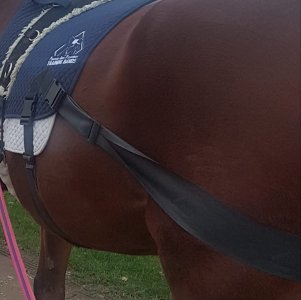
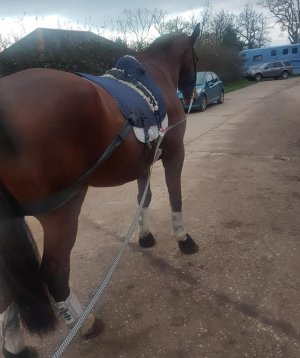
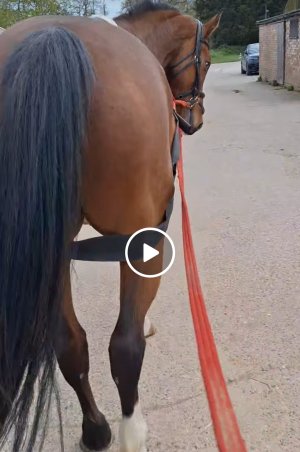
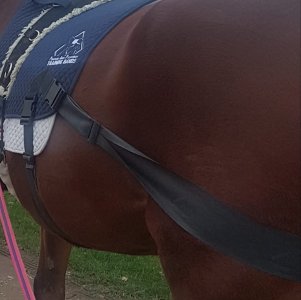
Normally I would agree, but in the past I have borrowed a friend's Equiband system, and found it to be useful in gradually building core and topline. https://www.horseandhound.co.uk/features/equiband-what-is-it-and-how-does-it-work-739313
 

Attachments

  • Screenshot_20250617_111551_Facebook.jpg
    Screenshot_20250617_111551_Facebook.jpg
    386.8 KB · Views: 17
Normally I would agree, but in the past I have borrowed a friend's Equiband system, and found it to be useful in gradually building core and topline. https://www.horseandhound.co.uk/features/equiband-what-is-it-and-how-does-it-work-739313

It promotes the hind leg coming under, and yet it doesn't even promote correct use of the hind leg (let alone any of the other aspects of correct balance and movement) so I remain to be convinced, though I know a lot of trainers, physios etc still often recommend them. Many still recommend restricting head/neck/front end which more and more people are realising isn't healthy, so I don't see that as clear cut...

The hind leg can come further under but still be very straight through the stifle, for example, giving a great overtrack etc, but putting strain on other joints. We just don't need to use this stuff - the hind leg can be better developed by understanding the role it has in deceleration, stopping the horse "falling forwards" which isn't corrected by driving the hind leg further under in itself. If we slow the walk down and ask the horse to come into better balance as a result, all the joints should work better/equally, and the hind leg coming under then comes in time. Deceleration first, "engagement" as traditionally seen, next. There is real nuance in this, you can even have horses whose toplines, to most eyes, look pretty good, and often very muscular, but the body still isn't working correctly, it's just become strong within the dysfunction.

I'm not saying it's not useful (potentially, we developed horses plenty well without anything like this in the past) but the horse MUST be using itself correctly, using that deceleration, de-rotated in the ribcage and able to push up between the shoulders for adding extra "load" like this to give clear cut benefits...surely?
 
Here's a nice post about rehab, the way I see it (and yes, I have mentioned the thoracic sling quite a lot over the years, because I think too many horses are ridden in compression, often a direct result of TOO MUCH leg to hand riding without understanding what's going on in the body). It explains why we use lateral work as therapy and a comment mentions long and low type rehab which may or may not be achieved with gadgets. It doesn't directly address adding extra load though, if I see a good post on it, I'll add it!:

 
I had my last mare di stretching exercises every morning, before and after every session of work and never had any issues with her, she was worked very hard at times, was very strong through her back and very supple for her confirmation too.
 
My exceptionally talented and astute chiropractor vet does recommend the use of the Equiband to certain of her clients with the proviso that it is used correctly.

She is a former senior equine vet at Leahurst who, though still fully qualified, registered and insured as an equine vet now does chiropractic work. She’s also studying osteopathy too. And she’s a bit fitter amongst her other talents. Her observations of how a horse moves and uses itself are second to none. She misses nothing. She will pinpoint issues that have been missed by multiple other equine professionals inc vets. Many she can help with, some she refers on, some can’t be helped as too broken.

If the Equiband was a harmful gadget for a quick fix she would not recommend it. There are plenty of common but harmful quick fix gadgets that she doesn’t recommend. Pessoa, anyone 😳?
 
It promotes the hind leg coming under, and yet it doesn't even promote correct use of the hind leg (let alone any of the other aspects of correct balance and movement) so I remain to be convinced, though I know a lot of trainers, physios etc still often recommend them. Many still recommend restricting head/neck/front end which more and more people are realising isn't healthy, so I don't see that as clear cut...

The hind leg can come further under but still be very straight through the stifle, for example, giving a great overtrack etc, but putting strain on other joints. We just don't need to use this stuff - the hind leg can be better developed by understanding the role it has in deceleration, stopping the horse "falling forwards" which isn't corrected by driving the hind leg further under in itself. If we slow the walk down and ask the horse to come into better balance as a result, all the joints should work better/equally, and the hind leg coming under then comes in time. Deceleration first, "engagement" as traditionally seen, next. There is real nuance in this, you can even have horses whose toplines, to most eyes, look pretty good, and often very muscular, but the body still isn't working correctly, it's just become strong within the dysfunction.

I'm not saying it's not useful (potentially, we developed horses plenty well without anything like this in the past) but the horse MUST be using itself correctly, using that deceleration, de-rotated in the ribcage and able to push up between the shoulders for adding extra "load" like this to give clear cut benefits...surely?


This is good research on the use of therabands https://www.rvc.ac.uk/equine-vet/ne...f-elastic-resistance-band-training-for-horses
 
They are all good things that were measured as outcomes, but they are not enough in themselves, and it's the belly band from what I can see, not the bum band which was mentioned before. These benefits plus more fundamental postural change, balance improvement, can still all be done, and imo with close observation of the horse, so more horse-centric development, if we learn the appropriate groundwork skills and work properly in hand.

The proprioceptive loose bum band, ie TTeam bodywrapping figure 8 and others, can be really good for proprioception, which is a fundamental input to good balance and posture.
 
If I was going to throw general stuff into the mix then I'd do tail pulls - nothing activates the quads in the same way. Start with just a few obviously but if you get resistance one way that's good feedback to the therapist (or even the vet)

Stepping over stuff is great for reminding joints of their range of motion. My shoulder was never as strong as when I had to haul a wheelbarrow into a muck trailer 2x day. It complained to start with but my physio probably wishes I still did it. I have old sleepers for my horses to step over to & from field and it works.

Asking for backwards. We reverse out of my tie-up area. Fascinating to see how hard one of mine finds reversing in a straight line. Because it's done daily and it's routine it's easy to see improvements (or not - also good therapist feedback)

Snaking over poles on the ground - another good quad exercise.

Lead from both sides. Dodgy shoulder makes me very bad at this.

If picking out feet hold it up for longer than just the time it takes to clean it. Ask for some gentle circular motion with the leg. Is there resistance? Place foot down slowly & deliberately.

Wither rocks (physio Gillian has a video somewhere Horses Inside Out group). Lovely one for pre tacking up.

ETA - what most bodyworkers moan about away from clients is that people start with intent and then just stop. Even it's just a small routine it's better to start with something than do nothing.

ETA #2 don't mind the TTouch bands but all my other gadgets are gathering dust. Equibands need to be correctly measured up IMO and used with a good understanding of why the horse doesn't have a good topline in the first place.
 
Had a new body worker out last night for my 2 girls.
Older mare was in worse shape than younger mare, but both had issues with thoracic sling.
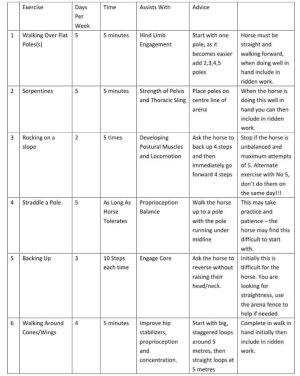
She recommended long reining in head collar, forward purposefully walk, over flat poles and then to add in these exercises alongside ridden work.E4168918-86EF-40D8-BD5E-611BDD0C023A.jpeg
 
Top