
(Why) is this bridling wrong?

Korg

Well-Known Member
Joined
22 October 2025
Messages
1,526
Visit site
I've used this kind of bridling on two horses. Usually prefer not to have a noseband, but I find this to work well when one is needed. I don't just want the noseband to restrict them from opening their mouths (which sometimes is necessary), I also want it to add stability. This does. It's a regular bridle with the noseband stuck in the side piece, so using the rein also pulls on the noseband if harsh enough. The bit won't go through the horse's mouth if something drastic was to happen.
I've never seen it used by anyone else but have googled and it seems to be a thing in the driving community.

So, why is this wrong, if it is? If it isn't, then why isn't it used more? I'd like to learn more about it.
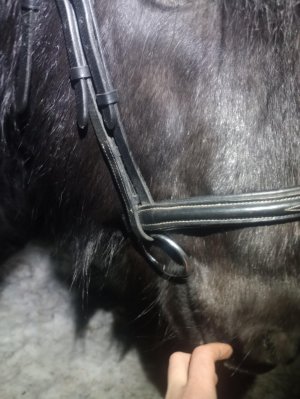
Messenger_creation_B9D1B0F4-BE50-4162-949E-1BFBD2569C7A.jpeg
 
I'd be interested to see a whole head shot to see where the noseband is sitting because with a snaffle I suspect it's too low if the bit is at the right height. I think most of the driving bridles I've seen have the noseband going through the cheekpiece at a higher point than the bit, but I'm not a driver so could be mistaken.
 
Driving bridles, the nose band would be sat higher up and not interfering with the bit
Your set up will mean each pull on the reins, or if the horse moves the bit in it's mouth, it's likely to hit the noseband and effectively make the bit hit it's teeth etc.
 
Thank you all!

I'll see if I can get a photo of the whole head. The horse seems more comfortable with this than with no noseband, but I haven't used it many times on him. It makes sense that the driving bridles would have a slot for that specifically, I didn't know it was a thing before I tried this.
 
I might also add that the noseband isn't particularly tight. It is tight enough for him not to easily get away from the bit by opening his mouth (he does have a bolting problem), but nowhere near how it appears to be on many show horses.
 
If he's happier with that set up maybe look at getting him a driving bridle, at least then you know it's designed to be used that way.
 
If he's happier with that set up maybe look at getting him a driving bridle, at least then you know it's designed to be used that way.
I'll definitely look at that. Will need to check his teeth soon anyway so will ask the vet about it then, if he thinks it harms his teeth/other areas. I think he needs the stability of a bit that won't slip, as he sometimes needs to be turned used a not ideal amount of strength, to prevent bolting. Feels useful to also have the bridle act as a sidepull in that case, but of course it shouldn't harm him more than absolutely necessary.
 
Maybe a bit with a full cheek would be useful then, they're designed not to pull through the mouth and will also put some pressure on the side of the face if needed. It may also be worth trying a correctly positioned drop that isn't fitted tightly as they can sometimes help with bit stability in the mouth.

I wouldn't be expecting a vet to advise on bitting or bridle fit, it really isn't an area they train in. It may be worth getting a bit and bridle fitter out though.

If he's genuuinely bolting then you've got big problems though and I hope you aren't riding him anywhere he poses a risk to others when he bolts. If he's "just" getting too strong and getting away from you then maybe look at getting an assessment done of everything and some help for both of you.
 
Maybe a bit with a full cheek would be useful then, they're designed not to pull through the mouth and will also put some pressure on the side of the face if needed. It may also be worth trying a correctly positioned drop that isn't fitted tightly as they can sometimes help with bit stability in the mouth.

I wouldn't be expecting a vet to advise on bitting or bridle fit, it really isn't an area they train in. It may be worth getting a bit and bridle fitter out though.

If he's genuuinely bolting then you've got big problems though and I hope you aren't riding him anywhere he poses a risk to others when he bolts. If he's "just" getting too strong and getting away from you then maybe look at getting an assessment done of everything and some help for both of you.
Vets are usually the ones you ask here, we don't have any bit fitters around. Though the vet I use is also somewhat specialised in teeth.

He is genuinely bolting and I am very much working on solving the issue from where it stems from. Still, it's also a learnt behaviour that he has had for many years before I got him, so I don't expect to solve it without also experiencing the bolting. He doesn't run blindly, but there is nothing I can do when he is bolting. Before that, there are a few seconds of him stressing and in that, I can brake if I do it right. I am careful about where I ride him.
 
Yes higher on a driving bridle and completely free to move/slide around you wouldn’t want it interfering.

Would a Worcester be a better option?
Possibly, though the regular driving bridles also look quite good. I like to keep it as simple as possible. It seems like the only place you can find a Worcester noseband here is in the trot shops, so I will assume they have a similar function.
 
Vets are usually the ones you ask here, we don't have any bit fitters around. Though the vet I use is also somewhat specialised in teeth.

He is genuinely bolting and I am very much working on solving the issue from where it stems from. Still, it's also a learnt behaviour that he has had for many years before I got him, so I don't expect to solve it without also experiencing the bolting. He doesn't run blindly, but there is nothing I can do when he is bolting. Before that, there are a few seconds of him stressing and in that, I can brake if I do it right. I am careful about where I ride him.

If he isn't running blind then he's running off with you rather than bolting - it may seem like a minor difference but it's actually a huge one given that a true bolter has no useful awareness of his surroundings and is the only time I would consider bailing at speed.

Bitting and bridles are so much more than teeth, but if you aren't in the UK I don't know what options are available to you, all any of us can do is the best with what we have.
 
Last edited:
If he isn't running blind then h's running off with you rather than bolting - itmay seem like a minor differencebut it's actually a huge on given that a true bolter has no useful awareness of his surroundings and is the only time I would consider bailing at speed.

Bitting and bridles are so much more than teeth, but if you aren't in the UK I don't know what options are available to you, all any of us can do is the best with what we have.
That's interesting, thank you. He definitely follows roads/paths, turns where he wants, and keeps track of his feet. He is also small and really doesn't move that fast even when trying, so while it is a dangerous behaviour, I don't consider it unreasonable to train it myself.

Yeah, I know it's more than teeth but a vet with a thing to keep the mouth open and actually look at how the bit reacts and lays is the best I can do. There really aren't many people here, especially not horsey ones, so I do have to guess, try and use The Internet quite a lot.

Either way, this thread has given some ideas I'll have to think more about and try, such as exactly how the bridling works when used. I appreciate those who have answered.
 
If you need some steering help then a full cheek snaffle may help, note the picture that has keepers that keep the bit straight.
I do think the way you have the current set up could be contributing to the bolting, as it's likely to be having a negative effect,
He goes...you pull it hurts/creates sudden pressure ...it's another thing he's running from.
 
If you need some steering help then a full cheek snaffle may help, note the picture that has keepers that keep the bit straight.
I do think the way you have the current set up could be contributing to the bolting, as it's likely to be having a negative effect,
He goes...you pull it hurts/creates sudden pressure ...it's another thing he's running from.
He's so far never bolted with this set up, so it's definitely not been a contributing factor. He has bolted (/taken off) with a snaffle bit and no noseband, and has not bolted with a pelham, albeit that might be because he wasn't in a state close bolting. However, it is definitely true that the pain from a bit also can contribute, so if this does hurt more than necessary, that's obviously bad.

I'll look at full cheek snaffles. Even if he doesn't like them, some of my youngsters probably will. Thank you for the tip and link!
 
I was always taught fulmer keepers were for fulmer snaffles, not full cheeks. A fulmer is effectively a loose ring with the side bar, like this 1768519004739.pngand so without keepers the sides can rotate too much. A full cheek is an eggbutt with sides and so has far less movement and putting keepers on may well position the bit wrongly in the mouth. Nowadays it feels like the terms are interchangeable though which is a pity since there are differences in feel.
 
Just a quick thought but would a kineton noseband not work similarly as to what you would want with the nose pressure of the current set up?
 
Just a quick thought but would a kineton noseband not work similarly as to what you would want with the nose pressure of the current set up?
That actually looks very similar. Though it doesn't stop him from opening his mouth and get away that way. Would it be wrong to add a strap beneath the muzzle, do you think?
 
The kineton works by adding nose pressure when you take a pull so him opening his mouth wouldn't allow the escape from the pressure as it hooks through the bit rings. I think adding the strap would nullify the effect of the noseband. The only other way I think you could get the nose pressure would be using a semi cavesson noseband and double reins this would allow you to ride with a bitless side pull and and a bit at the same time in a double sort of bridle and apply whatever you needed as you needed it.
 
A well fitted flash/drop noseband is designed to do just that, but not fitted so tight the horse can't open its mouth. If it's a case of crossing the jaw then it's a grackle.

What's worth thinking about though, is are you creating something else for the horse to fight against, when it gets to this point I'd personally be going back to ground work, and playing with with aids, reteaching aids, and looking at how I was Holding on the horse when riding.

Perhaps op, you need to forget gadgets, and ride slightly differently, more from your seat and body than from your hands.

Lots of circles, lots of transition's, lots of long rein and not holding onto his mouth

Experiment with your body position and see how it transmits to him
 
A well fitted flash/drop noseband is designed to do just that, but not fitted so tight the horse can't open its mouth. If it's a case of crossing the jaw then it's a grackle.

What's worth thinking about though, is are you creating something else for the horse to fight against, when it gets to this point I'd personally be going back to ground work, and playing with with aids, reteaching aids, and looking at how I was Holding on the horse when riding.

Perhaps op, you need to forget gadgets, and ride slightly differently, more from your seat and body than from your hands.

Lots of circles, lots of transition's, lots of long rein and not holding onto his mouth

Experiment with your body position and see how it transmits to him
He is in no way heavy to ride normally, and I ride with a very light hand as long as the situation allows of that. This is purely for when he decides to take off, seemingly reacting to small things, getting distracting, forgetting I'm there and then panicking because I'm there. It's not a slowly progressive thing where he wants to run, he's actually not very forwards but rather the kind you have to remind to actually walk forward. He's not fighting against me, nor the other way around, the very majority of the time. We just need tools that makes training and getting more experience safe, which does involve having a brake when he does react to something.

The other horse I used this set up on was the kind who just wanted to run. Used it on hacks, as cantering forward for longer periods of time was good for him. Still, very light contact most of the time.
 
The thing that s when a horse bolts very little will stop it, and sometimes the hauling on the reins makes it worse.

Strapping a mouth shut ln my experience doesn't help,

Could it be a pinch from the saddle effecting him?

A brake can come from the riders seat or voice before the use of the reins.
After all natural reactions of a rider of a horse shoots forward is to lean back, grip with legs and pull reins.
So in that alone your saying go stop go arnt you?.
 
The thing that s when a horse bolts very little will stop it, and sometimes the hauling on the reins makes it worse.

Strapping a mouth shut ln my experience doesn't help,

Could it be a pinch from the saddle effecting him?

A brake can come from the riders seat or voice before the use of the reins.
After all natural reactions of a rider of a horse shoots forward is to lean back, grip with legs and pull reins.
So in that alone your saying go stop go arnt you?.
No, when he is already running there's not really anything I can do. But in the time of trot/tölt before, there is. I've managed to turn him around, in which case he does stop. However, I need bit and bridle to be sharp and stable enough for that to work properly. I also don't think strapping the mouth shut tightly will help, I can still get a hand in between the strap and the horse when I have the noseband on.

I don't think it is from the saddle as it has happened bareback too.
 
Is he young? Or spooky?

If you’re looking for more control in the case of a spook or a very exciting situation, I would generally up the bitting from snaffle to Universal or similar. In the case of a healthy horse without pain, that would generally give more control, not upset them and enable you to desensitise to life safely. If upping the leverage makes them worse then I would stop and call the vet.

If we suppose in your case it’s just a green horse who you need to be able to safely contain a spook on while they are learning - I would pick something like a Kineton that is designed for this if you are wanting nose pressure. Or just use a standard noseband to stop them opening their mouth and crossing their jaw in the standard way plus a step up from a snaffle in terms of bit. We once had a young New Forest pony who spent her 5 year old year shooting off when she felt like it if the rider wasn’t paying attention. Problem was, once she had gone she wedged the bit in her teeth and couldn’t feel anything you did. We used a grackle and a universal. Problem solved. She grew out of her teenage need to run but it was an interesting year!
 
Is he young? Or spooky?

If you’re looking for more control in the case of a spook or a very exciting situation, I would generally up the bitting from snaffle to Universal or similar. In the case of a healthy horse without pain, that would generally give more control, not upset them and enable you to desensitise to life safely. If upping the leverage makes them worse then I would stop and call the vet.

If we suppose in your case it’s just a green horse who you need to be able to safely contain a spook on while they are learning - I would pick something like a Kineton that is designed for this if you are wanting nose pressure. Or just use a standard noseband to stop them opening their mouth and crossing their jaw in the standard way plus a step up from a snaffle in terms of bit. We once had a young New Forest pony who spent her 5 year old year shooting off when she felt like it if the rider wasn’t paying attention. Problem was, once she had gone she wedged the bit in her teeth and couldn’t feel anything you did. We used a grackle and a universal. Problem solved. She grew out of her teenage need to run but it was an interesting year!
He is neither young nor generally spooky, but a sensitive, introverted type and slightly scared of things behind him. I think he started when he was young and they didn't work through it. I know they just left him in a paddock (cared for, he's never been neglected) after the owner fell off and got injured. Then he wasn't ridden for a few years before I got him. So I think we will have to work through this, including get rid of the extra energy he has, for him to learn that he doesn't have to run. We're also working on general desensitising, have him realise he has a weird human but he's safe.
 
Top