6 Breeds that have changed drastically in the last 100 years

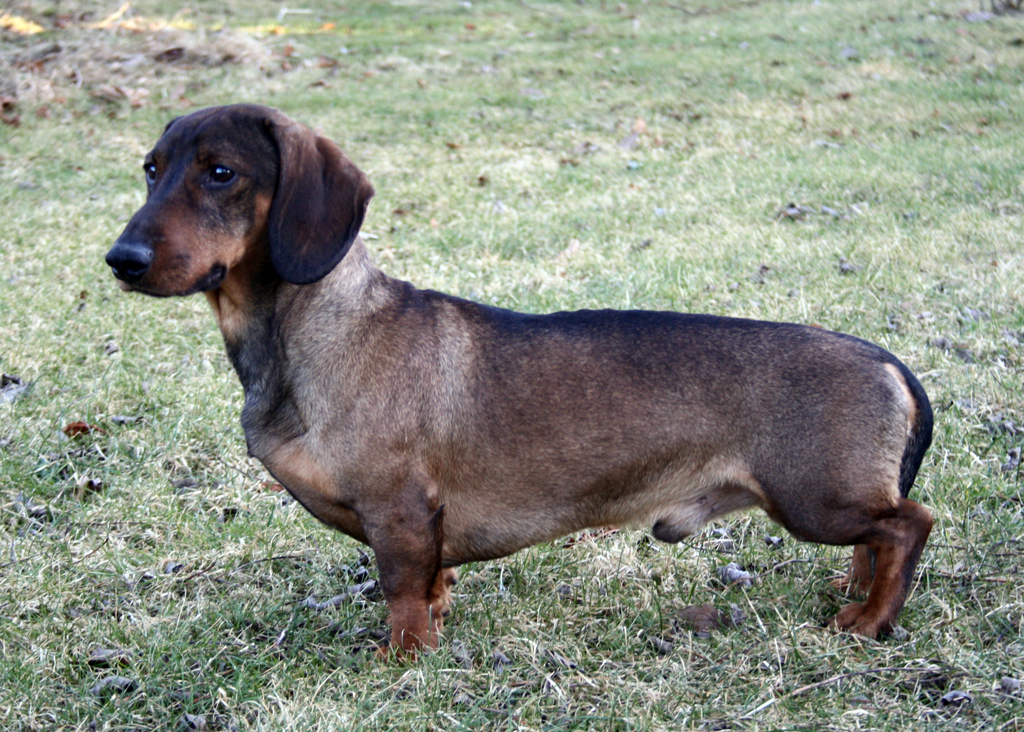
The dachshunds always make me cringe now. They look so out of proportion. They wouldn't be anywhere near capable of the job they were bred to do.

I only own one pedigree dog, a dobie, like yourself and thankfully these have stayed "normal"!
 
That's so very sad.

How do we even start to undo the damage?

Force the KC to become democratic? That would at least be a start. It is in fact a private club so it can do pretty much what it wants. Even it's own members do not have a right to scrutinise its accounts! It is run like a cross between the Mafia and the Free Masons. Anyone attempting to initiate reforms will be subjected to a smear campaign, ostracised, and victimised. See "Pedigree Dogs Exposed" on YouTube.

Power corrupts, absolute power corrupts absolutely. The KC has very little to do with dogs and a lot to do with petty politics.
 
Its my belief its the breed club that set the standard which is then presented to the KC so if enough people in the breed lobbied their breed club it could be changed. The English Bull Terrier for example has a massive change in its skull structure to give the desired roman nose affect, there iis a breed in India called the Gull terrier which originated from the EBT and in actual fact looks very much how they looked 100 years ago.
 
I neither like, nor dislike all the changes. With some breeds, e.g. the English Bulldog, I prefer the way they used to look, but with other breeds, e.g. the Bull Terrier, I prefer the way they look today. With some breeds, e.g. the Boxer, I wish there was a golden mean = some changes but not too much.


I admittedly don't know anything about the hunting ability of either of the Dachshunds on the photos in the link, but, as far as I know, the Dachshund is still a quite popular breed amongst Swedish hunters. The Swedish Dachshunds club homepages have a lot of info about the different types of hunting tests that a Dachshund can participate in, and even though it sadly seems as if it the breeding more and more becomes divided into dogs that have show champion titles, and dogs that have hunting champion titles, it is possible to still find Dachshunds with both show and hunting champion titles.

For example SE U(d)Ch SE J (d)Ch Aruts Laban:

11229171-gVSoo.jpg


(Photo found through Google image search, copied from this site http://www.kortharsgruppen.org/hanhundslista/hanhundslista-2013-8231707, unknown photographer.)


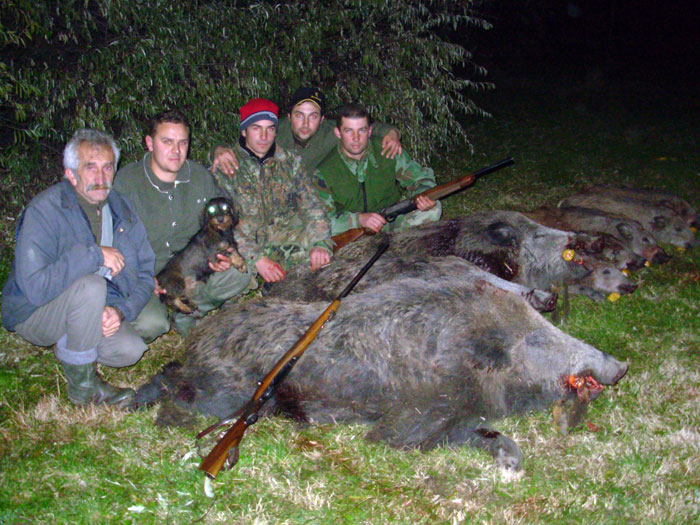
Even though they maybe doesn't look exactly like their ancestors did, it isn't just in Sweden where the Dachshunds still is capable to work as hunters, I think this is a photo from a Serbian site:

DSCN3492.jpg


(Photo found on a Swedish hunting forum, with a link to this page http://www.family-urban.com/takszi/galerija.htm.)
 
And here's me thinking that Dachsunds were bred to go to ground to badger?? did they hunt boar??.
 
And here's me thinking that Dachsunds were bred to go to ground to badger?? did they hunt boar??.


The Dachshund is a versatile hunting dog, which can be used to both hunt in underground dens, and to hunt above ground. As I understand it, in the Swedish tests that can lead to a champion title for their ability to hunt underground, so called tame badgers is used, but otherwise in Sweden, Dachshunds is mostly used to hunt foxes, hares and roe deer. Judging by what I've read on the internet, there is also a few Swedish Dachshund that hunts wild boar, but, again according to what I've read, there is more Dachshunds that is used to hunt wild boar in e.g. Germany and the Czech Republic.
 
I much prefer dogs that are healthy and comfortable i.e. can breath easily, run without wrinkles of skin tripping them up, see properly because their ears aren't so long they drag their eyelids down, aren't in pain because their skulls are too small and put pressure on their brain and so on and so on - the list is seemingly endless :(

I'm not fussed what breed or cross breed they are, I just want them to live healthy, comfortable lives. I prefer how those dogs looked 100 years ago compared to those today (even accounting for the fact that photos can be chosen to illustrate the author's point and could just as easily have been chosen to illustrate the opposite view, that today's dogs are healthier).
 
An interesting topic, OP, well to me anyway!

If we accept that most breeds of dogs were initially bred for a specific purpose, then if we look at the individual breeds, those which are no longer used, for their intended purpose, have ceased too evolve. They have if you like, stagnated and to emphasise the point, look at those breeds which have both a work variety and a show-bench type. The examples are legion, ALL breeds of working Spaniel, are Dachshunds a distinct and different breed to Tekels? I wouldn't know, but I know a guy who has 4 which he uses for trailing wounded deer which a client may have shot, and though they are Dachshund like in appearance, these are grand and game little dogs. Consider the Labrador Retriever; can you imagine a Field Trial Champion turning up at Crufts? Then there are those enigmatic and beautiful Scottish Deerhounds, and dear oh dear, there are those who should hang their heads in shame.

Thankfully, the GSD in its various forms seems to continue with a work breeding ethic, and if anything, it's a growth programme. I understand that you keep Dobermans, and as many other guarding breeds, they are really kept now more as pets, unless you know different. The Rottweiler being another breed which has been 'softened' through breeding, so perhaps it isn't all bad news.

Consider the Boxer, I've seen some first class working (sport) bred dogs in Germany, and they are barely recognisable from our own rather poor offerings.

There are other breeds, the EBT which you've mentioned, Corgis I suspect, possibly Lancashire Heelers, Manchester Terriers, and these dogs would all fall in to the category of dogs bred for a job, and one which they no longer do. The list goes on and on ......

Those dogs which are still carrying on with a job of work, and whether they are actually improving, is another matter, they certainly continue to evolve. The worry, I believe is for those dogs which have the limiting restriction of being considered for the show-bench alone.

The Breed Societies are undoubtably those who are responsible for the production of those dogs which now have the most minute of gene pools, and it's these restrictive gene pools which are the reason for our current downhill spiral. How those who would claim to have the best interests of a breed at heart, can continue to produce such deformities and such apparent weakness and animals which cannot considered, by any judgement, to be fit for purpose, remains a mystery.

There is a simple answer to this, but one which will never be taken up, and it's this; Every breed was formed by the cross breeding of other 'breeds'. As a breed, these animals have ceased to evolve, and the answer is to take those breeds which had a former influence, and out cross, with a breeding plan, and then return to the breed standards. This is all very well, but then perhaps only 10% of those dogs produced initially, will conform to Breed Standards (from here on in known as B_S!). Those dogs which don't conform, or at least make the effort to, should be sold off and NOT registered, whatever the temptation. Those dogs which have the ability to promote the breed, should themselves be retained, and bred from.

There are no simple answers to turning around any existing breed of dog, except that if we consider The Norfolk Horn sheep, and that the last purebred animal died in the 1960s. Judicial breeding has now recreated the original animal. From a commercial aspect, they're pretty hopeless (they always were!), but they've demonstrated one thing, it can be done, and our canine Breed Societies need to remove their heads from the sand (or wherever else they are), and wake up.

Alec.
 
Im a great believer in a breed being fit for function, I can say with certainty that some Lancashire Heelers do still do the job they were bred for. In all honesty how many people have access to cattle, in Finland they run herding classes for LHs, I know Ive seen the videos and one was even a blood tracking champion against all breeds in one of the nordic countries. Most of the LHs being shown still love to rat and mouse so the instinct in them is still very strong.

As for Dobermanns its been my opinion for some time that they have been dumbed down but again they still have or mine do still have that protective quality, maybe living on an isolated farm has helped but Ive made sure they are fully socialised. If they escaped they wouldnt go up the village randomly attacking people. There are breeders out there and Im sure this is not just Dobermann breeders who show and do tracking but also do Schultzhund as well so those dogs are fit for function.

Growing up we had several Corgis and all could work cattle and were excellent mousers, the only Manchester Terrier I can speak of from experience was my last foster dog and he was terrified of everything but given that poor little souls previous life Im not surprised. As he now lives with a couple of house rabbits admittedly giant ones I think its a given that he has no instinct at all.

It is a great pity that dogs are bred for a certain look and breeders have strived for this forgetting the fact what they were originally bred for, if they had kept this in mind some of the health problems would have been bred out because those dogs wouldn't have been able to work.

To me the ideal would be a Cruft winner going out and doing a days shooting or herding etc applicable to the breed, wouldn't that be wonderful and if some breeders kept that in mind and some do to be fair then a lot of health problems would cease to be.
 
Out of interest Dobiegirl, and accepting that magic wands don't actually exist, if you could correct the wrongs, where would you start?

The question is open to anyone, who has an interest.

Alec.

ets, CaveCanem hasn't been about for a while, but I'd be interested to hear her thoughts, too, should anyone be able to raise her from her slumbers!! a.
 
Last edited:
Slopey backed cripples! *whistles* That'll fetch her. :p

My breed is one without any exaggerated features and can be used for working purposes and yet there is still such a divide between the UK and US interpretations of the breed standard that the hoo-hah and vitriol after Crufts was astonishing. And these are still 'normal' shaped dogs. I would hate to be one lone breeder fighting the tide against shorter muzzles, heavier coats etc. in some other breeds...
 
The only true way to test a working dog is with work. Sticking it on the show bench and looking it up and down and gazing into it's eyes to assess temperament isn't going to achieve much, except, in the long run, the destruction of the breed.

Gundogs used to be tested "by rule of gun". It was what you had in your bag at the end of the day that was the acid test. And if that was lacking, you'd use the gun and get a spade. If a dog can work and run all day, there's not a lot wrong with it physically. Also, if the breeder has been watching dogs run for a life time, he should know when things are not right. Then the x-rays won't be needed.

Whatever the breeding system, the bottom line is the correct selection of breeding stock. That's the problem. Unless you can actually train and work the breed, you will never understand all the little subtleties that go together to breed the great ones. Working dogs were never bred to be pets but that will be the majority demand today and any rubbish IS bred from to fill that demand. Field trials as a means of selecting breeding stock have become a total farce.
 
I agree that many of us judge our dogs (and so their likelihood of being suitable for breeding), by their working ability but fail to see how Trial dogs should be excluded from a breeding programme, if that's your suggestion. I agree that our modern gundogs have been bred to be a little more amenable and so that includes our Trial dogs, as there are those Trialling now who couldn't handle one side of a decent dog from 30 years ago. That's the way of the world, I'm afraid to say, and the softening of dogs is the result.

The problem with many breeds of working bred dogs, as you say, is that they aren't bred to work, the previous work ethic has been ignored, and when the odd one crops up with a real sense of self worth, then they often prove unmanageable for the average pet owner, and they end up being labelled as misfits, when of course, they aren't. None-the-less, given any breed of dog which has a clear Show-bench type, and an equally clear Work-type, then the latter stands a greater chance of being a healthier animal.

That's wandering away from the subject though; The point raised was that attention has been drawn to the modernistic changes in some of our breeds of dogs, and their general conformation, and how those changes would affect their ability to give us a day's work, and even how those changes are all so often likely to affect the lifespan of a dog, and it's ability to live a normal and healthy life. Most would agree that the changes are undesirable, and the question's been raised, as to who's responsible. The answer invariably, would be the Breed Societies and the Judges, in my view. It's also my view that with many of the breeds, the gene pool is so small that without some research led outcrossing, so disaster looms for some breeds, but those responsible seem unable to realise that their own specific interests are following exactly the same path.

Alec.
 
Not all breeds were originally "working" dogs. There have been lap dogs for over 400 years, longer than most gundogs. So how are you going to test these? They were bred to be companions and as glorified flea traps. We also have to appreciate that the role of the dog has changed. When you have a litter of puppies, whatever the breed or type, at least 90% will end up in a pet type home.
If your criteria of a good well bred dog is one that can do a days work then my lot must be amazing
. Maya, now aged 12, successfully competed in working trials, obedience, agility and the show ring. Qualified for crufts for life, bred 1 litter.
Lily, aged 7, successfully competed in agility, obedience and the show ring, has 1 CC, crufts qualified for life, goes running with a university athlete 2 times a week
Tiva, aged 1 year, in training for obedience and lightly shown but already qualified for crufts 2015
 
I always fancied a Manchester terrier Alec. But the work has been bred right out of them and my OH was not keen. He says the same with most Border terriers too. I think I liked the idea of having a mini dobie to match the big one 😊
 
I am going to be repeating what has been written on here many times before but there are increasingly more GSD people who are trying to ensure the top winning dogs are fit for function. Regional shows are held which are run under a different system to the usual KC shows, and to win a top award dogs have to first pass a working test, and also have to have been health tested. However the dogs certainly don't look as they did 100 years ago, and whilst I am not going to get into the "slopey backed cripple" debate again, I wouldn't really want them to. I agree that many breeds have changed for the worse, but hopefully enough people are aware of these to gradually implement an improvement. Its not just dogs that have changed is it, not many horses nowadays look like the pictures from 100 years ago.
Our Lancashire Heeler doesn't work cattle but his father does. Both dogs are slightly lighter in body than some of the show heelers which I have to admit I prefer but as Dobiegirl says a lot of heelers are still very versatile little dogs with quite a strong working instinct.
 
Slopey backed cripples! *whistles* That'll fetch her. :p

My breed is one without any exaggerated features and can be used for working purposes and yet there is still such a divide between the UK and US interpretations of the breed standard that the hoo-hah and vitriol after Crufts was astonishing. And these are still 'normal' shaped dogs. I would hate to be one lone breeder fighting the tide against shorter muzzles, heavier coats etc. in some other breeds...

Am interested in the differences/hoo hah if you wouldn't mind expanding BC?
 
I am going to be repeating what has been written on here many times before but there are increasingly more GSD people who are trying to ensure the top winning dogs are fit for function. Regional shows are held which are run under a different system to the usual KC shows, and to win a top award dogs have to first pass a working test, and also have to have been health tested. However the dogs certainly don't look as they did 100 years ago, and whilst I am not going to get into the "slopey backed cripple" debate again, I wouldn't really want them to. I agree that many breeds have changed for the worse, but hopefully enough people are aware of these to gradually implement an improvement. Its not just dogs that have changed is it, not many horses nowadays look like the pictures from 100 years ago.
Our Lancashire Heeler doesn't work cattle but his father does. Both dogs are slightly lighter in body than some of the show heelers which I have to admit I prefer but as Dobiegirl says a lot of heelers are still very versatile little dogs with quite a strong working instinct.

This ^^^ and its precisely this why CC will not be answering, she like MM has said it many times before and Im sure she is bored having to repeat it constantly.

I purposely picked the link because it didnt have GSDs and I know the work going on with the breed but people will forever pick up on the bad examples as there are in all breeds.

As Satinblaze said not all breeds were bred to work but were bred as pets and some were bred for purposes which are no longer pc and some perform tasks they were never bred for such as my Dobes who are skilled ratters and mousers.
 
Am interested in the differences/hoo hah if you wouldn't mind expanding BC?

As random a sample as I can offer - I think anyone would be able to separate them into two distinct types, even though they are the same breed. Note that the piebalds wouldn't even make it into the ring in the US.

1622247_10202452148537987_1054904876_n.jpg


1234930_10202452157098201_516610599_n.jpg


10001419_10202452169138502_1339692025_n.jpg


1012068_10202452178218729_1465497708_n.jpg


CH+Paragon%27s+Red+Red+Wine.jpg


1462944_10152086432494739_1813875872_n.jpg


10178148_10152457192504739_8926048168867733955_n.jpg


485447_10151777003579739_1658979576_n.jpg
 
Out of interest Dobiegirl, and accepting that magic wands don't actually exist, if you could correct the wrongs, where would you start?

The question is open to anyone, who has an interest.

Alec.

ets, CaveCanem hasn't been about for a while, but I'd be interested to hear her thoughts, too, should anyone be able to raise her from her slumbers!! a.


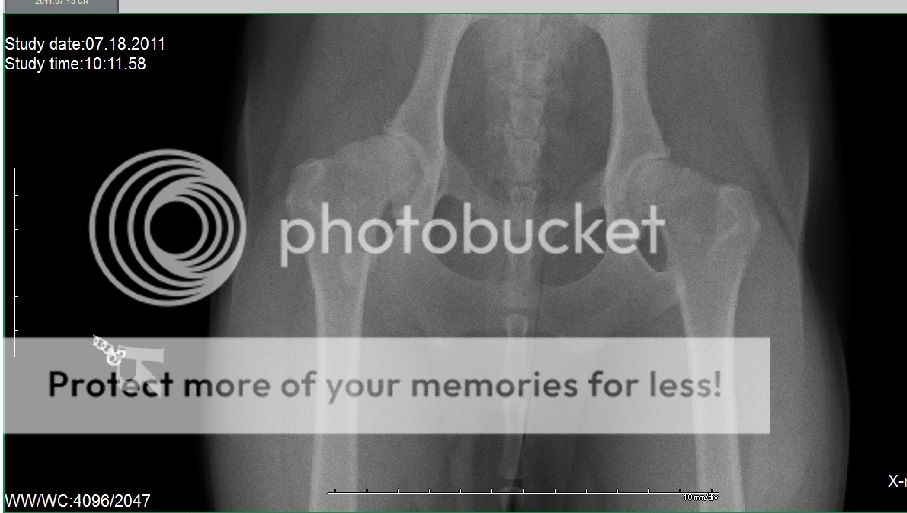
Hips - get rid of hip dysplasia. My collie si from working parents, not KC registered at all, a typical little farm dog, and she has bad hips and is now fairly restricted from arthritis even tho she's only 11.
 
Hips - get rid of hip dysplasia. My collie si from working parents, not KC registered at all, a typical little farm dog, and she has bad hips and is now fairly restricted from arthritis even tho she's only 11.

How interesting, and how sad to read of your dog.

There's a huge problem, I suspect. In the 1970s HD was considered to be a condition which was mostly found in the larger breeds. Consider that 'then' it was unknown in Spaniels and Sheepdogs, as were defective elbows. In the '70s there were extensive x/ray facilities, which were used, breeding programmes were formulated, and we were told that we were on the road to recovery. Were we? Were we buggery. The situation worsened, and despite being surrounded by geneticists and scientists and despite their assurances that we would find an answer, STILL we are not free of the heritable and horrible deformities which we see.

Indeed, and despite our health testing, so it seems to me, we make no progress. Sadly, I have no answers, only further questions, questions which few seem able to answer.

Alec.
 
I saw an article on fb a few days ago(wish I could find it) where they reckoned they had identified the gene responsible in HD in GSD, if memory serves me correct it was an American article but cant swear to it.
 
D_g, I'll be more than pleased to be proven wrong, but as the apparent gene exists in probably ALL GSDs, and Labs and Golden Retrievers, and Rotts, identifying it is one thing, isolating it will be entirely another matter.

Come to think of it, if the complaint is of multi-breed proportions, then I suspect that it can hardly be a gene which is at fault, or defective. Can faulty genes be responsible, and can they influence several breeds, simultaneously? Are there any geneticists out there? If not specific experts, a qualified Vet would do!!

Aru, your input would be appreciated.

Alec.
 
I think this is the article Dobiegirl is referring to.

http://idw-online.de/pages/de/news586117

If it is a gene, it is quite likely that every GSD carries it, HD is known to skip generations . It is an interesting article though.
As Alec says , responsible breeders and owners have been x raying since the 70s (and indeed before) and it is disappointing that the improvement has only been slight, although I do think there has been an improvement certainly in GSDs. The problem is that people x ray and then still breed from animals with poor hips, there is nothing to stop them doing this, even if they are members of the KC Assured Breeders Scheme. They have to health test to be members of the latter but don't have to abide by any criteria for result/score. As people posting on AAD have shown, the general puppy buying public are often still not aware of the need to buy stock from low scoring parents, and as long as the irresponsible breeders have a market they will keep churning them out.
 
Not all breeds were originally "working" dogs. There have been lap dogs for over 400 years, longer than most gundogs. So how are you going to test these? They were bred to be companions and as glorified flea traps. We also have to appreciate that the role of the dog has changed. When you have a litter of puppies, whatever the breed or type, at least 90% will end up in a pet type home.

Couldn't agree more Satinbaze..... I really cannot understand people who think that unless a dog works it isn't a 'proper' dog.

A couple of my greyhounds 'worked' for a number of years before they became my 'pets', yet there is absolutely no difference between them and my little white one, who was dumped onto the streets in Ireland as she didn't grow big enough to race - she was found as a starvation case, so I think perhaps she lacked the chase instinct as well :p
 
How interesting, and how sad to read of your dog.

There's a huge problem, I suspect. In the 1970s HD was considered to be a condition which was mostly found in the larger breeds. Consider that 'then' it was unknown in Spaniels and Sheepdogs, as were defective elbows. In the '70s there were extensive x/ray facilities, which were used, breeding programmes were formulated, and we were told that we were on the road to recovery. Were we? Were we buggery. The situation worsened, and despite being surrounded by geneticists and scientists and despite their assurances that we would find an answer, STILL we are not free of the heritable and horrible deformities which we see.

Indeed, and despite our health testing, so it seems to me, we make no progress. Sadly, I have no answers, only further questions, questions which few seem able to answer.

Alec.

She's fairly well managed with anti-inflammatories, joint supplements and codiene along with hydrotherapy and short (max 5 minute) walks and most of the time is bouncy and happy - you'd never think she was 11 but if she does too much or just on random days she gets sore (get extra codiene on those days), we're very much at the stage where we have a little leeway with pain meds but once I can't keep her comfortable and bad days outweigh good days then I'll say goodnight to her, I suspect that will be within the next winter or two as she has deteriorated a lot this winter. She's comfortable but her exercsie tolerance has seriously dropped from the start of the winter :-( Other than this she's a totally healthy, happy bouncy typical collie dog. Luckily we do obediance so I keep her happy with work rather than exercise.

this is her a few weeks ago
20140410_185656_zpsdf234c02.jpg


Swimming4_zpsa65aabda.jpg


This her x-ray, 3 years ago when she first started on her meds as she was getting stiff, I haven't x-rayed again since as it's not worth the anaesthetic but they would be a lot worse in x-rays now
Megships_zpse6db9f3c.jpg
 
Top