Jeef Perky
New User
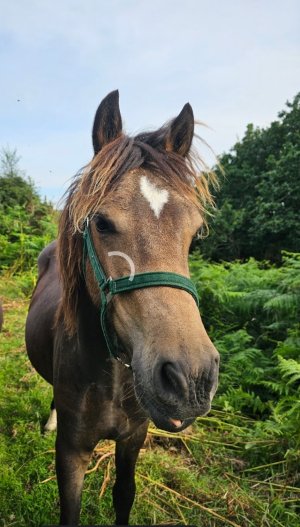
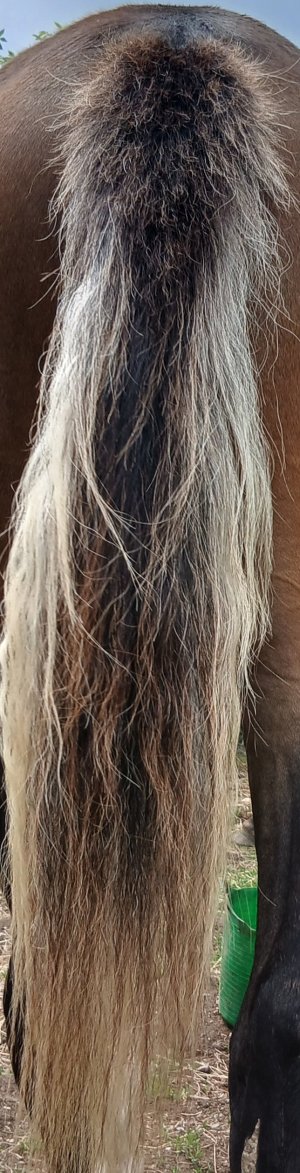
Yeah, that's a very obvious dun dorsal stripe.Here she is. The stripe along her back is quite visible. Are these faint primitive markings/bars on her legs??

Yeah, that's a very obvious dun dorsal stripe.Here she is. The stripe along her back is quite visible. Are these faint primitive markings/bars on her legs??

I think that must be right - that she is Nd1. Main thing is that we got her colour right on her passport. She IS a bay dun!@Marigold4 they do look like leg stripes but I agree her coat doesn't have the right dilution I wonder if she is Nd1 instead. I think @Caol Ila ha a mare with Nd1 that is similar.


Sorry to hear she has cushings. She looks very much the same colour as mine, doesn't she?My little one is homozygous nd1 and is really pale. It causes the pigment to be distributed asymmetrically in the hair shaft the same way dundoes but to a lesser degree, so does cause slight dilution in some individuals
View attachment 143295
this is an old pic, she's nowhere near as fat now, but unfortunately she has cushings and her coat quality has gone downhill as a result

Dun is first and foremost a dilution gene. Your horse has no coat dilution, I’d agree with bay nd1 (which is not dun 1 gene). She’s not bay dun IMO.I think that must be right - that she is Nd1. Main thing is that we got her colour right on her passport. She IS a bay dun!
That's interesting. So she is a bay then and the stripe along her back and into her tail, and primitive markings on her legs are irrelevant? And any horse with a bay colour cannot be a dun?Dun is first and foremost a dilution gene. Your horse has no coat dilution, I’d agree with bay nd1 (which is not dun 1 gene). She’s not bay dun IMO.
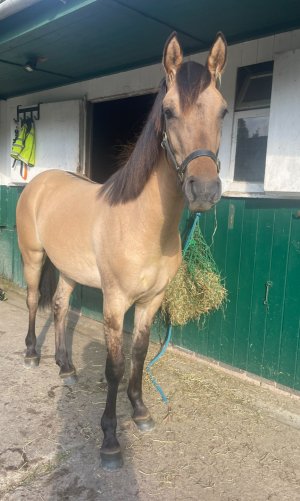
Her sire is Killour Star, a buckskin connemara. Mum is a British warmblood by Royaldik, an Oldenburg. She is a very dark bay, almost black in the winter. Here's a link to Killour Star. https://www.barrowbyconnemaras.co.uk/killour-starThe primitive markings are not irrelevant but are down to the nd1 gene, not the dun gene. There are lots of different shades of bay dun - mine is very ‘yellow’ but they do look diluted in comparison with a bay.
How is your girl bred? There’s not that much dun in uk breeds, relatively speaking.View attachment 143901

A dorsal stripe but the head isn't darker, coat faded, like a dun so I'd suspect ND1 rather than dun.Yeah, that's a very obvious dun dorsal stripe.
Connemaras have cream, not dun. They’re different genes and coat colours, although some still insist on using them interchangeably.Her sire is Killour Star, a buckskin connemara. Mum is a British warmblood by Royaldik, an Oldenburg. She is a very dark bay, almost black in the winter. Here's a link to Killour Star. https://www.barrowbyconnemaras.co.uk/killour-star

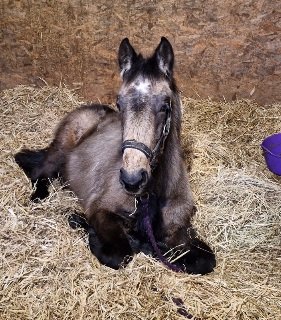
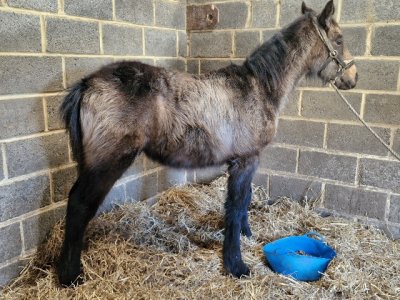
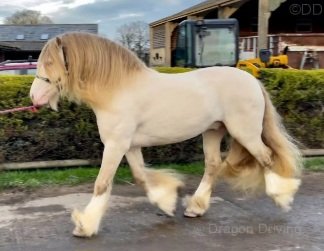

He's definitely Buckskin, he does look like he may be going grey too however, do you have any newborn pictures of him? That's normally the best time to assess for grey as they will have more visible hyperpigmentation and a lack of normal foal camouflage. The dorsal stripe could be from either Nd1, which can cause primitive markings similar to actual Dun but without the base coat dilution, or could be due to grey hyperpigmentation.I know this is an older thread however am a hit stumped on colour for this lad - sold as a buckskin, he's 8 months in pics, as he's grown a bit more (10.months now) has almost a silver top layer to his coat (still got the winter baby coat), bottom.pic is dad, mum was grey, he's got a fairly solid dorsal stripe with solid black legs - in am going to test him but came across this thread and figured I'd see what you lovely people thought
View attachment 158108View attachment 158109View attachment 158110
I know this is an older thread however am a hit stumped on colour for this lad - sold as a buckskin, he's 8 months in pics, as he's grown a bit more (10.months now) has almost a silver top layer to his coat (still got the winter baby coat), bottom.pic is dad, mum was grey, he's got a fairly solid dorsal stripe with solid black legs - in am going to test him but came across this thread and figured I'd see what you lovely people thought
View attachment 158108View attachment 158109

Just out of sheer curiosity, where would the 'blonde' come from on our baby? Her mane is black like her mums. Mum bay black points black mane and tail. Dad almost black with black mane and tail. Dam sire if the tale be true and not just a touch of the blarney stone is chestnut but mane and tail same not flaxen. Wondering whether it will end up all dark like her mane
ThankyouIts foal tail growing out and will end up black.

Do you know what base colour she is under the Appaloosa spotting so I could or narrow it down a bit? She must at least have one recessive copy of extension (little e that produces chestnut) if she's had a palomino foal.@MatHalTed this is so interesting! Just a question on colour breeding if I may? I have an Appaloosa leopard mini Shetland, her foal is palomino (as was sire) I intend to breed her next year with my perlino, any ideas on colour I could get?
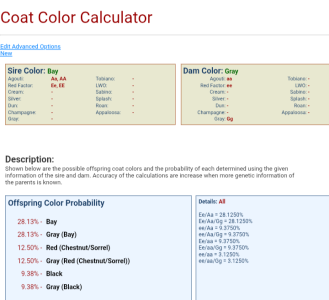 and these are the percentages if we say your mare is heterozygous dominant Agouti.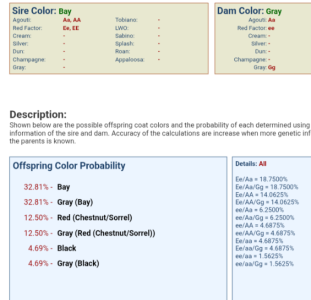
Thank you so much for your detailed reply, it is very interesting, and lovely to have an idea of my mares colour genetics like this. Thank youSo from what you've said your mare is heterozygous for the grey gene so Gg. As she is chestnut she is ee homozygous recessive extension and as she has had a black foal we know she is at least one recessive agouti so together eea_Gg.
Do you know if the stallion has any black or chestnut babies as that would help narrow down his genetics.
So in essence the grey is 50/50 the rest kinda depends on the stallion. These are the percentages if we use unknown for the stallion and homozygous recessive agouti for your mare.
View attachment 161256and these are the percentages if we say your mare is heterozygous dominant Agouti. View attachment 161257
White spotting genes are many and most white marks don't have a known single gene mutation. Other factors such as womb position can also effect it and it is possible there are also suppressor genes so I'm afraid not as simple as 50/50.

Oh great so now we know he is heterozygous dominant extension. If he has a lot of foals on the ground and no black ones then we could assume he's homozygous dominant Agouti so EeAA. That simplifies it to the point where you have no chance of a black foal it's 50/50 chestnut Vs bay but that is based on an assumption.The stallion seems to produce bay and chestnut foals
I have just had a good search and found this on Hilltop Stud "Steeped In Luck carries both the black and red factor genes. He can produce both black and red based coat colors" though I still haven't found any examples of black offspring!Oh great so now we know he is heterozygous dominant extension. If he has a lot of foals on the ground and no black ones then we could assume he's homozygous dominant Agouti so EeAA. That simplifies it to the point where you have no chance of a black foal it's 50/50 chestnut Vs bay but that is based on an assumption.
I think white markings tend to be more loudly expressed on chestnut but I'm not sure where I've got that from.


The stallion seems to produce bay and chestnut foals
They've worded this slightly oddly presumably they mean they've colour tested him and he's Ee, so black and red based, but as bay is black based and they've not mentioned his agouti factor he could still be either AA or Aa. My thoughts are still AA. I've had a look at his parents and they are mostly down as chestnut, bay or grey no blacks until very far back.I have just had a good search and found this on Hilltop Stud "Steeped In Luck carries both the black and red factor genes. He can produce both black and red based coat colors" though I still haven't found any examples of black offspring!
It's fascinating how black needs to come from both sides to have a small chance, but grey (not a colour in its self I know) only needs to come from one parent and has such an influence!
I love greys so I don't mind that at all!