
A constant battle against mites...

**Vanner**

Well-Known Member
Joined
29 July 2010
Messages
2,269
Location
North West, England
Visit site
My boy suffers terribly from this chronic problem. Having read various papers etc I am currently in the middle of a four week programme to try and combat the mites and heal his poor legs, he yet again has an attack of salanders that I tried treating in isolation but to no avail. So what have I done?

Week one: ivermectin wormer; he wouldn't let me bathe his legs at this point so had to do something from a distance. Sprayed with purple spray.

Week two: ivermectin wormer again, legs were much less sensitive so I could hibiscrub his sores and apply 'seal and heal'. Half way through this week I have washed his legs with poly tar shampoo giving it a ten minute contact time on each leg, rinsed and conditioned hair, combed through to remove any loose scabs, once dried I have massaged with equi oil tea tree and carrot seed oil and applied mud guard to his feathers.

So far he is showing serious improvement and his hock sores look much better.

Week three: repeat poly tar shampoo and then sponge on ivomectin wash or spot on spray eight pumps to each leg.

Week four: as week three.

I will keep you all updated. Fingers crossed.

I have just found a piece of research that uses a wash and a lime sulphur dip. This will be my next protocol if this one doesn't work.
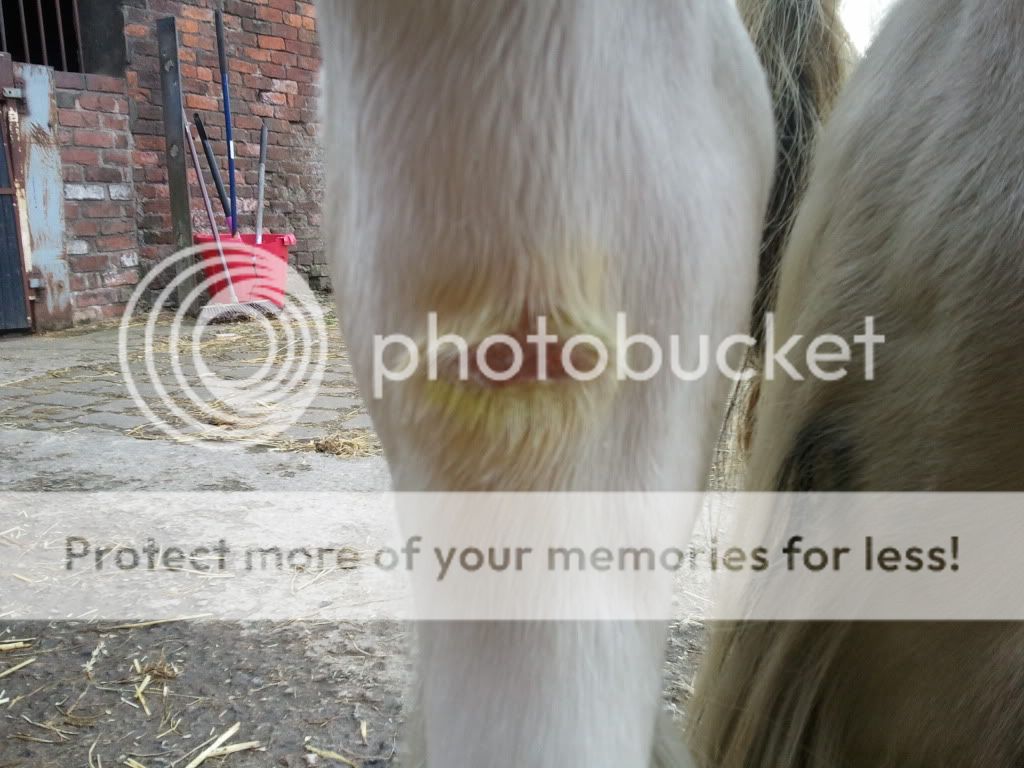
 
Sounds like you're doing the right thing if you're getting an improvement. Even if you can't cure the condition, if you can find a way to manage it so the horse isn't suffering that'll be something. It's good to hear about things that have worked for others. IME most owners seem addicted to using hibiscrub for everything whether its working if not. Is poly tar the same as coal tar shampoo? What is salanders?
 
Polytar is a coal tar shampoo yes.

Salanders is the sores, often seen behind the knees, in the front of the hock.

Cleaned example:

2011-04-11152321.jpg
 
I wonder if some of the owners addicted to Hibiscrub have ever used it on themselves? I have and it STINGS on wounds/grazes. I'm not surprised that many horses react to its use!
I'm not sure why OP started by using Hibiscrub for mites, as it is anti-bacterial. OP I'm glad you feel that you are getting on top of the problem, it certainly is an issue for those of us with feathered horses. I have had good results (after years of lotions and potions) with cooper's fly Repellent Plus on a cob and now am smothering Draft horse in Sudocrem with some success. She apparently had the Dectomax injections before I bought her but they didn't seem to be effective for her.
 
Last edited:
I can't see the pictures and not sure what else you've tried but I found that equimins lice and mite lotion did what other products couldn't.

I've tried everything including lime sulphur shampoo and treatments from the vet.

One bottle of the equims stuff and his fronts are clear and his backs are clearing up too.

Hope you finally get ride of the pesky things!
 
Thanks vanner I never heard the sores called that before.

Pearlsasinger I've heard people say they use it for lice then wonder why it don't work, watch mud fever get worse and worse and the owner says well I'm hibiscrubing daily nothing else I can do! Makes you want to bang their heads together. I've never even owned a bottle and none of mine have died yet lol.
 
A fair number of off the shelf products tend to be a bit pants, they waste time, money and prolong itchyness.

This stuff really works, you have to get it from the vets on prescription, but I'd never bother with anything you could buy over the counter anymore.

https://www.pfizeranimalhealth.com.au/products/369/barricade-s-cattle-dip-and-spray.aspx

For healing the sore bits I use either Sudocream or Lincolns Tea Tree oil lotion.

Good luck :)
 
A fair number of off the shelf products tend to be a bit pants, they waste time, money and prolong itchyness.

This stuff really works, you have to get it from the vets on prescription, but I'd never bother with anything you could buy over the counter anymore.

https://www.pfizeranimalhealth.com.au/products/369/barricade-s-cattle-dip-and-spray.aspx

For healing the sore bits I use either Sudocream or Lincolns Tea Tree oil lotion.

Good luck :)

This looks pretty pokey stuff, how do you apply it?
 
This looks pretty pokey stuff, how do you apply it?

It is, you do have to be pretty careful with it. Dilute it 1 part to 50 parts water then you apply it down the mane, spine and on to the tail. Works a bit like frontline you'd use for cat flies etc. You need to wear gloves using it and be careful not to get it on yourself, it smells like paint stripper! For one application I just use a tiny bit dabbed on a sponge in a few inches of water, a litle goes a very long way.

Its worth it though, I've only had to use a second application once, and its so much less fuss and faff, within 2 days you can see the relief in the horses :) An application will typically work for around a year, its great for keeping ticks at bay too, at my old yard they were a big problem but my lads really never got them, anything that stuck came unstuck fairly quickly.
 
Has anybody tried any human OTC scabies solutions like derbac M (malathion) or Lyclear (premethrin)? I have been given
lime sulphur to trial by the vet but
it just runs off the feathers and hasn't been very effective :(
 
I'm not sure why OP started by using Hibiscrub for mites, as it is anti-bacterial.

I hibiscrubed the sores on his hocks like that in photo because they had necrotic tissue (which hibiscrub removes) and were open. I did not use the hibiscrub in order to deal with the mites themselves. Sores are open to infection so I used this then sealed with seal to heal.
 
Ok I have a mare who in the past has suffered terribily with leg mites,firstly dont use straw as a bedding as most straw has mites unless it has been pre treated ,use shaving if you can or cardboard bedding,thirdly wash legs with hibiscrub the rinse well let them dry then apply Pig Oil and Sulphur only when legs are dry, you only need to do it every 3 weeks ,also have to add get everything out of stable and dis infect with a mild solution of Jeeys fluid when dry try and put shavings down . After years of trying every vet preparation going this was the advice from a friend and it worked good luck
 
**Vanner Salanders is the sores said:
The word is Malanders. They generally appear at the front of the hock.

I have found that washing with hibiscrub and then picking off the scabs is the worst thing to do with my Shires. The hibiscrub is very drying and stings and exacerbates the irritation. I wash their legs with Malaseb then dry them with wood flour. The drying process is very important, because warm, wet/damp feather can be a breeding ground for secondary infection. I've had varying luck with pig oil/sulphur. I mix up a bottle of Skin So Soft and Tea Tree oil and use it to discourage mites. The only thing that really works, once there is broken skin from chewing and scratching, is 3 Dectomax injections, each given ten days apart. I'm not keen on subjecting them to the chemical because it can affect the liver. However, when their stamping and rubbing produces bloody lower legs, all the Sudocrem and other topical applications just cover and prolong their discomfort (the girls had their first of three doses yesterday, after globs of Sudocrem the day before). I also find that when the girls are on new grass their itching is much worse.
 
The word is Malanders. They generally appear at the front of the hock.
.

It's called malanders behind the knee, salanders in the front of the hock ;)

I've just got some wood flour for drying and have skin so soft and tea tree so I'm going to rub that through too. I've also ordered malaseb this morning. I don't use hibiscrub as a rule, in fact normally I wash with baby shampoo!

They still seem to be improving and he seemed much more comfortable this evening.
 
Ok I have a mare who in the past has suffered terribily with leg mites,firstly dont use straw as a bedding as most straw has mites unless it has been pre treated ,use shaving if you can or cardboard bedding,thirdly wash legs with hibiscrub the rinse well let them dry then apply Pig Oil and Sulphur only when legs are dry, you only need to do it every 3 weeks ,also have to add get everything out of stable and dis infect with a mild solution of Jeeys fluid when dry try and put shavings down . After years of trying every vet preparation going this was the advice from a friend and it worked good luck

Sadly like many owners I wish this routine had been enough for my boy. He is on shavings, has had dectomax in the past and I use pig oil and sulphur. His condition has gone beyond these and I would call it chronic. Glad this worked for you and your pony.
 
My little cob has mallenders, I use Skincure to sort the sores, then aqueous cream on the new skin to stop it cracking-if I miss a tiny scab it can escalate amazingly fast :( Using pig oil and sulphur at the moment but it doesn't seem to be doing much. It does make it easier to rummage through his feathers though!

I had a chat with my vet when I first noticed the scabs, coblet wasn't stamping or scratching, so we didn't think it was mites but just in case, he was treated for them with Seleen shampoo followed by an ivermectin rinse-this is the important bit-I was told to really soak him in it, up to his elbows/stifles and along his belly. Apparently the nasty little critters can also live up there:(
 
My little cob has mallenders, I use Skincure to sort the sores, then aqueous cream on the new skin to stop it cracking-if I miss a tiny scab it can escalate amazingly fast :( Using pig oil and sulphur at the moment but it doesn't seem to be doing much. It does make it easier to rummage through his feathers though!

I had a chat with my vet when I first noticed the scabs, coblet wasn't stamping or scratching, so we didn't think it was mites but just in case, he was treated for them with Seleen shampoo followed by an ivermectin rinse-this is the important bit-I was told to really soak him in it, up to his elbows/stifles and along his belly. Apparently the nasty little critters can also live up there:(

Really wouldn't use aqueous cream, it contains sodium laurel sulphate (sp) which is a detergent.
 
It's the only thing that's stopping the skin from cracking.

My mare suffers badly with sallenders. I've tried all the usual stuff over the past 3 years - dectomax injections, hibiscrub, various creams, pig oil etc etc - all to no avail. The pony got so sore that she'd fidget and kick out when I tried to apply stuff to her legs. Then someone told me to mix sulphur powder with lard and apply that to the cracked skin. I had nothing to loose, so gave it a try. It works wonders on her, her legs are so much improved.
 
My mare suffers badly with sallenders. I've tried all the usual stuff over the past 3 years - dectomax injections, hibiscrub, various creams, pig oil etc etc - all to no avail. The pony got so sore that she'd fidget and kick out when I tried to apply stuff to her legs. Then someone told me to mix sulphur powder with lard and apply that to the cracked skin. I had nothing to loose, so gave it a try. It works wonders on her, her legs are so much improved.

Did your pony have feathers and if so, how did you get the lard on her skin without ending up with a horrible sticky mess?

It does sound disgusting!! But I'm not a veggie and I have gloves:p
 
There's another thread on here entitled "Feather Mites Nightmare" so worth a look at that too; a lot of the suggestions etc are duplicated.

My farrier says that years ago if horses had feathermites then they'd just slap on good old fashioned goosegrease. This works basically by suffocating the mites and making the environment non-feasible. I'd be careful if using sulphur tho' coz my boy came up very pink and sensitive when I used it on him - patch test first.

My vet has recommended the following treatment for mine:

Purchase three packets of Eqvalan (ivermectin-based wormer). First week - dose with one packet; then in a fortnight dose with the second; then wait another fortnight and dose with the third & final one. This should get rid of the mites at all stages of their hatching & development.

Have a look here: for anyone who's tempted to think Oh feather-mites, so what, not such a problem.......... basically its a form of chorioptic mange and so needs treating and keeping on top of.

http://www.harlequinfarmsgypsyhorses.com/ChronicProgressiveLymphedema.html
 
Did your pony have feathers and if so, how did you get the lard on her skin without ending up with a horrible sticky mess?

It does sound disgusting!! But I'm not a veggie and I have gloves:p

The cracked skin is only in the creases behind her knees. But her skin splits really badly and bleeds if not treated. I clip the hair short, melt the lard (cheap block stuff from Tesco), stir in the sulphur powder, leave to set and then rub in like a cream. Not sure if its cos of the sulphur but it rubs in quite easily - just like any other cream really. It only needs treating about once a week and washes out easily with warm water - not that I wash it out very often!! After three years I was in total despair about her legs and absolutely nothing was working but for some bizarre reason this works for her.
 
It's called malanders behind the knee, salanders in the front of the hock ;)

I've just got some wood flour for drying and have skin so soft and tea tree so I'm going to rub that through too. I've also ordered malaseb this morning. I don't use hibiscrub as a rule, in fact normally I wash with baby shampoo!

They still seem to be improving and he seemed much more comfortable this evening.

Thanks for that information. I've only ever heard the word mallenders, malanders or such, never salanders.

I hope the Malaseb, wood flour, Skin So Soft, tea tree oil work.

There's something else I'm going to try when their legs are healed. I use Diatomaceous Earth in my chicken huts, nest boxes, runs and even a bit in their mash to control red mites. The DE is made from the skeletal remains of diatoms, one-celled brown algae that existed million of years ago and accumulated in lake and ocean beds by the billions. Without getting too technical, these skeletons have formed a rocky sediment that is mined and fine-screened into a powder form. DE is a natural desiccant, and as such, it has the ability to dry up mites and other critters. It's action is mechanical rather than chemical, so it is completely safe, as long as it is food grade DE. I'm going to dust the DE into the horses' feather and on the floors of their field shelters. I'm undecided about dusting the floor of their polebarn, because they lie down and sleep in there and I'm not sure if I want them breathing in the powder. I'll keep you posted...
 
Has anyone tried SpotOn for cattle for feather mites? I know it is not licensed for horses but I would think that's because the licensing procedure is expensive, rather than it being unsafe. But don't take that as a recommendation, or I wouldn't be asking the question!:)
 
Last edited:
Has anyone tried SpotOn for cattle for feather mites? I know it is not licensed for horses but I would think that's because the licensing procedure is expensive, rather than it being unsafe. But don't take that as a recommendation, or I wouldn't be asking the question!:)

I have had some success using Spot On. With chorioptic mange mites, it seems to be very much a case of trial and error as what works on one horse will not work on another.
 
Thanks for that information. I've only ever heard the word mallenders, malanders or such, never salanders.

I hope the Malaseb, wood flour, Skin So Soft, tea tree oil work.

There's something else I'm going to try when their legs are healed. I use Diatomaceous Earth in my chicken huts, nest boxes, runs and even a bit in their mash to control red mites. The DE is made from the skeletal remains of diatoms, one-celled brown algae that existed million of years ago and accumulated in lake and ocean beds by the billions. Without getting too technical, these skeletons have formed a rocky sediment that is mined and fine-screened into a powder form. DE is a natural desiccant, and as such, it has the ability to dry up mites and other critters. It's action is mechanical rather than chemical, so it is completely safe, as long as it is food grade DE. I'm going to dust the DE into the horses' feather and on the floors of their field shelters. I'm undecided about dusting the floor of their polebarn, because they lie down and sleep in there and I'm not sure if I want them breathing in the powder. I'll keep you posted...

This is what I use and it works a treat. I haven't even had to take off my boy's feathers this year.
 
Top