Abscess through coronary band

Amy13

Member
Joined
28 June 2015
Messages
19
Visit site
Sorry for long post!

My cob pony went lame suddenly whilst out riding on 10th September. He was fine in walk then but still lame in trot. So not the usual lameness I’d expect with an abscess.

Vet came out 12th September. Did the usual lameness work-up. No obvious heat, no reaction to hoof testers and nerve blocked to isolate to front right foot (which got rid of lameness) so gave bute for a week thinking it could be bruising.

Still no improvement so had vet back out on 27th September and had full x rays of both feet. Nothing obvious on x-rays so showed to the specialist who queried one small dark spot.

On 5th October had vet and farrier out. Farrier pared surface of sole to look for tracks but nothing. Again no reaction to hoof testers but poulticed anyway.

7th October found a drain hole with pus on the coronary band.

Have been poulticing- wet poulticed for 3 days as advised and have been dry poulticing now (so a week since abscess broke out). However, horse is still lane despite the hole looking like it may be starting to close. There’s no swelling in the leg so don’t think the infection is migrating but in my experience once abscess has drained horse is normally sound.

He’s barefoot if that makes a difference so didn’t know whether it could just be the softening of the foot. However, I would say now that the frog feels a little more squishy than usual so am concerned about that.

I was wondering if you’ve had an abscess break through at the band how long has it taken for your horse to be sound again? I’ve only ever dealt with ones that have come through the sole!
 
Unfortunately my experience isn't a happy one, the abcess kept draining through our mares foot and then band, but kept on filling up during the week. Vet dug more out and said it was a deep underrun abcess, She never came sound even after draining. After 1 week she lay down and didn't want to get up, her leg had swollen up on that afternoon, the vet came out and suspected it had gone septic. At 28 we didn't want to put her through struggling to travel to the clinic, xrays/ surgery so we let her go. Her whole sole and frog went very very soft, felt like a bog. Keep doing what you're doing, and keep an eye on any swellings.
 
Unfortunately my experience isn't a happy one, the abcess kept draining through our mares foot and then band, but kept on filling up during the week. Vet dug more out and said it was a deep underrun abcess, She never came sound even after draining. After 1 week she lay down and didn't want to get up, her leg had swollen up on that afternoon, the vet came out and suspected it had gone septic. At 28 we didn't want to put her through struggling to travel to the clinic, xrays/ surgery so we let her go. Her whole sole and frog went very very soft, felt like a bog. Keep doing what you're doing, and keep an eye on any swellings.
So sorry for your loss. Praying this isn’t the case for my boy 😥
 
Hating to add to the tale of woe's but mine wasn't a happy experience either.

This was one of my old boys, long gone now. He'd been diagnosed with what was deemed "Cushings" in those days. He was also laminitic, and was a veteran (20+ at the time).

He got one coronary-band abscess, then another, and they never really cleared up. All on his front feet. Sadly they never really cleared up and in the end his hoof had got to the point where it was practically degenerating so we had to make a sad decision.

Sorry OP not what you want to hear I appreciate.

How old is yours? Are there any pre-existing conditions such as EMS or laminitis?

If not then I would be inclined to get your vet to take some bloods to see what might be going on.
 
I've dealt with quite a few of these over the years.

For a start I never understand why vets recommend poulticing the coronet band once it's popped. Before it's popped, yes, to soften the area and make it easier for it to get out. Afterwards, gravity will make a poultice which is above the abscess pretty pointless.

It's absolutely essential you stop the hole from closing from the top. To do that I would tub twice a day in warm salt water and then syringe on peroxide at 3% under as much pressure as you can give it. It will close from the bottom as the hoof grows down and takes the hole with it. When you can't get peroxide in any more you can stop the tubbing and peroxide

I then left it uncovered. I have never had one cause any problems beyond a few days lameness.
.
 
Last edited:
Hating to add to the tale of woe's but mine wasn't a happy experience either.

This was one of my old boys, long gone now. He'd been diagnosed with what was deemed "Cushings" in those days. He was also laminitic, and was a veteran (20+ at the time).

He got one coronary-band abscess, then another, and they never really cleared up. All on his front feet. Sadly they never really cleared up and in the end his hoof had got to the point where it was practically degenerating so we had to make a sad decision.

Sorry OP not what you want to hear I appreciate.

How old is yours? Are there any pre-existing conditions such as EMS or laminitis?

If not then I would be inclined to get your vet to take some bloods to see what might be going on.
I’m sorry to hear that 😞 He’s 17. We’ve EMS and cushings tested previously and both were negative. No signs of laminitis from x rays either.
 
I've dealt with quite a few of these over the years.

For a start I never understand why vets recommend poulticing the coronet band once it's popped. Before it's popped, yes, to soften the area and make it easier for it to get out. Afterwards, gravity will make a poultice which is above the access pretty pointless.

It's absolutely essential you stop the hole from closing from the top. To do that I would tub twice a day in warm salt water and then syringe on peroxide at 3% under as much pressure as you can give it. It will close from the bottom as the hoof grows down and takes the hole with it. When you can't get peroxide in any more you can stop the tubbing and peroxide

I then left it uncovered. I have never had one cause any problems beyond a few days lameness.
.
Oh that’s interesting! Did you keep it poulticed/covered whilst you were still syringing? My horse is kept out 24/7 as he spends all his time trying to break out of his stable and injured himself in the process.

Have been tubbing with Epsom salts daily too to try to draw anything remaining out.
 
Last edited:
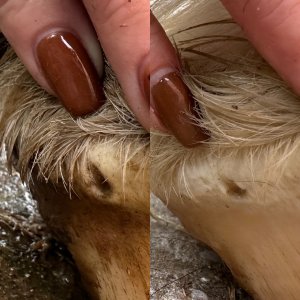
This is the drain hole- left was when it first broke last Sunday, right is today.
 

Attachments

  • 895A4E32-C9EE-41EB-AB45-B5E7F2F80A77.jpeg
    895A4E32-C9EE-41EB-AB45-B5E7F2F80A77.jpeg
    790.7 KB · Views: 62
Oh that’s interesting! Did you keep it poulticed/covered whilst you were still syringing? My horse is kept out 24/7 as he spends all his time trying to break out of his stable and injured himself in the process.

Have been tubbing with Epsom salts daily too to try to draw anything remaining out.

No, I don't poultice or cover anything that has broken open the coronet or heel.
 
Sorry for long post!

My cob pony went lame suddenly whilst out riding on 10th September. He was fine in walk then but still lame in trot. So not the usual lameness I’d expect with an abscess.

Vet came out 12th September. Did the usual lameness work-up. No obvious heat, no reaction to hoof testers and nerve blocked to isolate to front right foot (which got rid of lameness) so gave bute for a week thinking it could be bruising.

Still no improvement so had vet back out on 27th September and had full x rays of both feet. Nothing obvious on x-rays so showed to the specialist who queried one small dark spot.

On 5th October had vet and farrier out. Farrier pared surface of sole to look for tracks but nothing. Again no reaction to hoof testers but poulticed anyway.

7th October found a drain hole with pus on the coronary band.

Have been poulticing- wet poulticed for 3 days as advised and have been dry poulticing now (so a week since abscess broke out). However, horse is still lane despite the hole looking like it may be starting to close. There’s no swelling in the leg so don’t think the infection is migrating but in my experience once abscess has drained horse is normally sound.

He’s barefoot if that makes a difference so didn’t know whether it could just be the softening of the foot. However, I would say now that the frog feels a little more squishy than usual so am concerned about that.

I was wondering if you’ve had an abscess break through at the band how long has it taken for your horse to be sound again? I’ve only ever dealt with ones that have come through the sole!
My sister had one this year. The farrier did find a black spot on the sole but couldn't dig to the bottom of it, not prepared to draw blood. She then got much lamer and we had the vet out. She found a soft spot on the coronet and after poulticing that area it then broke out at the coronet. However it was several weeks before she came sound. Being only a field ornament we just gave her time and she eventually came 100% sound.
 
My sister had one this year. The farrier did find a black spot on the sole but couldn't dig to the bottom of it, not prepared to draw blood. She then got much lamer and we had the vet out. She found a soft spot on the coronet and after poulticing that area it then broke out at the coronet. However it was several weeks before she came sound. Being only a field ornament we just gave her time and she eventually came 100% sound.
That’s really good to hear. I’m in no rush for him to go back to work just want him to be comfortable so glad to hear it was successful!
 
I’d do as ycbm suggests and use peroxide daily. If you are worried about it getting dirty I find covering the whole foot with a nappy, then bandage, then duck tape, is much better than keeping them in. As it’s quite a small hole, i’d probably just leave uncovered.

My experience didn’t end well either, but that was because it progressed to a suspected infection if the pedal bone :(
 
I know one that ended well. We thought it was done and dusted after two weeks. Friend walked her mare down the road and we both thought she looked slightly off still so re-poulticed with a warm one.

Gunk everywhere. Coronet band and frog oozing green smelly stuff. This took ages to clear and friend was verging on asking for an X ray but vet wasn't sure what it would show. Important to say there was no heat up the leg so it was isolated to the hoof.

It was at least 4 weeks before it stopped oozing so we wondered if she'd got a blackthorn in there. Grew a funky hoof for 6 months but otherwise ok.

Although the poultice can soften the frog if there's something waiting to come out then it does help it find an exit route IMO.
 
Bit of a late reply but I've had 2 horses that had abscess burst at the coronet and not immediately clear/become sound. One was round towards the heel, it drained for ages and she was a lot better right away (this was after weeks of vet/farrier not finding anything) but she wasn't 100% for a while. I just kept her moving and kept it clean.
The other mare had one burst at the front of the coronet, was fine initially but then it recurred about a month later, so obv. wasn't fully gone. I did the same with her, kept her moving and cleaned the hole out as much as poss. A vet saw it when it was draining and wanted to poke around her sole to see if she could find it but I didn't let her because it can be a long slog if a vet digs out masses of sole. This mare's hoof did eventually break up a bit as it grew down the following summer and she ended up with a big chunk off her foot but she was OK.
Have so say both were older horses when this happened, early 20s, so I think that was maybe a factor although neither had a positive cushings test.
 
I had one, poor horse was very lame, vet came after much poulticing. Then after a few more days it burst out through the top. He wasn't too lame and the farrier then cut a wedge into the hoof wall and masses of gunk came out of the bottom of his hoof too, never seen so much in many years of abscesses.

It was summer so he was out so I kept it covered and he was fine.

But my feeling too is to keep it open and soak in warm water.
 
We had one last winter, back foot. Lame as a cat for two days, then it burst and seemed OK, but recurred about two weeks later, same pattern. Mare lived out, with shelter and a hard standing area. The event lines showed in the spring and she did lose a chuck of hoof, but she recovered really well, with little to no intervention. We took this route with her, as she had a difficult experience with very intervention with an abscess as a youngster, which led to her being quite tricky with her feet. However I would do that again, as she mended really well.
 
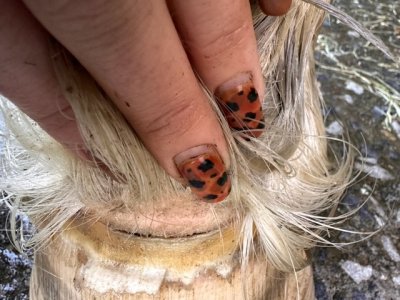
Horse still not sound. Second set of x rays and still nothing conclusive but now seems to be a gap forming between hoof and coronary band. Has anyone come across this before? Very worried.IMG_3880.jpeg
 
Horse still not sound. Second set of x rays and still nothing conclusive but now seems to be a gap forming between hoof and coronary band. Has anyone come across this before? Very worried.View attachment 126221
I think that looks like an exit hole. It should grow down as the hoof grows. I’ve got a good photo of one that did that. I’ll try and find it. How lame is he?
 
Last edited:
Horse still not sound. Second set of x rays and still nothing conclusive but now seems to be a gap forming between hoof and coronary band. Has anyone come across this before? Very worried.View attachment 126221

That's absolutely normal for a big abscess that came out at the coronet. That line will grow down the foot until it breaks off at the bottom. When it gets closer to the bottom it may be obvious that there's a void below it with no attachment to the foot, and a sizable chunk of hoof may break off the bottom because of that but it rarely causes any issues.


ETA that looks very central to the hoof. If it is, that would be a classic sign of a laminitic abscess, which is often in the dead (literally) centre of the toe.
.
 
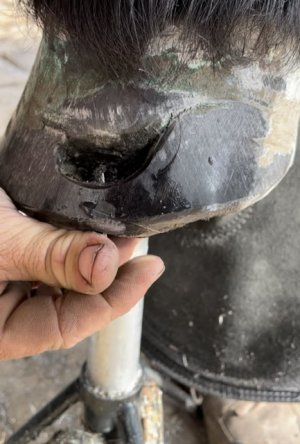
This was when my farrier cut all the dead stuff away. This grew out eventually. You can see how wide the split was when it first appeared. If he’s sound in walk I wouldn’t worry too much yet.
 

Attachments

  • DEC610C7-D0CA-4C5B-BAA4-FB87F07DCF19.jpeg
    DEC610C7-D0CA-4C5B-BAA4-FB87F07DCF19.jpeg
    87.6 KB · Views: 38
That’s good to know. He is a laminitic type. He’s shown no obvious signs of lami and x-rays were clear but it’s certainly something to keep in mind as he is absolutely the kind that would be prone to it. Thank you 😊
 
Last edited:
I've dealt with quite a few of these over the years.

For a start I never understand why vets recommend poulticing the coronet band once it's popped. Before it's popped, yes, to soften the area and make it easier for it to get out. Afterwards, gravity will make a poultice which is above the abscess pretty pointless.

It's absolutely essential you stop the hole from closing from the top. To do that I would tub twice a day in warm salt water and then syringe on peroxide at 3% under as much pressure as you can give it. It will close from the bottom as the hoof grows down and takes the hole with it. When you can't get peroxide in any more you can stop the tubbing and peroxide

I then left it uncovered. I have never had one cause any problems beyond a few days lameness.
.
This plus I put a stockholm wick in the hole, with non absorbant cotton wool, bandage well over the hole, going from heel to toe, and cover then turn out.
My flat footed maxi cob had a huge one, the vet also pared the sole so it was thin enough to try and get it to track that way. Came sound in about a week, he was out every day.
 
Top