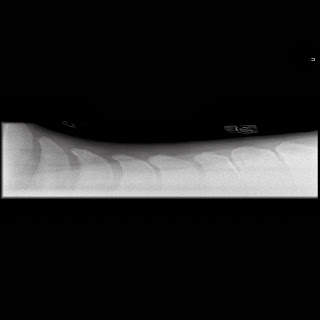
Age for backing, kissing spines, just thoughts....

So the 'average warmblood dressage horse' is retired hurt at 6!???
Where did you get this guff from!?

Go around the forums and you will find so many posts about warmbloods that have hock problems as a result of the work they've been asked to do.

My friends lovely warmblood mare spent a year resting in the paddock after her hocks were screwed up by being jumped in the 4yr old series - she will never jump top level now or do more than the average dressage test because of it.

Hocks and Spine are the last areas to complete maturity wise - both used heavily in a dressage horse and a showjumper.
 
A couple of pictures for the nurture v nature debate. The first is, I think, nurture. The horse was a finely boned 15.2 eight year old 7/8 TB mare with a history of having been broken in and jumped by a man of at least 11 stone. I think she was probably born with her processes far enough apart, but clearly she can't have had the right muscling to stop them clashing together. On higher resolution she has lots of bone formation and in one process, a hole right through it. She was put down.

breeze.jpeg


Next is nature. This is my horse, so if you are going to suggest that I caused this to happen, please do so as politely as you can manage. On higher resolution he has very little bone formation, indication that although they were desperately close, they weren't clashing much.

His breeding is Hanoverian high level dressage, though he is passported as a Westfalian. He's 17 hands and lightweight for a warmblood. I have owned him most of his ridden life, though I did not back him and do not know how he was backed, except for seeing one picture of him in a Pessoa.

His processes are so close together that I think the only thing that could have been done to spring them apart would have been to work him with his back bent upwards, a frame which he was not capable of as a newly broken four year old. This picture was taken at seven. I had been cautious about how far I pushed him physically as he seemed to me to be very slow to mature. As a result, I think we have avoided the PSD/SI injuries that 60% of these horses end up with as a result of trying to avoid back pain (statistic from Cotts Equine).

SPINE-Thoracic-09_07_2013-14_36_56-625.JPEG


Since his operation, he has developed a 15 inch walk overtrack, a 6 inch trot overtrack, corrected a significant front leg flight deviation, gone up a gullet plate in saddle fit, corrected bull nosed hinds and is well on the way to correcting under-run fronts with small frogs.
 
Last edited:
cptrayes - thats quite amazing as to how close together the spinal processes are - so easy to cause problems.

Good to know the op has made such a drastic improvement on your horses action.


It's no surprise they cause problems when we sit on them is it? The big surprise is that more horses don't have problems.

I'm just so glad I never listened to the dressage judge who judged his last test and told me that he needed a man on him.
 
I agree. To a large extent my boy could have been beaten to make him stop spooking, but the availability of back x rays, which are relatively recent, allowed us to get a proper diagnosis easily, without 'getting a man on him'.

My suspicion is that a huge proportion of horses probably have them to some extent, but they tolerate it.

Until we took the pain away with injections, my boy was really ridable if warmed up well. Once the pain had been taken away, then came back when the injections wore off, he would not move off from the mounting block, and if forced to, would buck like stink or rear. If we had never done the jabs, he might just have stayed a typical cold backed horse for the rest of his life.
 
I have just generally read through this thread and to be honest from my experience no two horses with KS are the same.

In my case I own a cob so this does disprove an earlier comment about breeds.
He had been a whips horse before I had him came over from Ireland at 5. I bought him as a 7 year old
I had a full vetting and happily rode him for 6 months before erratic behaviour developed.

I was having Classical Lessons on him no overbent horse for us but he just wouldn't use his back correctly. Then he went from saint to sinner and I was advised by various people to send him off to be fixed, cutting all feed etc etc. that horse needs a man on it,that horse needs a job to do.

I knew it was out of character so took him straight to my vet. Two impinging processes and keyhole surgery for us. It's just over a year since I started riding him again and I am finally getting my happy relaxed chap back.
My vets, in our case, believe it was caused by some sort of trauma. It has been very hard work and he had so much pain memory for a long time I didn't believe he was fixed. Time and patience are paying dividends and he is such a lovely horse I don't begrudge any of it although I was very naive as to just how much work I was undertaking.

I believe there is a greater instance because diagnosis is more accurate but the causes are as varied as the treatments.
 
Flibble I know exactly where you were with the pain memory. I'm right on the middle of it now. Ten weeks and doing really well, but still days like today when he thought it was going to hurt, but it didn't. Knowing that it took you a year will be useful, so thank you for posting :)
 
You are more than welcome. We were hindered by two other issues 1 being a dental situation which evolved during my check once, check twice, check once again and 2 his behaviour had been so bad I lost my nerve.
A less stubborn person would have got someone else to deal with it all but I know me and if he had behaved well for someone else I would still expect him to be nuclear with me and if they had been hurt I could not forgive myself.

The trust is building and now it is my job to sort myself out.
 
The maturation rate of horses is hardly new information. I think there is some argument to suggest some horses might benefit from being left to fully mature - leaving out the emotional aspects, it makes sense! But no one is going to actually DO that, are they? Even the complete natural horses aficionados don't do it.

I didn't back my home bred TB until he was 7. I could see he was physically unready, as well as mentally unready. I long reined him every summer, a few times a week, building up the miles, and then when he was 7 he suddenly looked like a horse instead of a colt, so I started riding him.

I am fortunate in that I had another to ride, and don't pay for livery. Very few are so lucky.
 
Also, remember that in the USA many, many horses are backed and ridden from the age of 2. There are also many USA horses that work well into their 20s - maybe different styles of riding?

I still think that the "traditional" of lightly backing at 3 and doing more work at 4 has stood the test of time.

There are also many horses successfully competing in their 20's in the UK.

I agree though about the tradition of backing at 3, riding at 4, for most horses.
 
What do you mean by "modern"? Jumping saddles have been similarly styled for 100+ years. And saddles in the UK have, generally, larger bearing surfaces and, from what I can see, are far more likely to be constantly professionally fitted. So there should be markedly less incidence of KS here, but I don't see that being the case.

No they have not - it is only in the past 35 years or so that saddle have changed to deeper seats and with gusseted panels - prior to that sadles were much flatter in the seat and the panels were thinner.

I've had more problems fitting gusseted saddles than the older flatter versions. Gusseted panels move out of shape easily.

I don't use a numnah under my saddle so can see exactly where the pressure is by the sweat/grease and friction marks on the underside of my saddle - and you would be very surprised that with the deep seated saddles there is often a friction mark right under the riders seat - suggesting that when the horse lifts its back the spinal processes make contact with the saddle.

Whenever I have seen these marks it has always tied in with my horse going a little hollow in his canter transitions - a visit to the saddler to add more flocking usually sorts it out.

And Tarrsteps in response to one of your other comments - I also leave my youngsters to develop well before backing - Milo was 4½ and Ruby 5 before being backed.
 
No they have not - it is only in the past 35 years or so that saddle have changed to deeper seats and with gusseted panels - prior to that sadles were much flatter in the seat and the panels were thinner.

I've had more problems fitting gusseted saddles than the older flatter versions. Gusseted panels move out of shape easily.

I don't use a numnah under my saddle so can see exactly where the pressure is by the sweat/grease and friction marks on the underside of my saddle - and you would be very surprised that with the deep seated saddles there is often a friction mark right under the riders seat - suggesting that when the horse lifts its back the spinal processes make contact with the saddle.

Whenever I have seen these marks it has always tied in with my horse going a little hollow in his canter transitions - a visit to the saddler to add more flocking usually sorts it out.

And Tarrsteps in response to one of your other comments - I also leave my youngsters to develop well before backing - Milo was 4½ and Ruby 5 before being backed.

Was not the original comment that "modern" jumping saddles have smaller bearing surfaces and are more "close contact", which concentrates pressure? (It was related to the idea that Western saddles should be "better", although I am not in agreement that Western horses are without their problems.) In fact, as you say, this was not at all the case and jump saddles were, generally, flatter and had thinner, narrower panels. My point was people argue that these "modern" saddles are better for horse's backs, having a larger bearing surface and a more "individual" fit, partly because of the range on panels available and partly because the rise of almost constant professional fitting. It was my point that I don't see this argument standing up as, if it is the case, the UK should have a much lower incidence of horses with back problems as most other jumping nations still favour the flatter, older style saddles.

I am not a fan of the deeper seats with gusseted panels at all and, tbh, had very little to do with such saddles as grew up in the tradition of Hermes type close contact saddles, some of them literally pre war! For individual fit beyond the usual restuffing, we used pads. As you say, I find the current saddles in fashion often concentrate pressure rather than disperse it and the extended panels in the back often cause soreness, rubbing etc. I also don't see, over all, that traditional flocking is better, in terms of results, over latex.

I also don't disagree with leaving horses later. I am just saying I don't think that's a very realistic "big picture" expectation, nor is it necessarily true that horses have traditionally been left later before starting work.
 
Last edited:
Top