
ester
Not slacking multitasking
I guess their business model is partly working on the basis that people are more likely to stay with them year on year if premiums aren't increasing.


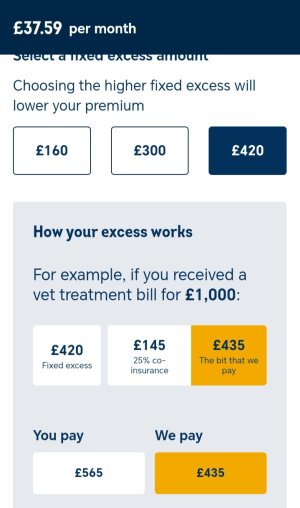


My friend, who insures through Agria, believes that you only pay the excess once per year no matter what you’re claiming for.
Incorrect.I think it's pretty clear from the example above that the excess is per claim not once per year and your friend might be in for a big shock.
.
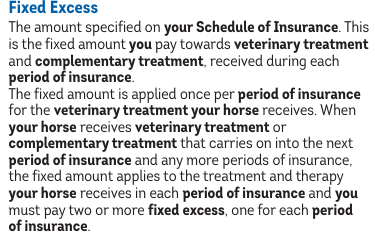
In the tiny writing above the example it says the fixed excess is applied once per period of insurance.I think it's pretty clear from the example above that the excess is per claim not once per year and your friend might be in for a big shock.
.
In the tiny writing above the example it says the fixed excess is applied once per period of insurance.
Which I clearly posted at the exact same time as the one above!

That’s correct, but I found that it actually wasn’t that different. I’m saving approx £100 a month on the premium by being with them, so put that aside for the copayment/excess and it evens out a little. I was planning on having longer without a claim to save up for it, but that’s the risk you take. Luckily in my case I had the funds to pay it, as the 5k was spread over a couple of months.There is something in the T&C about excess and Co-insurance percentage being able to increase at renewal. Its not clear whether agria can raise it?
And whilst it says premiums won't go up just because you have claimed I'd say that is not the same as saying premiums can't go up because your horse is in poorer health than he was a year ago.
Then there is whether owners can afford their share of a large claim. A £5k claim would cost the owner more than £1500 isn't that what a lot of owners pay to avoid?
Are vets happy to take Agria? Mine want insurance paid direct to them so they know they'll be paid, in the above scenario they could miss out on 30% of the claim if the owners can't pay.
I like the idea of agria, I just don't think it's suitable for anyone who doesn't have enough cash to back up a large claim.
It is also based off the advice of the vets and the company I believe have the right to contact the vets and chat with them about whether they will pay. So I guess this would come under that.The excess thing will be another way they are saving a lot of money. Roughly speaking, 50% of conditions that last over 6 months will be subject to the deduction of 2 excesses.
It's a very interesting business model. I would be very interested to know how a horse insured at, say, 14 is covered once it reaches 20, since they say it's a lifetime policy. It would, if that's true, be the only policy (???) paying out for a new hock arthritis diagnosis in a 20 year old.
.
It's the same model as dog and cat lifetime insurance policies - they carry on paying out no matter how old the animal is or what the diagnosis is but the premiums do rise and rise with age as do co pays. £300+ per month plus 20% co pay is not unusual for an older large dog. They cannot refuse to renew the policy unless there is fraud under financial regulators rules but there is no cap on premiums so I imagine they would ramp them up to stratospheric levels if they didn't want your business.The excess thing will be another way they are saving a lot of money. Roughly speaking, 50% of conditions that last over 6 months will be subject to the deduction of 2 excesses.
It's a very interesting business model. I would be very interested to know how a horse insured at, say, 14 is covered once it reaches 20, since they say it's a lifetime policy. It would, if that's true, be the only policy (???) paying out for a new hock arthritis diagnosis in a 20 year old.
.
We had a dog policy. Started out at approx £50 a month when she was young and in the ‘likely to get injured’ age group. We cancelled it when she hit 14 and they wanted nearly £200 a month for a dog who had never had a claim, was entirely healthy and who could no longer be bothered to wander off and get herself into trouble. In the end she died of old age without any long term conditions or other vet bills beyond the end of life ones. I think they did very well out of us!It's the same model as dog and cat lifetime insurance policies - they carry on paying out no matter how old the animal is or what the diagnosis is but the premiums do rise and rise with age as do co pays. £300+ per month plus 20% co pay is not unusual for an older large dog. They cannot refuse to renew the policy unless there is fraud under financial regulators rules but there is no cap on premiums so I imagine they would ramp them up to stratospheric levels if they didn't want your business.
However, certainly in the dog and cat market, insurers are very aware that most owners will get another pet alongside or after they lose the insured one and will be looking for insurance so they look further than just the original claim(s). It's all about market share for them.
Back in 2007/08 PetPlan had an insurance policy for horses that covered 16-21 year olds for full vets fees on a new policy - I bought a 16 year old then and none of the other insurance companies would insure him for anything other than external injuries on a veteran policy. PetPlan did, it was about the same price as my younger horse's NFU policy, no co pay IIRC and within 2 years did pay out to near the 5K policy limit for navicular and DDFT treatment. He never came properly sound and was retired after that so I didn't renew so have no idea how long they carried on offering the policy but I know it was new to the market when I bought it.
 .
.