Anyone ride in a jump saddle 24/7?

Well the Event I rode in in 1995 was most definitely cut as a jumping saddle and B may well be talking about a similar generation of Falcon Event. If you look at second hand ones the older ones are much more forward cut than new ones. There is simply no point in picking at B in this way, anyone who wants to know exactly how an Event is cut today can look it up.
I used to have a hawk event too! It was the first saddle I had for my old boy 20 years ago to accommodate his huge shoulders!
 
Last edited:
Can I just ask why the foam panel ones are not good for hacking?

They are thinner firm panels, short points, designed for faster work with the rider in two point. They are not designed for slower work where the pressure on the horse is more relentless. Plus they tend to sit the rider behind their feet which means the rider is harder to carry in all sorts of ways.

What always makes me smile is that they have to be used, or should be used, with a half pad, which kind of negates half the benefit of them being close contact.

I will also say that, although there is no set measurement(s) for this, a jump saddle has a stirrup bar in a jump position, a GP saddle has a slightly more set back bars, though not as much as a dressage saddle obviously. However once you require different stirrup bar locations for different rider geometry then you'll.find that a saddle that works for one person as a jump saddle may be more a GP for someone else.

Litetally all 3 brands that I fit may call their saddles jump, dressage etc but the trees each type is built on are the same. The seats are generally also the same (a seat being constructed onto a tree, they can vary a little even on the same tree) unless a higher cantle is added to a dressage version; it's then just the block placement, and the flap cut, that determine what sort of saddle it is. I much prefer this as we slightly separate the fit for the horse from the fit for the rider/discipline.
 
Last edited:
I used too, I loved it. More because I took it on the off chance to a saddle fitting for a new horse and it turned out to be a really good fit, so rather than buy new I kept that. Mine was flocked and so reflocked at that point for said horse. It was and still would be my favourite saddle. Sadly didn't fit the next horse was was sold- I regret that.
 
They are thinner firm panels, short points, designed for faster work with the rider in two point. They are not designed for slower work where the pressure on the horse is more relentless. Plus they tend to sit the rider behind their feet which means the rider is harder to carry in all sorts of ways.

What always makes me smile is that they have to be used, or should be used, with a half pad, which kind of negates half the benefit of them being close contact.

I will also say that, although there is no set measurement(s) for this, a jump saddle has a stirrup bar in a jump position, a GP saddle has a slightly more set back bars, though not as much as a dressage saddle obviously. However once you require different stirrup bar locations for different rider geometry then you'll.find that a saddle that works for one person as a jump saddle may be more a GP for someone else.

Litetally all 3 brands that I fit may call their saddles jump, dressage etc but the trees each type is built on is the same. The trees and seats are the same (a seat being constructed on a tree, they can vary a little even on the same tree) unless a higher table is added to a dressage version, it's just the block placement, and the flap cut, that determine what sort of saddle it is. I much prefer this as we slightly separate the fit for the horse from the fit for the rider/discipline.
Which category does this one fall into?!

 
They are thinner firm panels, short points, designed for faster work with the rider in two point. They are not designed for slower work where the pressure on the horse is more relentless. Plus they tend to sit the rider behind their feet which means the rider is harder to carry in all sorts of ways.

What always makes me smile is that they have to be used, or should be used, with a half pad, which kind of negates half the benefit of them being close contact.

I will also say that, although there is no set measurement(s) for this, a jump saddle has a stirrup bar in a jump position, a GP saddle has a slightly more set back bars, though not as much as a dressage saddle obviously. However once you require different stirrup bar locations for different rider geometry then you'll.find that a saddle that works for one person as a jump saddle may be more a GP for someone else.

Litetally all 3 brands that I fit may call their saddles jump, dressage etc but the trees each type is built on is the same. The trees and seats are the same (a seat being constructed on a tree, they can vary a little even on the same tree) unless a higher table is added to a dressage version, it's just the block placement, and the flap cut, that determine what sort of saddle it is. I much prefer this as we slightly separate the fit for the horse from the fit for the rider/discipline.

I managed to give my horse a really sore back from going for a 2 hour hack in my jump saddle 🙈 We had physio out that evening anyway and she picked up on it, I got my saddle fitter out in a panic and she said my saddle fitted just fine but explained the above to me - they're not designed to necessarily have riders weight in the seat for extended periods and also the position of the stirrup cars sits your weight further back which can put more strain on the horse. A GP saddle of course would be absolutely fine, this was a very forward cut jump saddle. I now hack in my dressage saddle... but it does give me a dilemma for hacks with fast work as I like the security of my jump saddle but we can often be walking for a good hour or 2 also.... I don't need 3 saddles, right?! :rolleyes:
 
It's all down to the definition of close contact and what that really means for panel thickness. A thin foam panelled jump saddle is often what people refer to as a "close contact saddle". Anything else some people would argue can only be semi close contact. It's why understanding what all this stuff may or may not mean is important. A thinner flocked panel may be absolutely fine on many horses, for hacking and all activities. On a horse with a slightly compromised back, then less so. And a more close contact panel reduces the options for sitting the rider well as the closer we are to their backs the more the shape we sit on will put our knees forward and into external rotation.

I literally had an enquiry this morning for a close contact dressage saddle and it takes a long time in conversation to unpick why that may not be why she has liked particular saddles in the past, nor is it a reason for selecting a saddle going forwards.

If you're keeping a close eye on his back, his way of going and the fit of the saddle, and are having appropriately regular saddle checks the, if used with the right pad/shims etc then there's no reason why it shouldn't work. I'd not recommend it for going endurance though :cool:
 
Well the Event I rode in in 1995 was most definitely cut as a jumping saddle and B may well be talking about a similar generation of Falcon Event. If you look at second hand ones the older ones are much more forward cut than new ones. There is simply no point in picking at B in this way, anyone who wants to know exactly how an Event is cut today can look it up.
.
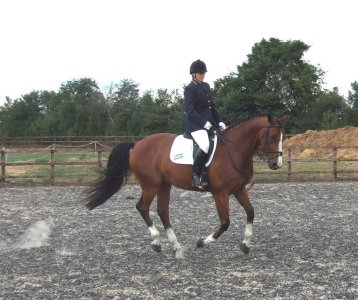
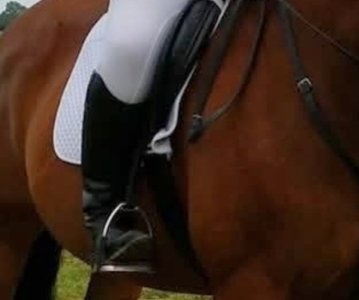
This was me in my saddle lol
 

Attachments

  • FB_IMG_1732782964973.jpg
    FB_IMG_1732782964973.jpg
    132.9 KB · Views: 25
  • Screenshot_20250403_110917_Gallery.jpg
    Screenshot_20250403_110917_Gallery.jpg
    206.7 KB · Views: 24
I managed to give my horse a really sore back from going for a 2 hour hack in my jump saddle 🙈 We had physio out that evening anyway and she picked up on it, I got my saddle fitter out in a panic and she said my saddle fitted just fine but explained the above to me - they're not designed to necessarily have riders weight in the seat for extended periods and also the position of the stirrup cars sits your weight further back which can put more strain on the horse. A GP saddle of course would be absolutely fine, this was a very forward cut jump saddle. I now hack in my dressage saddle... but it does give me a dilemma for hacks with fast work as I like the security of my jump saddle but we can often be walking for a good hour or 2 also.... I don't need 3 saddles, right?! :rolleyes:

And yes, this is exactly what can happen. The best saddle for longer rides is something that spreads weight through a panel that has dynamic properties (mainly shock absorbing but could be flexible too), something that sits the rider well without fatigue (if we get tired and unstable we're harder to carry), likely has at least a sheepskin underneath if not a high performance pad such as under some treeless saddles, and has a good supportive tree that helps the rider whether in the seat in walk, or two point in canter. Not an easy task and not necessarily things that apply to GP saddles per se. Every horse-saddle-rider combo is different.
 
Not 24/7 (!) but I have only had a jump saddle for the past 19yrs (2 different horses). First one was a Humphries and Swain, the current one is an Albion K2 jump.
 
And yes, this is exactly what can happen. The best saddle for longer rides is something that spreads weight through a panel that has dynamic properties (mainly shock absorbing but could be flexible too), something that sits the rider well without fatigue (if we get tired and unstable we're harder to carry), likely has at least a sheepskin underneath if not a high performance pad such as under some treeless saddles, and has a good supportive tree that helps the rider whether in the seat in walk, or two point in canter. Not an easy task and not necessarily things that apply to GP saddles per se. Every horse-saddle-rider combo is different.
It's a dilemma for sure trying to get it right sometimes! I use Equitex pads under my saddles now and do like them, tend to stick to the dressage saddle for walk/trot/steady canter hacks and split out my fast work to shorter sessions in my jump saddle where he's more likely to have a yee haa moment and I need the security of knee rolls 🙈
 
I only had this saddle for the first 14 months of Dex's ridden life, albeit I ride/rode VERY long in it for a jump as short stirrups cramp up my hips and glutes. It's what fit him best at the time and my fitter said that dressage saddles require more musculature through the trapezius area etc to fit to, which he didn't have as I had only just backed him (in a treeless). It's flocked and was checked every 10 weeks, along with a bodywork session every 4 weeks.

https://saddlesdirect.co.uk/product...CQi92YmT-3qH8Y4Jspc4OPItlXfAuzVhoCFAUQAvD_BwE

I have to say though I do now have a dressage also (as of Jan this year) and the difference in his schooling is vast. Those saddles are not designed for you to be sat on your seat bones and I find putting my thigh on/off to ask for shoulder in etc much easier for example.

https://www.thesaddlebank.com/product/idttdd-technical-traditional-t-t-dressage/
 
They are thinner firm panels, short points, designed for faster work with the rider in two point. They are not designed for slower work where the pressure on the horse is more relentless. Plus they tend to sit the rider behind their feet which means the rider is harder to carry in all sorts of ways.

What always makes me smile is that they have to be used, or should be used, with a half pad, which kind of negates half the benefit of them being close contact.

I will also say that, although there is no set measurement(s) for this, a jump saddle has a stirrup bar in a jump position, a GP saddle has a slightly more set back bars, though not as much as a dressage saddle obviously. However once you require different stirrup bar locations for different rider geometry then you'll.find that a saddle that works for one person as a jump saddle may be more a GP for someone else.

Litetally all 3 brands that I fit may call their saddles jump, dressage etc but the trees each type is built on are the same. The seats are generally also the same (a seat being constructed onto a tree, they can vary a little even on the same tree) unless a higher cantle is added to a dressage version; it's then just the block placement, and the flap cut, that determine what sort of saddle it is. I much prefer this as we slightly separate the fit for the horse from the fit for the rider/discipline.
Very interesting, thank you for taking the time to reply.

I had my girl in a flocked GP which allegedly fitted her well by a very respected saddle fitter but she hated it. We tried several different flocked ones and then switched to a foam panel jump and instantly she was happier. I do always use a half pad underneath (well apart from about 6weeks when she got a bit fat so I thought it was too tight but she got a sore back so half pad went back on).

I would say the jump rides more like a GP for me but it does make me think.
 
Top