Arthritis without lameness, what to do?

Status
Not open for further replies.
I wouldn't nerve block as he's not lame enough (at all) to show a difference.

I might well use arthramid though.
If there's filling and the vet has gixen steroids to reduce the inflammation, then there's obviously some activity going on in the joint. Some degree of reaction to work - even if the horse isn't visibly lame.

Arthramid is essentially a gel - the same stuff that they make breast implants out of - so it will have a cushioning effect. It diffuses over time, hence why it will eventually "stop working" bur in the meantime, the only harm it'd cause is to your bank account.

If he was out of work prior to your acquisition and he's now in work , then it's probably not a surprise that you're getting some reaction on that joint. As I said, I'd probably plan to Arthramid at Christmas and hope that over time, it all settled down now he's in consistent work.
 
I have no experience with these drugs so please feel free to ignore the following. I have had arthritis in my feet from my late 20's and they are now totally misshapen. It was painful then but as the joints fused themselves the pain went and I had years and years of being able to be on my feet all day with no trouble. A secondary problem arose and I had an op to fuse the bit toe on one foot and straighten the second toe. Now it may be coincidence, but the physio is suspicious that my different pattern of movement may now be contributing to knee problems I have on that side.

The point of this rambling is, as others have said, intervention may have consequences. If Charlie is generally comfortable but just gets a bit ouchy at times, then I would treat very, very conservatively. All the supplements others have suggested, keeping the joint as warm as possible and limiting his work as you do are the remedies I use for myself. You won't make it go away - arthritis is a total blight - but it is liveable with.

It sounds as if Charlie is one happy horse with you just now. Long may it continue!!
 
It's nothing to do with morally claiming it or even blagging it. If the horse was sound on purchase or passed a vetting then is either not sound or changes are discovered now at a later date, whether it's a week, a month or in your case 6 months it's not wrong to claim.

My understanding was the same @Birker2020 - my insurers paid out for arthritis treatment when we discovered it a year or so after purchasing the horse. It had clearly been there a while (as evidenced by the X rays of the joint that we sent to the insurance company), I just didn't know about it until he started presenting with soreness. So it was fine to claim. Obviously all arthritis is excluded now (sigh!).

As @mini-eventer says I would try Tildren to slow the progress of the arthritis, rather than medicating a joint that appears to be functionally fine. Also - going back to insurance - Tildren is quite pricey and you may as well have it on insurance. Now you've found it, the arthritis will be excluded next year anyway, regardless of whether you choose to treat it now or not.
 
I have no experience with these drugs so please feel free to ignore the following. I have had arthritis in my feet from my late 20's and they are now totally misshapen. It was painful then but as the joints fused themselves the pain went and I had years and years of being able to be on my feet all day with no trouble. A secondary problem arose and I had an op to fuse the bit toe on one foot and straighten the second toe. Now it may be coincidence, but the physio is suspicious that my different pattern of movement may now be contributing to knee problems I have on that side.

The point of this rambling is, as others have said, intervention may have consequences. If Charlie is generally comfortable but just gets a bit ouchy at times, then I would treat very, very conservatively. All the supplements others have suggested, keeping the joint as warm as possible and limiting his work as you do are the remedies I use for myself. You won't make it go away - arthritis is a total blight - but it is liveable with.

It sounds as if Charlie is one happy horse with you just now. Long may it continue!!

Thank you that's helpful in several ways.

He isn't ouchy in any way that I can tell (except the steroids made him footsore, which confused things mightily until I put his boots on! It's just wearing off now) . I trotted him downhill yesterday as a short test and there was nothing. The windgall is the only way you can tell anything is going on unless you lunge him on a 5m circle, which isn't in my normal repertoire!

He was very asymmetric when I bought him, very mismatched shoulders, different height on either side of his chest. Those are levelling up nicely, and as they improve he's growing markedly asymmetric (but matching) front feet. As I trim him myself I have absolutely no intention of changing them because his movement continues to get freer.

There were loads of other signs how physically screwed he was 6 months ago, including but not limited to a head tilt, head shaking, inability to keep his shoulders up and reach for the bit, extreme low head carriage, inability to strike off clean in canter on the lunge, and in the early days reluctance to move at all at the start of a ride. All those have disappeared.

He's never going to be asked to do more than simple schooling on big circles and hacking on straight lines, with a few small jumps now and then if the joint will take it. He's always on a big whack of MSM and very recently Devils Claw (because I had it in the garage). He can't take boswellia (see my other thread) and I'm researching other joint supplements but there is so little scientific evidence that they actually work. GLM seems to test well but only in quantities which are far in excess of anything in a supplement and pure GLM in horse quantities would be eye watering in cost.

There's nothing in his racing record that suggests he was ever laid off with an injury. The best guess is that he finished one season with a sesamoid fracture and by the time he came back into training for the next season he was sound. I don't think the trainer who sold him to me knew and I'm pretty sure he would have passed a vet when I bought him as he would only just fail one now.

I'm waiting for a response from the vet about the % likelihood the arthramid will do anything more than stave off the inevitable for a short time, and how short that time is likely to be. It does look bad on the x ray but nobody seems to have told Charlie!

It's really helpful to discuss it like this, thanks everyone.
.
 
I too think your assessment of the insurance situation is wrong ycbm. I think pre-existing is a bit of a red herring in this case and pre-diagnosed would be a better turn of phrase. If you didn't know about it and he was sound when you bought him, making a claim would not be wrong, morally or legally.

Just to give you an example, Archie is riddled with melanomas. They are mainly (now, but at that point, exclusively) inside his sheath. He never lets anyone anywhere near that area and I'm a believer in leaving those bits well alone unless there's a reason not to so the first we knew of them was when they grew to a size that meant they were visible outside the sheath. They would have taken years to grow to that size. They were clearly pre-existing but nobody knew about them. He had passed a 5 stage vetting (the checking of the inside of sheaths is obviously not standard procedure 😆) about 2 years previously. The insurance paid out fully for all his diagnostic work (he had to have biopsy to rule out the tiny possibility that it could be a much more dangerous carcinoma) and treatment. Everything from that point on was excluded but up until then it was considered a new issue.

Therefore, if arthramid has preventative qualities (I know very little about it) I'd go ahead and make a claim on your insurance. Be honest that it's at the site of a previous fracture which has only just been diagnosed and if they say no, you're in no worse a position.
 
I am not interested in discussing insurance, can we please keep the thread to the problem with the horse.
.
 
I’m actually not sure what I would do. If insured I would likely lean towards putting arthramid in, provided vets thought there was some preventative benefit. If uninsured I might be a little more strategic about it. It would completely depend what I was feeling with the horse underneath me.

Has the fetlock always swelled? If it’s a new thing it might just be a short term tweak/flair that the steroids settle.

Do I have it in my mind he his funny with water? Completely anecdotal but one subtle early sign I had with one of mine with what turned out eventually to be front foot arthritis was iffy with water. I think he just lacked confidence in depth and foot placement to protect himself
 
Slightly different, but we have a cob that had stifle surgery in 2020. He had a grade 3 meniscal tear, possibly worse as it went beyond where they could see.
He also had bone chips which were removed.
Anyway, he had surgery and was carefully rehabbed. At around 4 months it was suggested to give him steriods so the vet was booked.
When he arrived he was trotted up and had an examination. The vet couldn't believe how sound he was, and said in his opinion, hec would not medicate at that time.

He said at some point, he will need it, but why just use it now just for that sake of it.
He's so sound, back in full work, and still not had any medication.
 
I’m actually not sure what I would do. If insured I would likely lean towards putting arthramid in, provided vets thought there was some preventative benefit. If uninsured I might be a little more strategic about it. It would completely depend what I was feeling with the horse underneath me.

Has the fetlock always swelled? If it’s a new thing it might just be a short term tweak/flair that the steroids settle.

Do I have it in my mind he his funny with water? Completely anecdotal but one subtle early sign I had with one of mine with what turned out eventually to be front foot arthritis was iffy with water. I think he just lacked confidence in depth and foot placement to protect himself

Very interesting IHW. His dislike of stepping into water is limited to man-made puddles and running streams. Flood water and large natural puddles he has no problem with.

The windgall increased from zero at the start to at its worst after teaching him to jump. Clearly he's not going to manage being jumped very much, if at all.
.
 
Ligaments were scanned to ensure there was no complication with them. All clean.

To me this is encouraging, it would be trickier if the fracture had involved the attachment points. Standard management here for a presentation like this would be to manage exercise carefully, place on pentosan and 4Cyte combination as a gold standard. Our clinic has several arthritic horses successfully managed this way. The active ingredient of 4Cyte (Epiitalis) has been shown to be effective in the disease process in several clinical trials.
 
Looking at his race record I'd say he did the sesamoid either as a 2yo before he ever an or at the end of his 3yo year. He ran in October, wasn't seen again until near the end of July the following year. Plenty of time to get over the bone fracture, any ligament damage that went with it before moving to a new yard and not running on the all weather again for a few years.
 
To me this is encouraging, it would be trickier if the fracture had involved the attachment points. Standard management here for a presentation like this would be to manage exercise carefully, place on pentosan and 4Cyte combination as a gold standard. Our clinic has several arthritic horses successfully managed this way. The active ingredient of 4Cyte (Epiitalis) has been shown to be effective in the disease process in several clinical trials.

Damn, pentosan not yet available in the UK by the looks of it. I'll look up 4cyte. Thank you.
.
 
Damn, pentosan not yet available in the UK by the looks of it. I'll look up 4cyte. Thank you.
.

Pentosan probably sold as cartrophen over there, same thing (Pentosan Polysulfate Sodium 250 mg/mL). Alternative Disease Modifying Osteoarthritis Drugs are coming onto the market now such as a month course of injections marketed as Zycan here in Australia (Polysulfated Glycosaminoglycan 100 mg/mL). Basically a course of seven IM injections given every four days over the course of a month. Then repeated once you notice any effects wearing off. I guess you need to decide weigh up whether to go IA route now, or try the IM and/or oral options available to you and monitor.
 
Depends on what the arthritis looks like and is it a joint that would enable him to function just fine if it did fuse?
If he won't be able to function if the joint fuses, then I would definitely get the arthramid done as it takes the place of the damaged cartilage and should stay in place for up to 2 years and there's no reason not to repeat it.
 
Again no experience of the drugs or treating such a thing, but similar to Trouper, I shattered by ankle in my late teens and have associated arthritis within the joint. It can be uncomfortable, I notice it but it’s doesn’t stop me doing any form of activity, BUT if I have been unfit or not as active for a while and then start higher intensity exercise such as running it get can get puffy, sore and aggravated for a while… however the more I do the stronger it gets and the less painful it becomes. It may be a fine line but as long as the work is graduated and provisions are put in place it may be the more Charlie does (within reason) the better the joint will eventually feel for him and the swelling is actually a bit of a red herring?
 
Last edited:
The key sentence from my vet's email for me is, about arthramid

"the reality is I can’t give you definitive answers of the efficacy of this treatment as there is no published data to support this"

The rest of her response is written as if I took in a lame horse and what would be the best course of action if I had. That was actually pretty helpful, because the more times I read it the more I came out with the answer that we will never understand what is working and what the best course of action will be if we treat him with unproven drugs while he is sound in his normal level of work.

There is data for 4cyte, which is actually a distillation of thuja at a reasonable price, so I have bought a starter pack.

I am swinging towards "if it ain't broke don't fix it".

It's been very helpful to discuss it, thanks.
 
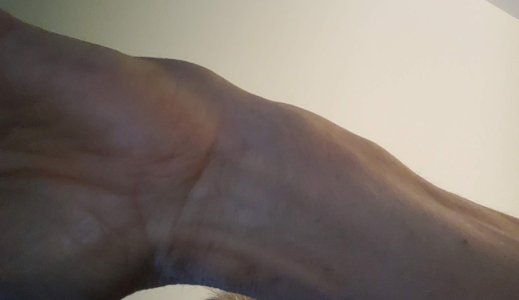
I keep looking at this photo of my wrist. This was filled with fluid for months. You could push one bit of it and see it bubble up further along. It was vaguely uncomfortable on a maximum of two days. Then it suddenly went, leaving a little extra knobble behind and is completely pain and constriction free. We can but hope Charlie's fetlock is similar.

image.jpg
 
I keep looking at this photo of my wrist. This was filled with fluid for months. You could push one bit of it and see it bubble up further along. It was vaguely uncomfortable on a maximum of two days. Then it suddenly went, leaving a little extra knobble behind and is completely pain and constriction free. We can but hope Charlie's fetlock is similar.

View attachment 128986
I hope so as you've had a rotten run of bad luck
 
I would just carry on as you are and only medicate if he goes lame on it. My mare went slightly lame when she was 20 and on Xray she a very old hairline fracture in her knee (can’t remember exactly where)she had arthritis in it and she had a cortisone injection which worked for a year, the second one didn’t work at all. I stopped all jumping and carried on hacking to keep her fit, lost her at 24 from a stifle injury in the field. I had owned her since she was 15 months and when jumping from one field to the other as a 3 year old she hit the fence very hard and almost came down, she took a few lame steps but by the time I caught her and trotted her up she was sound so I wonder if that was when she fractured it. So you may find similar with Charlie and it may only catch up with him as he reaches old age . I know you weren’t going to do a thread about him but could we have a current photo ? 🙂
 
On the subject of diagnostic tools such as bute trials and nerve blocking. You say that you probably wouldn't notice a difference as he currently presents as sound, and it's logical that if trotted up or lunged then there may be no difference. At the same time there are some lovely stoic horses out there, or those with high pain thresholds, that just don't show you any pain (I have one, and it's a total PITA trying to work out if anything is wrong with him). It may be interesting (and relatively harmless) to try a bute trial - not to see if he is less lame (as he isn't lame) but to see if over a week or so you do see any difference in his way of going that might indicate he is even more comfortable. That might help you to be clearer on whether to do anything now, or wait a while and support as much as possible without medicating.
 
Although we are still in the early stages of our Arthramid "journey" I thought I would share my experience so far just in case it helps at all - sadly can't be of any use regarding the long term effects (although I had some very positive long term arthramid replies on a thread I started not long back). Rising 17yo gelding came up mildly lame in front at the end of March - long story short a full lameness workup and xrays found a "strain" (no tear/lesions) to his FR suspensory, likely caused by loading due to the OA found in both hocks. His FR fetlock joint was injected with arthramid to treat the suspensory and he was rehabbed (only to a minimal level as hocks still not treated at this stage). Then once that was settled we injected both hocks with arthramid and are in the process of rehabbing again, hopefully back to where we were before all this. We are now ~8 weeks post hock arthramid and I feel like I have a different horse - my "young" boy is starting to come back again. We had a mild blip in the middle where the suspensory injury seemed to flare up again so we toned the rehab down and a short course of bute both did the trick. I really am incredibly impressed with this treatment and hope the effects are long lasting for him. Not sure if its worth adding that we did this on insurance but can find out costs for you if that would help at all?
 
Difficult one, sorry to read this about your gelding. I found reading all the replies really interesting.

If I were in your situation I would inject with Arthramid, it won’t do any damage. I wouldn't want to wait until he was stiff or lame on it. I wouldn’t inject with a steriod.
 
Status
Not open for further replies.
Top