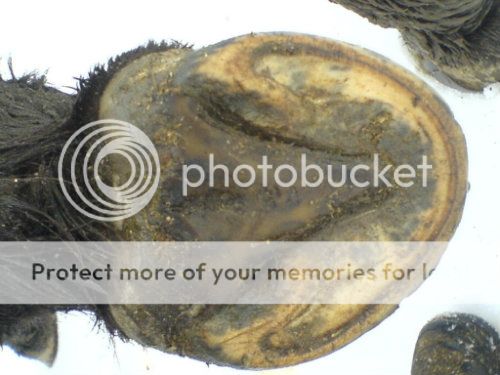
barefoot taliban - what do you think of these feet?

picture.php
 
Hah, I tracked them down via your album (upload them to somewhere like photobucket then copy the image code over to make them visible in the thread).

Erm, not an expert but I wouldnt be happy with them at all. They are really narrow at the frog (whole frog looks really contracted and tight?). There are big splits in the central sulcus which almost definitely are thrushy. The first photo almost makes it look as though the feet get smaller towards the bottom although surely (hopefully) thats just the camera angle?
 
The back of the hoof - frog, heels and therefore digital cushions (pink) and lateral cartilages (grey) are weak, contracted and basically incapable of doing their job properly.

fig1.jpg


Compare your horse's hooves to this healthy frog.

healthyfrog-1.jpg


Can you see the difference?

Does your horse land heel first or toe first?
 
ok being completely thick but where do i get that from?

If your on a computer, go to the online picture and right click and choose 'properties' at the bottom of the list. You'll get a web address somewhere halfway down the windows that comes up. Starts http:// and ends in .jpeg. That's the picture address and you just copy it then paste it into the box that comes up when you click the picture icon when writting a post.
 
i would say toe. Would it surprise to hear that he has collateral damage in both hinds and ddft in the off side hind, he has been off work since May and still does not want to fully weight bear on the hinds, I have always had my horse shod but on reading on here my opinions are changing.
 
Wow, they are some seriously contracted heels and useless frogs. Is the horse still sound!?

Eta: cross posted. Im not surprised he's lame with feet like that. Cause or effect??
 
Last edited:
i would say toe. Would it surprise to hear that he has collateral damage in both hinds and ddft in the off side hind, he has been off work since May and still does not want to fully weight bear on the hinds, I have always had my horse shod but on reading on here my opinions are changing.

He'll be walking toe first because the back half of the hoof is simply incapable of doing it's job. You are bypassing the natural suspension system of the digital cushions and frog. The tendons and ligaments will be under un-natural amounts of leverage and tension.

http://cvm.msu.edu/alumni-friends/i...siological-trimming-for-a-healthy-equine-foot

If you were wearing these shoes 24/7 and went to do sports - no one would be surprised when you damaged something......:D

hoofshoes.jpg


I'm not against shoes - but they work until they don't work. And for your horse - they really ain't working :eek:.
 
Agree with others and Oberon... they are probably the most contracted heels I have ever seen! I can just imagine all the tendons, cartilages and bones being squashed by those artificially small hoof walls.

Best image I can find at the mo to show what is in there being squashed by those shoes.

pr1211-OVAM-hoof.png


The best thing you could possibly do is let this horse have a rest out of shoes. This has nothing to do with barefoot taliban, its a method prescribed by farriers and they have all seem to forgotten about it favouring more metal (heart bars etc) instead of less.

That caudal structure needs room, it needs a blood supply, it needs to expand and I will say that your horse will probably feel his feet at first as the feelings all rush back to his feet. He needs to be turned away or bedded on a soft bed, a set of hoof boots WITH PADS to help him when he does feel his feet and with either vet, farrier or qualified trimmer supervision be helped to develop some structure again.

It may be that he doesn't feel a thing and his hooves change without a hitch and look normal again in 3 months. Whatever, those shoes need to come off and his hooves NEED to "unfold". Then shoe again if you want, to GOOD feet, not feet that look like this.
 
I have two horses both live on pasture (soft ground) One has been barefoot for 2yrs, she has under run heals and contracted frogs, her feet have probably got better since the shoes came off but they are not great to look at and we always wear boots for riding out, she has never been lame, what I am trying to say is that yes take the shoes off but dont expect miracles.

My other horse has feet to be proud of, round, wide, massive frogs, rock hard horn never chips, but lame with navicular (bone cyst), he has been barefoot for 5 years.. who knows
 
Yes, horse needs a rest from shoes. Take pictures and measurement to monitor the hoof change (sometimes we don't remember well how bad it was).

It is very important to restore the heel first landing.

Here is an interesting explanation about the biomechanics of heel first/toe first landing (from this article http://www.hoofrehab.com/NavicularSyndrome.htm, you can see it very well on the DVD "under the horse" where Pete Ramey shows the bones of the lower leg and strings pinned on the bones reprensenting the tendons, if you can get ahold of those DVDs definitely worth watching):

"During normal, heel first locomotion, the deep flexor tendon is quickly tightened by the descending fetlock joint. At the same time, the coffin joint is rotating forward toward breakover, and is loosening the deep flexor. In a toe first landing however, the descending fetlock joint is still tightening the tendon just after impact, but after the toe impacts the ground, then heel rocks downward, tightening the tendon at the same time. Understand that in a heel first landing we have one pulley tightening as the other is releasing tension, but with a toe first landing, both pulleys are tightening at the same time. Far greater force is directed to the navicular pulley than was ever intended by nature. This is a very big difference; adding greatly to the force applied to the tendon and navicular bone. "
 
well the contraction made me gasp, and my horse was barefoot for 10 years maybe more, but had shoes on 2 years ago ish, he does however have quite a bad imbalance, which we managed for years without shoes, when it got to the point of having no outside hoof wall left i was forced to put shoes on the front at least. Have to say he is currently only shod in front. Think you might have to serious re think your currently regime, you certainly have some feet issues.
 
me and OH both seriously shocked that a trained farrier did that to your horse's feet! I'd be inclined to report them, they shouldn't be allowed near any horses' feet imo.

On a more helpful note....agree with previous posters get shoes off and into boots asap. Try to find a good farrier or trimmer to help you (perhaps ask for recommendations on here from people in your area). Good luck
 
Wow - Im pretty sure that no horses foot should ever resemble a baby's bottom :eek:

Never seen any that contracted tbh.

Shoes off, treat for thrush, clean diet of any sugar and get on a good hoof supplement. Work in boots and pads to strengthen the back of the hoof - work can mean walking in hand/long lining if not sound enough to be ridden.
 
I think it's important not to condemn the farrier and to understand that this is not totally a farrier issue. Even the best farriers end up chasing a heel at some point in their career.

Long term shoeing will result in contraction of some form or another.

If anyone has read any hoof texts, inc Hickman's Farriery - it does explain that lack of stimulation to the frog will cause contraction and under run heels.

The action of lifting hooves off the floor by a shoe will remove almost all stimulation to the frog - that's the problem, not just farriery.

Over the years there have been many attempts at special shoes to counteract contraction at the heel......

http://www.horseandhound.co.uk/forums/showthread.php?t=559648&highlight=shoes

Even 'curative burning' :eek:

burningsole2.jpg


Nowadays remedial shoeing focuses on heartbars (with/without wedges) or Imprints which provide a small amount of frog stimulation.

But the easiest way is just to remove all barriers and let the frog touch the floor.

Shoes have their place, but we should be allowing a break from shoeing at least once a year. That would alleviate most of the problems we are seeing.
 
Thank you Oberon for posting my pictures when i couldnt. I am nearly in tears reading the comments BUT it has reinforced what i was thinking that the heels are contracted the frog is not doing its job and my boy is not comfortable, serious rethink is ahead
 
Good luck NooNoo59. A good rethink is a great idea and there is help on here for support in your plan. x

Keep a photo diary too, as memory is not reliable to see improvements or other changes.
 
Quote from Oberon.............

I think it's important not to condemn the farrier and to understand that this is not totally a farrier issue. Even the best farriers end up chasing a heel at some point in their career.

Long term shoeing will result in contraction of some form or another


Well said :)
 
Thank you Oberon for posting my pictures when i couldnt. I am nearly in tears reading the comments BUT it has reinforced what i was thinking that the heels are contracted the frog is not doing its job and my boy is not comfortable, serious rethink is ahead

Good for you, OP. No point worrying about how or why what happened happened - just focus on improvements and how to get them :)
 
Onwards and upwards. Those feet can only improve so if you start to get he frogs in action then you should start to see some changes. Take plenty of pictures so in a while you will be able to look back and see the progress. Good luck.
 
Top