Barefoot? When SHOULD you shoe

cptrayes

Well-Known Member
Joined
4 March 2008
Messages
14,748
Visit site
I wrote this originally about a year ago, but since then we have had a lot of new names on the forum. I think this thread is worth re-starting as a new one for the new people.

A barefoot view of when you SHOULD shoe:

I think there has finally been a big breakthrough in the barefoot/shoeing debate with a major horse monthly publishing an article (October 2010) that for the first time does not quote vets and/or farriers saying that barefoot is OK if your horse doesn't do much roadwork.

But the article makes me concerned for a lot of shod-horse owners out there because it does strongly imply that all horse owners could take off their horse's shoes and this simply isn't true. While I personally believe that most horses are capable, eventually, of a full workload with bare feet, there are many horse/owner/livery yard combinations where it won't work.

So while I am VERY against shoes where horses simply don't need them, (and there are thousands of horses in this country being shod when they don't need them), I'm also very against people who need their horse shod being made to feel guilty if they can't "do" the barefoot thing. So here are some pointers as to when you SHOULD have shoes on your horse.

I hope this will start a sensible debate with other barefoot devotees like me adding their advice, and we can show that we are not the mad ourwayistheonlyway nutters that many people want to think we are.

STUDS

If you are convinced you need studs you will need to shoe. There are boots that take studs but they are not legal for BE or BD. Many of us found that studs were unnecessary for jumping even up to Advanced Eventing but you will most likely lose marks on a slick dry grass dressage arena on hard ground without them.

GRASS

There is a very, very high proportion of barefoot horses who will feel stones in the spring summer and early autumn. This is actually very low grade laminitis. In most of those horses it can be controlled by removing them from grazing when grass sugars are high, late morning to early evening. In a smaller, but still significant, proportion a much greater restriction must be placed on sugar in grass and food.

If you simply can't restrict your horse's grazing like that, and you can't or don't want to use boots, or if you simply don't believe that your horse should have his grazing restricted, then you will need to shoe.

WORK

Many horses will cope with peaks and troughs of work barefoot, but some will not. So if you want to hack for four hours on Saturday, for example, your horse might not keep its foot condition well enough if he only pootles in an arena during the dark winter evenings. If so, you'll need to boot or shoe. Stony tracks and roads are no reason not to go barefoot, they cope brilliantly. But not unless they keep their conditioning, and some horses need more regular exposure than others to do that.

MINERALS

Mineral imbalances can be a nightmare. My own grazing, for example, is very high in manganese and iron. Until we knew that, my friends and I had trouble with abscesses and with insulin/laminitic issues. So we needed to investigate and found that copper and zinc are prevented from being taken up by manganese and iron. And seaweed supplementation, high in iron, was a VERY bad idea! Once we got that right by supplementing copper and zinc, abscesses stopped, cracks healed and our horses could tolerate more exposure to grass as well (copper has a role in regulating insulin, which is vital to digesting sugar). There are people on this forum and others who will help with this, but if your horse isn't "right" barefoot, and you can't find out what his imbalance is, or don't want to, you will need to shoe.

WET

Standing in a wet field all winter softens feet and some horses will not be able to cope barefoot unless they have a period each day in the dry. Unfortunately, some will also not grow foot fast enough if they stand still for more than half the hours in a day, and stabling overnight is not the best environment for them. If your horse is one of these, and you can't provide "dry turnout" (mine are in a barn, for example, others have partially covered and/or very well draining track systems) then you will need to shoe.

UNSUPPORTIVE FARRIER/VET/LIVERY

It can be very stressful to go against your farrier and/or vet in taking your horse barefoot. (Unfortunately, although there are more barefoot-aware farriers and vets every day, there are still plenty of farriers and vets telling owners that their horse won't manage when it is not true, as mine and many other barefoot horses demonstrate). Some livery yards can also be extremely hostile if your horse is at all footsore in the early days. If you can't face this, you'll need to shoe.

TRANSITION IS TOO PAINFUL

There are some horses which really struggle when the shoes first come off, and in rare cases this can last months. Those horses shouldn't be exposed to surfaces that they can't manage without protection, which can, to be honest, be a heck of a fuss and bother (booting up just to walk to the field, for example). If your horse is one of those and you can't cotton-wool him the way he would need, you'll have to leave the shoes on.

(Other than this transitioning issue, current foot quality has no bearing WHATSOEVER on whether a horse will work happily barefoot. The removal of the shoes, with a correct diet and work, improves foot quality beyond recognition within four months, and these are some of the very horses that will benefit most.)


I hope this helps those of you who are thinking about barefoot. Hopefully other people will add their advice too.
 
Good Post!
My boy is 7yo Anglo and barefoot, he has never worn shoes, not because i'm strongly for barefoot, but if there is no need, why do it. He is as sound as pound, good 'Arab' feet. We are SJ and Eventing PN. HOWEVER, last time we were out, he slipped on the grass during dressage (our weakest phase at the best of times) and slightly slipped XC on a tight turn. Come next season when he moves up to Novice, there is a very strong likelyhood he will need studs, for his and the riders safety. (Ive had one land backward on me and I wont take the risk. It HURTS!) I dont want him shod, but safety comes first. Having said that, end of season they will come off again!
My old boy 32yr had shoes on all his life. I took them off at 29, a year before retirement. He is Purebred Arab and again has super feet and they have adjusted superbly. He is more footy than the Anglo, but he's on grass all the time, so he will be. But the condition of his feet are super. Probably took 6month for them to sort out after shoe removal. I guess if he were working, I wouldnt be able to wait 6 month and that puts a lot of folks off. Im not against shoeing in anyway shape or form, if the work requires it, put them on. BUT I have also learnt that they are not always needed and the same level of riding/competing can be achieved.
Foot health and safety are the most important things to me, oh and my wallet!!!! (not opening the never ending debate, but im lucky enough to have a bloody good blacksmith who knows barefeet and actually wont let me put shoes on!)
 
Good thread. I would shoe if I got to the point where I just couldn't control environment, or diet enough to keep the horse sound. Touch wood though, we seem to do OK, even with less than ideal environment. I'd boot first though, as I don't compete and have several friends who boot for all ridden work with no problems. That's because I feel that good trimming and booting is better for the horse if you can make it work for both of you.
I'm not as worried about trimming as I used to be as my current trimmer is subtly training me (she thinks I haven't noticed, but I have...) and I seem to be doing a good maintenance job between trims myself.
 
I tried to go barefoot with my older horse. My farrier thought he'd cope, he has very hard feet in good condition. I had the shoes removed last December, as I had surgery planned for January. Due to complications he had 5 months off work, went through different weather/ground conditions, before I attempted a fittening programme with him. Unfortunately he didn't seem able to cope, he was moving so short, seemed slightly better on tarmac, hobbling in the sandschool. His feet were wearing down at the rate of growth so no trimming needed. I tried for 6 weeks but couldn't put him through any more; at the end of the day he's 19 and I didn't want to try any longer when I could be enjoying riding him, hope that doesn't sound too selfish!
 
It's not selfish to keep your horse comfortable. If you don't have the conditions available to support a barefoot horse, then I don't see why anyone should condemn you for using shoes. It would be nice to think that your farrier gave you some advice about appropriate diet and conditioning.
 
It would be nice to think that your farrier gave you some advice about appropriate diet and conditioning.

He didn't have much advice to offer as he thought his feet were in really good condition. I had good advice from here though. I have very little grass at my yard (good for the Welsh fatties I have there), and feed ad-lib mediocre hay with a few hi-fi cubes in a decahedron at night.
I have a 4yo who is unshod, and hopefully he'll stay that way!
 
If you buy a branded forage like ,say, horsehage, can you get an analysis from the company, without getting your own done? Also at work I have seen intelligent people make mistakes with drugs, even getting the dosage wrong by a factor of 10, do you think it is safe and sensible for horse owners to dose their own horses with supplements of copper and selenium that can cause harm if the dosage is wrong?
 
If you buy a branded forage like ,say, horsehage, can you get an analysis from the company, without getting your own done? Also at work I have seen intelligent people make mistakes with drugs, even getting the dosage wrong by a factor of 10, do you think it is safe and sensible for horse owners to dose their own horses with supplements of copper and selenium that can cause harm if the dosage is wrong?

If you have an analysis of your grazing and forage then Forageplus.co.uk will do you a feed and supplement plan to balance it, for a fee. They will also do the analysis if you need it done. I don't know of any other providers of that service.

No-one should guess at mineral balancing, it can have unintended consequences. There are also people feeding general vitamin/mineral supplements with good brand names on that add iron and manganese, for exampe, and if you are already high in those then that trusted supplement may actually be doing more harm than good.

Likewise, seaweed is a popular supplement at the moment, and liked because it is natural, but if you are high in iron, manganese or iodine or low in copper it can cause problems.

Basically, if you don't know what you are doing ask an expert before supplementing anything, natural or otherwise.

A couple of things I'd exclude from that is yeast, which seems, either as brewer's yeast or yea-sacc to be nothing but beneficial, and magnesium oxide, which also seems to have no downside but seems very effective for barefooters and is used for insulin regulation and nerve function (and currently in test to treat human type 2 diabetes).
 
Cptrayes - I am interested in this article because after having my horse barefoot for a year I am just putting front shoes on for one or two shoeing periods because the feet just seemed to be wearing quicker than they were growing and I felt the horse was starting to get sore feet and I didn't want to compromise the late summer fun and work we are doing.

The hacking around here isn't that great, so I tend to ride out only when I have company once a week and then do about 2 miles on the roads. Apart from that we school and go out once a week for a trip round a Xcountry course or showjumping.

We have very good draining land so it does go hard quite quickly. But my horse does have very good feet.

I guess, what I am saying is I can't see an alternative to shoeing if the work increases and the feet seem to be wearing away quicker than they are growing. If anything I am more concerned to keep the work rate up to keep him slim rather than cutting his food down. I don't want to wear boots as he is a bit trippy and has a natural tendency to go on his forehand (being a cob) and I just see boots making him more inclined to trip than shoes. So I can't really see much alternative?

Cptrayes, would love your view?

PS Also, I guess you have to have both your grass and hay analysed if you are going to do it?
 
There's no need to analyse forage unless you are having unexplained problems, and perhaps yours is just such a case?

Is your horse actually sore, or are you just afraid he might be? I have heard a lot of people saying that they put shoes on because the feet got too short, without realising just how short barefoot feet look if you are not used to them.

If he is sore, is it in general, or just if he steps on a stone? If it is when he steps on stones, it's possible that his feet being short are not the reason. Then you would need to look at how much have you been controlling his access to grass. I have two who can't eat daytime grass and one who can. Rockley Farm rehab centre has one which can't tolerate more than four hours grazing a day. Some horses seem fine and some are very sensitive. I even had one who couldn't eat the stuff at all, who is effectively a diabetic.

Have you increased his work recently? I have one horse (the one who can eat as much grass as he likes) who takes a long time (a month or so) to "realise" that his work is increasing and increase his foot growth to match. I was, like you, poised to shoe him last winter when he suddenly got his act together and started putting out foot again after the enforced break with the big winter freeze.

Are you absolutely certain that he has no thrush in his frogs or collateral grooves. That can make them quite footie if they are susceptible. If in doubt flush his feet well with household bleach (I know it sounds drastic but a vet told me it's the quickest, cheapest way to get rid of it, and completely harmless to the underside of the foot. I've used it and it works, though I tend to keep hydrogen peroxide now and use that as it's less of a problem for the human handling it!).

Any other barefooters out there got any other suggestions?

Don't beat yourself up if you have to shoe to keep the work going. A cob especially is better off working than being barefoot if you have to make a choice.
 
STUDS

If you are convinced you need studs you will need to shoe. There are boots that take studs but they are not legal for BE or BD. Many of us found that studs were unnecessary for jumping even up to Advanced Eventing but you will most likely lose marks on a slick dry grass dressage arena on hard ground without them.

WORK

Many horses will cope with peaks and troughs of work barefoot, but some will not. So if you want to hack for four hours on Saturday, for example, your horse might not keep its foot condition well enough if he only pootles in an arena during the dark winter evenings. If so, you'll need to boot or shoe. Stony tracks and roads are no reason not to go barefoot, they cope brilliantly. But not unless they keep their conditioning, and some horses need more regular exposure than others to do that.

In your defence, this is a very recent development, but some of the Easyboot range have studs available, now! I saw them t'other day on a boot search.

Completely agree about the work issue. This summer I've barely ridden due to MY foot issue, but normally my own work means a sporadic timetable of riding and I shoe in the summer to account for this. So, Henry has remained barefoot this year and I've booted when I've ridden out.

One you didn't mention is laziness. I must confess, sometimes I just want to get on and go and boots are a pain in the bum (haven't tried the gloves, yet, hence me keep looking and trying to decide on em!!). I do like just being able to pick out the feet and get on, rather than wrestle with his boots!
 
I don't want to wear boots as he is a bit trippy and has a natural tendency to go on his forehand (being a cob) and I just see boots making him more inclined to trip than shoes. So I can't really see much alternative?

I completely sympathise with you on this issue. Henry is only 12hh, so any boots add bulk more than they would to a bigger pony/horse. When I ride out in boots, it's not very enjoyable, as he trips a lot and has even gone onto his knees, which breaks my heart. It's why I'm reluctant to buy more boots, as I will then end up with THREE types and not two!

If your boy is bigger, though, might be worth looking at the gloves (which seem to be the least bulky option and I've seen them in the flesh - they're marginally less bulky than the epics).
 
I completely sympathise with you on this issue. Henry is only 12hh, so any boots add bulk more than they would to a bigger pony/horse. When I ride out in boots, it's not very enjoyable, as he trips a lot and has even gone onto his knees, which breaks my heart. It's why I'm reluctant to buy more boots, as I will then end up with THREE types and not two!

If your boy is bigger, though, might be worth looking at the gloves (which seem to be the least bulky option and I've seen them in the flesh - they're marginally less bulky than the epics).

My TB is very "trippy" but not in Gloves, they are so slim and tight fitting that they add very little to the bulk of the hoof, not more than a new shoe really in depth (and as bare hooves are usually shorter than shod ones you start from a better position in terms of length and tripping)
 
There's no need to analyse forage unless you are having unexplained problems, and perhaps yours is just such a case?

Is your horse actually sore, or are you just afraid he might be? I have heard a lot of people saying that they put shoes on because the feet got too short, without realising just how short barefoot feet look if you are not used to them.

If he is sore, is it in general, or just if he steps on a stone? If it is when he steps on stones, it's possible that his feet being short are not the reason. Then you would need to look at how much have you been controlling his access to grass. I have two who can't eat daytime grass and one who can. Rockley Farm rehab centre has one which can't tolerate more than four hours grazing a day. Some horses seem fine and some are very sensitive. I even had one who couldn't eat the stuff at all, who is effectively a diabetic.

Have you increased his work recently? I have one horse (the one who can eat as much grass as he likes) who takes a long time (a month or so) to "realise" that his work is increasing and increase his foot growth to match. I was, like you, poised to shoe him last winter when he suddenly got his act together and started putting out foot again after the enforced break with the big winter freeze.

Are you absolutely certain that he has no thrush in his frogs or collateral grooves. That can make them quite footie if they are susceptible. If in doubt flush his feet well with household bleach (I know it sounds drastic but a vet told me it's the quickest, cheapest way to get rid of it, and completely harmless to the underside of the foot. I've used it and it works, though I tend to keep hydrogen peroxide now and use that as it's less of a problem for the human handling it!).

Any other barefooters out there got any other suggestions?

Don't beat yourself up if you have to shoe to keep the work going. A cob especially is better off working than being barefoot if you have to make a choice.

Thanks Cptrayes, you always give practical advice. I hate him having shoes on, but I think maybe I don't get quite the right mix of work to keep his feet conditioned all year round and to cope with the wet/dry conditions we have had this year. But your - and others -advice on HHO has given me the confidence and knowledge, to go barefoot most of the year which I (and the horse) absolutely love. The farrier reckons he is footy because his feet are so worn and I guess I have to bow to his knowledge this year and try and work on getting it better next year (he is very OK with barefoot and a really supportive farrier).
 
In your defence, this is a very recent development, but some of the Easyboot range have studs available, now! I saw them t'other day on a boot search.

Completely agree about the work issue. This summer I've barely ridden due to MY foot issue, but normally my own work means a sporadic timetable of riding and I shoe in the summer to account for this. So, Henry has remained barefoot this year and I've booted when I've ridden out.

One you didn't mention is laziness. I must confess, sometimes I just want to get on and go and boots are a pain in the bum (haven't tried the gloves, yet, hence me keep looking and trying to decide on em!!). I do like just being able to pick out the feet and get on, rather than wrestle with his boots!

Studded boots are not legal for British Eventing, I don't know about BS?

There's no problem with an owner feeling lazy - boots are a pain!
 
Interesting post. I am considering taking my horse's shoes off over winter (he has flat feet which seem to be putting strain on his front suspensories, and I think taking his shoes off for a while may help with this). Reading through your post, though, I'm concerned about the 'wet' problem.

The horse will be stabled over night in winter, and out in a wet field during the day. I have no means of providing dry turnout over night. The horse needs to be kept in work, though, so giving a holiday over the winter is not an option.

Is there any way bare feet can cope with these conditions, or is it a case of 'you don't know until you try'?
 
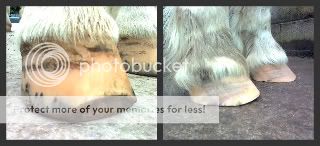
photo0114-1-1.jpg


When going from shod to barefoot, it is quite unnerving to see the difference in hoof height so can understand why owners can think the hoof is short. I just wanted to show the above where you can see the difference. This is 7 months apart - that foot has changed even more now (13months) but you can see how "short" it is.

Also the walking 'short' thing... the hoof grips better on tarmac rather than doing that micro "slip" on foot landing that metal shod horses have. Barefoot horses don't do this so the stride changes ever so slightly and seems less forward. Infact, all it is, is that the hoof is landing heel first (should be anyway if toe first, then that needs looking at - pain somewhere) and gripping the road surface. Waking downhill is slower for this reason too.

Boots weigh less than shoes. I think its psychological as they look clunkier and cumbersome and we think the horse trips more when in fact it's probably about the same as usual.
 
In my experience the more work that you do without shoes the more the hoof grows to compensate. We have being doing about 30+ miles a week of roadwork-walk, lots of trot and the occasional canter, as well as schooling in the field etc, but still need the trimmer every 6 weeks to tidy up.
Our horses only tend to 'trip' when they are a little footy, which is usually directly related to the amount of grass they have had! And this dissappears if ridden in boots (marquis).
 
My youngster takes shorter strides barefoot.

I need to try and increase hi stride length in trot and if he does a variety of work on different surfaces, then even though he has good hard feet he is cautious when barefoot. this shortens his stride. When he is shod, he is far more confident and his stride is rounder & longer.

It is one of the key reasons he is shod.
 
If you buy a branded forage like ,say, horsehage, can you get an analysis from the company, without getting your own done? Also at work I have seen intelligent people make mistakes with drugs, even getting the dosage wrong by a factor of 10, do you think it is safe and sensible for horse owners to dose their own horses with supplements of copper and selenium that can cause harm if the dosage is wrong?

When I was trying to source horsehage Timothy haylage for allergy exclusion testing for a horse I was having trouble getting hold of it and contacted Marksways. Turns out their haylage (and other products) are made under licence all over the country so the horsehage you buy in scotland will not be the same as the one you would get in Hampshire. Depending on the producers they may be cutting the grass over a wide area and minerals may differ so I'm not sure that using a branded product would give you more consistency.
You may even be better off using a local farmer who makes his own from the same fields every year as with that direct contact you can be sure where it comes from.

Canteron - depending on where you are this year seems to have been a bad one for grass and I have had to muzzle mine where I didn't last year.
 
I dont have anything constructive to add but I just wanted to say that I found the post really interesting.

I have a Rockley Farm rehab who has been barefoot since October 2010 now.

Before I knew anything about barefoot horses, I was one of the many naive people who thought it really was as simple as taking your horses shoes off and off you go, but I know that that is very much NOT the case and I wish others would also take the time to understand and realise that simply taking a horses shoes off is as simple as that. it fustrates me when people say 'my horse wont cope barefoot' when they feed it the wrong thing etc etc. If people took the time to learn, they might find that their horse would actually do very well barefoot.
 
Is there any way bare feet can cope with these conditions, or is it a case of 'you don't know until you try'?

Plenty of bare feet cope with those conditions. You have it in one in your last sentence. I would suggest that you ride as much as possible and definitely do not bed on rubber with thin or no bedding. You want the bedding to pack up inside the feet and to allow the horse to stand toe-down, which is normal for horses in a conformable surface. They actually stand on their heels and point their toes down with very little weight on them, it's quite odd! Bob Bowker did some doppler ultrasound and found that standing on concrete or flat matting disrupts the return blood supply up the leg. That was fascinating to hear about. Unfortunately I don't think he has published it but I heard it from him first hand.

The best barefoot bedding is pea gravel, but it is difficult to manage because you have to pick out the poo and wash out the pee. I don't know anyone who beds a stable in it, but I gather there are some. There are plenty of people who have a dry turnout of it, and my arena is made of it too.
 
Plenty of bare feet cope with those conditions. You have it in one in your last sentence. I would suggest that you ride as much as possible and definitely do not bed on rubber with thin or no bedding. You want the bedding to pack up inside the feet and to allow the horse to stand toe-down, which is normal for horses in a conformable surface. They actually stand on their heels and point their toes down with very little weight on them, it's quite odd! Bob Bowker did some doppler ultrasound and found that standing on concrete or flat matting disrupts the return blood supply up the leg. That was fascinating to hear about. Unfortunately I don't think he has published it but I heard it from him first hand.

The best barefoot bedding is pea gravel, but it is difficult to manage because you have to pick out the poo and wash out the pee. I don't know anyone who beds a stable in it, but I gather there are some. There are plenty of people who have a dry turnout of it, and my arena is made of it too.

Thanks for this, I'll just have to see how it goes.

He'll be on rubber mats (I don't think they can come out?) but he's always got a full, deep shavings bed when he's in for a long time. Bedding on pea gravel is an interesting idea... Would save a lot in bedding!
 
Balanced post which is nice regarding barefoot. I livery on a RS where there are about 30 horses/ponies which do everything including quite high level competition. Some are shod all round, some in front only and some barefoot. It what suits the horse and its workload. For example one pony was only shod in front which for a normal hack/school workload was fine but it then hunted a whole season and about 2/3 way through back shoes were needed as feet were just wearing down too quickly. Pony doesnt hunt now so no back shoes on.

Do whatever works for you and your horse there is no right or wrong answer when it comes to barefoot v shod.
 
Splash, wearing too quickly is not a reason to need to shoe. If the horse is not footie then it does not matter how short the foot is, but people get scared when they see a short foot and sometimes shoe in the expectation that they will get problems if they do not. Do you know if the pony was actually sore, or were the owners just nervous about the wear?
 
Thanks for this, I'll just have to see how it goes.

He'll be on rubber mats (I don't think they can come out?) but he's always got a full, deep shavings bed when he's in for a long time. Bedding on pea gravel is an interesting idea... Would save a lot in bedding!

The mats are no problem as long as he has a full thickness and full size bed to choose to stand in and pack into his feet. Good luck, I hope you have one of the many horses that do barefoot really easily.
 
Interesting post. I am considering taking my horse's shoes off over winter (he has flat feet which seem to be putting strain on his front suspensories, and I think taking his shoes off for a while may help with this). Reading through your post, though, I'm concerned about the 'wet' problem.

The horse will be stabled over night in winter, and out in a wet field during the day. I have no means of providing dry turnout over night. The horse needs to be kept in work, though, so giving a holiday over the winter is not an option.

Is there any way bare feet can cope with these conditions, or is it a case of 'you don't know until you try'?

My horses have coped with this routine for many years.

We're in Blackpool - so it gets plenty wet and muddy:)

Give em a scrub when they come in every now and again.

But my secret weapon is diet - if you feed a low sugar, high fibre diet with plenty of minerals then they become resistant to the mud;)
 
Splash, wearing too quickly is not a reason to need to shoe. If the horse is not footie then it does not matter how short the foot is, but people get scared when they see a short foot and sometimes shoe in the expectation that they will get problems if they do not. Do you know if the pony was actually sore, or were the owners just nervous about the wear?

Very good balanced posts here.

Last summer my horse was working hard 5-6 days/week and was getting trimmed every 3 weeks!

I've found that growth will catch up to any wear providing the horses are kept on dry footing and they have the right nutrients.

I feed no grain but I do supplement copper, zinc and magnesium oxide.

Good barefeet look so different to shod feet (even when the shoeing is good). There is no comparison and it's something that the eye has to get used to.

Providing the horse isn't sore and there is a rim of hoofwall around the sole then it's fine.
 
Top