Barefoot without a barefoot trimmer

I was just wondering this morning why making shoes is still part of the Farrier syllabus and not an extra, most shoes are bought in and modified aren't they? The time could be spent on other things such as diet and barefoot options for rehab along with maintaining working barefoot horses.
 
I was just wondering this morning why making shoes is still part of the Farrier syllabus and not an extra, most shoes are bought in and modified aren't they? The time could be spent on other things such as diet and barefoot options for rehab along with maintaining working barefoot horses.
My goodness, radical thinking, the Worshipful Company want horses to be shod, it is part of their philosophy, anyway four lectures on diet would be enough,
1 hi fibre
2 lo sugar
3 feed linseed
4 minerals
I was chatting to a good farrier [world class just does not enter competitions these days], he told me that he can easily identify a good potential apprentice farrier after a few days, if they can't "bend metal" they will never be any good, so the skills are required, and need to be honed. Otherwise they had better stick to making gates.
You have to realise a lot of these lads were not very academic, and may not be good communicators, that does not make them poor farriers.
 
Last edited:
how many actually forge (make from scratch) shoes after they become registered?
I will remind you of the rest of my post.............
QUOTE "I was chatting to a good farrier [world class just does not enter competitions these days], he told me that he can easily identify a good potential apprentice farrier after a few days, if they can't "bend metal" they will never be any good, so the skills are required, and need to be honed. Otherwise they had better stick to making gates." UNQUOTE
It does not matter how many do it, it is part of their education and understanding, I spent three years in higher education, and used maybe less than a one sixth of the knowledge gained, but that does not mean I should only have done a six month course.
 
Last edited:
You have to realise a lot of these lads

Don't forget the lasses! My farrier (who has done a brilliant job with my shod and unshod horses over the past 20 years) has had 'lasses' as his past 3 apprentices - all brilliant and just one left to qualify. I love listening to him teach them as he's also an international examiner and explain the differences between trimming the shod and unshod horses.
 
Don't forget the lasses! My farrier (who has done a brilliant job with my shod and unshod horses over the past 20 years) has had 'lasses' as his past 3 apprentices - all brilliant and just one left to qualify. I love listening to him teach them as he's also an international examiner and explain the differences between trimming the shod and unshod horses.
The wives round here don't trust their husbands enough !
 
It's not how long farriers spend learning, it's what they are taught that counts.

Reading past histories from horse owners on this forum about the futility and plain stupidity of some treatments undertaken by farriers and some clueless vets makes you want to weep.

Yet owners still sing their praises long after they've killed the horse.

It's about time this farrier/trimmer nonsense was sorted and farriers actually learned something relevant about horses.

I'd have thought the Ofsted report on farrier training would have made anyone with any sense realize 6yrs of bullying, exploitation and learning sweet F A is not comparable in any way to barefoot equine hoofcare no matter how you dress it up.

Even if the training was useful, 6yrs, talk about slow learners, you can qualify as a doctor in 5.
 
As opposed to farriers, whose syllabus contains not a single hour of learning how to manage hard working barefoot horses.

So your saying a farrier cannot care for a barefoot horse in hard work???

What a crock!!!!

Give me a good farrier over a barefoot trimmer any day.
 
Last edited:
OTOH I think I would take a good barefoot trimmer over a bad farrier any day.

OTOH I would not use a bad farrier I have only experienced 1 bad farrier- where as I have seen 4 bad trimmers 1 made no difference but charged £50 for the privilege.
This conversation goes round and round and I refuse to jump on the roundabout.
All I will say is I will only use a farrier now.
 
Last edited:
Of course the acid test is outcome from lameness and pain, anecdotally, from the threads on this forum, the barefoot system, which is presided over primarily by trimmers have better outcomes than farriers.

The farrier system of remedial shoeing, large doses of drugs and months of box rest, temporary respite, perhaps, before the inevitable destruction.

As opposed to proper diet, movement and limited invasive procedure.
 
So your saying a farrier cannot care for a barefoot horse in hard work???

What a crock!!!!

Give me a good farrier over a barefoot trimmer any day.


No I am saying that there is NOTHING in the farrier syllabus about trimming hard working horses with no shoes on. And that in consequence, a newly trained farrier will only know about hard working barefoot horses if the master who trained them has some on his books.

As opposed to trained trimmers. Where you have scoffed at the length of their training, but it is all related to keeping unshod horses working.

There are farriers who are good at managing working horses. But it's in spite of their training syllabus, not because of it.

I don't have a farrier. I trim my own and have done ever since two farriers told me that my horse would never manage barefoot because he could only be shod one front hoof at a time, he was too sore to stand on a bare foot while the other was done. He evented BE Novice.

Those two farriers had no idea what barefoot horses could do and only two weeks ago the young one said something to me which showed that he still does not understand, even after seeing a horse he told me would never do it prove him wrong.


There are good and bad trimmers. Some of each are farriers and some of each are non farriers.
 
Last edited:
Surely something that is important is what the farrier is willing to learn after he has qualified? I used to use a young farrier, a few years ago, who turned out to be terrible. He had one way of shoeing horses, he'd come to the yard on a Monday and shoe maybe 4 horses every time. At least one would be lame for the next week. He wouldn't entertain different ways of shoeing, didn't think any horse should ever even take a break from shoes, and generally refused to discuss anything he did. I changed farriers to one who was great. In that time I also have a visit from an equine podiatrist, who was worse than the farrier. Horse had shivers and struggled to pick up one hind leg. Farrier had at least got a way to get the horse to feel safe enough to pick it up and keep it up (without force, I should add). The podiatrist wouldn't even try, he was too frightened (I kid you not!). Told me it didn't matter, he just wouldn't ever trim that foot! LMAO.

I moved yards last year and am now using the yard farrier. Horse has been fully shod all round by him, and has now been out of shoes for about 9 weeks. I was always under the impression that the farriers from this particular forge were very average. The guy I'm using has turned out to be brilliant. I'd say he's maybe late 30s so not a newly qualified farrier but it's obvious from talking to him that he has taken time to learn since qualifying. When I mentioned taking off shoes he was all for it. Spent ages with me discussing my horse's feet, how (if at all) he would trim them, how he tidies them up, how he expects them to change. When I called him out last time to look at some flare, we discussed why it was happening. He is far more knowledgeable than the podiatrist who came out. And he only charges me £5 for a tidy up! Unlike the podiatrist who charged me £25 just to look at the horse, and couldn't even pick up one of his feet...

Good and bad in all trades, and I wish people would agree on that at least!
 
Good and bad in all trades, and I wish people would agree on that at least!
Of course!

CPD is very important but the basics need to be comprehensively covered in the training surely? There are increasing numbers of working barefoot horses and barefoot rehab is showing some great results so has to be an option that is included in modern Farriery and Veterinary training. :confused: Prevention is the big thing barefoot thinking has to offer imho.
 
I am just hoping I won't have to ask for too much intervention. I know the first thing my farrier would do would be to hack the frog to bits!
 
Thank you so much for all the replies, apologies it has taken me so long to get a chance to reply. Interesting hearing both viewpoints. For me a barefoot trimmer isn't an option. Its either me or the farrier. I do a fab job on my mini's feet, but his feet are fab anyway so it would be hard to get it wrong. So i'll do the occasional tidy up job and then have the farrier well warned to keep his hoof knife away when he does it. My favourite farrier emigrated about 2 years ago, but rumour has it he may be returning so i'll keep my fingers crossed for that.

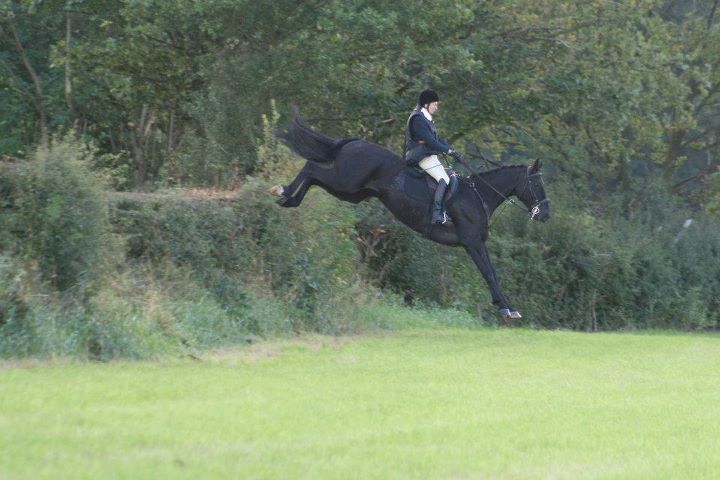
CPTrays what a fab pic, and just what I needed to see! Not that i'll ever be jumping that big, its just good to know its possible. I ordered the Feet First book so I'll be able to admire it closer than on this tiny screen. All the pics i've seen of people jumping barefoot were jumping fairly small on a sand arena. And the only horses i've known to hunt barefoot was the occasional super hardy cob with feet like rocks.

Brightbay if you're up in Dublin and at a loose end give me a shout.

Now I just need to start taking pics of their feet so I have a starting point!
 
You should have told me you wanted a barefoot hunting picture :D

radar+hedge.jpg
 
My boy is shod only in fronts, and the farrier has mentioned that he might need backs soon too as he's only shaping them when he visits, not taking anything off (I've started hacking him out in the last couple of months).
But he also said he won't do so unless he feels that Red is footsore. Been using him for a year, and when I first had him he told me he prefers to see a horse unshod and will do his utmost to keep it that way. He's an excellent farrier.

But he can't stand barefoot trimmers. Said they don't often know a fraction as much about the horses biology as try should do and can do more harm than good in the long run.
 
My boy is shod only in fronts, and the farrier has mentioned that he might need backs soon too as he's only shaping them when he visits, not taking anything off (I've started hacking him out in the last couple of months).
But he also said he won't do so unless he feels that Red is footsore. Been using him for a year, and when I first had him he told me he prefers to see a horse unshod and will do his utmost to keep it that way. He's an excellent farrier.

But he can't stand barefoot trimmers. Said they don't often know a fraction as much about the horses biology as try should do and can do more harm than good in the long run.

And yet you won't find a barefoot trimmer raising concern with the owner that the horse is matching its rate of growth of the foot to its wear and there is no foot to trim off.

And his solution, should the horse become sore, is to shoe immediately rather than investigate how you might encourage faster growth or stronger horn.

That's why people use barefoot trimmers.
 
Last edited:
That may be so, but they are still far too under qualified. And are only allowed to do what they can because there is a grey area in the law.

And I've known him treat footsore horses and ponies without shoeing. Just in my case we had a long discussion, in which he told me of several different things he could do, but I chose backs.

I would much rather have my horse seen by someone who has studied the horses hooves, legs and in fact entire nervous system for a good 5 years than ever risk him being seen my someone who once went on a week long or even weekend (!) course.
 
That may be so, but they are still far too under qualified. And are only allowed to do what they can because there is a grey area in the law.

And I've known him treat footsore horses and ponies without shoeing. Just in my case we had a long discussion, in which he told me of several different things he could do, but I chose backs.

I would much rather have my horse seen by someone who has studied the horses hooves, legs and in fact entire nervous system for a good 5 years than ever risk him being seen my someone who once went on a week long or even weekend (!) course.

Have you actually looked at the syllabus? They spend the vast majority of that time out of the classroom learning how to bend metal and nail it to horses feet. I don't believe that they leave college knowing nearly as much as you think they do.

You have a great farrier, now that you have explained the whole story. Others don't and are better off with their trimmer. If I'd listened to my two farriers, my horses would still be in shoes.
 
Strangely enough it was a farrier got me into barefoot, but he couldn't trim for toffee, he always trimmed for a shoe which isn't right for barefooters. Hence, a barefoot trimmer and success. I now trim all ours and we don't have any issues anymore like we did when we were shoeing.
As far as this farrier v trimmer debate goes, I'm now convinced that people who are anti trimmers purely on their training regime, are barmy. It really is a stupid reason to be anti trimmer. I'm certainly not anti farrier, I'm really pro farriers who train as trimmers, as these type of farriers know they are not taught anything about barefoot and need to know. I'm not into people who do a crap job be they trimmer or farrier. Owners have the choice what they do, which is fine, but it's only the thick ones who slag off trimmers for their training.
 
Have you actually looked at the syllabus? They spend the vast majority of that time out of the classroom learning how to bend metal and nail it to horses feet. I don't believe that they leave college knowing nearly as much as you think they do.

You have a great farrier, now that you have explained the whole story. Others don't and are better off with their trimmer. If I'd listened to my two farriers, my horses would still be in shoes.

To be perfectly honest with you, no I haven't. But from what mine told me, he did a lot of studying not just iron-mongering.
But the only 2 farriers I've ever known (mine, and my friend's) have both been very for barefoot horses. My friend has a TB who would get abscesses every time she was shod- she's an excellent farrier and the tb has great feet. My boy has always been shod so that's why I've kept him that way.
Suppose I've been lucky with the ones I've met. He really is brilliant. However the one I used before my current (never actually met him, he came on a work day) did such an awful job I never used him again- both the front shoes and the back trim!
 
I know that in theory farriers should be perfectly capable of trimming a barefoot horse...but I haven't come across any yet... They will trim and balance, but persuading them to leave the frog and sole alone is a challenge. They do what I ask, but obviously think I'm a little crazy.

Current farrier has a standard response of 'well, if you're happy with him like that...' e.g. he pointed out that there wasn't 8 weeks of growth on the front feet, and little for him to trim, so was I happy keeping him without shoes?... I know - in 8 weeks he has grown out the nail chips and crumble, and has started little walk hacks on smooth tarmac - I'm not expecting there to be 8 weeks of growth hanging off the bottom of his foot, and I don't think the farrier should either... It would be fab to be able to count on a supportive farrier, but I think that going along with me in a faintly disapproving way is the most I can hope for!

Learning to keep a roll myself has been v important - and gradually getting more confident in assessing balance etc but not brave enough to do without regular farrier checks yet. Perhaps once front feet have caught up with back feet and fully transitioned, I might take up his suggestion of only booking if I think he needs the farrier to check him rather than every 8 weeks...
 
They will trim and balance, but persuading them to leave the frog and sole alone is a challenge. They do what I ask, but obviously think I'm a little crazy.
I read this so often and there are two general points here. Why are frog and sole getting routinely trimmed and why would a well trained professional be happy to do what is asked when it comes to their specialist area? How much is actually done to please owners as opposed to what is right for the individual horse?
 
amandap - I know where you are coming from. I try to extend professional courtesy and let people do their job - I wouldn't like it if my patients told me how to do the job I've spent years training for, but my experience is that farriers (and I'm not saying they are the only ones!) base their practice on what they have been trained to do, rather than evidence based practice, and keeping an open mind to new developments.

Firstly I don't really know why the frog must be trimmed back - I can understand sole not exfoliating, and bars getting in the way of shoes, but every farrier I've asked says the frog gets in the way of the shoe and isn't needed on a shod horse. True enough I suppose.

Secondly, I think my farriers have been willing to put up with me asking for specifics, as long as the horse is sound. They know their job, but I know my horse and how sound he is on a day to day basis, before and after trimming. I think they should include your experience of the horse in how they work - if I said he was tripping a lot, they would shoe differently, so why should it be any different barefoot? I don't think they should just do whatever the owner asks willy-nilly, but if what I have asked for results in a sound horse, and I as the customer am happy...

In return for putting up with me and my whimsy of working barefoot, I promise to call him and think about shoes if cob is struggling barefoot. I would love to be able to have a balanced discussion about it, bearing in mind current evidence etc, but settle for keeping my opinion to myself if he keeps his shoes to himself.... Previous farrier refused to believe that improvement in horn was due to diet change. He did acknowledge changes, but obviously never agreed with me on what caused them! I always have coffee and cake on hand to sweeten the deal tho :)
 
I read this so often and there are two general points here. Why are frog and sole getting routinely trimmed and why would a well trained professional be happy to do what is asked when it comes to their specialist area? How much is actually done to please owners as opposed to what is right for the individual horse?

I can only give my experience but have used quite a few farriers over the years. With unshod horses, they trim frogs to cut out thrush, but with a healthy frog, they leave them alone.
I never tell them what to do but I do discuss any concerns and we work together. Without exception, the farriers I've had, have been really happy to work with an owner who takes foot care seriously and appreciates the importance of hoof health and balance.
I once had a dilemma when a highly regarded specialist remedial farrier prescribed a treatment plan that my own farrier disagreed with. I could see my farrier didn't take his refusal to cooperate lightly, but he basically said that he couldn't put his name to the work that was being asked for. I decided to stay with him and support his decision and in hindsight he was absolutely right.
 
Top