
Except it’s the local vet suggesting referral for a bone scan instead of them doing a work up for it so no.Typical of vets though don't you think?
The other week with Lari's kick they were offering me scans, xrays and potential surgical input
It always seems that vets have to promote every option these Fridays no matter how expensive or wild they might be.
I tend to always go down the route of consulting my equine physio in the first instance. What is rather confusing is that she came out when I first got Molly in May (I routinely get dentist/farrier/physio etc for any new horse) and there were no real issues noted apart from her being croup high, crepitus right hock and creaky medial stifles. But then I started ridden work and she found trot work difficult and particularly uphill work even in walk. At this point the asymmetry seemed to be picked up - not previously.Just as an aside and for context, it's high possible or even likely that there's some kind of early life trauma that led to the asymmetric pelvis, and that that then causes compensatory movement and that the straight hind leg comes from that.
As a very general pointer a low set tail may mean the pelvis is slightly stuck in posterior tilt (ie the top is further back than it should be), often coupled with dips in the spine around the sacrum/si, there will flexion in the hip joint but the others will be straight (think I have that the same ight way round!).
If in anterior tilt, with a high set tail, then all HQ joints are pulled straight. Hamstrings can be an issue with both, but suffice to say most hind legs straightness is at least partially or substantially postural.
For sure find the acute joints and treat, but looking at it from a posture and movement point of view (which often means moving away from your own vet's paradigm, and sometimes even to a different bodyworkers) may open up other options as you move forwards.
Good luck.
And the next client complains that they were given painkillers and sent on their way, and never offered the scans, X rays or surgical input that may have helped their animal.Typical of vets though don't you think?
The other week with Lari's kick they were offering me scans, xrays and potential surgical input
It always seems that vets have to promote every option these Fridays no matter how expensive or wild they might be.
I tend to always go down the route of consulting my equine physio in the first instance. What is rather confusing is that she came out when I first got Molly in May (I routinely get dentist/farrier/physio etc for any new horse) and there were no real issues noted apart from her being croup high, crepitus right hock and creaky medial stifles. But then I started ridden work and she found trot work difficult and particularly uphill work even in walk. At this point the asymmetry seemed to be picked up - not previously.
On trying her (before I bought her) I took her for a hack and did loads of trotting and she was really forward - that's why I liked her so much! Yes she could have been on bute - but I didn't actually go to try her - I went to try a gelding but didn't really click with him. So the seller was not expecting me to try her that day. I will never know for sure as bloods weren't taken, but she was a completely different pony when I got on her a month later (took that long to sort a saddle!).
I'm wondering whether another body worker might be useful as a second opinion. My friend uses one who has a thermal imaging camera so not sure how helpful that would be? For this the horse/pony needs to be stabled for 3 hours before treatment and I'm not sure Molly would cope with that as she is used to living out with a shelter so she can come and go as she pleases.
Typical of vets though don't you think?
The other week with Lari's kick they were offering me scans, xrays and potential surgical input
It always seems that vets have to promote every option these Fridays no matter how expensive or wild they might be.
This isn’t for a full lameness work up/nerve blocks though - either that or your vet has done you a massive favour bill wise!A full lameness workup might not be as costly as you're expecting and it's definitely the option I'd go with. One of mine had a full work up last year and it was a lot less than what I was expecting. I got neck, knees, hocks, and feet done.
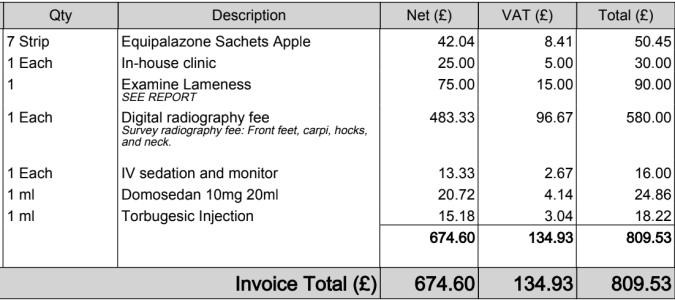
View attachment 152720
Thank you - this is the option I have decided to go for.This isn’t for a full lameness work up/nerve blocks though - either that or your vet has done you a massive favour bill wise!
OP - if you wish to investigate your horses lameness I would suggest nerve blocking (and then imaging based on that) over bone scanning, given that you already have a query over stifles, and saying that your horse has quite straight conformation behind - which leads to a higher risk of suspensory inflammation. As lots of stifle issues can be soft tissue related (with it being the equivalent to our knee) they may not light up on a bone scan, and neither do most suspensory issues. So there is a risk that the bone scan might not give you any answers. I hope that helps, and that it’s something manageable for your horse.
However my farrier said he took one of his mares to a place where sensors were attached to all four legs and the pattern of movement was analysed and she had modified shoes on one hind leg and all the unbalanced movement resolved over time. I don’t know what the sensor investigation is called.
So pleased for you! Much better than stifle issues.Just wanted to follow up on this for everyone who gave me advice. I decided to go for a full lameness work up with a different vet, and 5 weeks ago my mare went for a full lameness work up. When trotted up initially she was 2/10 lame, and after nerve blocks and x-rays and it turned out that the lameness was in her right hock. She had both hocks medicated, and was checked again last week and pronounced completely sound! So at a fraction of the cost of a bone scan I now have my mare back in work and am so happy that it wasn't anything more serious. (Well I know it's not ideal for a five year old to have problems, but in the grand scheme of things it was straightforward as we all know how things can go hugely wrong with horses!)
I did exactly that . An MRI was required to narrow down the injury site and when I asked my vet what treatment would be for the possible causes, it was the same treatment. I chose to spend the money on the treatments instead of the MRI, as all the MRI would do , would be pinpoint exactly where the injury was.If you're not insured I would ask the vet what the treatment options would be for what things he suspects it to be and if they are similar just do that. Ie box rest and anti-inflamitaries and then time in the field etc
Great update. Can I ask what the cost was?Just wanted to follow up on this for everyone who gave me advice. I decided to go for a full lameness work up with a different vet, and 5 weeks ago my mare went for a full lameness work up. When trotted up initially she was 2/10 lame, and after nerve blocks and x-rays and it turned out that the lameness was in her right hock. She had both hocks medicated, and was checked again last week and pronounced completely sound! So at a fraction of the cost of a bone scan I now have my mare back in work and am so happy that it wasn't anything more serious. (Well I know it's not ideal for a five year old to have problems, but in the grand scheme of things it was straightforward as we all know how things can go hugely wrong with horses!)
Thank you. I'm very happy. She lives out 24/7 on a track (to help with her weight as she's a very good do-er) and has regular trims. She feels great so far!So pleased for you! Much better than stifle issues.
Just keep an eye on what surface you ride her on and get her turned out as much as possible with a regular shoeing schedule and you'll be well away.![]()
It was just over £1400 for the lameness work up, nerve blocks, x-rays and joint medication. She was admitted first thing on the Monday, and was home lunchtime on the Wednesday.Great update. Can I ask what the cost was?
Thank you! Just interesting to know these things.It was just over £1400 for the lameness work up, nerve blocks, x-rays and joint medication. She was admitted first thing on the Monday, and was home lunchtime on the Wednesday.