bitting dilemma..

crazycoloured

Well-Known Member
Joined
2 April 2009
Messages
762
Visit site
I have a cob who has recently been grinding her bit. i ride her in a straight bar happy mouth .Previous to that i rode her in a jointed happy mouth and she kept trying to get her tounge over the bit.so i now ride her in a straight bar with a grackle noseband.any suggestions to which bit i could try? We are only hacking at the moment and may do a little schooling in a few weeks.She has good breaks and isnt strong to ride..
 
I always wonder why not more people realise that its far esier to ride without a bit. So many people ask bitting advise when the bit is the problem. I just dont get why people are so fixated on finding a bit the horse LIKES. Its funny, cus they dont.

Horses give us so many signs that they are uncomfortable in it. Most people just dont hear them, or dont listen. Just strap a flash on and forget it.

Sorry OP, not having a go at you. Just bits in general.

If your not interested in bitless, maybe try a metal mouth piece. Lots of horses grind and chew on rubber mouth pieces. Maybe try a french link, a sweet iron, a myler?

Her getting her tounge over the bit is her saying pretty loadly that she isnt happy. Fixing a flash or grackle wont fix the problem, just shuts her up i feel.

Its funny also, so many people spend a fortune on finding a bit their horse will accept, when it costs as much as a synthetic bridle to take away the problem.

Anyway, rant over. Hope you find something suitable for her.
 
Im not really a fan of riding bitless but we are all different iv known people to ride bitless in the past and have found it to be okay,What exactly does a sweet iron bit do?? im thinking maybe she dosent like the feel of the happy mouth..
 
riding bitless was the best thing i could have done for my pony.
its not the feel of the happy mouth that she doesnt like, it is the pressure on the roof of the mouth from the single jointed and the pressure on the tongue from the straight bar.
the mouth is very sensitive and if a horse opens its mouth whilst bitted it is trying to tell us something, so we should listen and help to get them comfortable, not strap it shut and silence them, this makes them even more uncomfortable, as they cannot get away from the pain and also causes problems elsewhere, as the horse will move and carry itself differently to help compensate.
a straight bar puts pressure on the tongue, if we hold our tongue down and try to swallow it is impossible and horses need to swallow whilst exercising.
if you are really opposed to going bitless, then how about trying a loose ring snaffle, double jointed, with a roller in the centre, as this is kinder on the roof, the tongue and has more movement and remove the grackle.
hope you can get her more comfortable
 
Last edited:
Would a bit with a thinner mouthpiece be better as some of the snaffles have a thick mouthpiece.I have heard that the sweet iron bits are good.I did think about trying her with a cherry roller as thought she may like something to play with in her mouth it may make her more comfortable.
 
Im not really a fan of riding bitless but we are all different iv known people to ride bitless in the past and have found it to be okay,What exactly does a sweet iron bit do?? im thinking maybe she dosent like the feel of the happy mouth..

What is it that you dont like about bitless? Surely something that will make a horse more comfortable is a good thing?

I suppose its such an alien thing for most people to take the point of control from the sensitive mouth to the nose. I just wish it was more widely accepted. At least we wouldnt have these questions about finding the right bit for a certain horse, because the answer would be quite obvious.

Maybe instead of trying to find a KIND bit, maybe more people should understand that the bit is the problem.

If your horse has a small mouth and big tounge, then a thinner mouth piece may be more suitable. But a thinner mouth piece will also be more severe because of less surface area.

If i were has to train a horse in a bit, i would use the micklem multi bridle so i could attach the bar guards and tranfer the rein fressure from the mouth to the nose. I would also use a french link snaffle, because there is much less nutcracker action.

But my horses all go very good without the bit, so i dont have much need for a bit. Its kinda weird when i go to shows and all horses wearing bits.
Its just not neccesary.

http://www.youtube.com/watch?v=0a-aV0Rsxmg

This in an interesting video.
 
Generally cobs have thick tongues and fleshy lips, so a slimmer mouth piece may suit your horse better.

If she is trying to get her tongue over the bit she probably doesn't like the pressure the mouth piece is putting on her tongue, so again the slimmer mouth piece should be better or you could try a mouth piece with a small port to take away the pressure.
 
Its funny also, so many people spend a fortune on finding a bit their horse will accept, when it costs as much as a synthetic bridle to take away the problem.

Well bear in mind you cannot compete dressage bitless. In addition there isn't a single example of top level competitors using a non-shanked bitless bridle (i.e. showjumpers use shanked english or german hackamores, which are arguably more uncomfortable than a bit!)

Whilst its fine for hacking about, you simply don't get the control and collected required in competition. This is why people spend time and effort to find the right bit.

That said ergonomics are developing and that why we have created new ranges like the tongue saver, which are vastly superior to the french link.
 
I would echo the suggestion about a thinner mouthpiece, and try something with either a port or two joints (french link, bit with a lozenge etc). Do bear in mind that a thinner bit has a smaller surface area an so is harsher than a thicker one - and that if your hands are not light and quiet then your horse may object to any bit.

Regarding bitless riding, it can be interesting to try out, but I don't feel it is the only answer. If the horse is happiest bitless then that's fine, but I don't think a correctly used and fitted bit that the horse has no issue with is a better or worse solution. I thoroughly enjoy riding tackless, but really fine, subtle control is easier with a bit and if you want to go out and about you'll need to find somehting competition legal.
 
Well bear in mind you cannot compete dressage bitless. In addition there isn't a single example of top level competitors using a non-shanked bitless bridle (i.e. showjumpers use shanked english or german hackamores, which are arguably more uncomfortable than a bit!)

Whilst its fine for hacking about, you simply don't get the control and collected required in competition. This is why people spend time and effort to find the right bit.

That said ergonomics are developing and that why we have created new ranges like the tongue saver, which are vastly superior to the french link.

Off course you can get the control and collection in a bitless. After all, the control and collection shouldnt come from the bit. It should come from your seat, and the horse being able to go in self carrage.

And i agree, most top level jumpers ride in a hackamore. Which can be severe. Im not taking about a hackamore. Im talking about a cross under, a sidepull, a scrawbrig, something that doesnt have a leverage effect.

I feel that to be able to ride a horse without a bit and be able to achieve a light, responsive horse that will go in self caraige you have to be able to ride at a better level. Any one can make a horse go on the bit, but to actually get a horse to use and carry himself takes a lot of training, for horse and rider.

I think its a cheaters way to use a bit to be able to control a horse.
You can get a horse to be really soft with his mouth because its so sensitive. You can but i more finner bit in a horse who leans and you can stop them leaning. If you screw up in a bitless and teach a horse to lean or pull, then because the mild bitless wont hurt the horse like the bit, its harder to get the horse soft again. Its easier to get a horse to go well in a bit than in a halter or bitless.
People always tell me that you can still hurt a horse in a bitless. Obviously. But because the nose is not as sensitive as the mouth, if you pulled on the mouth as hard as on the nose, the mouth would hurt more.

I think its opinions like yours that prevent most people from ever trying bitless as an option. I always like to state A HORSE DOES NOT NEED A PIECE OF METAL IN HIS MOUTH TO ACHIEVE LIGHTNESS, SELF CARRAIGE AND OBEDIENCE TO THE AIDS.

They just dont. People can achieve this without tack, not just bitless.

Another thing, not very many people are out competing at a high level bitless, so not a lot of people get to see how effective it is. Some day i hope that it does get more interest.

Its like the shod vs barefoot debate. People didnt believe horses could compete at top level without shoes. Now luckily we do have people out their proving the critics wrong.

Ps, i know you cant do dressage in a bitless. Thats part of the problem.
 
Can I ask what level & discipline you are competing at bitless?

Thought you would ask this. What has my credentials got to do with it. I can ride to novice dressage test bitless, including lateral work and jumping 1m+.

It doesnt matter what i can do, im no brilliant rider. But i can see with my own eyes what others can do.

Why do you need a bit to do collected work? Or to ride a horse at all?
 
jennyharvey, you said yourself the aids are more crude using a bitless bridle (because the nose is less sensitive)- i would much rather ride lightly in a bit, using refined aids than to tug at a bitless contraption to get them to turn, or neck rein as is so often seen.

fact is, many horses react violently to the constricting effect of some of these bridles on their head anyway
 
jennyharvey, you said yourself the aids are more crude using a bitless bridle (because the nose is less sensitive)- i would much rather ride lightly in a bit, using refined aids than to tug at a bitless contraption to get them to turn, or neck rein as is so often seen.

fact is, many horses react violently to the constricting effect of some of these bridles on their head anyway

How did i say the aids are more crude? I dont know where u got that from.
I said he nose is less sensitive than the mouth, yes, whats the issue. Doesnt mean u use more pressure on the nose. I also said, that if you do, the horse can learn to lean. Same as a bit i guess. Aim is to teach the horse to be light, whatever its ridden in.

I suppose i should have said that the nose is less sensitive, bt they do still have feelings in it. You dont have to pull in a bitless, this is not the aim. Sorry if you thought that is what i meant.

The aim is to get the horse to be soft and light, so you dont have to use force to turn or stop.
I said that if you pull on the horse it will hurt the mouth more than the nose.
But not that you should pull on the horses head in the first place.

Your putting words in my mouth.

Ps, i know a lot of people ride lightly in a bit. But what about when the horse pulls out hunting or jumping. Most people just pull back. This would hurt the mouth more than the nose.
Or while your riding nice and light and your horse spooks. You pull the reinst to stop the horse. Again, this would hurt the mouth more than the nose.

That doesnt mean that you cant hurt the nose by pulling hard.
Just that you are less likely to in these situations.
 
Last edited:
Why do you need a bit to do collected work? Or to ride a horse at all?


Why do you need a bit to do collected work? Or to ride a horse at all?

This is very true, I thoroughly enjoy riding tackless, and it is perfectly possible to achieve collected work.

However, the bit is a very precise line of communication, and so you can use it to give incredibly subtle and refined aids. I do not steer or stop with the bit, but when it comes to asking for a few degrees more lateral flexion, or for the horse to come a touch deeper or a touch lighter, it is much easier to use one.

So long as it fits and is used sympathetically, I don't see why using one is an issue. I'm willing to accept that some horses are simply happier bitless, but I wouldn't give up looking for a bit he is comfortable with just yet, OP, especially as it is likely to be a fairly simple issue of choosing a slimmer, jointed mouthpiece to fit your horse's mouth conformation.
 
Thought you would ask this. What has my credentials got to do with it. I can ride to novice dressage test bitless, including lateral work and jumping 1m+.

I was just wondering how far you had got and how much you competed bitless, is that a bad question?

I compete affiliated Showjumping, but only to 1.10m which is still fairly amateur. My horse uses a tongue saver lozenge baucher and simple loose cavesson, no martingale. Relatively simple tack for SJ'ing.

I hack around home bitless, we sell bitless bridles so not 'anti' either. That said I just cannot get the collection in my cross under that I can get with a shanked English hackamore or bit when jumping.

You seem to be a little het up, so I would tone it down a bit and have a debate not a shouting match and suggest that you don't tell people that using bits is "cheating", when in reality people ought to use what suits their horse and competition discipline!
 
This is very true, I thoroughly enjoy riding tackless, and it is perfectly possible to achieve collected work.

However, the bit is a very precise line of communication, and so you can use it to give incredibly subtle and refined aids. I do not steer or stop with the bit, but when it comes to asking for a few degrees more lateral flexion, or for the horse to come a touch deeper or a touch lighter, it is much easier to use one.

So long as it fits and is used sympathetically, I don't see why using one is an issue. I'm willing to accept that some horses are simply happier bitless, but I wouldn't give up looking for a bit he is comfortable with just yet, OP, especially as it is likely to be a fairly simple issue of choosing a slimmer, jointed mouthpiece to fit your horse's mouth conformation.

I have nothing against using the bit for subtle communication. If all the pro riders rode in this way, i wouldnt have an issue with it.

Thats why a like classical dressage. I think its a much nicer picture than what i see at the big dressage champs. Problem is, not very many people who do classical dressage compete at a high level.

But out of all the pro riders who compete at grand prix level, non ride with a light contact. Most are even behind the vertical, with tight reins.

I guess it depends what we consider to be a light contact. Some people want to feel the horse at the end of the rein, to work the horse into a contact.

What a lot of people consider a light contact is one where you still have a contact with the mouth.

If i were riding at grand prix level, i wouldnt want to feel my horse at the end of the rein. He should be perfectly capable of carrying himself, i shouldnt have to use my hands to control him movement.

If this was dressage, i wouldnt have a problme with it. But the thing i see most times with dressage is a stiff horse, behind the vertical, with the rider pulling on the reins, horses head bobbing.

I think too much emphasis is put on the rein, when it should be put on the seat and leg aids. If it were, then so many people wouldnt have horses ridden in gags and waterfords because they have no brakes.
 
I was just wondering how far you had got and how much you competed bitless, is that a bad question?

I compete affiliated Showjumping, but only to 1.10m which is still fairly amateur. My horse uses a tongue saver lozenge baucher and simple loose cavesson, no martingale. Relatively simple tack for SJ'ing.

I hack around home bitless, we sell bitless bridles so not 'anti' either. That said I just cannot get the collection in my cross under that I can get with a shanked English hackamore or bit when jumping.

You seem to be a little het up, so I would tone it down a bit and have a debate not a shouting match and suggest that you don't tell people that using bits is "cheating", when in reality people ought to use what suits their horse and competition discipline!

Sorry if my posts seem a bit rude. Its just how i feel about riding in bits.

I think that if a horse cannot collect as well in a bitless as in a bit, i would think it has more to do with the training as apposed to the tack.
Im not saying you arent a good trainer or rider, just that it does take to be very subtle with your rein aids to get a horse to back off a jump.

I want my horse to be able to come back to me from any pace, even from a canter to halt. I want my horse to be really responsive so that as soon as i ask him to slow or stop with a light cue, he does it.

I think its about teaching the horse to be extremely responsive to the rein aids, so you never need to pull on him. As soon as you ask for a collection or for him to back off a jump, or stop, he does it imediately.
 
Ah well you see stopping isn't the problem - quite the opposite! I just have to sit up and drop reins and all mine stop quickly

The problem comes when you are having to keep the collected and drive them forwards, without letting them get long. Keeping that bouncy canter without a shank / bit is very difficult. Actually its quite hard on mine with a bit!

However if you remember you posted a you tube video explaining why your standard single joint is bad and horses open their mouths. I totally agree with this and its why my bit is like this:
Bauch_TongueS2.jpg


I don't think I cause much discomfort as my reins are generally far too long:D
 
Thats why a like classical dressage. I think its a much nicer picture than what i see at the big dressage champs. Problem is, not very many people who do classical dressage compete at a high level.

But out of all the pro riders who compete at grand prix level, non ride with a light contact. Most are even behind the vertical, with tight reins.

I guess it depends what we consider to be a light contact. Some people want to feel the horse at the end of the rein, to work the horse into a contact.

What a lot of people consider a light contact is one where you still have a contact with the mouth.

If i were riding at grand prix level, i wouldnt want to feel my horse at the end of the rein. He should be perfectly capable of carrying himself, i shouldnt have to use my hands to control him movement.

If this was dressage, i wouldnt have a problme with it. But the thing i see most times with dressage is a stiff horse, behind the vertical, with the rider pulling on the reins, horses head bobbing.

I think too much emphasis is put on the rein, when it should be put on the seat and leg aids. If it were, then so many people wouldnt have horses ridden in gags and waterfords because they have no brakes.

I also prefer classical to contemporary dressage.

I think I would disagree slightly, in that at an advanced level I would still look to have a contact with the horse's mouth. Or perhaps connection would be a better word than contact? I mean that the weight of the looped rein should be sufficient - so there is no tension in the reins, the horse is in no way held in position by the rider's hands - but is relaxed through his jaw and ready to respond to a vibration down the rein when it comes. But perhaps this is a difference in terminology rather than ideas.

I'm sorry if we have hijacked this thread :o
 
Ah well you see stopping isn't the problem - quite the opposite! I just have to sit up and drop reins and all mine stop quickly

The problem comes when you are having to keep the collected and drive them forwards, without letting them get long. Keeping that bouncy canter without a shank / bit is very difficult. Actually its quite hard on mine with a bit!

However if you remember you posted a you tube video explaining why your standard single joint is bad and horses open their mouths. I totally agree with this and its why my bit is like this:
Bauch_TongueS2.jpg


I don't think I cause much discomfort as my reins are generally far too long:D

It looks like quite a nice wee bit.

I suppose i should really state who i am aiming most of my comments at. Im not aiming at those who use bits correctly, but i do aim them at those people who think that the bit is there as brakes, or those that have no regard for where the bit is on a horse.

I get really annoyed at riders who abuse the bit, or use strong bits.

Im not against strong bits either. Just that most of them are put on so called strong horses, instead of teaching the horse not to be strong in the first place.

Again, i just wish that bitless was more widely recognised because then people would be more likely to use it.
I really hope that soon i can get my boy out jumping, because i cant wait to show people how easy it is to control the horse without a bit.
 
I also prefer classical to contemporary dressage.

I think I would disagree slightly, in that at an advanced level I would still look to have a contact with the horse's mouth. Or perhaps connection would be a better word than contact? I mean that the weight of the looped rein should be sufficient - so there is no tension in the reins, the horse is in no way held in position by the rider's hands - but is relaxed through his jaw and ready to respond to a vibration down the rein when it comes. But perhaps this is a difference in terminology rather than ideas.

I'm sorry if we have hijacked this thread :o

I know what you mean by having a contact on the rein, or connection. Like i said before, i am no way against riding in this way, i just see to many people who ride with too tight a contact, sense horses, and relying on the bit for brakes.

I met a cowboy a few years back, and he was explaining to someone about contact. She was saying, what was wrong with having a contact. And he was trying to explain that why would you want a contact when you can have nothing. He didnt mean that you didnt comunicate through the rein, just that you didnt have the horse on the contact, as in dressage.

I have seen how a horse can go well in self carraige without a bridle, so i dont believe that you need a contact to ride a dressage test.
I like to think of a cross between western pleasure horse classes and dressage. A longer rein but still with the collection. It is possible.
 
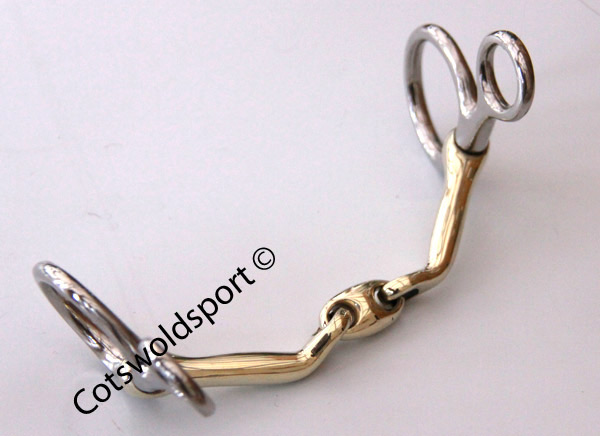
Is that a brachur bit? cotwoldssj but the hanning cheek type.I am going to borrow one of theses bits to try for my mare as they seem to provide more room in the horses mouth and encourage the horse to work on a contact.
 
Found an interesting article on the FEI in regards to bitless bridles, and were the term 'on the bit' came from.

http://www.bitlessbridle.eu/artikelen/On The Bit_A Misleading and Mischevious Phrase.pdf

It does talk about the Dr Cooks cross under, but i know a lot of horses dont like this bridle, so i like to think of it as any bitless bridle.


I don't like the term 'on the bit' To the uninitiated it can be misinterpreted. I prefer 'on the aids' it makes much more sense!:)
 
Is that a brachur bit? cotwoldssj but the hanning cheek type.I am going to borrow one of theses bits to try for my mare as they seem to provide more room in the horses mouth and encourage the horse to work on a contact.
That is a baucher (aka hanging cheek) with a german silver tongue saver lozenge mouthpiece. It was specially made for my horse who is too pink for a loose ring! Probably should have made it in a D ring too, but I think the bauchers are tidy!

The tongue saver means he doesn't stick his tongue out (which he used to) or open his mouth, so happy in a cavesson and does not evade the bit.
 
Im going to borrow one of these bits off a friend and try it with my mare and see how we get on.Im told it also helps them seek a contact which would be really usefull.Does it have a thick or thin mouthpiece?
 
the problem for horses is people, too many people are happy to put a bit into a very sensitive area (you dont have to be knowledgeable to know that your own mouth is very sensitive, so why not know that about a horse), without knowing anything about how the bit works, or the confirmation of the horses mouth and sometimes even just because someone told them to.
If most people saw someone on their yard causing their horse pain or discomfort in any other way, they would probably be asked to leave the yard.
as for riding bitless (and i dont mean something with a long levering shank), there is plenty of evidience of horses sj, xc and doing dressage at a very high standard and certainly at a standard above most average riders, so why do people when faced with bitless, always come up with the argument, that you dont see riders at top competition level using them. They always assume that it is because they cant acheive enough control, collection and so on, but they dont take into account that maybe it is because it isnt allowed. The equestrian world needs to get out of the dark ages and be more open minded and demand that it be allowed, all the time we dont, then it wont happen, it should be a choice.
Whether you ride bitless or bitted, dont take offence when someone has an opinion on getting a horse more comfortable and pain free, keep an open mind, listen to the horse and pull togther to get a solution to help the horse.
lastly, please dont strap your horses mouth shut to silence them, LISTEN
 
Last edited:
Top