Can you spot fake rolled leatherwork?

cremedemonthe

Well-Known Member
Joined
9 March 2011
Messages
5,779
Location
Was Caterham on the Hill, Surrey now Wales
Visit site
I have seen lots of so called "rolled" leatherwork on internet auctions and websites recently which is not rolled work.
For anyone who is thinking of buying a piece of rolled work whether a bridle or a dog lead/collar here are a few pointers to look out for.
IF you are happy with cheap imitations then fine, this article won't concern you, if you want the real thing read on.
Firstly, proper rolled work involves splitting the leather thickness down, adding a central round core and "rolling" the leather round to give it the shape. Then it should be hand stitched down one side and then finally worked in a rounding block to turn the ends of the leather back over the stitching to hide it. . There's a LOT of work involved to make rolled leatherwork. When finished and smoothed over with a bone and stain, you'll see the edges of the leather but you won't see the stitches, this is proper top quality rolled work.
Most of the rolled work I am seeing you can see the stitching and by looking at the stitching I can tell it's simply run through on a machine, the stitches don't last as long as hand stitched.
I'm also seeing lots of round leather belting which are lengths of leather bonded together and shaped into a round form.We use it for belts on old treadle sewing machines, some time ago people started using it to make dog leads/collars even bridles but it stretches like mad. I have made a slip lead out of it for my Lurcher, it's cheaper but not as good or as strong as rolled work. The round leather belting will always break before proper rolled work.
Proper rolled work costs much more than round leather belting because of the amount of labour involved so prices should give you a clue, cheap rolled work that you can see the stitching is probably machined or if it is hand stitched it's done by someone who doesn't know how to make rolled work properly, the stitches SHOULD not be seen as the leather turned over them protects them against wear and is an important part of the rolled work manufacture.
Round leather belting is cheaper as you simply buy a roll of it and cut off the length you need to make the item.
The turns on this belting (as in "turn" of leather round fitting such as ring or a buckle) are it's main weak point, even whipped and bound will not be as strong as proper rolled work.
Next time you go to buy any rolled leatherwork and you really WANT rolled work, have a good look at it first, don't simply ask the sellers how it was manufactured, they don't seem to know as I have asked a few.
Hope you can make sense of what I am trying to explain to you.
 
Last edited:
Thank you for that, I didn't know how it was done and what to look out for. Won't be splashing out on expensive leatherwork in the near future but it's good to have the information. When it comes to horse tack, knowing how to tell the difference between poor and good quality is important, not only for your health but your pocket too.
 
Thanks. I have often wondering how rolled leather is made!

I have always thought rolled leatherwork bridle looks lovely on arabs.

As usual if it is too cheap buyer beware!
 
Didn't have a clue and appreciate you taking the time to post about it.

I like the look of rolled leatherwork but have never considered the craftsmanship involved.
 
Hear hear Cremedemonth. Whenever we get calls about rolled collars and lead folk are always surprised at how expensive they are and give us the 'I can buy it on ebay for £10'. Lots of work goes into it!
 
Hear hear Cremedemonth. Whenever we get calls about rolled collars and lead folk are always surprised at how expensive they are and give us the 'I can buy it on ebay for £10'. Lots of work goes into it!

yes, I have heard that saying a few times too. For instance I can buy in machined made bridles made using English leather from equestrian wholesalers for about £25. They are cheap because the labour costs are minimal as it's produced in Asia as I'm sure you know.
If I hand make a bridle, the leather alone costs more than the ready made bridle. It's a no win situation for traditional saddlers and harness makers isn't it as most people buy the massed produced bridle and it gets tiring when you hear those words 'HOW much, I can get one on ebay for £35'
The same principle applies to rolled work or any handmade saddlery really.
Oz
 
Last edited:
I have seen lots of so called "rolled" leatherwork on internet auctions and websites recently which is not rolled work.
For anyone who is thinking of buying a piece of rolled work whether a bridle or a dog lead/collar here are a few pointers to look out for.
IF you are happy with cheap imitations then fine, this article won't concern you, if you want the real thing read on.
Firstly, proper rolled work involves splitting the leather thickness down, adding a central round core and "rolling" the leather round to give it the shape. Then it should be hand stitched down one side and then finally worked in a rounding block to turn the ends of the leather back over the stitching to hide it. . There's a LOT of work involved to make rolled leatherwork. When finished and smoothed over with a bone and stain, you'll see the edges of the leather but you won't see the stitches, this is proper top quality rolled work.
Most of the rolled work I am seeing you can see the stitching and by looking at the stitching I can tell it's simply run through on a machine, the stitches don't last as long as hand stitched.
I'm also seeing lots of round leather belting which are lengths of leather bonded together and shaped into a round form.We use it for belts on old treadle sewing machines, some time ago people started using it to make dog leads/collars even bridles but it stretches like mad. I have made a slip lead out of it for my Lurcher, it's cheaper but not as good or as strong as rolled work. The round leather belting will always break before proper rolled work.
Proper rolled work costs much more than round leather belting because of the amount of labour involved so prices should give you a clue, cheap rolled work that you can see the stitching is probably machined or if it is hand stitched it's done by someone who doesn't know how to make rolled work properly, the stitches SHOULD not be seen as the leather turned over them protects them against wear and is an important part of the rolled work manufacture.
Round leather belting is cheaper as you simply buy a roll of it and cut off the length you need to make the item.
The turns on this belting (as in "turn" of leather round fitting such as ring or a buckle) are it's main weak point, even whipped and bound will not be as strong as proper rolled work.
Next time you go to buy any rolled leatherwork and you really WANT rolled work, have a good look at it first, don't simply ask the sellers how it was manufactured, they don't seem to know as I have asked a few.
Hope you can make sense of what I am trying to explain to you.

This^^^
I trained at the same place as Oz (eek about 25 years ago) and can still remember the absolute trauma of making proper rolled work. It needs a huge of skill and patience. I despair when I see the cheap stuff these days. Apart from the safety angle, it just doesn't look right. Proper rolled work is just gorgeous.
 
This^^^
I trained at the same place as Oz (eek about 25 years ago) and can still remember the absolute trauma of making proper rolled work. It needs a huge of skill and patience. I despair when I see the cheap stuff these days. Apart from the safety angle, it just doesn't look right. Proper rolled work is just gorgeous.

Thanks.
Those days were fun at Cordwainers, weren't they!
I'm still in contact with my old tutor and see her now and again.
We have a re union of 4 old Cordwainers from 1987-88 meeting for the ghost walk at Hampton Court next month, should be fun as we still can't all behave when we meet!
Oz
 
As usual today almost everything is mass produced & produced as cheaply as possible. To get the quality that one took for granted years ago, costs a fortune now & very few people are prepared to pay the premium that is required. My wife is a bridle stitcher by trade & used to make rolled leather pieces, hand stitched bridles & reins. She'd re rubber reins but that is rarely done now, it's cost prohibitive.

She hand stitched the bridles that Princess Anne & the GB team used when she rode in the olympics.

We always buy quality bridles & other leather tack & any maintenance is done beautifully by her. Quite a few people ask her to repair their tack but to be honest some of it is such poor quality it's just not worth doing. Additionally many have no idea how difficult & time consuming much of the work is & won't pay a true price for the work. Now she just does ours & a few close friends. :)
 
As usual today almost everything is mass produced & produced as cheaply as possible. To get the quality that one took for granted years ago, costs a fortune now & very few people are prepared to pay the premium that is required. My wife is a bridle stitcher by trade & used to make rolled leather pieces, hand stitched bridles & reins. She'd re rubber reins but that is rarely done now, it's cost prohibitive.

She hand stitched the bridles that Princess Anne & the GB team used when she rode in the olympics.

We always buy quality bridles & other leather tack & any maintenance is done beautifully by her. Quite a few people ask her to repair their tack but to be honest some of it is such poor quality it's just not worth doing. Additionally many have no idea how difficult & time consuming much of the work is & won't pay a true price for the work. Now she just does ours & a few close friends. :)

All too often, this is the case, I turn leatherwork work away when asked now because as you have said, it's cost prohibitive and most of my bread and butter money now is earned mass producing synthetic items on one of my sewing machines.
I do very little handmade saddlery work now and even fewer repairs.
 
All too often, this is the case, I turn leatherwork work away when asked now because as you have said, it's cost prohibitive and most of my bread and butter money now is earned mass producing synthetic items on one of my sewing machines.
I do very little handmade saddlery work now and even fewer repairs.

I understand the real money in leatherwork these days is in *ahem* 'bespoke' items for the BDSM brigade.
 
The thread is informative as it is, but it would still be interesting to see photos, if you can find time to take and post any.

Finally got my act together here are some photos and descriptions

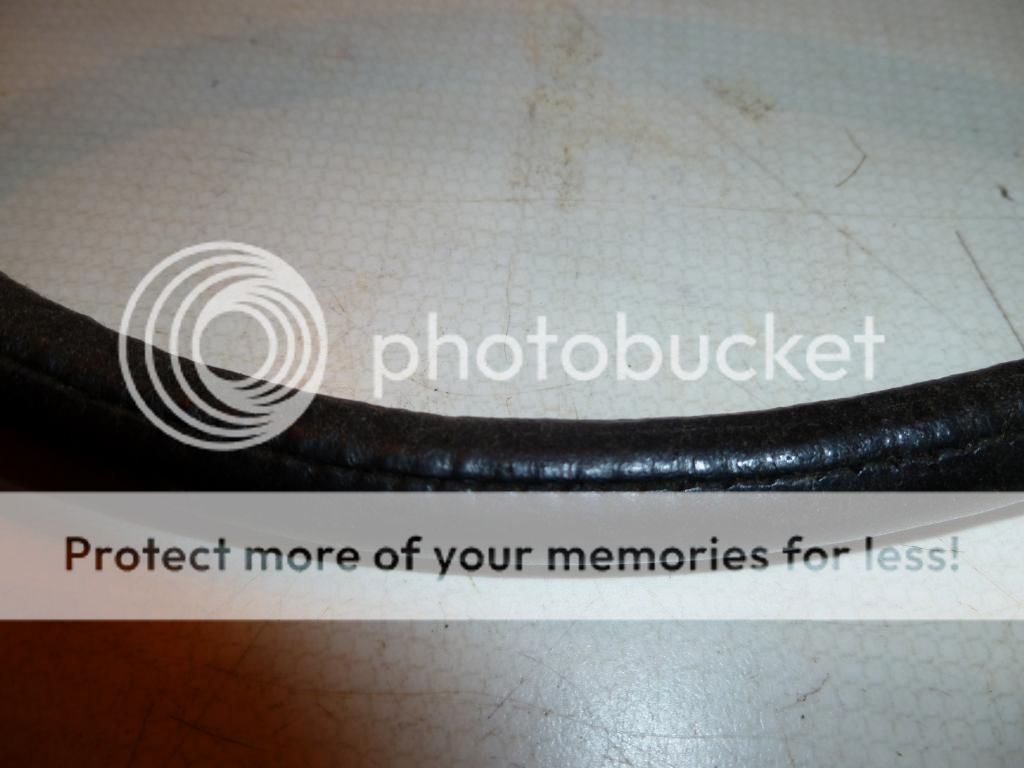
The first photo if of a dog collar, it's a massed produced and is rolled but not made or used properly in the fact that you can see the stitches still, it's been made by a sewing machine. Not used properly in the fact that the stitches should face towards the animal it's used on, unlike in the photo. The idea is to turn the edges of the leather back over the stitches so you can't see them, it stops them wearing through or rubbing the animal's coat or skin when worn and is the correct way to make and use ROLLED WORK

badlymaderolledworkmadeonamachine_zps21255788.png
[/URL]


This second photo below is a driving bridle throat, I made it by hand and the little ridges you can just see are where the stitching is under the leather. We put the edges of the leather in a rolling block and gently work it in to this shape, the stitches last so much longer, won't rub the animal and this is the correct way to make ROLLED WORK. The customer would be presented with the good smooth side facing out,with no ridges where the stitches are under the leather showing or facing them.
When this throat was new, the leather would have been much further down over the stitches to hide the thread more than it is today but this bridle IS 27 years old and over time the leather has receded a little but when it was new you wouldn't see any ridges or gaps.
Traditional saddlery is all about safety and presentation, some techniques were developed 200 years ago or more when horses were the main mode of transport. Infact in Victorian times brown Saddlers (term given to men who made gentlemen's riding saddles and bridles) would have had to use white thread so the customer could check your quality of stitching and work made with stitches of up to 16 to the inch not uncommon.
Most bridles now use 8 to the inch and are machined.
How many of you insist on white threads, often 12 or more stitches to the inch and inspect the bridle before you decide to buy it?
Would you know hand stitching from machine stitching?
Food for thought :)


P1010673_zpscb737ef2.jpg
[/URL]

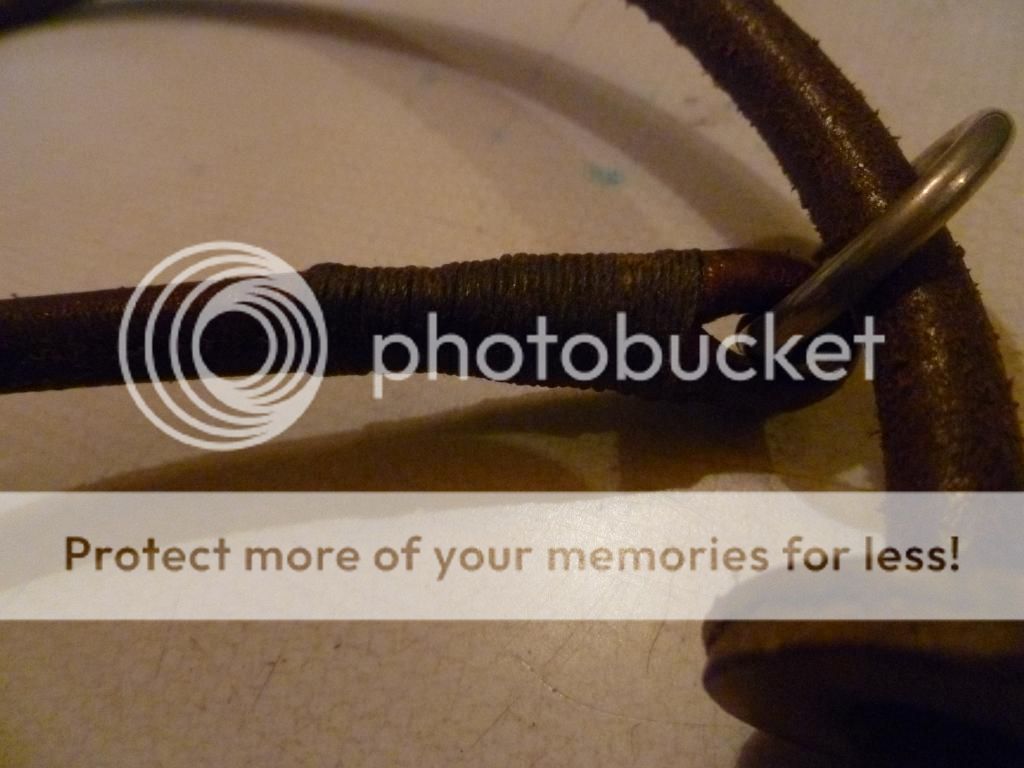
Lastly, the photo below is of ROUNDED LEATHER BELTING, people use it now for dog collars and leads, because mainly they don't know how to make real rolled work and it's quick, cheap and sells. It is not as strong as rolled work, will break before rolled work does and it tends to stretch where as rolled work doesn't if it's made well enough.I have seen it on bridles which is something I would not do or advise.
You can see the difference in thickness where it's stretched, look at the far left, then the far right, the right is near to the original thickness of when it was made.
It's a slip lead I made for my Lurcher so it's been used and a fit fluffy as the fibres get rubbed but you can see the difference to the real rolled work, the main weak link is the binding and underneath are a few stitches but this method of securing a turn of leather round the fitting is not as strong as a turn on rolled work.
I mainly use this ROUND LEATHER BELTING for a belt to run my ancient treadle 45k Singer sewing machine (circa 1915 vintage) when it's needed.

P1010675_zps7b7153fb.jpg
[/URL]

Oz
 
I made a rolled throat lash on my apprentice assessment head collar - it's a technique high on my "not if I can avoid it" list. I had a stamping feet toddler tantrum over it. On the plus side it did turn out nicely.
 
Last edited:
All too often, this is the case, I turn leatherwork work away when asked now because as you have said, it's cost prohibitive and most of my bread and butter money now is earned mass producing synthetic items on one of my sewing machines.
I do very little handmade saddlery work now and even fewer repairs.

That's just sad :(.

P
 
Top