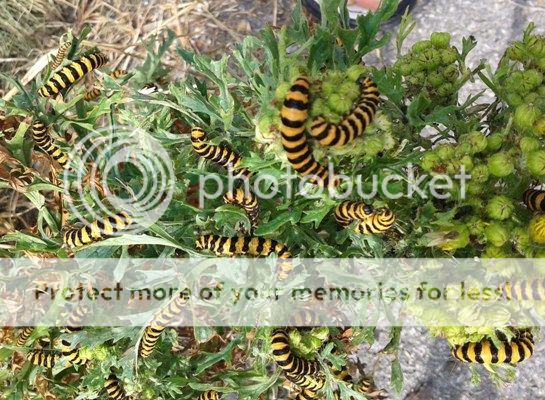
Cinnabar moths: any point in introducing to control ragwort?

FionaM12

Well-Known Member
Joined
9 August 2011
Messages
7,357
Visit site
I've spotted dozens of cinnabar caterpillars out for a walk today. That is, I was out for a walk, not them....

Would it be a completely nutty and pointless excersize to go back and collect some to introduce to our ragwort-problem grazing?
 
They do eat ragwort but not effective enough to eradicate it. If they were that effective they would be extinct along with the ragwort :)
 
Don't see why it would hurt! I thought I'd heard the species was in difficulty some time back? May have that wrong... but why not try cultivating your own little herd, they're nice things :)

(the image of dozens of them out for a walk is making me smile)
 
I had them in my field 3 years ago, they did eat the ragwort but not enough to kill it and made it harder to pull as you didn't want to squish them.
I have done experiments in my garden on ragwort plants, mowing every week, different weed killers, I have even used a flame thrower and the only granteed method is to pull the whole plant out including roots or spray with glyphosate which kills everything including the surrounding grass. On area where you can a tractor on spraying followed by sheep, but there are areas you are not allowed to spray.
I have a mountain of the stuff despite pulling every year and had decided to spray with glyphosate and reseed the really bad areas but unfortunately we ha a wet windy spring so I am now pulling every evening. Ugh!
 
About 5 years ago I had millions of the caterpillars and they ate plants down to the ground!! So yes, I think it would be excellent to breed and introduce them, they make a huge difference.
 
So, I left work this morning and stopped the car on the way home and collected a plastic box of caterpillars! :D

They are shortly to be transported to their new home. :) I don't expect it will make any difference, but it's worth a try.
 
There was a web site a few years ago trying to sell them as a bio friendly alternative to herbicides.
They are a native moth and trials by the said web site said that if introduced to a field, over a period of three years they did make a massive impact on the spread of the dreaded weed.
Unfortunately, the last few summers awful weather didn't do them any favours and they didn't breed and multiply for a few years but hopefully this year they will make up for lost time!

I'm going to use weedkiller when I get the chance but in the mean time I've been cutting the flowers off to set back the plant. I can cover a lot more plants in a shorter time and then it will give me a bit more time to get organised with the weedkiller.

If you knock the plant before you pull it, the caterpillars curl up and drop off into the grass. If you find them on any plants that are in a "safe" area, I would take them home and introduce them to your fields.
We have a section of our land which is down wind from the fields and we are letting the ragwort grow on there to feed and encourage the yellow and black army:D
 
I usually keep a patch of ragwort well away from the horses to put any catapillas on but this year I have not found a single one, which is a shame as they are a very pretty moth. :(,
I have heard that their numbers have fallen because of ragwort being removed everywhere, which is why I keep a little patch but the horses of course have to come first,
 
I don't think I have ever seen any. Be aware that should they run out of ragwort - if only - they will also munch away on wanted plants.
 
They are rubbish at reducing ragwort in my quite vast and long experience of this particular battle. They kibosh the odd plant but the ragwort is miles ahead in the race.
I got rid by pulling the plant up by the roots.
 
I have hardy seen any cinnabar caterpillars in the last few years, which is a worry considering the Oh and me pull ragwort on over a hundred acres of common land each year!!! I remember as a kid the stuff was overrun with them!! :( and they used to make a very good job of eating the vile stuff!! i dont think the argument that pulling all the ragwort had killed them off works, there isnt any less ragwort now than when i was a kid.....(hundreds of years ago!!) ;)
 
Last edited:
I have hardy seen any cinnabar caterpillars in the last few years, which is a worry considering the Oh and me pull ragwort on over a hundred acres of common land each year!!! I remember as a kid the stuff was overrun with them!! :( and they used to make a very good job of eating the vile stuff!! i dont think the argument that pulling all the ragwort had killed them off works, there isnt any less ragwort now than when i was a kid.....(hundreds of years ago!!) ;)

The disappearance of many of our butterflies and moths is a big worry. :(

Chemicals have a lot to do with it I think. Species-unfriendly farming practices have a lot to answer for.
 
Pulling the ragwort has got rid of it in my fields.

I'm not suggesting I introduce the moths as a replacement for any other control measures, but as well as. :)

We've pulled it all in Mollie's field, but there's so much of it in the surrounding fields it will come straight back. Also we keep getting moved to other fields where it hasn't been removed. :(
 
caterpillars_zpsb566bdee.jpg


Trying again from Photobucket...
 
About 5 years ago I had millions of the caterpillars and they ate plants down to the ground!! So yes, I think it would be excellent to breed and introduce them, they make a huge difference.

I imagine this would be the only way that they would be effective, in their millions haha! I'm interested to learn that they eat ragwort, I had no idea!
 
So now my rag digging is taking even more time as along with trying to get every last piece of root I'm also picking off the little catipillars and carefully moving them to the hedge incase there are bits in there I can't reach!!
 
.......

We have a section of our land which is down wind from the fields and we are letting the ragwort grow on there to feed and encourage the yellow and black army:D

Crikey, I bet that you're popular with your neighbours. I would point out to you that there's a legal requirement that you treat ragwort infested land, and to fail to do so is highly irresponsible.

Alec.
 
Perhaps I'm wrong, but I thought cinnabar moths could onlybreed on ragwort, so if you pick them off and put them on another plant they will die. I'm sure I read that they could take in the poison from the ragwort without it harming them and they in turn become poisonous, hence the warning black and yellow stripes. So to preserve the cinnabar moths you need to keep a certain amount of ragwort - but obviously not in the same field or near grazing livestock.
 
For now. ;)

The plant is a biannual and this year's rosettes will become next year's plants. Generally, a campaign of twice yearly spraying is about all that works, or doing as I now do, and that's to run sheep over the ground.

Alec.

We have eradicated ragwort on our land by hand pulling every year. First year we took off 38 wheelbarrow loads from 7.5 acres. This year (5 years on) I have pulled ONE plant. I win!
 
I am with Cortez, you can get on top of it no problems
I havent had any since I pulled all the plants in 2009
 
I am with Cortez, you can get on top of it no problems
I havent had any since I pulled all the plants in 2009

I'm sure you're right but my question wasn't about ragwort control in general, just cinnabar moths. :) Sadly I can't single handedly remove it all by hand as stated earlier.
 
We have eradicated ragwort on our land by hand pulling every year. First year we took off 38 wheelbarrow loads from 7.5 acres. This year (5 years on) I have pulled ONE plant. I win!

Lets hope so, but i doubt it, the seeds can stay dormant for years and years in the ground, until for whatever reason they start to grow!
There seems to be a cycle as well, just when you think you have got on top of it (around seven years or so) and you are patting yourself on the back.....pooof there they are again!!! :(
 
Top