Coloured question

platypus

Well-Known Member
Joined
3 March 2013
Messages
195
Visit site
This may be a stupid question but what would cause a coloured horse breeding wise? Can you get a coloured from two solid colours? and does a coloured always have a coloured offspring? :rolleyes:
 
Learn lots about horse colours here - http://www.whitehorseproductions.com/equinecolor.html

There are several 'coloured/pinto' genes. If you are talking about tobiano, which is common in the UK, then at least one parent needs to have at least one copy of tobiano gene to have a chance of passing it on.

So you only need one parent with it, the other could be a solid colour?
And if a pie bald bred with a chestnut are you more likely to get a skewbald?
:confused::confused:Think im just confusing my self:o
 
OK to keep it simple the horses will all be black.

Black X Black plus one copy of tobiano (piebald) = a 50% chance of producing a black foal and 50% chance of producing a piebald foal.

Black X Black plus two copies of tobiano = 100% chance of producing a piebald foal.
 
OK to keep it simple the horses will all be black.

Black X Black plus one copy of tobiano (piebald) = a 50% chance of producing a black foal and 50% chance of producing a piebald foal.

Black X Black plus two copies of tobiano = 100% chance of producing a piebald foal.

Sorry im going to really bug you and ask a stupid qestion-where does the tobiano gene come from in the two black is is just a gene they can carry with out presenting
 
Out of interest talking genetics (sorry to hijack)

When we are talking coloureds, is the gene specific to broken colour only or is is specific to broken colour and colour eg, specific gene for piebald and skewbald? It is just for pattern/colour isn't it? The colour bay/black etc is controlled separately... Am I right?
 
Out of interest talking genetics (sorry to hijack)

When we are talking coloureds, is the gene specific to broken colour only or is is specific to broken colour and colour eg, specific gene for piebald and skewbald? It is just for pattern/colour isn't it? The colour bay/black etc is controlled separately... Am I right?

Hijack away :) i don't want to bug faracat but its something ive always wondered and nobodies been able to explain :eek:
 
There are only two base colours - Black and chestnut. Everything else is caused by other genes. :)

I like to think about the coloured/pinto genes as white paint that gets painted over the base colour. You can generally work out which coloured gene or genes, a horse has by where the 'white paint' is on the horse and whether the patches have smooth or jagged edges.

Other genes dilute/modify the base colour.

You can have diultion genes and coloured/pinto genes.

So to get a bay skewbald (we'll stick to tobiano as the gene causing the colored/pinto effect) you need a black horse, then an agouti gene (to fade the body, but not the points to brown) plus a tobiano (to add the white patches).
 
There are only two base colours - Black and chestnut. Everything else is caused by other genes. :)

I like to think about the coloured/pinto genes as white paint that gets painted over the base colour. You can generally work out which coloured gene or genes, a horse has by where the 'white paint' is on the horse and whether the patches have smooth or jagged edges.

Other genes dilute/modify the base colour.

You can have diultion genes and coloured/pinto genes.

So to get a bay skewbald (we'll stick to tobiano as the gene causing the colored/pinto effect) you need a black horse, then an agouti gene (to fade the body, but not the points to brown) plus a tobiano (to add the white patches).


Thought so! It's awful that I used to be top in class for genetics and can't remember squat, other than snap dragons were the start of genetics! Lol! Rode past a couple of lovely Duns today and drooled.
 
Sorry all this i going way over my head

If you had a black horse and a chestnut with a tobiano gene you could end up with a skewbald??or you would have 50 %chance of a solid
 
Sorry all this i going way over my head

If you had a black horse and a chestnut with a tobiano gene you could end up with a skewbald??or you would have 50 %chance of a solid

Does the black horse have a 'hidden' chestnut gene?
Does the chestnut tobiano have one or two copies of tobiano?


ETA. If the black horse has two copies of black, every foal that it sires will be black (or black based), as black is dominant over chestnut (a horse needs two copies of chestnut, to look chestnut).

If the black horse has one copy of black and one of chestnut, then it can sire chestnut or black foals.

A tobiano horse with one copy of tobaino, can sire tobiano or non-tobiano foals.

A tobiano with two copies of tobiano will always sire tobiano foals.
 
Last edited:
Each horse has pairs of genes, but they only pass on one of each pair to their foals. The other halves of the pairs come from the foals other parent.

So you can get a chestnut foal from two black parents.

Black + chestnut (horse looks black) stallion is bred with a mare that is also black + chestnut (again, looks black) but, due to chance, this foal happens to inherit both chestnut genes (one from each parent). So the foal is chestnut.
 
Each horse has pairs of genes, but they only pass on one of each pair to their foals. The other halves of the pairs come from the foals other parent.

So you can get a chestnut foal from two black parents.

Black + chestnut (horse looks black) stallion is bred with a mare that is also black + chestnut (again, looks black) but, due to chance, this foal happens to inherit both chestnut genes (one from each parent). So the foal is chestnut.

Is there a dominant gene so if it had one black one chestnut gene what would it more likely be
 
Duns or Buckskins? LOL ;) :p

We did beans at school, snapdragons were far too exciting for us!

Sorry all this i going way over my head

If you had a black horse and a chestnut with a tobiano gene you could end up with a skewbald??or you would have 50 %chance of a solid

Thinking dun, but they were a way away so could have been buckskin... Will have a closer look at the weekend :p

We started with snapdragons... Perhaps we were just super brainy (a long time ago:p)

Just testing myself off the top of my head

Is black Ee and chestnut ee? Been about 3 years since I looked?
 
Chestnut is the most recessive gene... I think if I remember correctly

I should have never started this it was easier just thinking a bay was a bay and a piebald was a piebald lol but i there a bay gene or i that a mixture of black with a diluted gene?
 
I should have never started this it was easier just thinking a bay was a bay and a piebald was a piebald lol but i there a bay gene or i that a mixture of black with a diluted gene?

Am I right fc in thinking that is the brown gene? If I am right, up until recently all horses were classified as bay or black, then at a later date, there was a reclassification bay, brown and black... I 'think' it's all down to the colour of the muzzle, although... As I say, my knowledge pretty much dried up with school and snapdragons... Fc and others will probably tell you I'm completely wrong lol!
 
See op, as much as I loved genetics as a kid... This is why I steer clear... It's way too bleeding interesting! Good bedtime reading :) thanks :)
 
im lost!!!
what would my skewbald (ginger and white) mare be likely to produce with a chesnut stallion?

Ginger to ginger gives ginger.
The pattern gene would have a 50:50 or 100% chance of passing along depending how many copies the mare has (Heterozyous =1 or homozygous =2)

Genetics is easy but probabilities v. possibilities makes it interesting. (that and hiding genes eg Tobiano that is so minimally expressed it isn't seen -eg four white hairs in a mane)
 
Is there a dominant gene so if it had one black one chestnut gene what would it more likely be

Black is dominant over chestnut.

So a horse with one copy of black and one copy of chestnut will look black - it will have black fur (unless other genes alter it's appearance but it will always be a black based colour).

Just testing myself off the top of my head

Is black Ee and chestnut ee? Been about 3 years since I looked?

E = black
e = chestnut

So you can have these options EE, eE, eE and ee.

Only the ee will look chestnut (have chestnut fur or a chestnut based colour if other genes alter it).

Chestnut is the most recessive gene... I think if I remember correctly

Yes, chestnut is recessive to black. :)

I should have never started this it was easier just thinking a bay was a bay and a piebald was a piebald lol but i there a bay gene or i that a mixture of black with a diluted gene?

You will get your head around it. :)

Bay is a black horse plus the AGOUTI gene (it is a dilution gene), which fades the body colour to brown. This is why bays have black points, as they are really black.

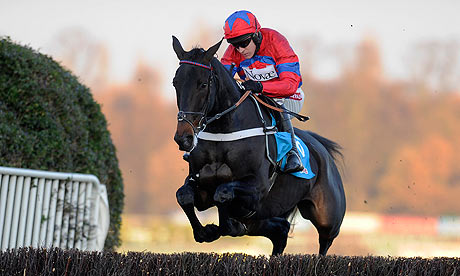
You also get seal brown (black + seal brown) which is slightly different from agouti. The racehorse Sprinter Sacre is an excellent example of a seal brown horse. Note the brown muzzle and brown on his stifle.

Sprinter-Sacre-wins-the-T-008.jpg
 
There are two separate things to consider - colour and then pattern.

All horses are either black or chestnut - but can have other genes which affect the colour further ie agouti which turns black into bay but has no effect on chestnut. Genes come in pairs.

If you look at colour - black is dominant, chestnut is recessive so chestnuts are always pure chestnut, but black horses can either be pure (homozygous black - they have 2 black genes) or black carrying chestnut (heterzygous black - they have one black gene and one chestnut gene).

Mating a pure black horse to a chestnut will throw 100% black horses carrying chestnut, mating two chestnut horses together will throw 100% chestnut. Mating a black horse carrying chestnut to a chestnut horse there is a 50% chance the black horse could pass the black gene to the foal and a 50% chance it will pass the chestnut gene to the foal so the expectation from mating a black horse carrying chestnut to a chestnut horse there is 50% chance the foal will be black (carrying chestnut) and chance the foal will be 50% chestnut.

Mating two black horses both carrying chestnut together and there is a 50% chance that each horse will pass the black gene E to the foal and 50% chance that each would throw the chestnut gene e to the foal so the expectations are:

EE
Ee
eE
ee

Ie 25% pure black (EE), 50% chance black carrying chestnut (Ee and eE) and 25% chance it will be chestnut (ee).


The Tobiano pattern gene is the most common pattern gene that produces piebalds and skewbalds and this is applied over the colour if you like and is dominant.

A pure (homozygous) patterned horse will always pass a pattern gene to the foal so mated to a solid coloured horse the foal will always be patterned. A heterzyous patterned horse (with one pattern gene and one non-pattern gene) mated with a solid coloured horse there is a 50% chance the foal will be patterned and 50% chance the foal will be solid coloured depending on whether the heterzygous patterned horse passes the pattern or non-pattern gene to the foal.

Therefore if you consider a black horse carrying chestnut mated to a chestnut horse will give you 50% chance of the foal being black and a 50% chance of the foal being chestnut. If one parent is also patterned - if that parent has two pattern genes then the foals would be 50% black pattern and 50% chestnut patterned. However, if the patterned parent only had one pattern gene then the chances would be 25% black pattern, 25% black solid, 25% chestnut pattern and 25% chestnut solid.

If you add in things like the agouti gene which is also dominant things get more complicated and there are more and more possibilities. Especially when you consider that the agouti gene turns a black horse into bay but has no effect on chestnut horses (as the agouti gene dilutes black to brown apart from on the mane, tail and legs - and a chestnut horse has no black present) so a chestnut horse could be agouti (but you can't see it) so mated with a black horse the black foals expected could turn out to be bay if the chestnut passes the agouti gene to the black offspring!
 
Last edited:
so what would a piebald mare (skewbald x blue&white) produce to a palomino (palomino xchestnut)
Is there anyway to know from the coat pattern if a horse is homozygous, I have read of a pawprint or spots being a sign.
 
There are two separate things to consider - colour and then pattern.

All horses are either black or chestnut - but can have other genes which affect the colour further ie agouti which turns black into bay but has no effect on chestnut. Genes come in pairs.

If you look at colour - black is dominant, chestnut is recessive so chestnuts are always pure chestnut, but black horses can either be pure (homozygous black - they have 2 black genes) or black carrying chestnut (heterzygous black - they have one black gene and one chestnut gene).

Mating a pure black horse to a chestnut will throw 100% black horses carrying chestnut, mating two chestnut horses together will throw 100% chestnut. Mating a black horse carrying chestnut to a chestnut horse there is a 50% chance the black horse could pass the black gene to the foal and a 50% chance it will pass the chestnut gene to the foal so the expectation from mating a black horse carrying chestnut to a chestnut horse there is 50% chance the foal will be black (carrying chestnut) and chance the foal will be 50% chestnut.

Mating two black horses both carrying chestnut together and there is a 50% chance that each horse will pass the black gene E to the foal and 50% chance that each would throw the chestnut gene e to the foal so the expectations are:

EE
Ee
eE
ee

Ie 25% pure black (EE), 50% chance black carrying chestnut (Ee and eE) and 25% chance it will be chestnut (ee).


The Tobiano pattern gene is the most common pattern gene that produces piebalds and skewbalds and this is applied over the colour if you like and is dominant.

A pure (homozygous) patterned horse will always pass a pattern gene to the foal so mated to a solid coloured horse the foal will always be patterned. A heterzyous patterned horse (with one pattern gene and one non-pattern gene) mated with a solid coloured horse there is a 50% chance the foal will be patterned and 50% chance the foal will be solid coloured depending on whether the heterzygous patterned horse passes the pattern or non-pattern gene to the foal.

Therefore if you consider a black horse carrying chestnut mated to a chestnut horse will give you 50% chance of the foal being black and a 50% chance of the foal being chestnut. If one parent is also patterned - if that parent has two pattern genes then the foals would be 50% black pattern and 50% chestnut patterned. However, if the patterned parent only had one pattern gene then the chances would be 25% black pattern, 25% black solid, 25% chestnut pattern and 25% chestnut solid.

If you add in things like the agouti gene which is also dominant things get more complicated and there are more and more possibilities. Especially when you consider that the agouti gene turns a black horse into bay but has no effect on chestnut horses (as the agouti gene dilutes black to brown apart from on the mane, tail and legs - and a chestnut horse has no black present) so a chestnut horse could be agouti (but you can't see it) so mated with a black horse the black foals expected could turn out to be bay if the chestnut passes the agouti gene to the black offspring!

Thanks
I think im slowly getting there:D:D
 
so what would a piebald mare (skewbald x blue&white) produce to a palomino (palomino xchestnut)
Is there anyway to know from the coat pattern if a horse is homozygous, I have read of a pawprint or spots being a sign.

Do you know what colour the grey and white was before he/she greyed out?
 
Sorry all this i going way over my head

If you had a black horse and a chestnut with a tobiano gene you could end up with a skewbald??or you would have 50 %chance of a solid

When I worked on a coloured stud, the 2 stallions were classed as black tobiano (they were both actually extremely dark bay) they covered several chestnut mares and all foals came out bay, or bay skewbald.

If you put a coloured to a coloured you are not guaranteed colour unless one is homozygous. A heterozygous coloured will only produce 50% coloured in its life
 
Top
