Contact Query

Your posts are always so interesting.

I think we can get trapped (particularly in dressage) in the logical fallacy that the horse isn't strong enough (yet) so we should hold it together to produce the shape. And of course, the more we hold the horse, the more the horse leans, and the horse might get stronger but it doesn't get lighter.

I just looked back at one of the notes I took after a master class with Gareth Hughes:

Gareth talks about the difference between ‘guiding’ and ‘holding’. Guiding a horse is where we want to be. We want to use technique over strength to ride. The difficulty with horses who have been trained by being held is that the more they develop, the stronger they become and therefore the more strength you need to hold them. That is going in the opposite direction of what we are trying to achieve in dressage. When we guide the horse rather than hold the horse, this is what develops self-carriage in the horse. It is that self-carriage without relying on the human to balance the horse that gives you the ability to do things like “give and retake”.

I think a lot of people look at the symptoms rather than train to improve the root cause. I probably fall into the trap too - getting too concerned with things like inconsistency in contact or falling behind the vertical and looking to improve that so that things optically look better but are probably just resulting in a better horse from the pole forward rather than from the core and thoracic sling. Not to say that I don't try to do a lot of work to strengthen the horse properly, but I probably want to quieten the things that make the picture less harmonious more quickly than if they were the last thing to come through from truly strengthening the horse and having the horse find its own balance and self carriage. Thought provoking.
I think of it like yoga.
The exercise you are doing needs to be of benefit to the horse.
The horse gets the benefit from carrying themselves / putting themselves in the positions you request.
If you went to a yoga class and your instructor put you in the yoga poses and held you there, you wouldn’t get the benefit of challenging your body to do it for itself.
 
I have some thoughts on this.

A good few years back I went to America to co train in 2 or 3 day clinic where the strap line was "English V Western, Good Horsemanship is Universal."

I was there as the English trainer, and the Western was taught by a 3rd generation working cowboy, who also trained many horses (and was a journeyman farrier to boot!).

We both taught mounted, I borrowed his working cow horse and took an English saddle, and used a snaffle (that he'd made me from an old farrier rasp - it is a thing of beauty). He rode his other working horse.

I had half an hour before the clinic started to saddle/bridle and work the horse. He was fascinated while watching, as the horse had never carried an English saddle (I took an Ansur), never been ridden on a contact and hadn't worn a snaffle in about 8 years.

That horse taught me a lot when converting from Western to English. He was a fully trained bridle horse, who responded to the very weight of the rein being picked up, no actual contact. He was a little puzzled with the new way of going, but was easy in the mind and just set about seeking 'the answer' to his new little issue. The issue being that he thought any contact was an instruction or correction.

He was seeking peace.

In his normal way of going, he had peace. A loose rein, and he would respond to the weight of the rein being picked up. I took a soft and elastic contact, and he thought he should lose that, so he tried everything. He slowed, I asked him forward and he responded - knowing that slowing was not what I sought. He lifted his head, I closed my hand, he realised that this is also not what I wanted. He tried lowering and overbending, I rode him out again - he went back to the drawing board. He tried fixing his mouth, I played it and he knew that no, this would not bring peace.

In reality, due to the fantastic training and good mind the horse already had, he worked out that I simply wanted to hold the soft contact, and we could both move and stay in harmony. I was there to ask and advise, he simply held the contact and responded to requests. Simple as that.

Within the half hour, he not only worked out the contact but, as we were there to demonstrate English riding, mainly in dressage (although we did also do jumping in grids and courses) we started to play a bit more. He soon learned to lengthen and shorten, to leg yield, shoulder in etc. He was a superstar and, on his first ride in a contact, could easily have gone and ridden an Elementary test.

His owner was really happy, to see his training was so solid that the horse didn't lose his mind, just adapt to the new circumstances. He was amused to see the horse doing lateral work, and demoed to me the type of lateral work they would normally do, which was sideways but not in collection. He'd never jumped other than to cross open country chasing cows, but also found no issues with adapting to that. I then had the absolute pleasure of riding slide-stops and spins, something totally new to me. I was guilty of thinking that such explosive and dramatic moves would need big aids - not so. A change of weight, a change of rein position, a bump with a leg and woo-who! Or, Ho!

I don't think contact or not is the deciding factor between English and Other, it is more that Other teaches the horse to be self carrying in mind as well as body, from more remote signals.

Another observation... Joe rode my horse weekly when Mr Red died and I couldn't be interested. He was aiming at self carriage, obviously, but H is a big old lump and Joe hauled on the reins a good few times, sitting the horse on his arse, when he was being a big clumsy lump! His method is about, as Mark Rashid once told me, being as light as you can, which may not be as light as you want to be.

I saw Mark give a horse, who was being somewhat 'otherwise' in a clinic, and he mounted it, a real good telling off. He admitted that, on that horse, he certainly couldn't be as light as he wanted to be LOL.

So, I think it is about helping the horse to find peace. Be that with no contact or with a light elastic contact. Anyone wanting a strong contact other than momentary is wrong, IMO.
 
Last edited:
When Joe first rode Lottie she could look 'nice' but in canter if you dropped the contact she'd pretty much fall over! The weight she needed in-hand to stay balanced was crazy. She was never ever ever even vaguely aproximating self-carriage at aged 8/9 with a long SJ career behind her. But she was schooled weekly by a PSG rider, professional trainer and young horse producer, who assured me she was fine and was going well. This was just how she needed to be ridden. After a year of riding her like that I had one Joe lesson and he turned everything on its head for me. I am happy following Joe, but am now trying to reconcile it with 'Classical' or leg into hand.

Red, yes I do think the 'Other' is a stronger focus on the horse being balanced mentally and physically. I wonder what would happen to higher level dressage if a true test of descente de main was introduced to all higher level competiton riding.
 
Last edited:
I have some thoughts on this.

A good few years back I went to America to co train in 2 or 3 day clinic where the strap line was "English V Western, Good Horsemanship is Universal."

I was there as the English trainer, and the Western was taught by a 3rd generation working cowboy, who also trained many horses (and was a journeyman farrier to boot!).

We both taught mounted, I borrowed his working cow horse and took an English saddle, and used a snaffle (that he'd made me from an old farrier rasp - it is a thing of beauty). He rode his other working horse.

I had half an hour before the clinic started to saddle/bridle and work the horse. He was fascinated while watching, as the horse had never carried an English saddle (I took an Ansur), never been ridden on a contact and hadn't worn a snaffle in about 8 years.

That horse taught me a lot when converting from Western to English. He was a fully trained bridle horse, who responded to the very weight of the rein being picked up, no actual contact. He was a little puzzled with the new way of going, but was easy in the mind and just set about seeking 'the answer' to his new little issue. The issue being that he thought any contact was an instruction or correction.

He was seeking peace.

In his normal way of going, he had peace. A loose rein, and he would respond to the weight of the rein being picked up. I took a soft and elastic contact, and he thought he should lose that, so he tried everything. He slowed, I asked him forward and he responded - knowing that slowing was not what I sought. He lifted his head, I closed my hand, he realised that this is also not what I wanted. He tried lowering and overbending, I rode him out again - he went back to the drawing board. He tried fixing his mouth, I played it and he knew that no, this would not bring peace.

In reality, due to the fantastic training and good mind the horse already had, he worked out that I simply wanted to hold the soft contact, and we could both move and stay in harmony. I was there to ask and advise, he simply held the contact and responded to requests. Simple as that.

Within the half hour, he not only worked out the contact but, as we were there to demonstrate English riding, mainly in dressage (although we did also do jumping in grids and courses) we started to play a bit more. He soon learned to lengthen and shorten, to leg yield, shoulder in etc. He was a superstar and, on his first ride in a contact, could easily have gone and ridden an Elementary test.

His owner was really happy, to see his training was so solid that the horse didn't lose his mind, just adapt to the new circumstances. He was amused to see the horse doing lateral work, and demoed to me the type of lateral work they would normally do, which was sideways but not in collection. He'd never jumped other than to cross open country chasing cows, but also found no issues with adapting to that. I then had the absolute pleasure of riding slide-stops and spins, something totally new to me. I was guilty of thinking that such explosive and dramatic moves would need big aids - not so. A change of weight, a change of rein position, a bump with a leg and woo-who! Or, Ho!

I don't think contact or not is the deciding factor between English and Other, it is more that Other teaches the horse to be self carrying in mind as well as body, from more remote signals.

Another observation... Joe rode my horse weekly when Mr Red died and I couldn't be interested. He was aiming at self carriage, obviously, but H is a big old lump and Joe hauled on the reins a good few times, sitting the horse on his arse, when he was being a big clumsy lump! His method is about, as Mark Rashid once told me, being as light as you can, which may not be as light as you want to be.

I saw Mark give a horse, who was being somewhat 'otherwise' in a clinic, and he mounted it, a real good telling off. He admitted that, on that horse, he certainly couldn't be as light as he wanted to be LOL.

So, I think it is about helping the horse to find peace. Be that with no contact or with a light elastic contact. Anyone wanting a strong contact other than momentary is wrong, IMO.

What a fascinating write up.
And what a gem the western horse must have been (both in mind but with foundations too), I suspect it would be pretty rare to so readily adapt that quick.

And yes, even the good ‘natural horsemanship’ trainers will have moments of strong/clear black and white with horses.
It’s the fluffy fannying about that us amateurs think is nice, but it often just confusing the horse!
 
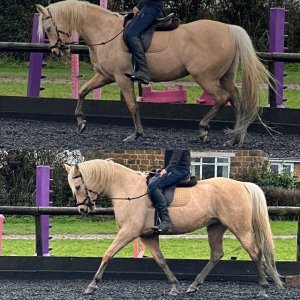
Me again. I've just seen a FB ad for a horse. It's a ranty 'why is no-one interested in this gorgeous mare working at advanced medium with all the talent to go on' ad. Looking at her, every picture has her with a bulging muscle next to the throatlash - sternocephalicus? Horse is also always either BTV or the angle between jaw/head and neck is super narrow and constricted. She looks awful to ride and none too happy either.

The ad goes on to say she's 'spicy' but what do you expect from a talented athletic mare.
All the comments are roundly mocking people swerving this one. (Everyone wants a rocking horse etc)

I'm no expert but even I can see this horse is chronically heavy in the hand and braced. I can literally see the braced muscles bulging! In what are presumably the best pics they have available. And why is she doing so 'well' in her competition career.

Something seems very very wrong to me.
 
Top