Core tendon injury - how does it heal?

MagicMelon

Well-Known Member
Joined
6 November 2004
Messages
16,378
Location
North East Scotland
Visit site
So one of my horses (my superstar basically!) injured himself in the field 3.5 years ago which ended his career. He went to Dick Vet and was operated on to tidy it up - he ended up with a big hole in the centre of his DDFT. The vets told me at the time that they'd only seen one other similar case so they couldn't really give a great prognosis but that they felt it was definately career ending and we'd be lucky to have him sound enough as a field ornament. After a year though he surprised my vet by becoming sound and has remained so since, although if he messes in the field too much (he bronc's, rears, generally acts like a 2yo when he's 17!) then he can look a tiny bit sore on it the next day. I have ridden him on and off, he even did a few intro dressage tests - I avoid canter completely though as I'm paranoid the tendon could go again as I assume its not nearly as strong as it used to be... or is it? Does anyone know enough about how tendons heal to know if they are substantially weakend by things like this? Is it wise not to canter him etc.? I know I wouldn't risk jumping him again (which was what he used to do) but he gets so bored in the field doing so little, he thrived on work and it would be great to be able to do a little bit of trotting poles or canter without thinking he's going to crumple to the floor in a broken heap.
 
New tendon fibres (collagen, I think, couple of types, some more stretchy than others) tend to be arranged in a rather untidy fashion, so they aren't as elastic as the original, neatly aligned fibres. They're strong, but not stretchy, so injury is more likely in a tendon that has had previous damage.

Sort of remembered from college many, many years ago!

Can you have it scanned to see the extent of the damage/repair?
 
My big horse did his hind check, scans showed what the vets described as a 'mush'. After 4 years the horse is sound but the healing process shortened the check and left the heel raised off the floor, that in turn altered the break over and the horse now lands toe first, which shoves the shoe back and smashes the toe.

He is ridden occasionally, only on grass barefoot or if I can be bothered to put his cavello boots on he can go for a trundle around the lanes.

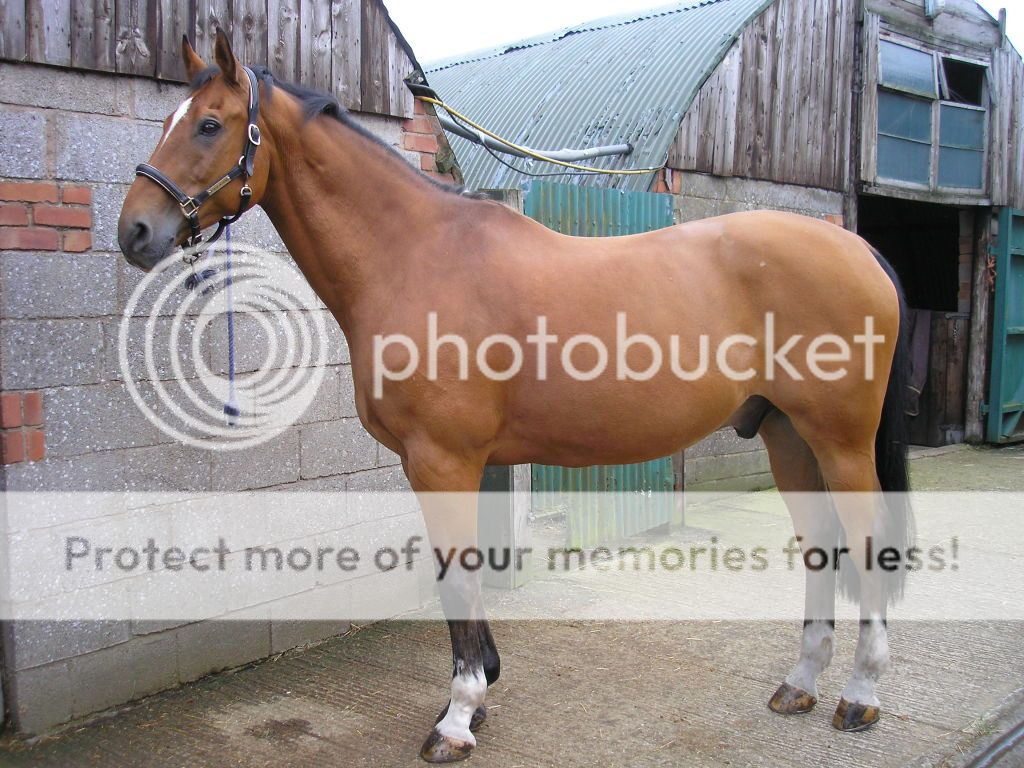
This photo shows the change in the injured limb, he cannot get his heel to the ground.

Leoretirestoday772012004.jpg
 
Tendon is mainly made up of type I collagen but if injured heals with type II - this is not elastic like type I. However through proliferation these fibres will act more like the type 1 over time. Exercise helps improve the health of tendons as it maintains the crimp wave structure of the fibres - this structure is lost as the horse ages. Returning to work should be a gradual process and i would recommed asking your physiotherapist about a rehab programme. Also may be wise to re-scan first. Trotting poles shouldnt be a problem as although horses flex their limbs more when going over the poles- their body does not move any higher meaning no extra force on the limbs.
 
When I was a poor teen I bought a horse with 2 huge tendons. She had just done her rest and a basic fittening, but they had not been tested. She had been fired by the previous owner, which I know is not considered correct now.

Having done some research about it, I was told that after a year the tendon can scan as if it is not bad, but the hole will have been filled with the incorrect collagen. The trouble is, this is when most owners start hard work, and in reality this is the most vulnerable time, as the hole is filled, the inflammation gone down, so the horse feels OK and is willing to use the leg.

We used the horse for a bit of hacking and schooling (including canter) for another year, so the leg was brought up to strength.

After that she started some SJ, then hunting, then she even took me round an open team chase! The tendon was never a problem, in the end she had an issue with her sesamoids, I think due to the abnormality of the size of the tendon.

In your case I would re-scan the tendon to see that it is looking OK. After that it is a case of horse welfare, if I read it correctly?

I would agree with no jumping, as the stresses come sharply. TBH this would also preculde trotting poles, as when they are done correctly they are not too stressful, but most horses mis-time a pole once in a while, and can roll forwards with the pole, putting a LOT of stress through the tendon.

If the horse is hooning round though, and is sound, I would do some cantering. TBH if he canters more with a rider, in a controlled fashion, then maybe he would be a hooligan in the field less!

I know that if he walked everywhere that would be better for him, but it does not seem that he is satisfied with walking! I would have the vet have a look, so you have all the facts you need to be easy in your mind.
 
Top