Curb chain problem

copper72

Member
Joined
8 January 2018
Messages
16
Visit site
Hi I'm hoping for some advice on the use of curb bits. When I bring my 16hh mare on trail rides, she becomes very head strong and I really struggle to hold her back. I have no such issues when schooling in an arena. She is 8 and has only ever been ridden in a snaffle. I've just tried her in a mullen mouth pelham (with a rubber cover on the curb chain) but I'm having problems with it. She has no objection to it in walk or trot but when in canter and fighting for her head (again only on open trails), the action of the curb gets her very het up. She throws her head around and it becomes a very unpleasant experience. I have checked to ensure the chain is not too tight. I'm very conscious of using light hands and use my seat as much as possible to control downward transitions.

My question is, is this a normal teething problem? With time, do more sensitive horses adapt to the curb action? Or should I give up on it as obviously I don't want it to distress her? If so any alternate suggestions?
TIA
 
I was having a similar conversation with a friend only yesterday, both our horses were in snaffles but needed more brakes at times, hers would not tolerate a Pelham but settled in a continental gag. Mine reared in a gag and settled in a Pelham or an English hackamore.
 
Sounds like this bit is causing her discomfort and/or pain. Have you considered teaching her a verbal stop cue? You can positively reinforce halting with a treat, there are probably some good tutorials on Youtube or the like.

Assuming you are using the snaffle in the school and have no issue with downward transitions, it sounds like she may be getting too excited or overwhelmed in a hacking environment.

I would personally go back to the bit you know she is comfortable in and go for a tiny 'ride' - like 5, 10 minutes and then back again. Do lots of walk to halt, reinforce the halt with a treat. When she understands that the rein cue for halt = a treat, you can add a verbal cue of 'halt', or 'whoa' or 'stand' etc.

Go a bit further each time, see if you can progress and go for a trot, bring that down to walk and then halt etc.

I personally don't 'believe' in bitting up, more often than not it is a band aid to a lack of training, and can cause physical harm to the horse.

A lot of horses do get their brains blown a bit when they're in open spaces particularly - I would look at your management of her too, is she getting plenty of turnout to let out any excess energy?

A lot of the time with these things, it's more complex than just one reason/answer. Good luck, let us know how you get on :)
 
I was having a similar conversation with a friend only yesterday, both our horses were in snaffles but needed more brakes at times, hers would not tolerate a Pelham but settled in a continental gag. Mine reared in a gag and settled in a Pelham or an English hackamore.
Each to their own!
 
Sounds like this bit is causing her discomfort and/or pain. Have you considered teaching her a verbal stop cue? You can positively reinforce halting with a treat, there are probably some good tutorials on Youtube or the like.

Assuming you are using the snaffle in the school and have no issue with downward transitions, it sounds like she may be getting too excited or overwhelmed in a hacking environment.

I would personally go back to the bit you know she is comfortable in and go for a tiny 'ride' - like 5, 10 minutes and then back again. Do lots of walk to halt, reinforce the halt with a treat. When she understands that the rein cue for halt = a treat, you can add a verbal cue of 'halt', or 'whoa' or 'stand' etc.

Go a bit further each time, see if you can progress and go for a trot, bring that down to walk and then halt etc.

I personally don't 'believe' in bitting up, more often than not it is a band aid to a lack of training, and can cause physical harm to the horse.

A lot of horses do get their brains blown a bit when they're in open spaces particularly - I would look at your management of her too, is she getting plenty of turnout to let out any excess energy?

A lot of the time with these things, it's more complex than just one reason/answer. Good luck, let us know how you get on :)
Thanks for the advice. Yes it is definitely an excitement thing when out on open tracks.

She understands and responds perfectly to 'whoa' when schooling. But I will try what you suggest with positive reinforcement.

Incidentally, she isn't stabled and has access to 115 acres. She is often seen burning off plenty of energy galloping around the property. My husband says "there goes your crazy horse again". She isn't fed hard food, she just seems to be a naturally excitable horse who loves to get a bit of speed up! Hence my need for a little more brake on board.
 
You could try the pelham without the curb chain, which will tell you if it is the bit or the curb chain that is the problem.
Ah yes I tried that yesterday. It is definitely the action of the chain she objects to - she was very accepting of the pelham without the chain. Unfortunately of course, it totally negated the purpose of the pelham.
 
Is the chain flapping around? Is it secured with a lip strap? If it's not this could affect the angle it comes into force.

I was always surprised that the vast majority of people that use curb chains don't even know about using a lip strap. For me, the photo below is still incorrect, the ends of the curb chain should be over the hooks not allowed to bang around loose.
 

Attachments

  • 20230730_130314.jpg
    20230730_130314.jpg
    88.7 KB · Views: 36
Last edited:
That’s what I was wondering. In making sure the chain isn’t too tight I wonder if you have it too loose so it’s swinging and banging in the horses jaw.
Also the purpose of the chain is to prevent the bit over rotating so being very loose isn’t being kind because the bit can then move too much.
Check the fit of the chain, and you could also try either a chain cover or a leather / elastic curb if you feel the chain to too much.
 
T
Is the chain flapping around? Is it secured with a lip strap? If it's not this could affect the angle it comes into force.

I was always surprised that the vast majority of people that use curb chains don't even know about using a lip strap. For me, the photo below is still incorrect, the ends of the curb chain should be over the hooks not allowed to bang around loose.
Tbh I always thought that a lip strap added to it's severity. So there you go, I've learnt something. Will give it a go. And I agree, I never leave the excess chain links loose.
 
I used a leather curb "chain" when using a double rein Pelham bit on my exuberant Arabian. It was effective and he responded to far less pressure on the curb rein.
 
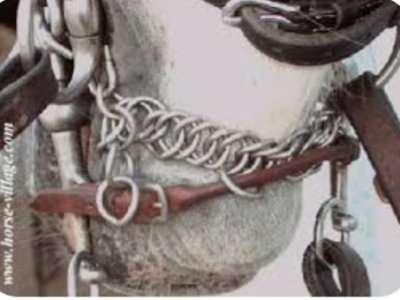
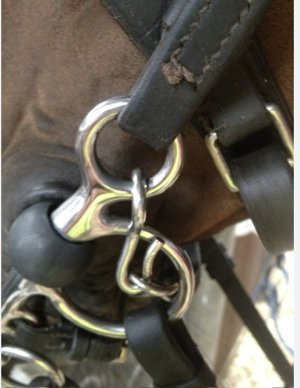
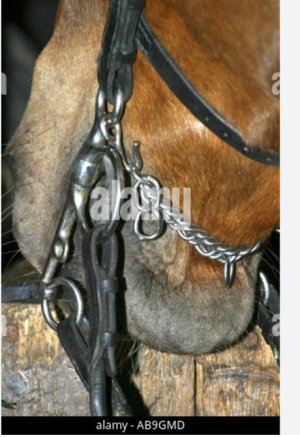
Re fitting, I do sometimes see curb chains in Pelham’s fitted without dropping them through the snaffle rein hole. This means they ride up onto the bony part which is obviously more uncomfortable. I’ll try to find a picture.
 
I used a leather curb "chain" when using a double rein Pelham bit on my exuberant Arabian. It was effective and he responded to far less pressure on the curb rein.
Yes I'm looking into a leather one. This could be a silly question but do you just use the chain hooks to attach the leather one?
 
Ah yes I tried that yesterday. It is definitely the action of the chain she objects to - she was very accepting of the pelham without the chain. Unfortunately of course, it totally negated the purpose of the pelham.

There's no problem using a pelham without a curb chain . It still gives you poll action which is very effective with some horses. It still allows you two reins to save the curb for when it's really needed.

Straight bar bits that with a short shank and limited poll action are rare and a pelham with no curb chain is a good solution for many horses.


ETA remove the hooks and if a curb is needed in future for limited amounts of time you can attach it using small carabiners.
 
It sounds like you might have to 'bore the pants' off her for a while. Find quiet, more enclosed places to hack and just walk, walk, walk for a while...then up to a very unexciting trot, then walking again. If she starts hotting up, put in a few quiet circles to settle her again. Keep to more enclosed areas to ride through. I know Ive made it sound easy - I know it's not, but you will get there eventually. Good luck!
 
The first photo is correct, the second one allows the chain to ride up the jaw bone

I've never attached the chain through the bit or used a lip strap, and never had a problem with how it operates.

I have replaced the chain with a piece of stirrup leather with a hole punched in each end.

I always shorten the chain to suit the horse so I don't have l loose links jingling around.
 
Yes I'm looking into a leather one. This could be a silly question but do you just use the chain hooks to attach the leather one?
Usually the leather ones have a couple of chain links on either end to attach them to the hooks.
Is her head going up or down when she's getting strong? If she's running along with her head in the air a gag will worsen the situation (Dutch gags are a bit of an exception here- they don't have a traditional "gag" action) but if she's dropping her head to the floor and tanking it might help.
Anything stronger will only help if you get the correct action- if she is going along head up in the air, there are alternatives to a curb bit- you can pop an English hackamore on alongside the snaffle and try that- that has the advantage that if she objects to the action of the hackamore you can always ride entirely off the snaffle on the way home!
Some people swear by martingales- personally I'm not the biggest fan as I find they can be more of a hindrance than a help, bit it might be worth a try, they also have the advantage that they don't act (when correctly fitted) until the head is above the point of control.
I use a Kineton on one of mine who can be strong- he responds well to the pressure on his nose and he doesn't fight it like he will a martingale.
If her head isn't going too high or too low but she's doing something else like leaning on your hands or tossing her head about, it might be worth looking at the mouthpiece you're using, you don't have to go "stronger" necessarily, but a roller mouthpiece is harder for them to take hold of and will encourage them to soften.
You're right to try and bring her back with your seat- but sometimes you need a bit of backup! If it's open spaces that are the issue, you could try a bit of schooling in open fields so that they become less exciting- that can then translate to out on hacks, if she learns that every time she tanks off she then has to to 15-20mins of hard work, circles/transitions/lateral work then it should start to lose its appeal.
 
Usually the leather ones have a couple of chain links on either end to attach them to the hooks.
Is her head going up or down when she's getting strong? If she's running along with her head in the air a gag will worsen the situation (Dutch gags are a bit of an exception here- they don't have a traditional "gag" action) but if she's dropping her head to the floor and tanking it might help.
Anything stronger will only help if you get the correct action- if she is going along head up in the air, there are alternatives to a curb bit- you can pop an English hackamore on alongside the snaffle and try that- that has the advantage that if she objects to the action of the hackamore you can always ride entirely off the snaffle on the way home!
Some people swear by martingales- personally I'm not the biggest fan as I find they can be more of a hindrance than a help, bit it might be worth a try, they also have the advantage that they don't act (when correctly fitted) until the head is above the point of control.
I use a Kineton on one of mine who can be strong- he responds well to the pressure on his nose and he doesn't fight it like he will a martingale.
If her head isn't going too high or too low but she's doing something else like leaning on your hands or tossing her head about, it might be worth looking at the mouthpiece you're using, you don't have to go "stronger" necessarily, but a roller mouthpiece is harder for them to take hold of and will encourage them to soften.
You're right to try and bring her back with your seat- but sometimes you need a bit of backup! If it's open spaces that are the issue, you could try a bit of schooling in open fields so that they become less exciting- that can then translate to out on hacks, if she learns that every time she tanks off she then has to to 15-20mins of hard work, circles/transitions/lateral work then it should start to lose its appeal.
Great advise there. Thanks so much. Gives me a lot to work with 🙏
 
Top