not sure tbh,however we have clover in our fields (lots of bees)and 1 of the big lads came in last night plastered in lumps and a swollen eye,we can only think that he has either been stung by a bee or something has bitten him??If it was a bee i can only imagine that he had laid on it.....dont think they will attack for no reason,however sooner you can get rid of nest the better,not sure if they get protective over them??Not much use really was i,lol
They do sting horses. We have a nest and cant get rid of it without taking the end of the stable block down. My girl does get stung when the bees are sleepy and she lies on them.
I dont think unless the are African killer bees
they will attack as a swarm as such, unlike wasps. But i may be wrong!!
There were bees at a yard I used to be at, and, yes, they did sting the horses. The yard owner wouldn't do anything at all about them, and it became quite an ordeal to tie the horses up outside for grooming etc. I don't know why the bees stung them, but they did.
Depending on types, the answer ranges from possibly to probably, but it depends on what you mean by 'attack' (i.e. swarm? Or a single sting?).
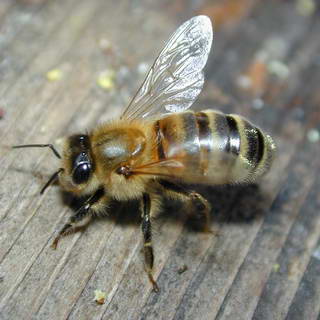
Some types, like the scary Africanised honey bee which is a hybrid between the African bee and the European honey bee are very defensive and will swarm anything that moves too much and/or makes too much noise. They also tend to focus their attacks on dark colours, so usually eyes, nostrils and mouth get the brunt of the attack. Even European honey bees will swarm anything nearby if provoked enough (i.e. if someone beat the nest with a stick), but the type should determine how urgently you deal with the situation. See if you can't get a good look at one of these bees. Whatever type, they really should be exterminated because bee nests can get huge, but if it looks more like the Africanised honey bees around the centre bee in this picture (note their orange colouring; the centre bee is a queen European so ignore her):
rather than like this (Western honey bee - note the bright yellow):
then you REALLY have to get it sorted as a matter of very serious urgency.
Big sigh of relief! (But I'd still exterminate. I don't like the idea of it myself, we had a wasp-nest in our yard a few years ago that had somehow set up home in a hole created by a fence-post and it felt awfully like destroying a little community that had worked so hard to be there, but at the end of the day if kids, cats or dogs could get near it I wouldn't take a chance.)
If they're ordinary British honey bees I certainly wouldn't recommend outright destruction of the entire nest. Contact a local bee keeper for advice coz British bees are becoming worryingly scarce because of the bee mite that has spread from the continent. Bees help pollinate all our crops and hedgerows and wild flowers so the loss of half the bee population will eventually have a staggering effect on crops and then on horse feeds etc. It's a further blow to the hidden biodiversity that keeps us all alive. Honey bees will die after stinging so only sting literally as a last resort. Wasps can sting over and over again. Many, many local beekeepers have empty hives and would be delighted to collect a "wild" nest.
Bees tend to be less aggressive (well, OK not the African and related varieties!), as they die every time they sting, so they are unlikely to sting unless provoked and unlikely to swarm. Animals often get stung in the mouth because they try to eat the bees. Wasps, on the other hand, can be very aggressive, as they don't die when stung and will attack as a swarm.
If you are looking to remove them you need to kill the queen, otherwise she will set up another hive (they can die of exposure but the others will huddle around her to keep her warm), so a job best left to the experts.
I completely see the point about preserving bees as they play a vital role in the ecosystem, but I am allergic to wasp stings and have to admit that they have to go as soon as I notice a nest!
Your horse then had an allergic reaction to the bee sting. Horses like humans can have allergic reactions of bee or wasp stings, although, interestingly enough an individual who is allergic to wasp stings will be fine with bees and the other way round. The severity of the reaction will depend on the number of stings and their location, anything close to the throat risks compromising breathing through the swelling and stings close to the heart are more dangerous than stings in the extremities. The first time an allergic animal (or person) is stung they won't have a reaction as they don't have antibodies, but from the second sting onwards they will have an allergic reaction (e.g. swelling, pain), and every sting after that will provoke a more severe reaction. You can get injections for emergency treatment in severe cases of allergies and you will see a few, unlucky, people who have to carry them with them everywhere.