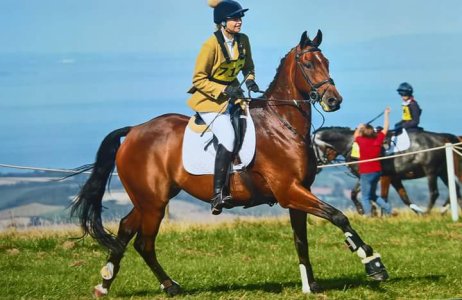
EMS management support/solidarity thread?

My
Hermosa is semi clicker trained, so I keep treats on hand to click-treat for certain things (sidepassing to a mounting block, crap like that). Since her EMS diagnosis, I have only been using celery, and she is really fed up with celery. She does the stuff she's well-trained to do anyway, then I have to shove it into her mouth, and for new stuff, like Spanish walk (I never said it was important), she rolls her eyes at me. "This isn't worth the effort for that shight."

Any recommendations for EMS friendly treats that are a little more exciting than celery? You can't blame her.
My boy does like his sweet potatoes chopped up into bite sized chunks….
 
Hi all.

My 21 year old ISH (non-good doer), came out the stable lame on Monday 22nd December. Initially thought it was an abscess, had both the farrier and vet and they couldn't find anything. Vet advised box rest and bute for 7 days then reassess. Stopped bute on Saturday 27th as IU thought if it was an abscess, this would prevent it coming to a head. Found a thorn in right fore heel on Sunday 28th and thought that was the issue. Poulticed to get any remaining nasties out. Unfortunately by Tuesday 30th, he was crippled lame and couldn't even walk, obviously by this point the bute had worn off. Got the vet out straight away, as he started shifting weight onto hind legs - the typical laminitis stance. Got rushed to the vet hospital that evening and was diagnosed with EMS and laminitis. Insulin was at 307 - only meant to be 47. He is not a great doer over winter and is 3/4 TB and 1/4 ID. He is therefore leaner than your average ISH. Baffled as he is not overweight and isn't on high sugar feeds - in fact, all the feeds he is on are EMS friendly.
He is due to come home today from the hospital and I'm just stressing myself out on how to manage him. I have downloaded an app on my phone which tells me the NSC/fructose levels of the grass in our area so I know when to/when not to turn out.
Anyone else on here in a similar situation to me? Non-obese, non-EMS-characteristic sports horse type that has managed to develop EMS? If so, please can you advise me on how you manage?

Thanks in advance!!
UPDATE – Just had vet back on the phone. He’s now also been diagnosed in the early stages of PPID Cushings. Starting on Prascend and coming home tonight on limited diet etc.
 

Attachments

  • Merlin4.jpg
    Merlin4.jpg
    41.6 KB · Views: 9
Hi all.

My 21 year old ISH (non-good doer), came out the stable lame on Monday 22nd December. Initially thought it was an abscess, had both the farrier and vet and they couldn't find anything. Vet advised box rest and bute for 7 days then reassess. Stopped bute on Saturday 27th as IU thought if it was an abscess, this would prevent it coming to a head. Found a thorn in right fore heel on Sunday 28th and thought that was the issue. Poulticed to get any remaining nasties out. Unfortunately by Tuesday 30th, he was crippled lame and couldn't even walk, obviously by this point the bute had worn off. Got the vet out straight away, as he started shifting weight onto hind legs - the typical laminitis stance. Got rushed to the vet hospital that evening and was diagnosed with EMS and laminitis. Insulin was at 307 - only meant to be 47. He is not a great doer over winter and is 3/4 TB and 1/4 ID. He is therefore leaner than your average ISH. Baffled as he is not overweight and isn't on high sugar feeds - in fact, all the feeds he is on are EMS friendly.
He is due to come home today from the hospital and I'm just stressing myself out on how to manage him. I have downloaded an app on my phone which tells me the NSC/fructose levels of the grass in our area so I know when to/when not to turn out.
Anyone else on here in a similar situation to me? Non-obese, non-EMS-characteristic sports horse type that has managed to develop EMS? If so, please can you advise me on how you manage?

Thanks in advance!!
UPDATE – Just had vet back on the phone. He’s now also been diagnosed in the early stages of PPID Cushings. Starting on Prascend and coming home tonight on limited diet etc.
Even stranger than this is that I have a 10yo 15.1 mare who came down with severe laminitis 2 weeks before xmas and insulin count was 37 and negative for cushings. Now having to follow all of the precautions to prevent laminitis again even though we have no idea why she has it in the first place e.g. watching bodyweight (she's already slim however), sugar levels in grass etc etc.

We do however have an EMS type pony that we strip graze, soak hay and double net when she is needs less to eat but slower, is on molasses free happy hoof and helps when in regular work. Less grass, more soaked hay is always a good rule of thumb, and you can always look at feed alternatives such as linseed if body condition is on the lower end
 
Even stranger than this is that I have a 10yo 15.1 mare who came down with severe laminitis 2 weeks before xmas and insulin count was 37 and negative for cushings. Now having to follow all of the precautions to prevent laminitis again even though we have no idea why she has it in the first place e.g. watching bodyweight (she's already slim however), sugar levels in grass etc etc.

We do however have an EMS type pony that we strip graze, soak hay and double net when she is needs less to eat but slower, is on molasses free happy hoof and helps when in regular work. Less grass, more soaked hay is always a good rule of thumb, and you can always look at feed alternatives such as linseed if body condition is on the lower end
Do you feed alfalfa? Only thing I could trace my TB mare’s lami back to was her losing weight in winter and me trying alfalfa based feeds to get it back on rather than sticking with the oats and balancer we had used before. She showed significant sensitivity to it thereafter.
 
the very recent post on this FB page "winter laminiti and circulatory issues"


B arklands I don't know if this will help you.
 
Do you feed alfalfa? Only thing I could trace my TB mare’s lami back to was her losing weight in winter and me trying alfalfa based feeds to get it back on rather than sticking with the oats and balancer we had used before. She showed significant sensitivity to it thereafter.
Nope, she was on oat straw chaff! Just bizarre isn't it!
 
the very recent post on this FB page "winter laminiti and circulatory issues"


B arklands I don't know if this will help you.
Super useful thank you!

We did a full blood panel and absolutely everything came back as normal so this has been my gut instinct that it was the sudden change from mild to freezing weather. Her progress began to plateau and she was still very lame so my gut instinct said to put very fluffy exercise boots on to heat the legs (which obviously goes against the advice of icing hooves) and an extra rug and hey presto she has improved dramatically!
 
Super useful thank you!

We did a full blood panel and absolutely everything came back as normal so this has been my gut instinct that it was the sudden change from mild to freezing weather. Her progress began to plateau and she was still very lame so my gut instinct said to put very fluffy exercise boots on to heat the legs (which obviously goes against the advice of icing hooves) and an extra rug and hey presto she has improved dramatically!
I'm type 1 diabetic and my blood sugar has been stupidly high working outside in the cold - normally lugging containers of water around would have the opposite effect. I can absolutely see how the cold could affect a metabolic horse.

My EMS/PSSM mare is in 2 x heavy weight rugs despite being unclipped and overweight to avoid her having a laminitis event again at this time of year. That happened on a virtually barren field and i could only put it down to weather
 
Super useful thank you!

We did a full blood panel and absolutely everything came back as normal so this has been my gut instinct that it was the sudden change from mild to freezing weather. Her progress began to plateau and she was still very lame so my gut instinct said to put very fluffy exercise boots on to heat the legs (which obviously goes against the advice of icing hooves) and an extra rug and hey presto she has improved dramatically!
I asked my vet only yesterday if stable wraps will help and he said no. Its all so confusing.
 
Yes I think the position is generally not but nothing else had worked for mine so I gave it a go, it could well be coincidence but she is definitely much improved since putting the boots on!
As mine is past the acute stage, and is just not really improving, I thought keeping her legs warm would increase blood flow to her feet. I was surprised (and a bit disappointed when vet said not to)
 
It's big mess of contradictions, isn't it?

1. Clip and under-rug horse to facilitate more weight loss, because being too fat is bad, and winter is a good time to get them to lose weight.

2. Bundle them in every rug you own, including their legs and feet, because decreased circulation due to the cold causes laminitis, aka, the problem you're trying to solve by....wait....making them cold.

3. Oh, wait...another risk factor...stress! So if the horse is stressed 'cause you're not feeding it enough...you might again put it more at risk of the thing you are trying to prevent in the first place.

Joseph Heller would love this one. Me, not so much.

I deny this reality. The reality is a computation matrix.
 
It's big mess of contradictions, isn't it?

1. Clip and under-rug horse to facilitate more weight loss, because being too fat is bad, and winter is a good time to get them to lose weight.

2. Bundle them in every rug you own, including their legs and feet, because decreased circulation due to the cold causes laminitis, aka, the problem you're trying to solve by....wait....making them cold.

3. Oh, wait...another risk factor...stress! So if the horse is stressed 'cause you're not feeding it enough...you might again put it more at risk of the thing you are trying to prevent in the first place.

Joseph Heller would love this one. Me, not so much.

I deny this reality. The reality is a computation matrix.

I think you are confusing 2 separate issues. What has been called winter laminitis is in fact cold induced hoof pain. It just seems that whilst many are fine top of the list for this is EMS and PPID. Quote below is taken from equinatural site. There is more info if you study Dr K's articles.​

"art 2 – Cold-induced hoof pain​

- A second winter syndrome – brilliantly described by Dr Eleanor Kellon, VMD (26 December 2024)​


Not all winter hoof pain is metabolic or inflammatory. Dr Kellon describes a distinct syndrome often mislabelled as laminitis but rooted in circulatory dysfunction, not inflammation.

- When hooves react badly to cold​

Most horses feel bright and energised in cold weather. But some – particularly EMS horses – experience:
  • sudden, severe hoof pain
  • reluctance to move
  • a stance that resembles laminitis
  • no heat, no pulse, no radiographic change

For some, the threshold is surprisingly mild – as warm as 4°C.

- What’s actually happening?​

Cold weather naturally reduces blood flow to the limbs – it’s the body’s way of conserving heat. The hoof manages this using tiny 'bypass channels' called arteriovenous shunts, which divert blood away from the tissues and straight back toward the core when temperatures drop.

In most horses, these shunts don’t stay open for long. The body periodically sends warm, oxygenated blood back into the hoof to keep the tissues healthy.

But in susceptible horses – typically those with EMS, insulin resistance, a past history of laminitis, or generally sensitive circulation – this re-warming process doesn’t happen as it should. Their blood vessels simply don’t respond efficiently to cold. The shunts stay open for too long, the hoof tissues miss out on oxygen and nutrients, and circulation falls below their personal tolerance level.

When that happens, the feet become painful very quickly. Movement slows or stops altogether until the horse warms up again and blood flow returns to normal.

- Support strategies (Dr Kellon’s recommendations)​

These focus on supporting circulation:
  • Jiaogulan → stimulates nitric oxide, a potent vasodilator *We're currently not able to supply the J-herb – our three suppliers are no longer able to source it, but shop around – it’ll be out there somewhere.
  • Arginine, citrulline & folate → support endogenous nitric oxide production
  • Rugging → reduces the need for shunting blood away from the limbs
  • Leg wraps → lined shipping boots work especially well
  • Wool socks inside hoof boots → keep coronary bands & heels warm

With warmth and circulation support, the pain usually resolves quickly and completely.

Bringing it all together – a safer winter for sensitive horses​

Winter laminitis is not a myth – it’s a physiological reality, driven by:
  • drought-stressed grasses
  • sudden rainfall
  • cold, clear days with bright sun
  • low-growth pastures rich in stored NSC
  • weed foraging
  • microbial disruption
  • and, in some horses, circulatory dysfunction once temperatures drop

Understanding these mechanisms means you can plan ahead, rather than react later.

A huge thank-you to Dr Eleanor Kellon, VMD, whose decades of work on metabolic horses have transformed how we recognise winter hoof syndromes and protect the most vulnerable."
 
On top of all of that: how is everyone managing to soak their hay?
I have only been able to give soaked hay in the mornings for the last few days as the pipes only unfreeze in the afternoons, so can only soak overnight. Horse won't eat hay that has been soaked for longer then left out. Not ideal in the middle of acute laminitis!
 
On top of all of that: how is everyone managing to soak their hay?
Mine won't even eat his soaked hay. I've got a spare stable next to me which has a drain in thank god so I've been doing it in there. Really getting stressed with it all, he won't eat the soaked hay, I'm having to syringe his meds and he's only allowed 200g of chaff twice a day. I'm so worried he's not eating enough and as a horse prone to ulcers I just don't know what to do.
 
Mine won't even eat his soaked hay. I've got a spare stable next to me which has a drain in thank god so I've been doing it in there. Really getting stressed with it all, he won't eat the soaked hay, I'm having to syringe his meds and he's only allowed 200g of chaff twice a day. I'm so worried he's not eating enough and as a horse prone to ulcers I just don't know what to do.
How long do you soak for - my vet said if they won't eat try just soaking for 2 hours so it is more palatable, so may be worth a try soaking for less time if you haven't already! Are you able to add protexin into the chaff to help prevent the ulcers?

As if laminitis isn't stressful enough, dealing with it in the middle of winter is just so tough! We need our own support group! 🤭
 
How long do you soak for - my vet said if they won't eat try just soaking for 2 hours so it is more palatable, so may be worth a try soaking for less time if you haven't already! Are you able to add protexin into the chaff to help prevent the ulcers?

As if laminitis isn't stressful enough, dealing with it in the middle of winter is just so tough! We need our own support group! 🤭
So my vet said to soak for at least 8 hours. So I'm literally soaking in the morning for the night and overnight for the next day. Its exhausting and when he's not eating it, its not great! He's bedded on straw so I'm hoping he's nibbling at that so at least he has something in his stomach. Not a bad shout re the protexin! I might invest in some.
Tell me about it! My anxiety is through the roof with it all!
 
So my vet said to soak for at least 8 hours. So I'm literally soaking in the morning for the night and overnight for the next day. Its exhausting and when he's not eating it, its not great! He's bedded on straw so I'm hoping he's nibbling at that so at least he has something in his stomach. Not a bad shout re the protexin! I might invest in some.
Tell me about it! My anxiety is through the roof with it all!
I would go back to your vet in that case and explain he's not eating it and check if it is alright to reduce the soaking time to make sure he has something in his tummy!

Eating with mine hasn't been too much of an issue but drinking was! It got to the point that the vet recommended we add apple juice to the water, despite the sugars as did not want colic on top of everything else! The whole thing just seems to be a big balancing act!
 
Mine refuses soaked hay so I just have to carefully ration her dry hay. Ive tried ALLSORTS so get her to eat soaked hay and she flatly refuses it.
 
I use a refractor to test my hay if it’s under 10 I don’t soak at all. If it over 10 in the winter when I can’t soak I use bagged haylage . This is working fine so far for my ems and Cushings pony
 
I've rang the vets, waiting on a call back. So stressful!
I would go back to your vet in that case and explain he's not eating it and check if it is alright to reduce the soaking time to make sure he has something in his tummy!

Eating with mine hasn't been too much of an issue but drinking was! It got to the point that the vet recommended we add apple juice to the water, despite the sugars as did not want colic on top of everything else! The whole thing just seems to be a big balancing act!
 
So my vet said to soak for at least 8 hours. So I'm literally soaking in the morning for the night and overnight for the next day. Its exhausting and when he's not eating it, its not great! He's bedded on straw so I'm hoping he's nibbling at that so at least he has something in his stomach. Not a bad shout re the protexin! I might invest in some.
Tell me about it! My anxiety is through the roof with it all!
Mine refused to eat and it caused massive complications. Please lay it on THICK with your vet that he won't eat hay. Dry hay is better than no hay.
Also, is your horse on ertugliflozin, as this can affect appetite.
 
Mine refused to eat and it caused massive complications. Please lay it on THICK with your vet that he won't eat hay. Dry hay is better than no hay.
Also, is your horse on ertugliflozin, as this can affect appetite.
Yes he is. He's on ertugliflozin and the prascend and I know both affect appetite don't they.
 
My horse is clearly a weirdo, she prefers soaked hay to dry. A fact I’m currently very thankful for!
Does anyone use a grazing muzzle in winter? I’ve been keeping her off the big paddock to rest it because the grass is so short and needs a rest but she could do with the space to move so I’d love to leave her out for 2hrs but I’m worried with the muzzle on she won’t get anything at all.
 
I use a refractor to test my hay if it’s under 10 I don’t soak at all. If it over 10 in the winter when I can’t soak I use bagged haylage . This is working fine so far for my ems and Cushings pony
Kingofmagic has your vet had your hay tested? if not then as above I would get it tested to see what you are dealing with. You could use say Forageplus or D & H or other companies to do this. I have for example 2 sorts of hay from the same supplier, one is not even safe for my EMS/PPID horse even with a very long soak yet the other could be fed without any soaking (I soak just for a few minute for the dust) It is best to know what you are dealing with iro hay.

If your horse is giving up on eating I would be asking if he could have Marksway haylage Timothy. I find Timothy very safe and that make is very very palatable.
 
Last edited:
It's been so cold here troughs have been refreezing within minutes so soaking hay is out. I don't think it can be good for them to eat soaked hay that's freezing solid in nets either. I've stopped for the moment and upped her timothy haylage in tiny holed nets (one of them doubled, she still empties it.)
 
Both times we had to deal with laminitis we found low sugar haylage (high fibre bagged stuff with analysis available) easier than soaked hay (not cheaper, but much easier!). I mixed it with straw. Saved trying to somehow soak in winter or at a yard with no running water. Had to soak hay twice to get anywhere near the same level of sugars. Current EMS pony is on that same haylage in her loan home through the winter.
 
Thanks for all responses: it's really useful to read what others' experiences and strategies are.

Could I ask, without having to do the research myself, which types of bagged haylage are OK to use for EMS/laminitics, please?

So far we've managed to soak as, apart from 2 days, we've had running water by mid afternoon and been able to drain the soaking container, and then refill it. I soak for about 3-4 hours (my vet advised 1-2 hours), sometimes longer. Ice is lifted off the container in the morning and nets put in. By about 2 pm they are taken out & drained for quite a while, before we've put them under cover. Even so they have frozen on the outside when it was -5C or lower (lowest here was -10C), and during those days we took the net into the house in a large plastic bag to defrost. We're lucky enough to have horses at home, so also access to pouring a boiling kettle of water or two into the water tub to encourage drinking.

It's been a lot of work and going back and forth. Knowing of an alternative would be handy, also as I think my hay supplier is going to run out of hay (we don't have storage for more than a couple of months' worth of hay unfortunately)
 
Top