
Forage analysis... shit. What now?

The lead level looks high, too. Is your land in an area where there were lead or tin mines?

I had a look in Advanced Grassland Management, hoping I'd find some detailed info about how different forage plants take up minerals from the soil and concentrate these in their leaves and stems, but there is not much, other than a passing remark in the description of red fescue, that "its main drawback is low digestibility and poor mineral concentration".

The book doesn't have much horse-specific information at all: a table of seed mixtures and two paragraphs of text on pp36-37.

One table of interest might be 14.1 on p150, Mineral composition of herbage.

Major Elements
P 2 - 3 g/kg of Dry Matter
K 15 - 40 g/kg of Dry Matter
Ca 5 - 15 g/kg of Dry Matter
Mg 1.2 - 2.8 g/kg of Dry Matter
Na 0.5 - 5 g/kg of Dry Matter
S 2 - 5 g/kg of Dry Matter
Cl 4 - 20 g/kg of Dry Matter

Minor Elements
Fe 100 - 300 ppm
Mn 20 - 200 ppm
Zn 15 - 50 ppm
Cu 5 - 15 ppm
Co 0.1 - 0.2 ppm
I 0.2 - 1.0 ppm
Se 0.1 - 1.0 ppm
B 1 - 10 ppm
Mo 0.2 - 3 ppm
 
I have nothing to add specifically to this this but I hope you won't mind me jumping on your thread PF just to ask how you go about forage analysis and does it have to be on each field you use..???
 
It specifically lists lead as "very low"?

You're right, damn my eyes!

I mistook the bar for "relative copper antagonism" for the lead content.

SLH: Albion Laboratory Services, take a look at the website, it explains how to bag your samples and send them in. I didn't look carefully, but maybe for a big field you'd take a small sample from each corner (say 10m in) and one from the centre and combine those to form a field sample... just guessing, and there is probably somebody on here who knows about soil and plant analysis and about seeding who could weigh in. The website also has a couple of interesting PDF documents here and here.
 
We got sent a ziplock bag that we had to stuff full of grass and send bsck to the company. We just did it for the one field and will do it for the new field too when it has grown. Also thinking about testing hay if we get a barn full from one place. The price wasnt prohibitive for us doing this a few times a year.

I think we might have to go to ForagePlus for an actual diet plan. I imagine they could collate grass an hay mineral profiles together etc... for 70 odd quid I'd hope so!
 
In term of collecting the sample we just wandered around the field at random stopping every few strides to take a cut of grass. You need quite a lot of grass to get enough dry matter so you can cover the whole field easily.
 
In term of collecting the sample we just wandered around the field at random stopping every few strides to take a cut of grass. You need quite a lot of grass to get enough dry matter so you can cover the whole field easily.

How does that work in, say, a field with very little grass and lots of (horse-safe) plants which aren't grass?
 
How does that work in, say, a field with very little grass and lots of (horse-safe) plants which aren't grass?

It would be fairly easy to contact the lab directly. If you manage to just somehow slip in to the conversation that you know of plenty of horse owners who would find the service useful, and you offer to help the lab to draft sample collection instructions, you might even get your own test done for free. Stuff like that has worked for me in the past.
 
How does that work in, say, a field with very little grass and lots of (horse-safe) plants which aren't grass?

When I did them via forageplus there were instuctions. Walk a W shape, pick more than you need , cut down and mix in a plastic bag to get a good random sample, cut a certain distance from the root, concentrate on the areas your horses graze.

However I think it if was bare, then you would struggle to get an adequate sample. When I've already been at a yard and got an analysis done, I have taken it when the fields have been rested before the horses go on.

The levels by themselves aren't much help without someone to interpret them. The high, low medium don't actually mean anything in terms of horses; some minerals like mg/ca and zc/cu need to be in the correct ratio and some like Iron and Manganese block uptake of other minerals so it's quite a complicated thing to work out.

The other thing that is interesting about yours in how low the Calcium levels are, I've had a few done and every one Calcium has been off the sheet high. Most of the 'barefoot' supplements don't include it as usually it's so high so you may end up supplementing.
 
We aimed to sample what the horses are eating as accurately as possible. So took some clover as well as grass. My field is divided into 3. It was hard to sample from where the horses were actually eating right now due to the grass being very short but the sample was representitive of the field as a whole.
 
I was thinking thar about the calcium as well. The field was limed two years (by previous owner) ago too! But unfortunately liming the fields can push molybdenum in the forage up apparently so won't be limin again. Will probably be liming the horses though!
 
When I did them via forageplus there were instuctions. Walk a W shape, pick more than you need , cut down and mix in a plastic bag to get a good random sample, cut a certain distance from the root, concentrate on the areas your horses graze.

However I think it if was bare, then you would struggle to get an adequate sample. When I've already been at a yard and got an analysis done, I have taken it when the fields have been rested before the horses go on.

The levels by themselves aren't much help without someone to interpret them. The high, low medium don't actually mean anything in terms of horses; some minerals like mg/ca and zc/cu need to be in the correct ratio and some like Iron and Manganese block uptake of other minerals so it's quite a complicated thing to work out.

The other thing that is interesting about yours in how low the Calcium levels are, I've had a few done and every one Calcium has been off the sheet high. Most of the 'barefoot' supplements don't include it as usually it's so high so you may end up supplementing.


Yes, be careful with your sample - I did one once where the grass was really short and this led to a high level of contaminants in the sample - a forage analysis was done and feed plan BUT the contaminent level definately didn't help with calculations or our confidence in the feeding. It is possible that in certain situations an analysis would be difficult...
 
I was thinking about having this done in April but a lot of the labs were shut. One of the sites did have very specific instructions on how and where to cut the grass from, so it's worth looking at some different sites. I decided not to do it at the time because the grass was too short, so I wouldn't have been able to follow the instructions. My feeling is that if the grass is short then that's what the horses are eating, so if the sample has contaminants then that's what the horses are eating too! But I'm not a scientist and know even less about forage analysis.... Might get it done now if the labs are open again.
 
We got sent a ziplock bag that we had to stuff full of grass and send bsck to the company. We just did it for the one field and will do it for the new field too when it has grown. Also thinking about testing hay if we get a barn full from one place. The price wasnt prohibitive for us doing this a few times a year.

I think we might have to go to ForagePlus for an actual diet plan. I imagine they could collate grass an hay mineral profiles together etc... for 70 odd quid I'd hope so!


You could make your own with a simple Excel sheet as well. :) I've done one and you can play with numbers (ie, increased hay and decreased grass in the winter, etc)
 
You could make your own with a simple Excel sheet as well. :) I've done one and you can play with numbers (ie, increased hay and decreased grass in the winter, etc)

Where did you get the fomulae to calculate how much to allow for antagonists? e.g how much copper and zinc to feed given the levels of magnesium and ron.
 
Ok. Here's a curveball. Just been told by one company, without even mentioning copper in the email (just asked if they can do a bespoke mix based on forage analysis), that it is illegal to supply a supplement that provides more than 350mg of copper!

Given that my horses went copper deficient while getting a supplement with a low iron, high copper profile AND stayed copper deficient when put onto a 400mg copper supplement... and are *just* coming right while getting 580mg of copper....erm so I'm going to have to break the law to get my horses healthy??!
 
After reading this thread earlier in the week, I've mulled it over a few times in my head and I've ordered a sample kit. It's arrived today so I'll be sending a sample off next week.
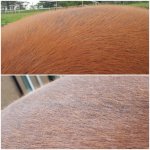
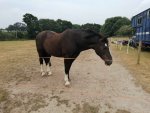
Here's a photo of B1 with his funky 2 tone coat.
 

Attachments

  • IMG_20200612_111303_compress36.jpg
    IMG_20200612_111303_compress36.jpg
    262.8 KB · Views: 8
Ok. Here's a curveball. Just been told by one company, without even mentioning copper in the email (just asked if they can do a bespoke mix based on forage analysis), that it is illegal to supply a supplement that provides more than 350mg of copper!

Given that my horses went copper deficient while getting a supplement with a low iron, high copper profile AND stayed copper deficient when put onto a 400mg copper supplement... and are *just* coming right while getting 580mg of copper....erm so I'm going to have to break the law to get my horses healthy??!

I doubt that very much, that there is any law against it.

You could just add food grade copper sulphate, or copper bioplex (much more expensive).

.
 
I doubt that very much, that there is any law against it.

You could just add food grade copper sulphate, or copper bioplex (much more expensive).

.

That would be the plan. I just thought it was odd because, I'm assuming it would not be illegal to feed more copper (!?) but it is illegal to supply it in a pre-mix. Just strange and confusing. We're on to Forage Plus now anyways so we'll see what they say.

And I thought it was weird that we even got that comment back when the question was "can you do a bespoke mix?" Without mentioning we'd need high copper. But maybe everyone needs higher than legal copper so they just don't do bespoke mixes on those grounds.

I think I am just easily confused.
 
Top