Friesian horse doesn't want to go on the bit at trot

LyannaStarkkk

New User
Joined
24 February 2019
Messages
5
Visit site
Hello! I ride a 13yo friesian stallion which goes amazing under the saddle. He was a driving horse, and still has days when my trainer puts him at the carriage.
Now, my trainer told me that in May he wants me to enter a dressage competition with him.
I have this problems with him, at trot he rises his head like he does at driving, and that's it, i can't bring him down. Also, since he never actually worked at canter, I have really big problems when wanting to canter, he starts very hard and heavy. How can I correct these things?
 
Lots of practise is the only way. If he is still driven it will be harder and for the canter you need to work on sparky transitions on 20m circles..ask for canter..do half a circle..back to trot..balance for half a circle then back into canter...that sort of thing.
 
You have a big task if you want him to be a dressage horse. Freisian’s are naturally like that and it’s going to be even harder if he’s driving too because he’s naturally pulling himself along, rather than working from behind. They don’t find it easy to canter either. Bringing his head down will only come when he lifts his back correctly and that’s going to take a lot of work.
 
Does the owner have him trotting on the bit and cantering? If not then I think that you might struggle to get him ready for a dressage test in May as he will have been using himself very differently as a driving horse. Not impossible, of course, but it will take a lot of retraining, patience and tact. If he's already able to work on the bit properly then I'd be asking his owner how she manages it.
 
Freisian’s are naturally like that and it’s going to be even harder if he’s driving too because he’s naturally pulling himself along, rather than working from behind..

Why do people think that? My driving pony is expected to go correctly. They don't really pull the carriage at all, they push from behind into the collar.
 
Why do people think that? My driving pony is expected to go correctly. They don't really pull the carriage at all, they push from behind into the collar.

Umm, I don't agree. I've taken several Friesian driving horses (and other carriage trained horses) into riding and dressage training, and they all travel over the shoulder initially. Friesians are bred very upright in front, with tall necks. They are not precisely hollow over the back, but they most definitely carry themselves very differently to modern riding horses.

OP you will have a lot of trouble if you try to ride this horse against his natural shape and carriage; some Friesians have real problems with canter that are only resolvable when you get to the higher collection. Trying to force this type of horse to go "long and low" is not the solution, no matter what people tell you.
 
Umm, I don't agree. I've taken several Friesian driving horses (and other carriage trained horses) into riding and dressage training, and they all travel over the shoulder initially. Friesians are bred very upright in front, with tall necks. They are not precisely hollow over the back, but they most definitely carry themselves very differently to modern riding horses.

OP you will have a lot of trouble if you try to ride this horse against his natural shape and carriage; some Friesians have real problems with canter that are only resolvable when you get to the higher collection. Trying to force this type of horse to go "long and low" is not the solution, no matter what people tell you.

I am nowhere near Cortez in experience, but with my two Friesian crosses I'd very much agree with ^.

Both of mine have needed to strengthen behind before they could reasonably stretch 'long and low' as trying to force the head down makes them unbalanced and on the forehand (even if physically they are uphill, they can still be falling on their heads when moving). Topaz only stopped her four beat canter once we started on collection needed for the higher movements (pirouettes etc), both struggled with canter the most.

Getting them supple helps (leg yield spirals on a circle are good), as are transitions and half halts to encourage them to engage more from behind but it could be a long process.
 
Why do people think that? My driving pony is expected to go correctly. They don't really pull the carriage at all, they push from behind into the collar.

I’m sure your horses have been trained to go correctly, but I think your average horse, especially a Freisian, who has naturally big powerful shoulders, is predisposed to pull the carriage from the front.
 
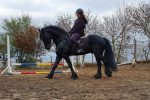
This is how he looks. He goes really nice on the bit at walk. From what I know he was trained in the past to go on the bit at trot and canter, but it's really hard to do that now
 

Attachments

  • JPEG_20200107_230141.png
    JPEG_20200107_230141.png
    969.7 KB · Views: 75
Umm, I don't agree. I've taken several Friesian driving horses (and other carriage trained horses) into riding and dressage training, and they all travel over the shoulder

That’s a schooling issue not a driving issue though. If they’ve only been trained in commercial or hacking work to get from A-B and stand still when asked then you’ll need to reschool in the same way a racehorse has learnt to get from A-B in gallop or a trekking pony in walk. If they’ve been produced correctly then the transition to ridden competition will be much easier. That’s why I asked why he’s raising his head driving, the schooling issues are likely to be the same as under saddle.

The Confo ‘issues’ of the breed only add to the ‘fun’! I’ve not had much experience beyond competing 1 mare at prelim (ridden) dressage and she was a lazy moo without much control of her balance at canter so there’s many more experienced people to talk about that part of the challenge.
 
This is how he looks. He goes really nice on the bit at walk. From what I know he was trained in the past to go on the bit at trot and canter, but it's really hard to do that now

Another "um..." - he's not "on the bit" in that photo; he's behind the bit, and anyway a horse shouldn't really be asked to go on the bit at walk at that stage of training. Look, retraining any horse from one discipline to another is a really big job and should be undertaken with either a professional, or at least with a lot of input from someone experienced.
 
What does your trainer advise? They are the best person to advise really. I’d say from the photo the reins are short which is making him tuck his nose in. Hard to tell from a moment in time photo but he doesn’t look as if he’s stepping under behind at all. Simply put the hind legs need to propel the horse forward and the head will naturally lower.
 
This is how he looks. He goes really nice on the bit at walk. From what I know he was trained in the past to go on the bit at trot and canter, but it's really hard to do that now

He's lacking the musculature to truly move through the shoulder, pushing from behind. He lacks muscle behind the saddle and you definitely have him overbent and too short, the lowered hand forces him there. You may be able to muster a test in May but it kind of depends what you'd like to achieve, I'd say you'll learn to get a horse through a test, your trainer will presumably give you the "tricks" to get him to do what's needed, but my instinct is he needs some "undoing", some correction to his body and better posture/musculature, and then he'll find it easier.

I saddle fit for a lot of horses and ponies that mainly drive, and you can really tell those that did driving for some period before being ridden, or were barely schooled under saddle while driven, they really struggle to come through from behind, usually are too short/high in front and dropped through the sternum.
 
I’m sure your horses have been trained to go correctly, but I think your average horse, especially a Freisian, who has naturally big powerful shoulders, is predisposed to pull the carriage from the front.

Mine is an average horse with an enormous bulldog chest and big shoulders. She pushes from behind to move the carriage. Shes not particularly well schooled, mainly due my failings not hers, but that's how its easiest for them to pull the carriage. If they are running along with their head in the air, back hollowed and ploughing on the forehand, then theres issues. Those issues aren't anything to do with driving.
 
Mine is an average horse with an enormous bulldog chest and big shoulders. She pushes from behind to move the carriage. Shes not particularly well schooled, mainly due my failings not hers, but that's how its easiest for them to pull the carriage. If they are running along with their head in the air, back hollowed and ploughing on the forehand, then theres issues. Those issues aren't anything to do with driving.
Your horse is not a Friesian. They, and other specialist carriage horses (such as gelderlanders) are built very differently to cobs.
 
Your horse is not a Friesian. They, and other specialist carriage horses (such as gelderlanders) are built very differently to cobs.

Indeed, but there are lots of specialist carriage horses who dont run a long on the forehand Theres a reason driving horses tend to get knackered hocks.

i've just been looking at pictures of Friesians driving, I cant find one thats pulling itself along on its forehand. Lots have the horrible high head carriage, but with the neck set theres not a lot you can do about that.
 
Ah, but I don't think the high head carriage is "horrible" - it's a characteristic of the breed, and a very old, beautiful and historic one at that. It's also one of the reasons why I only have Baroque breeds now, the higher placed neck facilitates collection and means that these type of horses use themselves differently to the modern "back movers".
 
Top