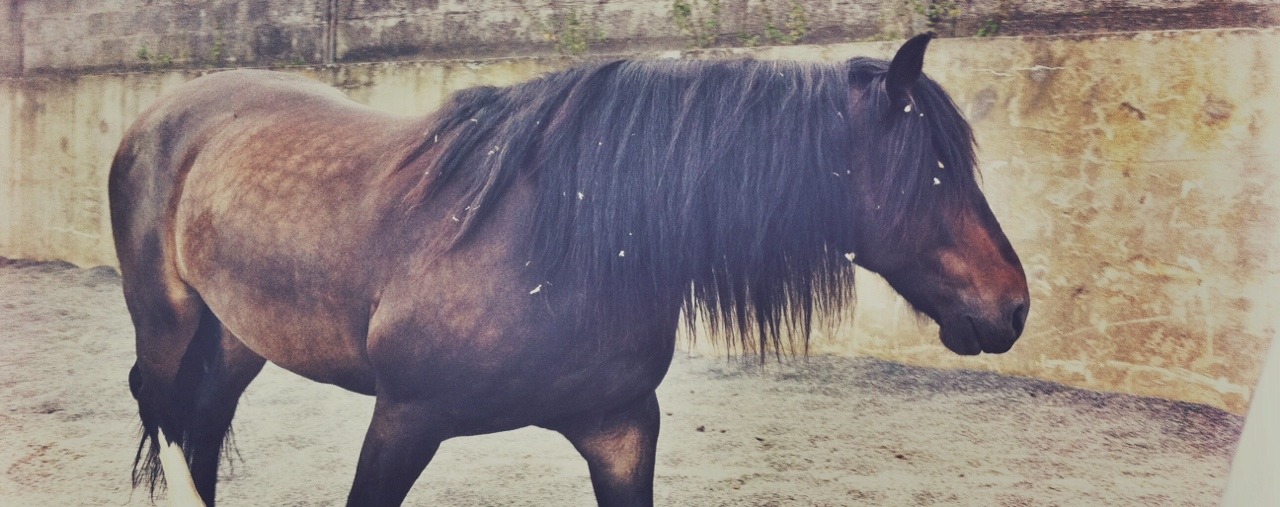
Fun poll. What is your favourite colour horse?

What is your favourite colour horse?


  • Total voters
    0
Wow your horse and mine must be related they both strongly exhibit the mud monster gene! Does your also have the hippopotamus gene, mine likes to wallow in the pond with the ducks!

If it's not muddy enough he'll dig it up first to create more mud - then as he's on his back he'll wipe his muddy hooves (because you can't possibly have muddy hooves :rolleyes:) all over his tummy just to make that filthy too. I knew a grey would be extra work but he is BEYOND! The worst is he has very dense coat so you think he's clean, then he sweats mud!
 
Last edited:
As much as I love the lovely dark, dark dapple greys, I will always have a soft spot in my heart for coloureds.

The only thing better than a really well marked traditional cob is a well marked traditional cob who has a sense of house keeping!
I also love the tobiano coat pattern, think it looks gorgeous.

i'm really not a fan of bays and solid horses in general, however I quite like my boy as stains dont show up so easily, it's just a shame he likes to come in from the field with 4 black legs, not 3.

This is him here, not sure what colour you'd call him :)

tumblr_nb8kpiyW6J1qexyquo1_1280.jpg
 
Coloureds for me - not trying to be fashionable, I've liked them since I was a tiny tot and still love them now I'm in my (ahem) 4th decade!

Currently have one coloured and one light bay, also had a blue roan mini shettie until June this year and I ride a piebald for a friend. First pony was a dark bay.
 
I am not sure whether my horse is seal brown or very dark bay - from what I can establish they are very similar to look at, though genetically different. I do love the colour that he is though, particularly at this time of year - very dark brown, almost black, body which glows almost purply aubergine colour in the sunlight, black legs, mane and tail, and cream fluffy bum and nose.
 
1. Black with no white bits

2. Grey - white rather than dark, although dapple is lovely

3. Really smart bay, with proper defined black legs - not too bright, or chestnutty in the brown bit, and no white on the legs.

I have the smart bay, and a very orange chestnut!
 
Dorsal stripe which is obviously not visible in this photo and primitive markings on the legs. His stripe isn't very visible in most photos on account of his muscular quarters / conformation but you can see a hint of it here.

10338226_236560169886370_7792722733370366993_n.jpg

Oh right ok thanks, baffles me all these colours now |0| :)
 
Dorsal stripe which is obviously not visible in this photo and primitive markings on the legs. His stripe isn't very visible in most photos on account of his muscular quarters / conformation but you can see a hint of it here.

10338226_236560169886370_7792722733370366993_n.jpg

Just to confuse things further
DSC01728_zps698fa282.jpg

both these ponies are Dun neither has a grey parent and therefore cannot be grey mother is 20 daughter is 5 but the "white" one is just very pale cream and has faded to this colour from dun

Aren't they lovely, i have a soft spot for highlands.
I would say 1 dun and 1 grey, that's my knowledge ;)

Loving this thread,
 
Windandrain; I am very surprised as unless it is some dilute I have never come across both horses exhibit all visible traits of carrying grey. I will eat my hat if they're not grey. ;) Not trying to come across as rude, I promise but I do believe they are grey. Sorry.


I think often, as there are various terms amongst breeds and what one person deems as A, may not be what someone else classes as the same, terminology wise, there should be some rule when passporting or registering, that all animals should be colour tested so no confusion ever arises.
You are of course entitled to you opinion but in all the genetics I have read a grey horse has to have a least one grey parent neither of the mares parents are grey both lived into their 20s neither parent was grey the filly is a curious one as her father does have grey gene but she is getting darker cream as time goes on
 
I'm a chestnut fan - and I still don't get the chestnut mare thing. I have two and as far as colour goes, love how you can polish them.

I have always said I would never own a grey, not because of keeping them clean, but becuase of spring and all that hair. The other colours aren't quite so obvious on your work clothes after it has all migraged via the washing machine and the car seat. However, I now do and as someone has pointed out, a good horse is never a bad colour.
 
I love Duns/buckskins but love how dark bays shine up.

One of my ponies is a funny colour, he's golden dun in the summer but has no dorsal strip!! Winter he's grey with his black mane/tail/legs and in spring he turns a roan colour before his golden coat comes through again.

So what colour would he be? I just call him dun
 
If a horse has the grey gene they are always grey as grey is a dominant gene which masks all other colours. If neither horse has a grey parent then those parents can't have a grey gene at all. I wonder if they have a dun modifying gene which causes the colour to fade? One which hasn't been identified yet?
 
Dorsal stripe which is obviously not visible in this photo and primitive markings on the legs. His stripe isn't very visible in most photos on account of his muscular quarters / conformation but you can see a hint of it here.

my grey was markedly dun as a 4/5yo, had a dorsal and primitive leg markings up until he was 7/8-then greyed out quite quickly and was turning flea-bitten before PTS at 11. What makes my horse grey and yours dun? (not being argumentative, just trying to understand the genetics).
 
You are of course entitled to you opinion but in all the genetics I have read a grey horse has to have a least one grey parent neither of the mares parents are grey both lived into their 20s neither parent was grey the filly is a curious one as her father does have grey gene but she is getting darker cream as time goes on

Yes, they do have to have one grey parent. I am curious as to if one was extremely slow to grey. They just scream grey to me, that's all.

Do you have pictures of the parents?

Sorry, hope you don't think I'm picking you out constantly, I'm just intrigued. :)
 
my grey was markedly dun as a 4/5yo, had a dorsal and primitive leg markings up until he was 7/8-then greyed out quite quickly and was turning flea-bitten before PTS at 11. What makes my horse grey and yours dun? (not being argumentative, just trying to understand the genetics).

To be honest ALL greys could be described as their base colour: grey dun, grey chestnut, grey black, grey bay, grey palomino etc. At the end of the day they are all grey.
 
my grey was markedly dun as a 4/5yo, had a dorsal and primitive leg markings up until he was 7/8-then greyed out quite quickly and was turning flea-bitten before PTS at 11. What makes my horse grey and yours dun? (not being argumentative, just trying to understand the genetics).

Neither dun nor grey are colours, so to speak. They dilute or modify the base coat. Mother of Chickens; every horse with grey changes at different speeds. Some are white by the time they are not very old at all, others grey more slowly. Both horses were/are dun and both horses were/are grey. It's just that often, as grey takes over the original colour, most people don't always know what colour their horse truly is, underneath it. So your horse would be dun (again, not sure of base coat) gone grey.

ETA: Beaten to it by Wagtail. ;)
 
my grey was markedly dun as a 4/5yo, had a dorsal and primitive leg markings up until he was 7/8-then greyed out quite quickly and was turning flea-bitten before PTS at 11. What makes my horse grey and yours dun? (not being argumentative, just trying to understand the genetics).

Nothing. Your horse was dun too ;)

To be honest ALL greys could be described as their base colour: grey dun, grey chestnut, grey black, grey bay, grey palomino etc. At the end of the day they are all grey.

Er. Not with a dorsal stripe they aren't. No more grey than dun, so grey dun remains the most sensible term. Mine has markings which are distinct from a grey without dun, and he is genetically different too. It would be unnecessarily confusing and daft to try and homogenise them into the same colour... I could add in his base colour, but I don't think that would add to the sense of the description ;)
 
Last edited:
W&R should get the mare DNA'd for grey just to solve the mystery! :p

I will say that I am surprised how common it is for greys to not be identified as grey especially if they are slow to grey out. It is possible that one of the parents was grey but not identified as such. I've no idea what the parents look like so this is all theory.

I will say that W&R's 'white' mare has black skin. As far as I'm aware the only gene that gives black skin with white fur, bar any white markings, is grey (LP isn't an option and one of the characteristics of LP is mottled skin). Double dilutes, dominant whites and maximum pintos have pink skin. It's also highly unlikely that something else (eg a skin problem) has resulted in all of the fur losing it's pigment.
 
Nothing. Your horse was dun too ;)


Er. Not with a dorsal stripe they aren't. No more grey than dun, so grey dun remains the most sensible term. Mine has markings which are distinct from a grey without dun, and he is genetically different too. It would be unnecessarily confusing and daft to try and homogenise them into the same colour... I could add in his base colour, but I don't think that would add to the sense of the description ;)

What about cream then? Would you say a buckskin dun? I know buckskin doesn't have markings like a dun but it does have characteristics such as a lighter face and soft parts. Counter shading in other horses such as bay can look exactly like a dorsal stripe. Then there are other genes that modify such as sooty. I don't understand why dun should be any different. But anyway your horse to call what you want. But all I'm saying is that other colours could be described in the same way. At least you are being accurate.
 
What about cream then? Would you say a buckskin dun? I know buckskin doesn't have markings like a dun but it does have characteristics such as a lighter face and soft parts. Counter shading in other horses such as bay can look exactly like a dorsal stripe. Then there are other genes that modify such as sooty. I don't understand why dun should be any different. But anyway your horse to call what you want. But all I'm saying is that other colours could be described in the same way. At least you are being accurate.

Why would I call a buckskin dun if it doesn't carry the dun gene? I'm a touch confused there - similar markings are irrelevant if the genetic basis is different. Yes, sometimes standard classifications need more descriptors to accurately describe the animal - and if it's genetically accurate and phenotypically useful, I'm all for it. I can be very confident F carries the dun gene (and his markings aren't based on any other genetic interaction) because of his breeding - hence I can say that he is definitely a grey dun. If the horse was phenotypically complex, the only way to say with certainty would involve DNA testing - and that's exactly what I'd say about a horse with markings which were difficult to ascertain the genetic basis of on sight.

As for Fergs, I'm calling him what he's passported, and what he "is" genetically (other than omitting his base colour because while that's genetically relevant, it's not phenotypically useful anymore). I do roll my eyes at people who call him grey because it isn't an accurate description, just as I roll my eyes at people calling buckskins "dun". I'm a raving pedant - but we've been knocking around on the forum together long enough for you to know that I'm sure :p
 
With greys I personally like the base colour to be recorded in the passport too. So chestnut/grey, bay/grey etc... I don't mind if people prefer to put it the other way round eg grey/chestnut as it makes no odds. With Duns, I would say chestnut dun/grey, black dun/grey, bay dun/grey etc... as dun works on both chestnut and black based horses. With buckskins you know the horse is black based as if it was chestnut based it would be a palomino/grey. The one that is very, very useful to know is double dilutes with the grey gene (cremello/greys and perlino/greys) as it's pretty much impossible to see that they have the grey gene due to having pink skin and fur so pale that it doesn't appear to grey out.
 
FWIW, Faracat, I'd rather F's passport recorded his base colour too. I just wouldn't sneer at someone in the street who called him a grey dun not a black-grey-dun :p
 
Top