Grass Sickness

(68116)

Well-Known Member
Joined
20 December 2009
Messages
957
Visit site
I don't often venture in here, so please be gentle with me! I am also going to post this in nl in the hopes of getting some ideas.

A horse at my yard has Grass Sickness I have never seen such dramatic weight loss in my life. The vet has told us that there are 3 types of the illness all with differing prognoses. The horse at the yard has the 'milder' version of it. He has spent time in horspital and is now back on the yard to be nursed at home and hass a 50/50 chance. In himself he seems bright enough, has a spring in his step and seems interested in his surroundings. However he is having trouble eating, most of what he takes in, he dribbles back out and seems unable to swallow. The vet has given him a week to start eating or time will called as he is starving to death Between us we have been wracking our brains trying to come up with things that he can easily eat and will tempt him. It is absolutely heart breaking seeing his teenage owner spending every day and half the night sat with him, with bowls of different things trying to get him eat and she is breaking her heart.

Does anyone have any tips? Has anyone been through this and come out the otherside? How did you manage it? Please help.
 
You need to find out for certain if he can swallow.

If he can, then she has a chance to feed him - get his owner to find the biggest syringes she can (60ml? 100 ml better) cut the delivery end off so you can suck up food into the tube then tie him up short and syringe food into his mouth.

I used to buy baileys top line conditioning cubes and high protein racehorse cubes, soak them in hot water till they were pulped, then added copious amounts of vegetable oil - it contains lots of calories and helps eveything to slide down. Each feed used to take me about 30 mins to administer and I did that about 4 - 5 times a day. The horse needs to be consuming about 5 kilos of feed a day to have a chance, but he can start off smaller till everyone gets the hang of it.

I also used to mix in probiotic yogurts, Yakult, Aloe vera juice etc etc. Walking out is important to keep the horse interested in life - he has to want to live to get anywhere with him.

Gully didn't want to eat anything himself, but in this way, we got him to the point that he actually did start to want eating again.

See my account on the grass sickness fund website for more info and pm me if you want.

Good luck to her.
 
Last edited:
That is invaluable advice thank you very much. He can swallow, I managed to get a handful of my ponies feed - Safe and Sound, I told you we're trying everything! - down him this evening. He swallowed just over half the handfull and dribbled the rest out so he's def still swallowing a bit. His owner bought Baileys Topline today and was pulping it with molasses when I left tonight. She has got Aloe Vera juice and yakult and probiotic yoghurt that she is mixing into things and hand feeding him. She hasn't tried syringing yet as far as I'm aware but I will definitely suggest it tomorrow and the veggy oil too.

I'm very glad to hear Gully pulled through. Thank you very much again
 
Thanks Oberon. I am following up on some of the info and advice posted by the wonderful people here and I hope I can post some more positive news in the near future.
 
How terrible i really feel for anyone who has had to cope with this terrible sickness, I am in NE Scotland apparentlyit is most common up here i'm not sure. In 2006 i worked on a yard where 3 horses got it the first had to be pts immediately as he had the most debilitating form of it and was in a lot of pain, the second a little welshie sec a belonged to a livery she pts very quickly to, and the last was a 5yr old clydesdale mare who i broke in she was a lovely girl we tried to help her but i think she just gave up she was very deppressed i think.

I have heard that things like keeping radio on outside horses stable can help keep them interested.
And as you guys are allready doing spending a lot of time with horse to help keep there spirits up.
Have also heard of people hanging buckets from different heights in stable with different foods when you are not their to try and tempt them and find what height they find eating from easiest.

I kept my sec d mare on livery at this yard at this time and i was so worried i took her in every day and gave her hay throughout the day, i have no idea if this helped but she was in same field as clydesdale mare, and she remained fine.

I wish you and this young girl and her horse the very best of luck in pulling through from this awful sickness..x
 
I don't often venture in here, so please be gentle with me! I am also going to post this in nl in the hopes of getting some ideas.

A horse at my yard has Grass Sickness I have never seen such dramatic weight loss in my life. The vet has told us that there are 3 types of the illness all with differing prognoses. The horse at the yard has the 'milder' version of it. He has spent time in horspital and is now back on the yard to be nursed at home and hass a 50/50 chance. In himself he seems bright enough, has a spring in his step and seems interested in his surroundings. However he is having trouble eating, most of what he takes in, he dribbles back out and seems unable to swallow. The vet has given him a week to start eating or time will called as he is starving to death Between us we have been wracking our brains trying to come up with things that he can easily eat and will tempt him. It is absolutely heart breaking seeing his teenage owner spending every day and half the night sat with him, with bowls of different things trying to get him eat and she is breaking her heart.

Does anyone have any tips? Has anyone been through this and come out the otherside? How did you manage it? Please help.

Jack Frost please go onto www.grasssickness.org.uk for information (please google as not sure address is the correct address). Please try and get anyone on your yard who has a case of grass sickness to complete the grass sickness organisations incident form. This way information can be collated to help to fight this dreadful disease. There are two types of GS one is chronic and one is acute. Acute horses are pts as soon as they are diagnosed. A chronic GS horse might survive but it nearly always ends up a weakly type. The GS organisation have recently found a possible link to paddocks which are poo picked with machinery which has a brushing action, presumably this changes the molecular structure of the grass. If you yard uses this method I would stop using it asap. Please access the website where you can obtain reams, and reams of advice from owners whose horses are currently suffering from grass sickness. They will have loads of tips and useful advice for you.

I hope the horse in question makes it.
 
The poster above has mentioned the website I was going to suggest, grasssickness.org. If you haven't already, click on the section marked 'recovery' there are several case studies which detail exactly what and when these owners got their horses eating during their nursing. You may also be able to contact them for advice.

Good luck to you all, I hope he makes it and please keep us updated.
 
Just a quick reply to Applecart who said that survivors nearly always end up as weak types - I would hate for people to think that they would go through all the stress and strain of nursing for them to believe that their horses definitely wouldn't get back to a normal life afterwards.

Gully (one of the grass sickness site's case studies) is fully recovered, as far as we can tell, from EGS. I actually have trouble with him putting too much weight on now, and there doesn't seem to be any deficit or weakness from the disease itself - he is a happy healthy horse. It took a while for this happen (the first year after his disease, he had very little stamina and had compromised thermoregulation) and he is a lazy sort, but then he seemed that way when he was just backed too. He did his first ODE at the end of last year.

I know this is sadly not the case with all survivors, but there is a chance that those that do make it get their full strength/health back and you have to use that hope as a dangling carrot for all of your effort.
 
Equijewel produced by saracen feeds is a good energy source .It is rice bran and contains a lot of oil. It also doesnt tend to go rancid in hot weather unlike some feeds where oil is mixed in with fibre.Give the nutritionist at Saracen a ring ,I believe her name is Natalia Davis.She is very helpfull and may have some good ideas. I wish you good luck ,grass sickness is terrible.
 
Wonderwall - what a very sad story :( but thank you for sharing it. His owner spent a great deal of today on the phone to the Edinburgh Veterinary College and one of the Grass Sickness associations that has been mentioned. I also printed off both threads and gave them to her, she is grateful for all your 'virtual' support and best wishes. She is spending most of every day with him and into the evening and I am bringing my two horses in at night to keep hers company. I think she has a radio up there.
Applecart - poo picking is done manually at our yard lol
Ziggy - thank you and I will.
Pootleperkin - the owner knows about Gully already! Is in he featured in a leaflet or paper? I think he is a bit of hope for her.
 
There are 3 types - acute, sub-acute and chronic.

With acute the horse goes downhill within 24 hours and is in so much pain and discomfort that is usually put down within that time.

With sub acute - also lots of pain and very rapid weight loss - usually go within the week.

Chronic - as per the horse you know and Gul.

Gully is on the EGS website Jack Frost, as a case study - they asked me to write his experience up to help out folk like your friend.
 
I have experience of this too. The only thing Nod would eat was Blue Chip original..Clare at blue chip VERY kindly donated a couple of sacks and he was used in some of their first before/after adverts!
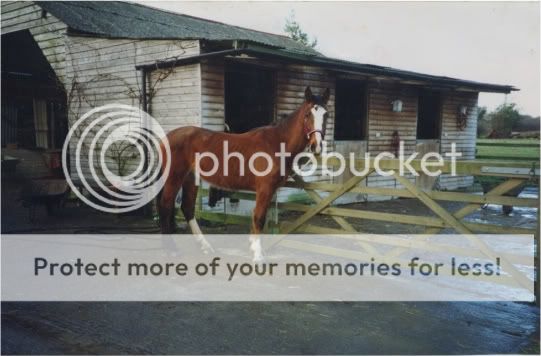
Nod as a very sick yearling- vet diagnosed grass sickness- he was very lucky to survive and took a year to recover all his hair and body weight. He had a very sucessful career as a show cob, ending up at HOYS and is now happily semi retired in the field at the age of 18!

Nod1993---473-2.jpg

Nod1993---473-1.jpg


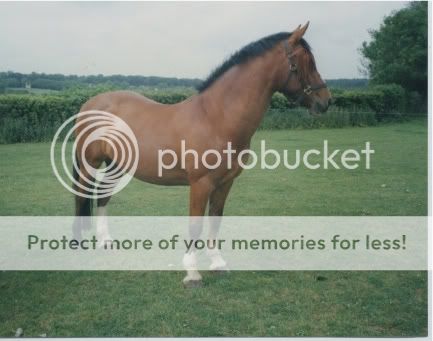
In case anyone wants to know- here he is at 4 yrs:
Nod19946---475-1-2.jpg


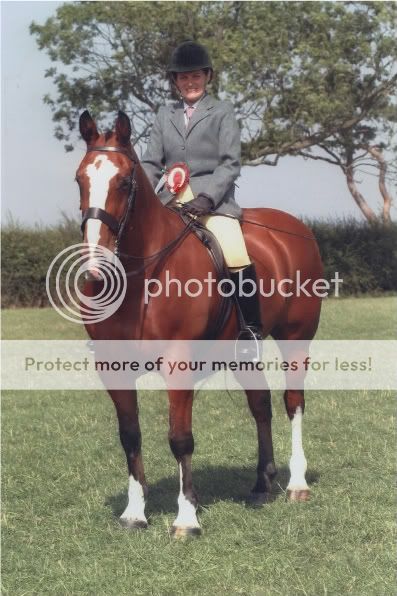
and at 12 yrs, he won the Chiltern & Thames Cob Championship and went on to qualify & compete in SFAS at HOYS
Nod2005---481-1.jpg


and at 16 yrs, still a thruster on the hunting field:
SarahBrockhurst---479.jpg


At 18 he won a Le Trec competition with his sharer and he is now 19 and helping my OH return to riding after breaking his back last year. They are planning on hunting gently this winter too :)
 
I would also try offering a warm(Warm not hot!) Bran mash with boiled linseed and a touch of salt. One of the problems is that the sphyncter into the stomach is partly paralysed by the neurotoxin and this makes swallowing difficult. A warm bran mash should slide down nice and easy,and at body heat is less likely to cause an involuntary restriction of the sphyncter.Boiled linseed contains a lot of energy so should help slow the weight loss.
Also the height the food is at is very important .Our problem with Dennis was getting him to drink and we had to try all sorts of additives and flavours .What worked one day was useless the next. Strangely the bright red shallow water bucket I bought him seemed to be the most effective. It is vital to keep the horses spirits up. Dennis would love to be gently groomed and thiswould cheer him up no end. He seems to be well on the mend but it has been a hard road.
Please keep us updated and what you are trying . All of us who have already faced this are right behind you and wishing you all the best luck.
 
Just a quick reply to Applecart who said that survivors nearly always end up as weak types - I would hate for people to think that they would go through all the stress and strain of nursing for them to believe that their horses definitely wouldn't get back to a normal life afterwards.

Gully (one of the grass sickness site's case studies) is fully recovered, as far as we can tell, from EGS. I actually have trouble with him putting too much weight on now, and there doesn't seem to be any deficit or weakness from the disease itself - he is a happy healthy horse. It took a while for this happen (the first year after his disease, he had very little stamina and had compromised thermoregulation) and he is a lazy sort, but then he seemed that way when he was just backed too. He did his first ODE at the end of last year.

I know this is sadly not the case with all survivors, but there is a chance that those that do make it get their full strength/health back and you have to use that hope as a dangling carrot for all of your effort.

I apologise if I have got my facts a bit wrong. This is the information that I have read previously from other sites and remembered seeing it more recently when the lady I knew from Rugby had four horses lost on her yard last May. Sorry if I've upset anyone, last thing I wanted to try. I'd always be guided on vets advice and my own common sense if my horse was stricken with this dreadful disease. I wish everyone with GS horses the very best of luck x
 
A quick update on Fin. Yesterday morning his owner arrived at the yard to find the most revolting, vile smelling 'stuff' coming out of Fins nose. She called the vet and cleaned him up while managing to get most of the goo into a carrier bag for the vet even though the smell was making her heave. The vet came straight away and checked Fin over. Her worry was that the stuff was coming from his stomach, which would have been a very bad sign. Fortunately it wasn't, it is coming from his airway. His breathing the last week or so has sounded very loud and laboured but since this muck has come out you can barely hear his breathing and he seems brighter. He also ate a couple of grated carrots yesterday morning, some ready brek, some soaked topline cubes and I spent 10 mins last night watching him eating chopped hay :) He ate more yesterday after this muck had come out than he has any other day. There was some more discharge last night that I cleared away and then he again ate more hay. We are really hoping this has helped him turn a corner. His owner has been spending a long time on the phone to Dick Vet and the GS Fund - thank you for those numbers and especially to Peteralfred for the contact names. Fins owner is trying everything you have suggested - as someone said, what works one day doesn't the next but we have our fingers crossed very firmly for him. Thank you all again.
 
Been following this thread though don't know much about grass sickness myself and just relieved to hear some progress on the eating front, fingers crossed he continues to slowly improve. You both sound like you're doing a great job with him.
 
The grass sickness fund are brilliant there was a slight chance my pony had it a couple of years ago and I contacted them they were so helpful and happy to answer questions by mail and phone. Luckily mine just had a virus
 
Hopefully Fin is still improving? Any luck with the syringing.

Applecart - I certainly didn't take offence, and you are probably correct that some cases don't manage to thrive in the way you would like, but most of all, I did want people to realise that full recovery is possible (just look at those photos of Nod - fantastic!) and that they are not just wasting their time with all of the nursing :)
 
I am so so glad to hear the boy has made progress :) fingers and toes all crossed for him and his owner and everyone helping him. Hope to hear more good news soon xx
 
Sorry, my router got temperamental!
I haven't seen Fin today because Jack (my boy) is being used for Pony Camp so I had a night off :)
On Sunday Fin poo'd for the first time in nearly two weeks and again yesterday. He is tucking into grated carrots and soaked barley rings and likes Pepper's (my mini shetland) feed so I've donated a bucket of it lol He is still getting the foul smelling discharge from his nose but his breathing is better and since he started getting it he has started eating a bit more. The vet asked his owner not to syringe food incase it went into his lungs so it has been a case of trying to tempt him slowly with little bits and handfuls of this and that. So all in all he is holding his own at the moment. Apparently this is a crucial week for him - week 5 - and if he can get through this week then we have a better chance of pulling him through. I will update again in a few days. Thank you all so much again for your help advice and good wishes xx
 
Top