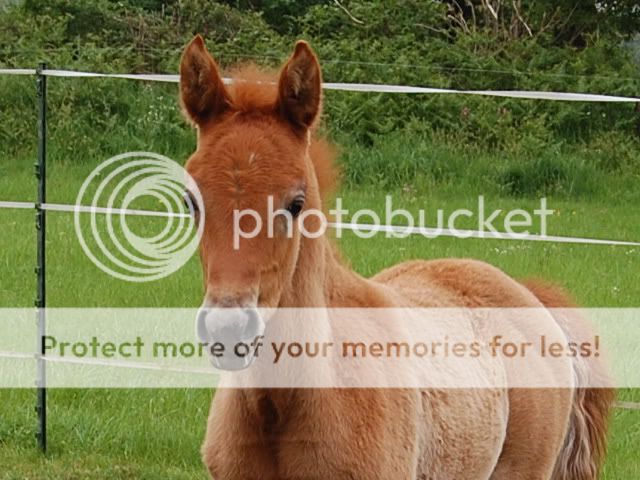
Grey parent means grey horse eventually?

Greys are born black or chestnut. If you don't know what colour it was born then black foals have lovely dark dapples then black fleabites. Chestnut foals have slightly brown edged dapples then brown fleabites.


If the youngster is bay it will always be bay. It will not grey out.

My grey was born bay so they can be bay at birth, have a look around it's eyes if they have grey flecks the chances are it will go grey
 
It doesn't matter if the foal was born pink with purple spots and lime green stripes, if it has inherited one grey gene (or two) it WILL grey out.

Greys can have non grey offspring. If the above foal doesn't inherit any grey genes it will remain pink with purple spots and lime green stripes.

Here is my gelding with his dam and while he isn't as wildly coloured as the fantasy foal he will not grey out as he has no grey gene. His dam has one copy so each foal she has, has a 50% chance of inheriting it from her. His sire has no grey genes.

AnyaPrince.jpg


Still flaxen chestnut (with sabino).

100_0157_zps0bc562cf.jpg

I'm in love
 
So obviously there are huge variations but just to show what I sort of mean about grey foals showing a more adult colour
Grey
foals-labanxpaler-shade-of-grey-08-08b.jpg

foals_4_4259432841.jpg

can see the goggles on this one
foals-caesar-bernwode-filly-08.jpg


and normal bay foals - tend not to have any black points
Strider2.jpg

a11_3120Sec%20B.JPG

Not an exact science obviously!
 
Definitely not as big as that the spot on his forehead is about an inch big i guess (it always confuses people into thinking he is bleeding) and then the weird brown flecks that remind me of roaning but surely can't be? I will try and get close up pictures this Friday I won't see him til then thanks to work unless he needs to see the vet again.

Blood marks can be small, medium or big and placed anywhere on the body. So it could be a possibility for your chap still. I look forward to seeing the photos. :)
 
It does. You can sometimes work out what colour a horse was before it greyed out by the colour of its fleabites.

Chestnut fleabites?

100_2211.jpg


Bingo! :D

Flossyfour.jpg


Note the grey coming in around the eyes.

And also note the grey around this foal's muzzle. My late father told me that the muzzle colour of a youngster would denote the eventual colour at maturity. Tue or false??? Maybe just another old maid's (or in this case man's) tale. Just recently I was shown a nice youngster a friend had bought, a rather woolly coated steel grey 3/4yr old. Apparently her passport says she was a bay foal. Another friend's pure bred Arab mare changed from bay to roan, to rose grey to flea bitten to white during her long life time.
 
My two boys are both from a grey mare and a bay stallion. One is black and the other is grey. The black was born black and the grey was black when he was born, then went a rose grey and is now dapple grey.
 
My foal was born bay, looked the spitting image of his mum. Bay with white socks and a blaze. He was born with grey goggles around his eyes though. (dad is grey so is grandad etc) he looked awful when he was shedding the bay coat and the grey was coming through. We used to get phone calls saying the foal in the field had a terrible skin condition etc! He was completely grey by 8 months old. He's now rising 3 and is getting lighter by the day. He still has his white socks and blaze though. But I bet he'll be 'white' by the time he's 5. Nothing wrong with a grey anyway! X
 
Well I would have thought if she is bay now she will always be bay. I thought grey horses tended to be black when born. My boy was black when a foal now he is a sort of dappled grey going whiter by the day.

Grey is just a masking gene and so foals can be born any colour: chestnut, bay, brown, black, palomino etc. If they have one or two copies of the grey gene then they will turn grey.
 
Greys are born black or chestnut. If you don't know what colour it was born then black foals have lovely dark dapples then black fleabites. Chestnut foals have slightly brown edged dapples then brown fleabites.


If the youngster is bay it will always be bay. It will not grey out.

No, greys can be born any colour at all. Grey just masks their original colour.
 
Ester she's 2 weeks old, She's in a field I hack past 3 times a week, been watching the mares foal one by one, Filly is the last one.

Bay foals that are going to grey out usually (but not always) have black legs already, where as bay foals that will not grey out tend to have pale coloured legs (the black points come out when they shed their foal coats).
 
Another friend's pure bred Arab mare changed from bay to roan, to rose grey to flea bitten to white during her long life time.

This is a common misunderstanding. The foal you mention was never Roan, despite having a mix of white and non white hairs. It was grey, but not fully greyed out yet. Roan is a separate gene and Roans are born Roan and stay Roan (unless they have grey too). The easy way to tell a Roan from a partly greyed out horse is to look at the head, greys will grey out on the head too, but Roans are not really 'roany' on the head or points (ignore white markings).
 
So have I got this right...If you have a bay mare whose sire was grey she definitely cannot be carrying a grey gene so could not have a grey foal (unless of course the foal's sire was a grey gene carrier)?
 
So have I got this right...If you have a bay mare whose sire was grey she definitely cannot be carrying a grey gene so could not have a grey foal (unless of course the foal's sire was a grey gene carrier)?

One of the parents has to be grey to produce a grey foal. The grey gene is never "hidden".
 
One of my minis seems to be greying out, her mum is a minimum chestnut pinto (liver chestnut) her sire is a palamino. She was born bright chestnut but is registered as a minimum chestnut pinto and is 5 years old. I always thought at least one parent had to be grey?
 
Blood marks can be small, medium or big and placed anywhere on the body. So it could be a possibility for your chap still. I look forward to seeing the photos. :)

Sorry still not got photos. I went tonight in the hope of getting photos, and then noticed he has a lot of skin removed from one of his back legs, looks like a horse kicked him. So I got distracted. I did get a quick look though before I noticed that and the brown flecks are mainly around his eyes. Do you think that probably just means he was dark bay or something when born?

http://www.stallionsonline.co.uk/stallion_58870.html This is his sire so he was definitely always black. If anyone can find photos of his dam (Tabatha Twitchet) online, you are amazing as I cant. She is a connemara.
 
I hope his leg is OK.

I washed it and he didn't even try to kick me thank god. It looked clean enough and there was no flap of skin sadly to reattach but put lots of wound cream on it. Think he is ok he is just feeling sorry for himself.
 
And of course - no matter what colour a foal is born - you can be fooled by Rabicano. I spent YEARS expecting one of my stallions to go grey - he was by a dark brown stallion out of a grey mare. At 7, he's still dark brown/black - but has a lot of white hairs on his face, and white streaks in his tail. His foals out of chestnut or bay mares have always been definitely chestnut or grey - but a lot of those from grey mares have fooled us until they were 2 - or 3. A couple definitely have the Rabicano gene. The important thing to remember is that a good horse is NEVER a 'bad' colour!
 
Winnie has black flea bites, she was pie bald, then blue and white, then totally white and now has flea bites coming in on the parts of her that had colour.

Oh no, does that mean my beautiful grey and white Sam will end with fleabitten patches :( He's 8 and his face and legs grey bits are definitely getting lighter).
 
Top