Greying out

cheeryplatypus

Well-Known Member
Joined
18 December 2006
Messages
1,065
Location
scotland
Visit site
At what age can you tell if a pony will grey out?
I really like the fact that mine is dapple grey now but he started out yellow dun colour. I'm going to look at a 3yo yellow dun soon. Is it possible to tell if he will grey with age too?
 
Are either of the parents grey? If neither parent is grey, then the youngster can't be grey.

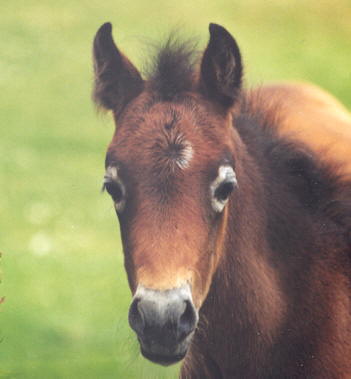
If the youngster is a grey, then normally the first area to grey out is around the eyes (grey goggles) and also the face. I would expect to see evidence of greying out at 3 years old, even on a slow 'greyer'. My grey was pretty fast and was white at 2 years old and is now covered in fleabites.

Grey goggles

grey_goggles.jpg
 
Last edited:
The dam is cream-dun and the sire is yellow. I can't really tell from the pictures if he has any grey arund the eyes yet! Will have to wait until I can see him in a couple of weeks. Am trying to decide between him and one which is lovely dapple already but older than I was after.
 
Faracat, what constitutes a flea bitten grey?
Would it be generally if the grey was born chestnut, to rose grey, to 'white' and flea bitten?
 
Any base colour can go fleabitten if they have the grey gene. Generally horses take longer to grey out than mine did, plus they often go through a dapple stage (which mine missed out). Once the horse has greyed out completely, then fleabites often grow in - but there always seem to be exceptions.

I did read that someone proposed that only greys with two copies of grey, go fleabitten, but mine only has one copy - so that doesn't work. Mine was born chestnut and her fleabites are chestnut.

Greys are quite interesting, particularly when you get a bloody shouldered grey, that has a patch of fur that fails to grey out (doesn't have to be on the shoulder).

Like this -
423111_417496151651270_1490158655_n.jpg
 
Any base colour can go fleabitten if they have the grey gene. Generally horses take longer to grey out than mine did, plus they often go through a dapple stage (which mine missed out). Once the horse has greyed out completely, then fleabites often grow in - but there always seem to be exceptions.

I did read that someone proposed that only greys with two copies of grey, go fleabitten, but mine only has one copy - so that doesn't work. Mine was born chestnut and her fleabites are chestnut.

Greys are quite interesting, particularly when you get a bloody shouldered grey, that has a patch of fur that fails to grey out (doesn't have to be on the shoulder).

Like this -
423111_417496151651270_1490158655_n.jpg

Very interesting, thank you.
 
Well he doesn't look like he's greying out. If the dam only had one copy of grey, then she would have a 50% chance of passing it on to her foal.
 
Is that not a chimera? Will try to post pictures of my bloody-shouldered PRE........

I did see some discussion that proposed that she was a chimera, but it's not thought to be the case. Other horses have BS marks on the face/head and it's one of the common places for it to occur. If you look - the fleabites are the same colour as the non grey area. You can also see that the area where the star should be (on the grey side) doesn't have fleabites.
 
this is my 4yrs - grey or not
http://s1051.photobucket.com/user/S...531799_10151728595093950_792234543_n.jpg.html
Mother - dapple grey
Dad - dapple dun
1003778_10151728599473950_280020033_n.jpg

or
547424_10151728602008950_225460185_n.jpg

Hmmm - no goggles, the 'grey' tail and white flecks could be caused by sabino. Although your horse doesn't have much white, there is the roany stripe on the face, which looks sabinoy. A nice jagged edged sock would have been nice! :p

By four - I would have expected grey to have been obvious by now. Has his/her colour remained pretty stable?
 
Sorry - I couldn't quite tell from the photos. :)

Sabino can add a few white hairs that show up when the winter coat moults and the summer coat comes through. Grey would add more. Has the tail always been 'grey' or has it got greyer?
 
Any base colour can go fleabitten if they have the grey gene. Generally horses take longer to grey out than mine did, plus they often go through a dapple stage (which mine missed out). Once the horse has greyed out completely, then fleabites often grow in - but there always seem to be exceptions.

I did read that someone proposed that only greys with two copies of grey, go fleabitten, but mine only has one copy - so that doesn't work. Mine was born chestnut and her fleabites are chestnut.

Greys are quite interesting, particularly when you get a bloody shouldered grey, that has a patch of fur that fails to grey out (doesn't have to be on the shoulder).

Like this -
423111_417496151651270_1490158655_n.jpg

I actually heard that it was the other way around, only herero greys will get fleabitten (my definiate hetero grey was very fleabitten).

There is also a train of thought that thinks that hetero greys grey out slower than homozygous ones. The eyes are not always an indicator either, I have bred several greys and only only one (homozygous btw) has 'spectacles', he greyed out a lot quicker too. A surefire way of knowing if they will grey out (assuming one of the parents is grey) are dark legs when newborn.
 
this is my 4yrs - grey or not
http://s1051.photobucket.com/user/S...531799_10151728595093950_792234543_n.jpg.html
Mother - dapple grey
Dad - dapple dun

or

I do think your youngster will grey out, the tail and head are a giveaway, however there will be only one copy of the grey gene. It is not the rabicano gene as the white hairs tend to be at the top of the tail rather than the bottom.

I had a homebred, def single grey, who was still black (apart from the tail) at 4, she is 19 now and pure white with fleabites
 
Top