
Growth plate fusion vs Bone density

tallyho!

Following a strict mediterranean diet...
Joined
8 July 2010
Messages
14,953
Visit site
1565961950127.png

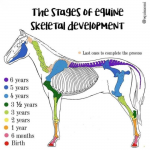
Keep seeing this at the moment on various horsey pages on fb with lots of text about not starting horses until 6yo or else!! And whilst I think it's a good guide, it says nothing about the effect of exercise on bone mineral density, joint health/strength and soft tissue health/strength. It is something I've always thought of, and frankly have followed the old books which say start them at 4, turn away, start training at 5, turn away and then begin in earnest at about 6.

I've had a google of the studies on the effect of exercise on all of these factors and mainly there are small groups of thoroughbreds and warmbloods studied and show that "forced exercise" is important in a young horses BMD development (forced exercise is the only exercise available I guess because they are not wild). Most are positive about the impact of exertion on BMD, cartilage and tendon mass even as young as 1.5yrs in TBs.

I keep thinking about how a foal, if it were wild (maybe not in the day of humans), would be exposed to "forced exercise" - predators, roaming for food or running from stallions etc. over any terrain. I'd imagine they would be exposed to much higher levels of exertion - from birth almost. Levels a foal would never be subjected to at a stud, in a protected flat field lets say.

Armed with a tiny bit more google knowledge.... I'm not sure I would wait until a horse was 6yo to start training as by then, bone and tendon remodelling happens much slower according to the studies, and has little effect on BMD. Nor would i start sitting on a yearling; I'm coming to the conclusion that the old books were about right - foals must have access to an active herd life and training needs to start lightly at around 4yo and gradually increase with age.

What do YOU think?
 
I wouldn't leave a horse till 6 either. My 6 year old was backed two years ago and has been in work since (although varying levels with lots of easy hacking) - that's pretty much the approach I would apply by choice.
 
Horses need training from a young age, not necessarily all physical. Leaving a horse to mature without lunging, long lining, hacking (when 4) will mean you have a delay in its development. Handling is more important that riding up until 4, learning boundaries, respecting people and so on. If you look at the 5 year old and 6 year old classes, these horses don’t wake up one day and can jump. What I don’t agree with is jumping too young. My mare is 12 and having had her back done recently (first time for me after purchasing her) the chiropractor could tell she was jumped too high too young and had some issue with her spine. Not serious but just a sign of the bones not being ready for the pressure on the back
 
Horses need training from a young age, not necessarily all physical. Leaving a horse to mature without lunging, long lining, hacking (when 4) will mean you have a delay in its development. Handling is more important that riding up until 4, learning boundaries, respecting people and so on. If you look at the 5 year old and 6 year old classes, these horses don’t wake up one day and can jump. What I don’t agree with is jumping too young. My mare is 12 and having had her back done recently (first time for me after purchasing her) the chiropractor could tell she was jumped too high too young and had some issue with her spine. Not serious but just a sign of the bones not being ready for the pressure on the back
Your right horses don't wake up one day and are able to jump at 5 or 6, that's not an essential life skill to the horse though so why is it an issue?
What delay in development will you have if a horse is not lunged, long lined or hacking when 4?
Many horses get no training when young and are just fine many more have too much done with them too early and are spoilt wither physically or mentally.
My take is that as long as handling is done sympathetically and with care for the individual horse most will be fine, physically I would do ground work till rising 4, very lightly back and then leave riding till 5-6 yrs old depending on the horses physical and mental maturity.
As for forced exercise as youngsters I believe they should live out fill time in a herd environment, should be handled and walked out in hand and that would be plenty.
 
The studies I have read the alternative to 'forced exercise' was essentially box rest. A youngster raised outside with other horses in a space large enough to allow some roaming should be sufficient for building good BMD and soft tissue structures.
Where humans have gone wrong is in bringing youngsters inside, turning them out in tiny paddocks and being in a rush to get on them and get going when they do start working them.
IMO, backing a horse should take several months of careful conditioning to allow the horse's body to adapt and respond to the different forces. Suddenly putting a horse on the lunge for a couple of weeks then getting on it and riding it in an arena at walk, trot and canter at aged 3, often held in with side reins, within less than a month as seems to have become the norm just doesn't sit right with me.

I have two 2 year olds. My plan with them is that they come hacking with me ride and lead next year to start to condition the muscles I'm going to need them to use, they gradually have different things introduced into the equation (saddle, loose harbridge) and they go up and down as many hills as possible before I sit on them and all their early riding will be out hacking, but not before they're 4
 
My idea always was started at three then turned them away .
They where taught to lunge did a little long reining out and about backed and ridden away they perhaps did a few sessions of pole work and a hack out then turned away
At four they did a recap of what they did at three did hacking saw water started flat work did some jumping saw hounds in the autumn went to some clinics perhaps a few little shows .
They went out for the winter when hunting started .
At five they came back and started proper work .
All the evidence from work on race horses is that work young gives better bone density but that does not consider the joints and soft tissue .
I think horses learn to learn best when they are young and you should exploit that .
I don’t it’s working while young that’s the issue I think it’s how we keep young horses stabled in small paddocks not out in large fields .
One of my first jobs was in a yard where we did a lot of backing if they where they lived out in a huge hilly field ( as long as they where tame enough to catch ) got stabled for a time during each day for work and handling looking back they where getting a great start .
They charged more than some places I hear are doing it for today which is something to think about .
It’s not the work that the problem its the work they do it has to be the right work .
 
i sat on my youngster when she was 3. i had gradually leaned over her in the stable and being sat on was no big deal mentally i literally sat on and was led round in walk for about 5 mins. i then left her till she was 4 and did similar but walked round the field for about 10 to 15 mins, getting her to walk on,stop and turn each way.also then did a little bit of lunging.. at the end of that summer i hacked out with a friend for about half an hour a few times and as i had taken her out with my friends before in hand she adjusted to being ridden really easily. in her 5th year i started training properly..also .during her 2nd and third years i did a little bit of in hand showing so she could see the world...
 
I can only presume exercise does improve bone density, but weight loading on the spine is not the same thing. Therefore movement in the field, long reining, etc is probably good while too much riding too young is not. Fwiw I back at 4 but dont do anything strenuous until 5 going on 6.
 
Pregnancy also loads the spine - although maybe not in the same way. Wild mares probably have their first foal at around 3 or 4 perhaps. Domestic mares probably the same although bigger. Let's call it an average of 40kg foal born. A considerable weight to carry around (add the pregnancy extras too, but all day every day).

The average domestic horse carries average 80kg when fully mature and up to weight (I'm including men) for a couple of hours a day to hunting all day.

(I'm trying to compare it to my pregnancy although it's hard as I'm bipedal and the end was blooming tough... but I do carry a 10kg child (more than 10% of my bodyweight :D) on my back doing chores several times a week for a few hours at a time with transient back pain)
 
The thing is without doubt the two soundest horses I have owned where in work at two .
The least sound was started at six .
 
The thing is without doubt the two soundest horses I have owned where in work at two .
The least sound was started at six .

It's certainly only one small variable in a horse's life - the quality and nature of its work throughout its life is probably a bigger determinant of longevity I'd think.

I completely agree with the above comments about keeping horses inside / in postage stamp flat paddocks by themselves. Forced exercise of young horses probably isn't essential or even desirable if it has a natural herd life. As humans, I think we sometimes obsess about what we're doing with horses, but actually, the bigger problem is what they're doing themselves for the other 23 hours in the day.
 
She ran out with her mum and sister .
While the TB was racing just after his second birthday and raced until he was eight and hunted into his twenties the other a Dutch horse was probably barn raised and was pulling a carriage at two .
They just show you can’t assume anything .
So I don’t think you can assume that starting later is better ,that mare was very fat when I got her I think that was at the base of the issues but she was a vets delight I was so careful with her .
I am convinced its about the skill of the people who start them how well they understand how to get on the horse with minimum fuss and stress and how well they understand how you develop the horse .
You can’t develop an athletic horse at any age unless you understand how .
 
I have never had a problem with backing at 3.5yo, hacking and baby schooling at 4, and proper jumping etc at 5 - and I keep my horses into old age.

We don't stop children exercising, and they don't stop growing for a very long time!

Growth plate damage occurs in a similar way to broken bones - repeated over-use or trauma. So controlled exercise is fine, just not too much, and you don't want hard ground, sudden twists/turns/slips with a rider, too much 'violent' arguing through being over-faced etc. Think of the way our joints are designed. The ends of the bones are cushioned. Exercise a horse steadily at a sensible age, building the muscles gradually so they can support the joints, with plenty of 'time off' and not for too long, and they'll be fine.
 
Last edited:
Top