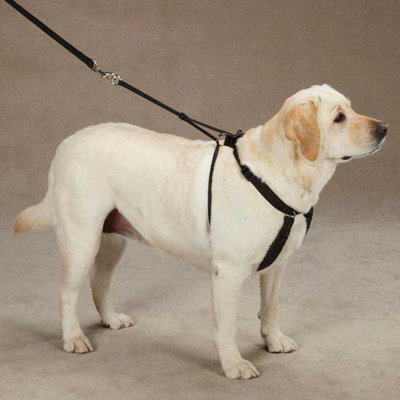
Harnesses and larger dogs.

tomdakota

New User
Joined
3 November 2013
Messages
4
Visit site
Hi :)

I would just like peoples opinions on using harnesses on larger dogs.

It is for a Romanian Capathian Shepherd... just image a collie x golden retriever. Haha.. He is very big and very strong. He walks to heel but as soon as he sees another dog is jumps upwards and gets sooo excited and sends me flying.. What doesn't help is that I can't hold him with both hands as I have another dog. And whats more is it can happen near a road which scares me slightly as I don't want to let go.

Anyway, harnesses.. do they just encourage more pulling? Do you actually gain more control from using one with a bigger, strong dog.

Any feedback would be marvellous. :)
 
We've found that a gentle leader (with professional guidance on how to use it) is much more effective.

I've never understood how harnesses stop a dog from pulling.
 
My thoughts on a harness is it just gives the dog more purchase to pull and put their strength into it. I would second the gentle leader / halti. I've found them very effective - my collie no longer pulls as soon as it goes on, without it she pulls like a tank (we used to competitve obediance but if not 'working' she insists on pulling), as soon as it goes on she walks nicely with a loose lead.
 
I have two sets of leads hanging in my hallway for each of my three bitches, one lead each with harnesses and one lead each with half chokes (martingale collars).

I often prefer using the harnesses because they are milder and less interfering, but they also means that it is more difficult for me to control my bitches with my body strength. After all, dogs pull even better in harnesses, than in collars. Personally, I would say that using harnesses can prevent pulling because they are milder (= the dog doesn't tries to pull to get away from potential discomfort), but it only works, if the owner understands that they instead have to teach their dog to really listen to them.

I use the half chokes either when I feel lazy, it takes a few seconds less to get on and off, or for when I want a little extra control.

So in your situation, I don't think it sounds as if a harness would help. I ditto the suggestions about trying a half choke (martingale collar), or a Halti, Gentle leader or something like that, and getting proper instructions about how to use it. And/or perhaps taking him to a dog class.
 
The best investment here would be a good training class so he can learn to be calm around other dogs :)

A headcollar may well help with immediate control (you must introduce it properly, as per the instructions most of them come with - don't just whack it on and go!) but there is nothing a dog can't pull into IME - training is the long-term answer.
 
Agree training is most important thing, there is no point throwing a gadget on if the dog has no idea of the difference between a tight line and a slack one in the first place. The very basic tenet of this is that the dog has to realise that the best place to be is beside you, pulling, forging, leaping etc, results in going nowhere and nothing good happens. What way you choose to train this depends on what motivates the dog and what might make him think 'oh dear, I don't like this'.

I personally do not like harnesses for large dogs. You are strapping yourself to the strongest part of the dog and giving him all the power. As has been pointed out before, this is why huskies pull sledges in harnesses, not thin collars. As was pointed out elsewhere, you wouldn't strap yourself to the strongest point of a horse, either, by and large we use bridles and bits because that is what gives us most control, otherwise we would all be pootling about in rope halters.

If a dog has to bear a few moments of discomfort via half or full choke, slip lead, headcollar, whatever, I think that's better than me getting my arms pulled out or leaping into the path of a vehicle etc.
 
Agree training is most important thing, there is no point throwing a gadget on if the dog has no idea of the difference between a tight line and a slack one in the first place. The very basic tenet of this is that the dog has to realise that the best place to be is beside you, pulling, forging, leaping etc, results in going nowhere and nothing good happens. What way you choose to train this depends on what motivates the dog and what might make him think 'oh dear, I don't like this'.

I personally do not like harnesses for large dogs. You are strapping yourself to the strongest part of the dog and giving him all the power. As has been pointed out before, this is why huskies pull sledges in harnesses, not thin collars. As was pointed out elsewhere, you wouldn't strap yourself to the strongest point of a horse, either, by and large we use bridles and bits because that is what gives us most control, otherwise we would all be pootling about in rope halters.

If a dog has to bear a few moments of discomfort via half or full choke, slip lead, headcollar, whatever, I think that's better than me getting my arms pulled out or leaping into the path of a vehicle etc.

I'm not sure whether it is necessary, but I want to clarify my earlier reply, and say that I don't believe that everything except harnesses on dogs, must cause some degree of discomfort. E.g. correctly used, I don't think that their half chokes causes my bitches discomfort, they just notice that they're wearing them, more than they notice that they're wearing their harnesses.

Regardless if someone uses a collar, head collar or harness, they're all devices that the owner can use as aids to train their dog. In general, I think that dog owners should use what works for them and their dog, but the device itself doesn't train the dog, nothing replaces that it is the owner that has to train their dog.
 
Hello, every dog will be different but i thought you would want to know a situation where a harness has worked.
My rescue Labrador Lucy used to be desperately afraid of the outside, as she didn't see it for the first six months of her life.
She very quickly learnt to walk to heel beautifully on a normal collar. However when something she didnt like occasionally went past she would go into a blind panic and fling herself at the end of the lead to run. I very nearly couldnt hold her and worried about letting go. I found a harness that has thin loops that go under her armpits that you clip the lead to, and i would clip the other end to her collar. We could walk along perfectly normally, with no pressure on the harness at all. When she panicked and threw her weight into the harness it pulled her front feet off the ground giving her no purchase so she couldnt escape... once she learnt she couldnt get away, she stopped trying. (her fear's only lasted six months and i have never needed to use it again.)
I think it is an unusual type of harness... has anyone else seen what im talking about?
 
I used to walk our 2 GSDs using one finger, they were trained anyway, but the bitch always had to be in front, resulting in pulling, used halti's on them and problem solved

I have exactly the same with my 2, great walking individually but take them both an its a battle to be in front, so when I take them both together they are in dogmatic headcollars.
 
I think that's a GSD thing!!

Finny I suppose would classify not allowing a dog to move freely/a dog feeling restricted by any sort of equipment or indeed a leash correction if it is warranted as a discomfort/negative/pressure...allowing a dog to pull into a harness or collar and still get to where it wants to go would be seen by the dog as a positive.
 
I have the same thing with my mals as murphys minder, my bitch just has to feel she is in charge if I am walking them together but put her in a halti and she is a little lamb. I bought a harness for the new boy when we got him as the rspca said he had no recall so would unclip him from his collar and put a long line on his harness purely for recall training but could not imagine walking him in it as there just never felt like there was any response if we corrected him when wearing it.
 
To be honest OP, a headcollar might help to relax you too which may be a big help. (I realise that might sound like you should be wearing it but that's not what I mean, lol :D). Some dogs are very sensitive to their owners mood - if you tense up when you meet other dogs in the expectation of your dog reacting in an excitable way, that could actually trigger the dog into doing just that. If a headcollar allows you to feel more relaxed because you have a bit more control, you might well find the reaction from your dog also lessens. :)
 
Hello, every dog will be different but i thought you would want to know a situation where a harness has worked.
My rescue Labrador Lucy used to be desperately afraid of the outside, as she didn't see it for the first six months of her life.
She very quickly learnt to walk to heel beautifully on a normal collar. However when something she didnt like occasionally went past she would go into a blind panic and fling herself at the end of the lead to run. I very nearly couldnt hold her and worried about letting go. I found a harness that has thin loops that go under her armpits that you clip the lead to, and i would clip the other end to her collar. We could walk along perfectly normally, with no pressure on the harness at all. When she panicked and threw her weight into the harness it pulled her front feet off the ground giving her no purchase so she couldnt escape... once she learnt she couldnt get away, she stopped trying. (her fear's only lasted six months and i have never needed to use it again.)
I think it is an unusual type of harness... has anyone else seen what im talking about?

There is several versions of anti-pull harnesses available, here is a few that I know of (photos found through Google image search):

Mikki Anti-Pull Harness (old picture, the "rope" now have covers to prevent rope burn)
anti-pull.png


Guardian Gear Anti Pull Harness
Guardian-Gear-Anti-Pull-Harness.jpg


Sporn Non Pulling Mesh Dog Harness
T400636


Xtreme Training Harness
harneessPic.jpg


Walkezee Dog Harness
img_1191276756_15166_1265662495_mod_415_306.jpg


And on the subject of harnesses, not an anti-pull harness, but the Fusion Pet Tempo Dog Harness has a flexible handle bar on the back, intended for the owner to be able to grab hold of, if they need extra control (I'm not quite sure how effective that is when it comes to larger dogs)
tempo_3__93988.1361036037.320.320.jpg


Also not an anti-pull harness, Guardian Gear No-Jump Harness (though, they doesn't seem to prevent standing on the back legs, judging by the photos that I've seen)
guardian-gear-nojump-harness-1.jpg


I'm not sure whether this harness is classed as an anti-pull harness or not, but I've heard that it is supposed to prevent pulling, the Easy Walk Dog Harness
799-default-m.jpg


There is lots of other harnesses, my bitches current harnesses is only simple, ordinary harnesses (which they're only allowed to pull in, on my command CaveCanem), similar to the following, but with reflexes
image.jpg


But even though, I think that dog owners should use a collar/head collar/harness which helps them make their dog listen to them, nothing replaces training! If used incorrectly, or once the novelty wears off, it seems (to me) as if some dogs can get used to ignore almost any type of discomfort/negative reinforcement. I've seen dogs which have pulled on their leads, whilst out walking in anything from choke chains (either those dogs must have developed huge neck muscles, or the choke chains can't have been used/fitted correctly, since the dogs did not choke to death), to various versions of head-collars and anti-pull harnesses etc. The times that I've talked to the owner in tow, all of them have seemed to be convinced about that the device, somehow, should have magically trained their dog for them...
 
I am glad that the Mikki and hopefully the Lupi harnesses now have covers over the ropes as my older dog wore a lot of skin off the underside of his elbows and carved a huge X into his chest by pulling into it. Went back to a slip lead and lots of repetitions and that did the trick!

The Julius K9 ones have a handle also which are quite useful.

As to your last point, agree, that's a lack of training, so either the dog's behaviour has still been reinforced, IE, we still go out for a walk and it still works out for me, it's worth fighting through this discomfort because it all ends well, or, the dog is pulling because it is trying to escape the force/pressure, doesn't make the connection between pulling and discomfort and it never learns what a loose line feels like and how much more pleasant that can be.

Everyone of us has at one point or another gone 'I'm late for work/I want to go home for my tea/I'll just keep walking and put up with this pulling', rather than stopping dead and keep stopping dead, or just taking the dog back home.

I hear good things about the front leading harness but I have never used them. There is also another type of harness/bellyband which I use for tracking where there is a loop around the dog's belly and a running line on which one end clips to a collar and the other end has a ring where you attach the line just below the tail, helps keep the dog's head down and stops the line getting tangled around the legs. Don't think it would have much of an application for walking though.
 
Last edited:
The front leg harnesses work better indeed CC and by basically preventing the dog taking a normal stride, they walk in restrained strides (odd) so it prevents pulling this way, a bit of a cop out if you ask me.
I personally would not use a harness of any kind and im very strong for a female weakling :p I would go for the halti with the kind of behaviour you are wanting to prevent for head control in such a large dog.

I meet and work with a lot of people who have reverted to a harness for one reason or another and they merrily say "it's so much better, I feel its better for him/her and they have definitely stopped pulling so bad" and there I am standing wide gobbed at a dog pulling like a bull:( (not my idea of not pulling at all) it's obs just an improvement for them on a tiny scale :rolleyes:
 
A harness will not stop any dog pulling, training will teach the dog not to pull, BUT a harness is a more humane way to walk your dog on a lead. I walk my reactive dog on a harness and a dogmatic headcollar, on a double ended lead. He walks well on the harness, but I have the back up of the headcollar if he does start to react and I need to get him away from another dog etc. I use the Perfect Fit harness.
 
Top